
Amazon affiliate links - we earn a commission.Affiliate disclosure

Buying guide · 12 min read · Updated 2026-11-12

Best Snow Blowers for Hills (2026)

Five snow blowers compared for sloped driveways, with self-propelled two-stage gas and battery machines plus two light single-stage options.

James MillerBy James MillerLead Machine Editor5 machines comparedSpec-sheet verified
Best Snow Blowers for Hills

At a glance

Our top picks

Side by side

Spec comparison

Slopes change what a machine has to do. On a flat drive the operator only steers, but on a hill the machine must pull its own weight uphill, hold traction on a slick surface and avoid sliding sideways on the way down. A hill is a safety question as much as a clearing one. Planning for the worst spot makes the rest of the drive easy.

That makes the drive system the main specification, ahead of path width or throw. A self-propelled two-stage with good tires does the climbing for you, while a light single-stage relies on your legs and the grip of your boots. Check the drive and tires first, and the width second. Walk the drive before buying and note the steepest section. A short test pass on a gentle section tells you how the drive feels before you commit to the steep part.

Before you buy

6 Criteria to Look For Before Buying a Snow Blower for Hills

  1. 01

    Self-propelled drive

    On a hill, a machine that pulls itself is worth more than extra width or throw. The WEN, EGO SNT2405 and SNT2425 all have powered wheels. A hand-pushed single-stage forces you to push or restrain the machine, which is tiring and unsafe on ice. Many buyers focus on width and throw and forget the drive, and only learn on the first icy morning that a hand-pushed machine slides back down. Test the drive on a gentle slope before you rely on it. Add a bag of grit or salt to the kit, because no machine replaces traction on a bare ice patch.

  2. 02

    Speed range and reverse

    The WEN offers six forward and two reverse speeds, and the EGO uses variable speed. A wide range lets you crawl uphill under load and slow down on a descent. Reverse gears help you back out of a drift on a slope. A wider speed range also helps on the flat, where you can speed up on light snow and slow down on heavy snow. Reverse gears help you back out of a drift without lifting the front of the machine. Note that a self-propelled drive is usually adjustable, so practise on the flat to learn how it feels before you try it on the hill.

  3. 03

    Tires and traction

    Knobby snow tires bite into packed snow, but glare ice defeats most tires. Chains or tracks add grip on slick slopes. Check whether tire chains are an option for your machine before the first storm. If your slope has an icy patch that never melts, chains or a sprinkle of grit under the tires will do more than any engine upgrade. Check the clearance before fitting chains. A tire that grips on packed snow can skate on thin ice, so pick chains or studs if your slope ices over.

  4. 04

    Weight and balance

    A heavy two-stage pulls itself but is harder to restrain going downhill, while a light single-stage is easy to move but needs your muscle. A self-propelled machine with a low center of gravity is the safest. A heavy machine has more traction but more momentum, which is why the descent is the dangerous part. Keep a firm grip, work slowly and never walk in front of the machine going downhill. A light single-stage can be easier to control on a short slope, but only if you are strong enough to hold it back.

  5. 05

    Battery or fuel on climbs

    Climbing draws more power. A gas engine copes with load easily, while battery packs run for less time than the listing rates. Plan on a spare pair of packs for a long slope. On a long slope, plan your charging routine around the climb, because the battery will run down faster than on a flat drive. Gas gives you more margin. Rotate packs between climbs so that neither runs down first.

  6. 06

    Chute control and direction

    On a slope you want to throw snow downhill and away from the drive. A chute that rotates through a wide range, like the WEN's 190 degrees, lets you aim without stopping. Throwing downhill is easier and uses less power, so work from the top down where you can. Aim the chute away from the road and neighbours. Aim the chute downhill and clear from the top, so the machine is never throwing snow up the slope. A clear throw path also keeps the machine from burying itself.

Detailed reviews

The 5 best snow blowers for hills, explained

01
WEN SB209E 24-inch 209cc two-stage, self-propelled
24 in path209cc6F/2R30 ft throw
Check price on Amazon
Best for: Sloped gas drives where self-propelled drive is the main need.

The SB209E is a conventional gas two-stage with a 24-by-20-inch clearing path, a 209cc engine and a self-propelled drive with six forward and two reverse speeds. WEN rates it for over 2,000 pounds of snow per minute and a throw of up to 30 feet.

Self-propelled drive is the reason it suits hills. The wheels pull the machine uphill and the speed range lets you slow down on a descent, which keeps the operator from being dragged. The 190-degree chute lets you throw downhill without stopping.

Electric start is useful on a cold slope. Keep fresh fuel, check the oil and consider chains for the tires on glare ice. Check the garage door and any ramp before ordering, because the machine is heavy and a slope makes it harder to move. Many owners fit tire chains for glare ice before the first storm. It also helps that the chute rotates far enough to throw downhill without turning the whole machine.

What works

  • Self-propelled with six forward and two reverse speeds
  • 24-by-20-inch path with 209cc engine
  • 190-degree chute
  • Electric start for cold mornings

Watch out for

  • Heavy for tight garages
  • Gas upkeep each season

Spec sheet

Clearing width
24 in
Intake height
20 in
Engine
209cc gas
Drive
Self-propelled, 6 forward and 2 reverse
Chute
190 degrees
02
EGO SNT2405 24-inch self-propelled two-stage kit, 2 x 7.5Ah
24 in pathSelf-propelled50 ft throw2 x 7.5Ah
Check price on Amazon
Best for: Sloped drives where quiet, fuel-free operation matters.

The SNT2405 is a battery two-stage with variable-speed self-propelled drive, a 24-inch path and a 20-inch intake. The listing rates it for an 18-car driveway in 8 inches of snow on two packs.

For a hill, the variable speed is the valuable feature. You can crawl uphill when the load is heavy and speed up on the flat, and the machine holds a line without the operator pulling. Packs drain faster on a climb, so expect fewer cars per charge than the listing.

Store the packs indoors and charge them before the forecast. It is a quiet choice for early starts on a slope. Because the climbs drain packs faster, keep a spare pair charged and use the lower speed on the hill to save runtime. A cold pack can look weaker, so bring both inside between sessions. The variable drive lets you ease off on a steep stretch, which is the single most useful control on a hill.

What works

  • Variable-speed self-propelled drive
  • Two 7.5Ah packs in the kit
  • Up to 50 feet of throw
  • No fuel or carburetor

Watch out for

  • Climbs shorten runtime
  • Costs more than gas

Spec sheet

Clearing width
24 in
Intake height
20 in
Drive
Self-propelled variable speed
Max throw
Up to 50 ft
Batteries
Two 7.5Ah 56V
03
EGO Power+ SNT2425 24-inch two-stage kit, 2 x 7.5Ah
24 in pathTwo-stage50 ft throwPeak Power
Check price on Amazon
Best for: Buyers who want the current EGO 24-inch kit for a slope.

The SNT2425 is the newer 24-inch EGO two-stage, with two 7.5Ah packs and Peak Power mode. The listing claims an 18-car driveway in 8 inches of snow and a 50-foot throw.

It shares its class with the SNT2405, so the choice is largely about which version is available and what the box contains. For a hill, the same logic applies: choose the self-propelled drive and expect shorter runtime on climbs.

Consider a spare pair of packs if your slope is long. If you are choosing between the two EGO kits, compare what is in each box and whether the packs and charger are included, since the machine is otherwise the same class. Its Peak Power mode helps when a wet berm crosses the slope, though it drains the packs quickly.

What works

  • Peak Power mode for heavy loads
  • Two-stage with a 50-foot throw
  • Two 7.5Ah packs
  • No fuel needed

Watch out for

  • Runtime shortens on climbs
  • Similar to the SNT2405

Spec sheet

Clearing width
24 in
Design
Two-stage battery
Max throw
Up to 50 ft
Batteries
Two 7.5Ah 56V
Mode
Peak Power
04
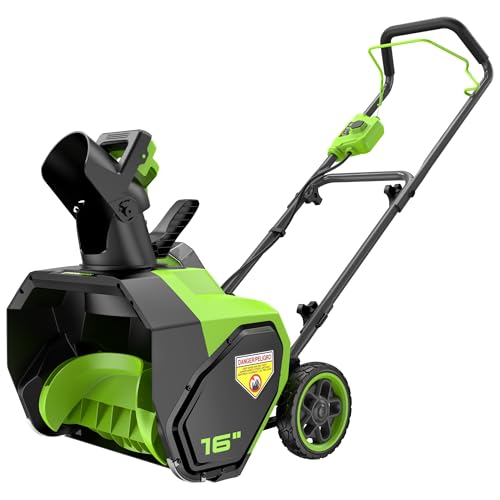
Greenworks 40V 16-inch brushless snow blower, tool only
40V16 in path10 in depth25 ft throw
Check price on Amazon
Best for: Gentle slopes where a light machine is easier than a heavy one.

This is a light single-stage with no wheel drive, so it relies on you to push it uphill. It makes sense only on a gentle slope where a small machine and good boots can manage.

Its advantage is weight: it is easy to carry and turn on a slippery grade. A 16-inch path and a 10-inch depth suit light snow, and the listing is tool only, so battery and charger are extra.

For a steep hill, choose a self-propelled two-stage instead. If you already own 40V packs, the bare tool is the cheapest way to get a very light machine for a gentle grade. It is the pick when you need to carry the machine up steps to a hillside property.

What works

  • Light and easy to turn
  • 10-inch clearing depth
  • Fits the 40V tool family
  • Brushless motor

Watch out for

  • No self-propelled drive
  • Battery and charger not included

Spec sheet

Clearing width
16 in
Snow depth
10 in
Max throw
25 ft
Drive
Hand pushed
Battery
Not included
05
Snow Joe IONMAX 24V-X2-SB18-GO 18-inch cordless blower
48V (2x24V)18 in path10 in depth700 lb/min
Check price on Amazon
Best for: Gentle slopes and short hills with light snow.

The SB18-GO is an 18-inch cordless single-stage with a 1,200 watt brushless motor and a stated 700 pounds per minute. It has a 180-degree chute and throws about 20 feet.

Like the Greenworks, it has no wheel drive, so it suits a gentle grade only. The light frame makes it easier to control on a slope than a heavy two-stage you would have to hold back.

For a steep or long hill, move up to a self-propelled model. Ask the seller about warranty and replacement paddles, and keep the plastic auger away from gravel patches on the slope. It is the cheapest way to try a battery machine on a modest grade.

What works

  • Light 18-inch body
  • 180-degree chute
  • 1,200W brushless motor
  • Two batteries included

Watch out for

  • Hand pushed, no drive
  • Plastic auger wears on rough surfaces

Spec sheet

Clearing width
18 in
Clearing depth
10 in
Motor
1,200W brushless
Capacity
Up to 700 lb per min
Drive
Hand pushed

Spec sheet decoder

What the numbers on the box really mean

The specs manufacturers lead with, translated into what they tell you about real-world performance.

Self-propelled

Powered wheels pull the machine forward. It is the most important spec on a slope.

Watch forWEN and EGO have it; the Greenworks and Snow Joe do not.

6F/2R

Six forward and two reverse drive speeds. More gears give finer control. On a hill, reverse also lets you retreat from a spot that has stalled.

Watch forThe WEN uses it.

Variable speed

A continuous drive speed set by a lever. It is good on both climbs and flats.

Watch forThe EGO uses it.

Peak Power

A mode that combines two packs for extra output. It drains packs faster.

Watch forIt drains packs faster.

Chute rotation

How far the chute can turn. A wide range lets you throw downhill.

Watch for190 degrees on the WEN.

Methodology

How We Evaluated These Snow Blowers for Hills

Drive system

We split the lineup into self-propelled two-stage and hand-pushed single-stage machines. On a hill, drive is the deciding feature. On a slope, the wrong drive makes every other spec irrelevant. A slope amplifies every weakness in a machine, so a feature that is minor on the flat becomes decisive on a hill.

Traction and speed

We compared drive speed ranges of six forward and two reverse against variable speed. A wide range controls the machine on a descent. Speed control matters as much as pull on the descent. We read the six forward and two reverse speeds as a control feature as much as a power feature.

Power under load

We considered how gas and battery cope with a climb. Gas holds power longer; battery runtime shortens. A climb shows how much reserve a power source has. Gas engines keep their output; battery output sags as the pack drains.

Ownership burden

Based on the spec sheet and owner feedback patterns, we weighed fuel upkeep, pack care and wear. A drive belt and tires are the wear items that matter most on hills. On a slope, a broken belt or worn tire is a safety problem as well as an inconvenience.

Fit to slope

We matched each model to a gentle or steep slope. This is an editorial assessment, not a measured score. We recommend picking for the steepest section of the drive. We assumed a slope of moderate steepness for ranking.

Decision guide

How to Choose the Right Snow Blowers for Hills

By Slope Steepness

Slope steepness is the first filter because it decides whether you need powered wheels.

SituationPickWhy
Gentle slope, small driveSnow Joe SB18-GOLight hand-pushed
Gentle slope, narrow pathGreenworks 40V 16-inchLight and narrow
Moderate slope, batteryEGO SNT2405Variable speed drive
Moderate slope, newer kitEGO SNT2425Peak Power
Steep slope, gasWEN SB209ESix forward and two reverse speeds

Choose by the steepest part of your drive. Walk the drive first and note the steepest spot.

By Budget

Hill machines cost more than flat-drive machines because the drive adds cost.

Budget tierPickWhy
LowestSnow Joe SB18-GOEntry cordless
Low to midGreenworks 16-inchTool only
MidWEN SB209ESelf-propelled gas
Upper midEGO SNT2405Battery two-stage
HighestEGO SNT2425Newer kit

Match the budget to the slope. Plan for the steepest spot.

Self-Propelled vs Hand-Pushed

Self-propelled

The WEN and both EGO models pull themselves uphill and give you speed control on the way down.

Hand-pushed

The Greenworks and Snow Joe are light and cheap but rely on your effort and grip. Do not use a hand-pushed machine on a steep grade.

Pick self-propelled for anything steeper than a gentle slope.

Gas vs Battery on Slopes

Gas and battery handle load differently on a climb.

PreferencePickWhy
Unlimited runtimeWEN SB209EGas
Quiet, fuel-freeEGO SNT2405Battery
Peak PowerEGO SNT2425Battery boost

Both options suit moderate slopes.

For Icy Slopes Specifically

Look for

Tire chains or tracks, a speed range for controlled descent and a machine with weight. Glare ice defeats plain tires.

In this comparison

The WEN SB209E has the speed range and a gas engine for sustained climbs, and the EGO SNT2405 offers variable speed. Chains cost little and help a lot.

When to Spend More

Spend more if

Your slope is steep or long. A self-propelled two-stage is the safe choice.

Save if

Your slope is gentle. A light single-stage will do. Safety is worth more than a saving.

Ownership

Maintenance schedule

The upkeep that decides whether this machine lasts two seasons or ten.

TaskIntervalWhy it matters
Check tires or chainsBefore each seasonTraction is the key spec on a hill. Fit chains before the first ice. Test the grip before the first storm.
Inspect the drive beltEach seasonA worn belt slips on a climb. Replace a belt that shows cracks or glazing. Look for glazing on the belt.
Change engine oilStart of each seasonFresh oil protects the engine under load. Fresh oil helps a hard-working engine. Check the level after a few hours of climbing. Check the engine mount bolts while you are there.
Store packs indoorsAll winterCold reduces output. A warm pack climbs better. Store packs warm and dry.
Check shear pinsBefore each seasonPins protect the gearbox. Carry spares in the garage. Keep the shoes adjusted for the surface. Wait for the auger to stop before touching anything.

FAQ

Frequently Asked Questions

Do I need a self-propelled machine on a hill?

On anything steeper than a gentle slope, yes. A hand-pushed machine is tiring and can slide. If you are unsure, choose self-propelled; the cost of the wrong choice is a fall. Many owners also add a handrail on steep steps beside the drive.

Gas or battery on a slope?

Gas holds power under load. Battery is quieter but climbs drain packs faster. Many owners keep a bag of salt or grit by the door as well. Gas is the easier choice for a long slope.

Do I need chains?

On glare ice, yes. Chains add grip where plain tires fail. Chains are cheap and quick to fit once you have tried it. Salt or grit helps too.

Which way should I work on a slope?

Work across or downhill where possible and throw snow downhill and away from the path. Starting at the top is safer because the machine pulls away from you. A zigzag pattern on a steep slope reduces the load.

Can a single-stage handle a hill?

Only a gentle one. It relies on your effort and boot grip. A light machine suits a gentle grade where you can keep your footing. Hand-pushed machines are for gentle slopes only.

How steep is too steep?

If you cannot walk it safely, a machine will not make it safer. Add salt and traction aids. Safety on the slope comes before clearing speed. Ask a neighbour or a dealer if you are unsure how steep is too steep. A cleared slope still needs salt or grit afterward.

Bottom line

The short version

Browse more snow blowers for hillson Amazon →
James Miller, Lead Machine Editor

About the author

James Miller

Lead Machine Editor, MachineFanatic

James Miller leads MachineFanatic's buying guides, turning spec sheets, manuals and owner feedback into clear verdicts on power tools, outdoor power equipment, shop machines and kitchen machines.

More from James →

Keep reading

Related guides