

Amazon affiliate links - we earn a commission.Affiliate disclosure

Buying guide · 13 min read · Updated 2026-11-13

Best Solar Generator Systems for a House (2026)

Six whole-house solar generator systems, from expandable plug-in batteries to a 10kW split-phase kit and a 12kWh home battery, compared on scale and install.

James MillerBy James MillerLead Machine Editor6 machines comparedSpec-sheet verified
Best Solar Generator Systems for a House

At a glance

Our top picks

Side by side

Spec comparison

A system for a house is a different purchase from a camping battery. Instead of one box you carry, you are assembling storage, an inverter and solar input that can scale as your needs and budget grow, and that can feed household wiring rather than a handful of extension cords.

We sorted six options into three families: expandable plug-in batteries, a kit-style off-grid system, and a purpose-built home battery. The goal is to show where each approach saves money, what it needs from an installer, and how far it can grow.

Before you buy

6 Criteria to Look For Before Buying a Solar Generator System for a House

  1. 01

    Daily watt-hour budget

    A typical home uses 25 to 30kWh a day, but a backup plan covers a fraction. A refrigerator, router and lights use about 3kWh, a well pump and furnace blower add another 3 to 5kWh. The Jackery 5000 Plus's 5,040Wh covers that plan, while the E10 and ECO-WORTHY kit have far more.

  2. 02

    Inverter wattage and voltage

    Household panels are split-phase 120/240V. The Oscal PowerMax 6000, Jackery 5000 Plus, ECO-WORTHY kit and a pair of Helios 3600 units deliver 240V, while the DELTA Pro's 3,600W is 120V. Match the inverter to your biggest 240V load. A common mistake is buying on the headline wattage and discovering later that the output is one leg only.

  3. 03

    Install complexity

    Plug-in stations like the Jackery need only a transfer switch, a half-day electrician job. The ECO-WORTHY kit needs real DC and AC wiring, and the Anker SOLIX E10 requires a licensed installer and permits. Budget labor as a real part of the price.

  4. 04

    Expansion path

    The Jackery grows to 60kWh, the Helios 3600 to 36kWh and the E10 to 90kWh. The Oscal's expansion is described less clearly. Buy a platform whose battery packs will still be sold in five years.

  5. 05

    Solar input and array size

    A system with weak solar input is just a grid-charged battery. The Oscal accepts 2,400W and the Jackery supports high-voltage strings, while a 400W starter kit takes days to refill 5kWh. Size the array to refill your daily budget in 4 to 5 sun hours with a 0.7 loss factor.

  6. 06

    Outdoor and temperature ratings

    Only the Anker SOLIX E10 is rated NEMA 4 and 3R for outdoor mounting. The Growatt lists cold-start technology for low temperatures. Plug-in stations belong indoors, and charging any lithium battery below freezing is a common mistake.

Detailed reviews

The 6 best solar generator systems for a house, explained

01
Jackery Solar Generator 5000 Plus with 2x200W Panels
5,040Wh LiFePO47,200W AC120/240VExpands to 60kWh
Check price on Amazon
Best for: Homeowners who want a plug-in system that scales to a very large bank.

The 5000 Plus is the closest portable gets to a house system. 7,200W of rated output at 120/240V with 14,400W of surge can feed a transfer switch and run a well pump, a refrigerator and a furnace together, and expansion packs raise the bank to 60kWh. It accepts both high and low voltage solar, so a ground array can be wired in without a separate controller.

The cost of that flexibility is price per kilowatt-hour and weight. Each battery module is heavy, so you place the stack once and leave it. The two 200W panels in this kit are a starter set: real output of roughly 250 to 300W will take days to refill 5,040Wh, so most buyers add panels or rely on grid recharging.

Against the Growatt Helios 3600 it holds 1,440Wh more energy and about twice the output, at a higher entry price. Keep the unit in a dry, temperate space, check the vents each season and test the transfer path before storm season.

What works

  • 7,200W at 120/240V for household panels
  • Expands up to 60kWh with extra packs
  • Accepts high and low voltage panels
  • No installer needed for the battery itself

Watch out for

  • Heavy modules need a permanent location
  • Starter panel kit refills slowly
  • Highest entry cost among plug-in options

Spec sheet

Capacity
5,040Wh
Rated AC output
7,200W
Surge
14,400W
Voltage
120V and 240V
Expansion
Up to 60kWh
02
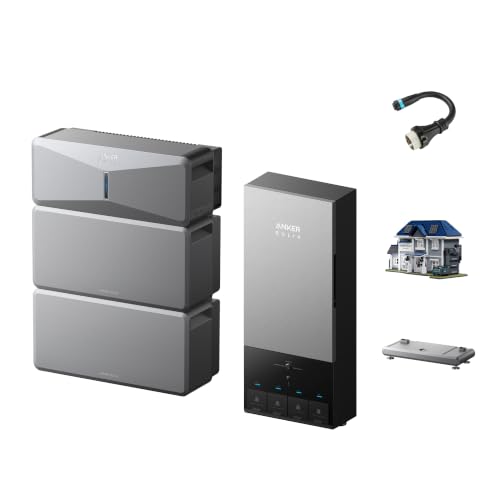
Anker SOLIX E10 Power Dock and Extra Battery, 12kWh to 90kWh
12kWh to 90kWh7.6kW continuous10kW turboNEMA 4 and 3R
Check price on Amazon
Best for: Homeowners ready for a permanent installation that runs the whole house.

This is not a portable station. The E10 is an installed home battery system with a power dock, and the listing describes whole-home coverage at 200A, 7.6kW continuous output that scales to 22.8kW with more units, and a 10kW turbo mode. Its outdoor NEMA 4 and 3R rating means it can live on an exterior wall or pad, which no plug-in station here can.

That capability buys a different experience: a licensed electrician ties it into the service panel and it runs the house the way a utility would, including central air in many cases. Capacity ranges from 12kWh to 90kWh, vastly beyond the other options in this guide. Measured against the Jackery 5000 Plus it holds more than double the energy at its smallest configuration.

The install is the real cost. Expect permits, a licensed installer and a utility interconnect conversation, and note the listing says the pieces ship separately. After that, maintenance is light: keep the enclosure clear of debris and vegetation and check the app for firmware updates.

What works

  • 200A whole-home coverage with scalable output
  • 12kWh starting capacity, up to 90kWh
  • Outdoor NEMA 4 and 3R rated enclosure
  • 10kW turbo output for big motor loads

Watch out for

  • Requires licensed installation and permits
  • Components ship separately
  • Far outside a casual DIY budget

Spec sheet

Capacity
12kWh to 90kWh
Continuous output
7.6kW, scales to 22.8kW
Turbo output
10kW
Whole-home rating
200A
Enclosure
NEMA 4 and 3R
03
ECO-WORTHY 10KW Off-Grid Solar Kit with 48V Batteries
10kW split-phase120/240V output48V 100Ah x4All-in-one inverter
Check price on Amazon
Best for: Cabin owners and DIY homeowners who want maximum storage for the money.

The ECO-WORTHY kit is the outlier: a complete off-grid system built from a 10kW split-phase all-in-one inverter/charger and four 48V 100Ah server-rack batteries. By simple arithmetic that is about 19kWh of storage, so it is the largest battery bank per outlay in the lineup, and 10kW of split-phase output can run a whole cabin or a modest house.

The tradeoff is labor. The batteries stack vertically in a standard 3U rack format, and you are expected to wire the DC and AC sides, size the breakers and cable, and ideally have the work inspected. Compared with the Jackery 5000 Plus you get roughly four times the energy for a similar spend, but you give up plug-and-play and a single warranty point.

This suits buyers who are comfortable with electrical work or have an installer in the family. Maintenance means checking torque on terminals once a year, keeping the rack dry and cool, and confirming the inverter settings match the lithium battery profile.

What works

  • Roughly 19kWh of battery storage in the kit
  • 10kW split-phase inverter for big loads
  • Standard rack format simplifies expansion
  • Lowest cost per kilowatt-hour here

Watch out for

  • Requires real electrical wiring skill
  • No plug-and-play portability
  • Support is split between components

Spec sheet

Inverter output
10kW
Voltage
120V and 240V split phase
Batteries
4 x 48V 100Ah
Battery format
3U server rack
Type
Complete kit
04
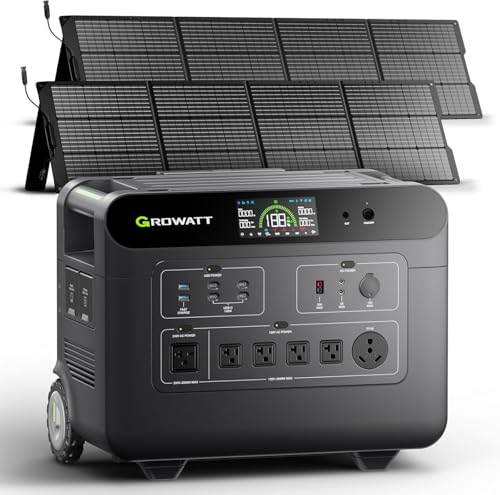
GROWATT HELIOS 3600 with 400W Solar Panels
3,600Wh LFP3,600W AC240V/7,200W parallelExpands to 36kWh
Check price on Amazon
Best for: Buyers who want to start with one unit and pair a second for 240V later.

The Helios 3600 is the system you grow. One unit gives 3,600W and 3,600Wh, and the listing says two in parallel produce 240V at 7,200W, suited to heavy appliances like air conditioners and dryers. Capacity expands up to 36kWh, and a 15ms EPS switchover keeps critical loads alive when the grid drops.

Growatt is a large inverter maker, so the electronics have a solar-industry pedigree, and the listing calls out cold-start technology for low-temperature charging, useful for unheated garages. Against the EcoFlow DELTA Pro it offers a clearer 240V path via parallel units, though its ecosystem of accessories is smaller.

The two 200W panels are a modest start. Plan to add panels, keep the units dry, and run the batteries through a partial cycle each season so the monitoring stays calibrated.

What works

  • Parallel pair reaches 240V and 7,200W
  • Expands up to 36kWh
  • 15ms switchover for critical loads
  • Cold-start technology for low temperatures

Watch out for

  • Second unit needed for 240V loads
  • Two panels are a small starting array
  • Smaller accessory ecosystem than EcoFlow

Spec sheet

Capacity
3,600Wh
Rated AC output
3,600W
Parallel output
7,200W at 240V
Switchover
15ms EPS
Included panels
2 x 200W
05
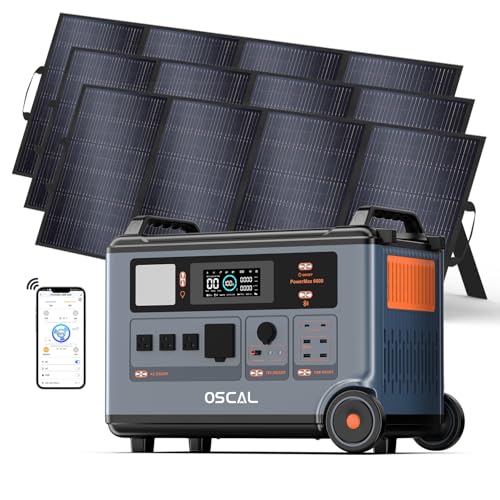
OSCAL PowerMax 6000 with 3x400W Solar Panels
3,600Wh LiFePO46,000W 120/240V2,400W solar input9,000W surge
Check price on Amazon
Best for: Homes with a yard for panels that want a fast daily refill.

The PowerMax 6000 brings a house-scale inverter and a house-scale solar array in one box. Its 6,000W split-phase output with a 9,000W surge runs a well pump and an air conditioner, and the listing quotes a full charge in about 1.44 hours from a combination of AC and 2,400W solar input. With three 400W panels included, it is the only plug-in kit here that can nearly refill itself from sun in a day.

The weak spot is storage. 3,600Wh is a modest tank for a 6,000W inverter, so heavy loads drain it fast; the listing also mentions a 7,200Wh configuration, which suggests expansion. It sits between the Helios 3600 and the Jackery 5000 Plus on capacity but ahead of both on solar speed.

Place the three large panels where they can be anchored against wind, and keep the unit in a conditioned space. Inspect connectors each season and clean the panels in spring.

What works

  • 2,400W solar input refills in a sunny day
  • 6,000W split-phase output
  • Three 400W panels included
  • 9,000W surge handles pump startup

Watch out for

  • 3,600Wh drains fast under heavy loads
  • Large panels need yard space
  • Newer brand with limited support history

Spec sheet

Capacity
3,600Wh
Rated AC output
6,000W
Surge
9,000W
Solar input
2,400W
Included panels
3 x 400W
06
EcoFlow DELTA Pro 3,600Wh Power Station, 120V 3,600W
3,600Wh LFP3,600W ACExpandable output1.8h at 240V
Check price on Amazon
Best for: Homeowners who value a mature platform and broad installer familiarity.

The DELTA Pro anchors a house system for people who want a proven product. A 3,600Wh LFP tank, 3,600W of output that grows to 4,500W with an accessory, and a quick 1.8 hour recharge from a 240V outlet make it a flexible core for a home battery rack.

Its strength is the ecosystem: expansion batteries, transfer kits and many installers have experience with it. The limitation is voltage, since the listed output is 120V, so a house panel gets one leg unless you add accessories.

Keep it out of damp basements, wipe the fan screens each season and test the transfer path every few months. Against the Growatt Helios 3600, its edge is accessory choice and recharge speed, while the Growatt has the cleaner 240V route.

What works

  • Quick recharge in under two hours at 240V
  • Large ecosystem of expansion and transfer kits
  • 3,600W output grows to 4,500W
  • LFP cells with long cycle life

Watch out for

  • Listed as 120V output only
  • Older platform than the newest options
  • Heavy, needs a fixed location

Spec sheet

Capacity
3,600Wh
Rated AC output
3,600W
Expanded output
Up to 4,500W
240V charge
About 1.8 hours
Wall charge
About 2.7 hours

Spec sheet decoder

What the numbers on the box really mean

The specs manufacturers lead with, translated into what they tell you about real-world performance.

Split-phase output

Two 120V legs forming 240V, the way a US home panel is wired.

Watch forThe Oscal, Jackery 5000 Plus and ECO-WORTHY kit advertise it; the DELTA Pro lists 120V.

Continuous vs turbo output

Continuous is what the system sustains all day and turbo is a limited-time boost.

Watch forThe Anker E10 lists 7.6kW continuous and 10kW turbo.

Server-rack battery

A standard 3U format battery module that stacks in a rack and parallels with identical modules.

Watch forThe ECO-WORTHY kit ships four 48V 100Ah units.

EPS switchover

How quickly the system moves critical loads to battery during an outage. Under 20ms is a common target.

Watch forThe Helios 3600 quotes 15ms, the Jackery HomePower family 20ms.

NEMA enclosure rating

A standard for how well a housing resists weather and dust. NEMA 3R and 4 suit outdoor mounting.

Watch forOnly the Anker E10 carries this rating in the group.

Methodology

How We Evaluated These Solar Generator Systems for a House

System scale

We compared storage and inverter output to a realistic backup plan of 3 to 8kWh a day. The ECO-WORTHY kit and Anker E10 have headroom, while the DELTA Pro and Oscal are sized for essentials.

Voltage match

We checked for split-phase 120/240V, since household panels expect it. The Oscal, Jackery 5000 Plus and ECO-WORTHY kit passed outright, and the Helios needs a second unit.

Installation burden

We rated each option by how much professional work it needs, from plug-in to licensed hardwiring. The Jackery 5000 Plus scored best for ease, the Anker E10 worst.

Growth potential

We checked how far each system expands: the Anker E10 to 90kWh, the Jackery to 60kWh and the Helios to 36kWh.

Support and ecosystem

We assessed owner feedback patterns and listing details for warranty and parts availability, not our own ownership. EcoFlow and Jackery scored well for accessories. We also looked at whether replacement battery modules are still sold in the same format.

Decision guide

How to Choose the Right Solar Generator Systems for a House

By Scale of Backup

GoalPickWhy
Refrigerator and essentialsEcoFlow DELTA Pro3,600Wh with fast recharge
Well pump and furnaceJackery Solar Generator 5000 Plus7,200W at 240V
Heavy loads, many daysECO-WORTHY 10KW kitAbout 19kWh and 10kW
Whole-house coverageAnker SOLIX E10200A coverage
Start small, add laterGROWATT HELIOS 3600Parallel for 240V, expands to 36kWh

By Budget

TierPickWhy
Lowest per kWhECO-WORTHY 10KW kitMost storage for the outlay
MidGROWATT HELIOS 3600Solid inverter maker, expandable
Upper midOSCAL PowerMax 6000Includes 1,200W of panels
Premium plug-inJackery Solar Generator 5000 PlusNo installer for the battery
Premium hardwiredAnker SOLIX E10Permanent whole-home system

Plug-In vs Hardwired

Plug-in stations

The Jackery 5000 Plus, DELTA Pro, Helios 3600 and Oscal can be moved and sold on, and they need only a transfer switch. They suit renters, second homes and anyone who wants to take the battery along.

Hardwired systems

The Anker SOLIX E10 and ECO-WORTHY kit are installed permanently, store more per dollar and run bigger loads. They need permits, wiring and a plan for the lifetime of the house.

Choose plug-in for flexibility and essentials; hardwired for whole-house coverage.

Panels: Starter Kit vs Large Array

PreferencePickWhy
Big array includedOSCAL PowerMax 60001,200W across three panels
Moderate starterGROWATT HELIOS 3600Two 200W panels
Small starter, expand laterJackery Solar Generator 5000 PlusTwo 200W panels, high-voltage ready
Bring your own arrayECO-WORTHY 10KW kitInverter accepts a large PV array

For Whole-Home Air Conditioning Specifically

Look for

Look for 240V output, a 6kW-plus inverter and at least 10kWh of storage, since central air can draw 3 to 5kW. Soft-start kits reduce the surge.

In this comparison

The Anker SOLIX E10 and ECO-WORTHY 10KW kit are the only two that realistically carry central air for hours. The Oscal can start it but the 3,600Wh tank drains in an hour or so.

When to Spend More

Spend more if

You want to ride out multi-day outages with central air or have medical needs. The Anker SOLIX E10 is the only option that scales to that level.

Save if

You just need a refrigerator, lights and communication. The DELTA Pro or the Helios 3600 handles it.

Ownership

Maintenance schedule

The upkeep that decides whether this machine lasts two seasons or ten.

TaskIntervalWhy it matters
Torque-check terminals and lugsOnce a yearThermal cycling loosens DC connections, and a loose lug on a 48V system heats up quickly.
Test the transfer switchEvery six monthsContacts can stick or corrode. A load test confirms it before a storm.
Clean panels and check mountsEach springDust and pollen cut output, and wind loosens mounts over time.
Check firmware and settingsTwice a yearUpdates tune charging profiles, and inverter settings must match the lithium profile. Write down the settings you chose so a firmware reset does not leave the system on a lead-acid profile.
Keep batteries dry and temperateAlwaysLithium cells age faster in heat and should not be charged below freezing.

FAQ

Frequently Asked Questions

What is the difference between a solar generator and a home battery system?

A solar generator is a self-contained plug-in unit with battery, inverter and charger. A home system like the Anker SOLIX E10 is installed permanently and hardwired to the panel. The first is portable, the second runs the whole house.

Can I add batteries later?

Yes on most of these. The Jackery 5000 Plus expands to 60kWh and the Helios 3600 to 36kWh. Confirm the expansion packs are sold and compatible before relying on them.

Is the ECO-WORTHY kit really cheaper?

Per kilowatt-hour, yes, by a wide margin. You pay in installation labor and design effort. If you cannot wire a split-phase system safely, pay an electrician or choose a plug-in unit.

Does bigger inverter wattage mean longer runtime?

No. Runtime comes from stored watt-hours, not inverter size. A 6,000W inverter on a 3,600Wh tank drains faster under heavy loads. Pair a big inverter with enough storage, or you will trip the low-battery cutoff in the middle of a cooking session.

How many solar panels do I need?

Divide your daily watt-hours by 4 to 5 sun hours and then by 0.7. A 5kWh day needs roughly 1,500W of panels. The Oscal's 1,200W kit comes closest. Ground mounts are easier to clean and tilt than roof arrays, and they keep wiring short if the batteries sit in a garage.

Do I need a permit?

Hardwired systems like the Anker E10 and ECO-WORTHY kit almost always do, and many utilities require interconnect approval. Plug-in stations with a transfer switch often need only an electrician's permit. Check local rules.

Bottom line

The short version

Browse more solar generator systems for a houseon Amazon →
James Miller, Lead Machine Editor

About the author

James Miller

Lead Machine Editor, MachineFanatic

James Miller leads MachineFanatic's buying guides, turning spec sheets, manuals and owner feedback into clear verdicts on power tools, outdoor power equipment, shop machines and kitchen machines.

More from James →