
Amazon affiliate links - we earn a commission.Affiliate disclosure

Buying guide · 13 min read · Updated 2026-11-07

Best Sovol 3D Printers (2026)

Sovol T300, SV08 and SV08 Max compared: Klipper firmware, Voron-based CoreXY frames, build size, speed claims and what each open-source machine demands.

James MillerBy James MillerLead Machine Editor3 machines comparedSpec-sheet verified
Best Sovol 3D Printers

At a glance

Our top picks

Side by side

Spec comparison

MachineDesignSpeedHotend
Sovol SV08 CoreXY 3D printer, Voron 2.4 based, 700 mm/s classBest OverallSovol SV08 CoreXY 3D printer, Voron 2.4 based, 700 mm/s classVoron 2.4 based, open sourceUp to 700 mm/s300 C clog-free
Sovol T300 3D printer, Klipper, 300 C all-in-one hotendBest ValueSovol T300 3D printer, Klipper, 300 C all-in-one hotendn/aUp to 600 mm/s300 C all-in-one
Sovol SV08 Max CoreXY 3D printer, 19.7 in cube, 700 mm/s classBest Large FormatSovol SV08 Max CoreXY 3D printer, 19.7 in cube, 700 mm/s classCoreXY, Voron 2.4 basedUp to 700 mm/sn/a

Open-source printers appeal to people who want to understand and modify the machine. Instead of a sealed appliance with a locked app, you get firmware you can edit, a design others have documented and parts you can swap. The price of that freedom is time spent tuning.

The buying question is whether you want to tinker or simply print. A machine based on a community design rewards calibration and punishes neglect, and speed claims depend on tuning. The three machines below sit in that open-source camp, with different sizes and motion systems.

Before you buy

6 Criteria to Look For Before Buying a Sovol 3D Printer

  1. 01

    Tinkerer versus appliance

    Open-source machines like the Sovol SV08 give you control and require knowledge. You edit configuration files, tune acceleration and fix problems with forum help rather than a support ticket. If you want a printer that works out of the box with an app, a closed machine is a better choice. Be honest about how much time you will spend. A machine that sits unfinished because the setup was too much is an expensive lesson. The people who enjoy these printers are usually the ones who like reading a configuration file, comparing a print with a calibration chart and adjusting one value at a time. If that sounds like a chore, the freedom you are paying for will go unused, and a closed machine will serve you better.

  2. 02

    Klipper and tuning features

    Klipper moves motion planning to a faster board and enables input shaping, which cancels ringing, and pressure advance, which sharpens corners. The Sovol T300 and SV08 both use it. These features let a machine print at higher accelerations without quality loss, but they require a calibration session. Expect to spend an evening on tuning before you see the benefit. A common routine is to print a resonance test with an accelerometer or a ringing tower, enter the suggested shaper values and then raise acceleration in small steps until corners start to round. Save a backup of the configuration after every successful change, so a bad edit never costs you the settings that worked.

  3. 03

    Gantry leveling

    The SV08 uses four independent Z motors to level the gantry, which fixes the bed tilt and sag common on large plates. Simpler machines use a single lead screw or a probe mesh to compensate. Four-point leveling gives a flatter first layer across the plate. For large prints, it is the difference between a reliable plate and a fussy one. The routine takes a minute before a print, and it keeps the gantry parallel to the bed even after the machine has been moved or the frame has settled, which is why open-source builders prize it. Machines with a single Z screw cannot correct a twist in the gantry at all.

  4. 04

    Build volume and failure cost

    The SV08 Max's 19.7 inch cube lets you print furniture-scale parts, but a failure at hour thirty wastes a large amount of filament. Bigger plates also take longer to heat and level. Choose a volume that matches your biggest regular part, not your biggest dream. Many owners find that the mid-size machine handles ninety percent of what they print. The extra volume is best used for batches, such as filling the plate with small parts for a weekend run, rather than for a single giant object that can fail near the end. Remember also that a larger machine needs a larger enclosure, bigger spools of filament and a more powerful circuit.

  5. 05

    Speed claims versus reality

    The SV08 lists up to 700 millimeters per second and the T300 up to 600. These are ceilings that need tuning and good filament. Real print time depends on acceleration, cooling and part shape. A faster machine also shakes more, and ringing appears if input shaping is not set. Treat the speed as potential, not a promise. The practical gains come from acceleration, cooling and a hotend that can melt enough plastic, so a faster frame without a strong hotend is limited by flow. Ask owners what layer heights and speeds they actually run for functional parts, since that tells you more than the box.

  6. 06

    Hotend and filament range

    A 300 degree hotend handles PLA, PETG, ABS, ASA and many nylons. It does not cover high-temperature plastics. The SV08's clog-free hotend and the T300's all-in-one hotend are both rated to 300 degrees. Check your filament datasheet against that limit and use a hardened nozzle for abrasive materials. A hotend rated to 300 degrees is a comfortable ceiling for nylon blends, but polycarbonate and high-temperature filaments often want more, and printing them at the limit shortens the life of the PTFE parts inside the heat break. Know which parts in your hotend are rated for sustained heat before you push it.

Detailed reviews

The 3 best sovol 3d printers, explained

01
Sovol SV08 CoreXY 3D printer, Voron 2.4 based, 700 mm/s class
Voron 2.4 based700 mm/s class300 C hotend4 Z motors
Check price on Amazon
Best for: Tinkerers who want a Voron-class machine without sourcing parts.

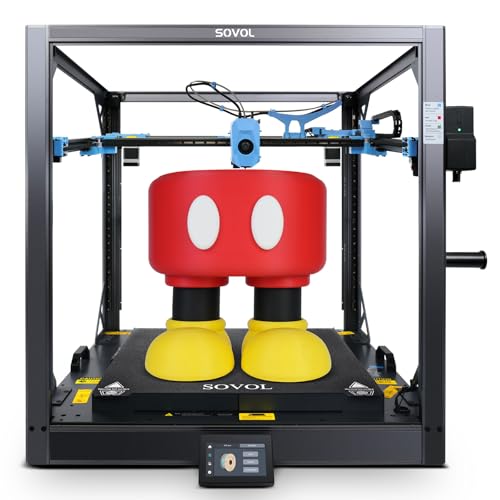
The SV08 is based on the Voron 2.4, a community CoreXY design known for a flying gantry that is leveled by four independent Z motors. Sovol made it open source from the start of development, so firmware and design files are available for modification. The CoreXY layout reduces moving mass, which the maker says lifts maximum speed to a listed 700 millimeters per second, and the hotend reaches 300 degrees Celsius.

The four-motor gantry leveling is the part that matters most for quality. Each corner of the gantry is adjusted independently until the bed is trammed, which fixes the tilt and sag that plague cheaper machines on large plates. The tradeoff is complexity. More motors and more tuning mean more things that can go wrong, and a first print can take an afternoon of setup.

In ownership, treat it as a hobby project that happens to make parts. Klipper gives you control over acceleration, pressure advance and input shaping, but you must learn the configuration file. Compared with the Sovol T300, it is more capable and more demanding. Keep spare nozzles and belts, update firmware through the project channels and expect to tune at least once a season.

What works

  • Voron 2.4 based open-source design
  • Four independent Z motors level the gantry
  • 300 C hotend for engineering filaments
  • CoreXY motion with a 700 mm/s class ceiling

Watch out for

  • Needs tuning and configuration knowledge
  • More motors and parts to maintain
  • Speed claim is a ceiling, not typical

Spec sheet

Design
Voron 2.4 based, open source
Kinematics
CoreXY
Speed
Up to 700 mm/s
Hotend
300 C clog-free
Z axis
4 independent Z motors
02
Sovol T300 3D printer, Klipper, 300 C all-in-one hotend
Klipper firmware600 mm/s class300 C hotend81-point leveling
Check price on Amazon
Best for: Buyers who want Klipper speed and metal build at a lower tier.

The T300 runs Klipper on a 64-bit microcomputer, which the maker says raises computing speed and enables features such as input shaping and pressure advance. A new all-in-one hotend reaches 200 degrees Celsius in about 30 seconds and tops out at 300, which shortens waiting and handles most common filaments. A listed 81-point automatic leveling routine maps the bed before a print, and most of the frame and components are metal.

The tradeoff is design complexity versus the SV08. The T300 is the simpler machine, without the four-motor gantry and the Voron lineage, so it is easier to run but less upgradeable. The speed figure of 600 millimeters per second is a ceiling and demands tuning to use.

Ownership is friendly for a Klipper machine. The all-in-one hotend swaps in as a unit, and a metal frame resists the flex that plagues cheaper designs. Keep the bed clean, update Klipper when new features arrive and run an input shaping calibration after any hardware change. It is the right starting point for someone curious about Klipper but wary of a full Voron build. The quick preheat is a small but welcome comfort for anyone who prints short parts through the day, because waiting several minutes for a hotend to rise gets old fast.

What works

  • Klipper firmware on a 64-bit board
  • Hotend reaches 200 C in about 30 seconds
  • 81-point bed leveling routine
  • Metal frame and components

Watch out for

  • Speed claim needs tuning to realize
  • Less upgradeable than the SV08
  • Klipper has a learning curve

Spec sheet

Firmware
Klipper on 64-bit board
Speed
Up to 600 mm/s
Hotend
300 C all-in-one
Preheat
200 C in 30 seconds
Leveling
81-point
03
Sovol SV08 Max CoreXY 3D printer, 19.7 in cube, 700 mm/s class
19.7 in cube700 mm/s classEddy current sensorVoron 2.4 based
Check price on Amazon
Best for: Makers printing furniture-scale parts or large batches.

The SV08 Max scales the SV08 design to a build volume of 19.7 inches in every direction, which is a true large-format plate. It keeps CoreXY kinematics with a compact moving mass and adds an eddy current scanning sensor that levels the bed quickly without contact. The maker says it can cut print times by up to 50 percent compared with slower large machines.

The tradeoff is size and risk. A plate that large means long prints, heavy plates and high filament use per failure. It also needs a sturdy bench and a larger power draw. Against the SV08, it offers volume but not a different philosophy, so choose it only when parts need the space.

In ownership, plan for calibration. Large plates take time to heat and to tram, and a small error is magnified across 500 millimeters. Use the eddy current sensor's mesh, check it after moving the machine and dry filament before long runs. For someone who builds furniture-scale prints or batches of small parts on one plate, it replaces several smaller machines.

What works

  • 19.7 inch cube for large parts and batches
  • Eddy current sensor levels without contact
  • CoreXY keeps moving mass low
  • Open-source Voron-based design

Watch out for

  • Long prints make failures expensive
  • Needs a sturdy bench and more power
  • Tuning effort grows with plate size

Spec sheet

Build volume
19.7 in cube
Speed
Up to 700 mm/s
Leveling sensor
Eddy current scanning
Design
CoreXY, Voron 2.4 based
Claim
Up to 50 percent shorter print times

Spec sheet decoder

What the numbers on the box really mean

The specs manufacturers lead with, translated into what they tell you about real-world performance.

Klipper

Open-source firmware that runs motion planning on a faster computer. It enables input shaping and pressure advance.

Watch forThe T300 uses it on a 64-bit board.

Voron 2.4

A community CoreXY design with a flying gantry and quad gantry leveling. It is the base for the SV08.

Watch forThe SV08 and SV08 Max are based on it.

Quad gantry leveling

Four independent Z motors that level the gantry before a print. It corrects tilt.

Watch forThe SV08 uses four independent Z motors.

Eddy current sensor

A contactless sensor that scans the bed surface quickly. It builds a mesh for leveling.

Watch forThe SV08 Max uses one.

Input shaping

A software method that cancels vibration. It allows higher acceleration without ringing.

Watch forKlipper machines need a calibration run.

Methodology

How We Evaluated These Sovol 3D Printers

Openness

We looked at firmware and design availability. The SV08 and SV08 Max are open source and Voron-based, while the T300 runs Klipper. We scored how much control each gives, and we noted that open firmware is only valuable when the documentation and community are strong enough to help you use it.

Motion system

We compared CoreXY layouts, speed claims and leveling methods. The SV08's four-motor gantry and the SV08 Max's eddy sensor stood out. Speeds were treated as ceilings.

Build volume

We compared plate sizes and failure risk. The SV08 Max's 19.7 inch cube is the largest, while the SV08 and T300 are mid-size. Bigger was not treated as better.

Ease of ownership

We weighed tuning effort and parts. The T300 is the easiest of the three. The SV08 family rewards tinkering, but it also asks for more time in the first month than a closed machine, so we marked it down for buyers who want to print immediately.

Cost and fit

We weighed price against what each adds. The T300 is the value core, and the SV08 Max is the premium for volume. We avoided recommending size for its own sake, and we gave extra weight to machines whose extra capability a typical hobbyist would actually use within the first year.

Decision guide

How to Choose the Right Sovol 3D Printers

By Experience Level

SituationPickWhy
New to KlipperSovol T300Simpler machine with Klipper
Wants a Voron-class buildSovol SV08Voron 2.4 based
Large-format ambitionsSovol SV08 Max19.7 inch cube
Fast iteration on small partsSovol T300Quick preheat
Gantry accuracy on a big plateSovol SV08Four independent Z motors

By Budget

Budget tierPickWhy
Lowest of the threeSovol T300Klipper at a lower tier
MidSovol SV08Voron-based machine
HighestSovol SV08 MaxLarge-format plate
Best value for tuningSovol T300Easy Klipper start
Best value for sizeSovol SV08Mid-size with strong motion

Simple vs Voron-Based Design

Sovol T300

The T300 is the simpler design with Klipper, an all-in-one hotend and 81-point leveling. It is easier to set up and run, but it is less upgradeable.

Sovol SV08 family

The SV08 and SV08 Max follow the Voron 2.4 design with four-motor gantry leveling. They are more capable and more demanding, and they reward tuning.

Pick the T300 to learn Klipper and the SV08 to build skill.

Mid Size vs Large Format

PreferencePickWhy
Everyday partsSovol SV08Mid-size plate
Large parts and batchesSovol SV08 Max19.7 inch cube
Smaller footprintSovol T300Compact machine
Fast leveling on a big plateSovol SV08 MaxEddy current sensor
Lower failure costSovol SV08Smaller plate

For Open-Source Tinkering Specifically

Look for

Documented firmware, accessible configuration files and a community that shares tuning. A machine with four-motor leveling and Klipper rewards the effort.

In this comparison

The Sovol SV08 is the pick for tinkerers, the T300 is a gentler start and the SV08 Max adds size.

When to Spend More

Spend more if

You need a large plate or a Voron-class motion system. The Sovol SV08 and SV08 Max justify their cost with leveling and volume.

Save if

You want Klipper speed on a simpler machine. The Sovol T300 does that at a lower tier.

Ownership

Maintenance schedule

The upkeep that decides whether this machine lasts two seasons or ten.

TaskIntervalWhy it matters
Run input shaping calibrationAfter hardware changesChanging nozzles, belts or toolhead weight shifts the machine's resonances. Re-run the calibration to prevent ringing, and save the new shaper values to your configuration file.
Check belt tensionEvery few monthsLoose belts cause layer shifts, ghosting and uneven walls, while overtight belts wear bearings. Retension to the maker's guide and compare the two belts so that they match in pitch when plucked.
Lubricate rails and screwsEvery few monthsDry motion causes noise and wear, and a gantry that runs fast needs smooth rails. Use the grease the maker recommends and wipe old grease and dust off before adding new.
Update KlipperQuarterlyNew releases fix bugs and add features, but an update can also change configuration syntax. Back up your configuration first, read the release notes and update one component at a time so you can trace any new problem.
Clean the bed and nozzleBefore each printResidue ruins the first layer and can confuse a contactless sensor. Wipe the bed with isopropyl alcohol and brush the nozzle while it is warm, then run the leveling routine before a long print.

FAQ

Frequently Asked Questions

Is a Sovol printer good for beginners?

The T300 is a reasonable start if you are ready to learn Klipper. The SV08 and SV08 Max reward patience and are better for tinkerers. Beginners wanting plug and play should consider a closed ecosystem machine. If you do pick a Sovol as a first printer, set aside a weekend for the first calibration, follow a written guide step by step and avoid changing several settings at once, because that is how a working machine turns into a puzzle.

How much should I budget for a Sovol printer?

The printer is the main cost, and the T300 is the lowest tier. Add filament, spare nozzles, belts and time. The SV08 Max uses more filament per print. Because the whole range is aimed at hobbyists who enjoy modifying the machine, many owners also budget for upgrades such as a camera, a better build plate or a chamber heater, which can add a meaningful amount over a year.

How long do these machines last?

Frames last years. Nozzles, belts and hotend parts wear and need replacing. Open-source designs have community parts supply. A printer built on a shared design is easier to repair years later than a sealed appliance, because the parts are documented and often interchangeable, and enthusiasts publish replacements when the maker stops selling a component.

What is Klipper?

Klipper is open-source firmware that moves motion planning to a faster board. It enables input shaping and pressure advance. It requires editing a configuration file. The benefit is that you can read exactly what the machine is doing, change one setting at a time and share a working configuration, while the cost is a learning curve that a push-button appliance does not have.

Is 700 mm/s realistic?

It is a ceiling. Real speeds depend on tuning, acceleration and part shape. Expect faster prints than older machines but not 700 mm/s averages.

Do I need an enclosure?

For PLA and PETG, no. For ABS and ASA, an enclosure helps. The SV08 design is enclosed, so it suits higher temperature materials. Even so, keep the lid closed for ABS and ASA, ventilate the room and let the chamber cool before you open it, because the air inside can be hot enough to deform parts removed too early.

Bottom line

The short version

Browse more sovol 3d printerson Amazon →
James Miller, Lead Machine Editor

About the author

James Miller

Lead Machine Editor, MachineFanatic

James Miller leads MachineFanatic's buying guides, turning spec sheets, manuals and owner feedback into clear verdicts on power tools, outdoor power equipment, shop machines and kitchen machines.

More from James →

Keep reading

Related guides