

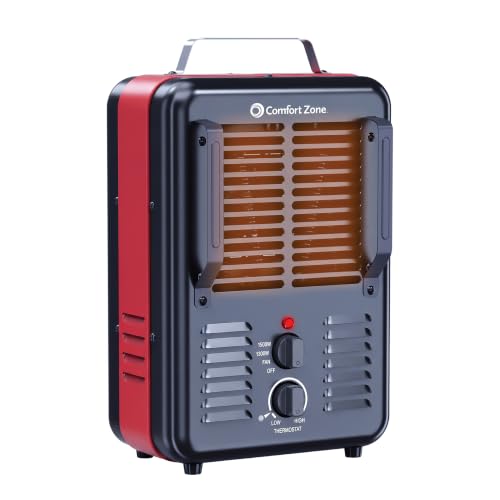


The milkhouse shape is the classic utility heater: a metal cabinet with a fan at one end and a stout stance. This BEYOND HEAT adds three power levels, fan-only, 1300W and 1500W, plus a thermostat and a tip-over switch, which suits the conditions of an attic room.
The metal housing matters more here than in a bedroom. Attic dust is abrasive, and a plastic heater can scuff and warp, while a steel box shrugs it off. The tip-over switch is worth having on an uneven floor, since a slope that is barely noticeable to you can be enough to let a light heater creep.
Its limit is the same as any 120 volt unit: 1500W warms a modest room, and on the shared circuit of an upstairs bedroom it needs an outlet to itself. Use the 1300W step if the breaker trips. Keep clear of insulation and boxes, and sweep dust off the grille. A practical habit in an attic is to give the heater a bare plywood or tile platform, because a heater standing on carpet remnants, foam board or a pile of stored fabric is a fire waiting for a bump. Heat also rises, so in a sloped attic the warm air collects up against the ridge while your feet stay cold, which is a good reason to aim the airflow low and sideways and not straight up at the roof.
What works
- Heavy-duty metal body
- Three levels including fan-only
- Thermostat holds temperature
- Tip-over switch for sloped floors
Watch out for
- Utility looks, not furniture
- Fan noise at 1500W
Spec sheet
- Power
- 1500W at the top step
- Settings
- Fan-only, 1300W and 1500W
- Control
- Thermostat
- Safety
- Tip-over switch
- Build
- Heavy-duty metal, milkhouse style