
Amazon affiliate links - we earn a commission.Affiliate disclosure

Buying guide · 13 min read · Updated 2026-11-15

Best Space Heaters for Camping (2026)

Seven camping space heaters compared across propane, butane and plug-in electric designs, with campsite wattage limits, safety shutoffs and tent fit explained.

James MillerBy James MillerLead Machine Editor7 machines comparedSpec-sheet verified
Best Space Heaters for Camping

At a glance

Our top picks

A camping space heater has to answer one question before any other: where does the energy come from. A campsite with a power pedestal opens up electric ceramic heaters, while a backcountry site leaves only fuel.

That split decides almost everything else, from safety shutoffs to how much heat you can realistically use. This guide covers both camps so the choice follows your site, not a spec sheet. Safety and tent size come next, since a heater that suits a cabin can be wrong for a bivy.

Before you buy

6 Criteria to Look For Before Buying a Space Heater for Camping

  1. 01

    Power source first

    Electric heaters such as the DREO, JIBUFI and the two Amazon Basics models need a pedestal. Propane and butane units like the Portable Buddy and the Naturehike work anywhere. Decide this before comparing watts or BTU. Many first-time buyers pick a heater by output, then discover their site has no outlet within cord reach, which wastes the purchase.

  2. 02

    Campsite circuit limits

    A standard 15A circuit supports about 1,800W continuous, so a 1500W heater leaves little room for anything else. The Amazon Basics 500W draws about a third as much and can share a pedestal. Many sites split a 30A feed across several loads, so check the breaker before plugging in.

  3. 03

    Combustion gases

    Propane and butane heaters release carbon monoxide and water vapor, which a closed tent traps. Electric units add neither. If you have the choice, prefer electric for sleeping spaces. If you must use propane, run it before bed with the vents open, then shut it off and rely on insulation overnight.

  4. 04

    Thermostat and timer

    A thermostat cycles the element and saves electricity, and a timer shuts the heater off if you fall asleep. The DREO and JIBUFI offer both, while the 500W mini is a plain on and off device. A timer is the feature that matters most for camp use, because a sleeper cannot watch a heater.

  5. 05

    Weather protection

    The electric heaters here are household units and are not splash rated. Keep them off wet ground and out of rain, and use a heavy outdoor cord. Propane units have no cord but need dry tiles. A cheap waterproof cord cover and a drip loop in the cable are small habits that prevent most wet-plug problems.

  6. 06

    Tip stability and size

    Compact boxes like the Amazon Basics 3 lb unit stay put on a table. Tower heaters like the JIBUFI tip more easily. Place any heater on a flat firm surface away from sleeping bags. The minimum clearance is usually three feet from fabric, which is hard to find in a small tent and a good reason to size the heater to the room.

Detailed reviews

The 7 best space heaters for camping, explained

01
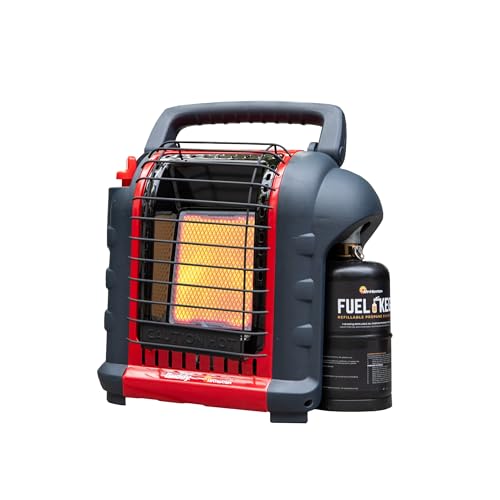
Mr. Heater Portable Buddy 4,000 or 9,000 BTU radiant
4,000/9,000 BTU225 sq ftPropaneODS
Check price on Amazon
Best for: Off-grid camps, vans and larger tents.

For a campsite with no hookup, this is the baseline. It makes 4,000 or 9,000 BTU per hour from propane, needs no electricity and is rated for about 225 square feet. That heat range handles a camper van, a screened shelter or a mid-size tent without a generator.

It carries an oxygen depletion sensor and tip switch, and it is approved for indoor and outdoor use outside Canada and Massachusetts. Even so, a closed space needs a vent and a CO alarm, because the heater burns oxygen and sheds carbon monoxide and moisture. A 1 lb cylinder lasts a little over two hours on the high step.

Next to the electric DREO it is far louder in output and far less polite about humidity, but it works where no cord does. Keep spare cylinders outside and the tile face dry. A hose and regulator kit is the upgrade most campers add, since it lets one 20 lb tank feed the heater for a full weekend instead of swapping 1 lb cylinders every evening.

What works

  • Needs no power, so it works at any site
  • Two output steps from 4,000 to 9,000 BTU
  • Oxygen sensor and tip switch
  • Rated for about 225 sq ft

Watch out for

  • Adds moisture and carbon monoxide to a closed space
  • High step empties a 1 lb cylinder in about two hours

Spec sheet

Output steps
4,000 or 9,000 BTU/hr
Rated area
About 225 sq ft
Fuel
Propane, cylinder or hose
Power
None needed
Approval
Indoor and outdoor use
02
Naturehike camp heater with warming shelf, 3,750 BTU butane
3,750 BTUButane240 min per canWarming shelf
Check price on Amazon
Best for: Three-season camps where canisters are already in the kit.

This Naturehike runs on an 8 oz butane canister and the listing quotes up to 240 minutes on one can. It outputs about 3,750 BTU and adds a detachable insulated shelf where you can warm a mug or a snack. A carry handle makes it easy to move between tent and picnic table.

Butane canisters are light and clean, and the output is gentle enough for a small tent. The catch is butane's weakness in cold: below freezing the pressure sags and the flame can fade, so this is a three-season heater more than a winter one.

Against the Mr. Heater it has less output and fewer documented shutoffs, but it is lighter and easier to carry. Store canisters out of sunlight and keep the shelf clear of fabric. Spare canisters are cheap and light, so most owners carry two for a weekend. The handle also doubles as a point to hang the unit away from kids and pets when it is cooling down.

What works

  • Up to 240 minutes from one 8 oz canister
  • Detachable insulated warming shelf
  • Carry handle for moving between spots
  • 3,750 BTU is gentle enough for a small tent

Watch out for

  • Butane weakens in freezing weather
  • Fewer safety shutoffs documented than the Mr. Heater

Spec sheet

Output
3,750 BTU (listing)
Fuel
8 oz butane canister
Runtime
Up to 240 minutes
Shelf
Detachable insulated
Carry
Comfortable handle
03
DREO 1500W ceramic space heater with thermostat and 34 dB mode
1500W PTCThermostat34 dB12H timer
Check price on Amazon
Best for: Hookup campsites, cabins and RVs.

The DREO is the electric pick for campsites with a pedestal. Its listing cites a 34 dB quiet mode, a 12 hour timer and an enhanced NTC sensor for tighter thermostat control. A thermostat cycles the element, which holds a tent or cabin steadily instead of running at full output.

At 1500W it makes about 5,100 BTU per hour, and the same heat on any campsite outlet. That is the key constraint: a standard 15A circuit supports roughly 1,800W, so a coffee maker or a second heater on the same pedestal can trip the breaker.

Compared with the Mr. Heater it adds no combustion gases or moisture, which is the best reason to use electric when you can. It is an indoor-rated heater, so keep it out of rain and off wet ground, and never run it on a thin extension cord. Wrap the cord loosely for storage, because tight coils overheat and age the insulation. If the plug feels warm to the touch after an hour, move the heater to a different outlet and replace the cord.

What works

  • Thermostat holds a steady tent temperature
  • 34 dB quiet mode helps you sleep
  • 12 hour timer shuts it off automatically
  • No combustion gases or moisture

Watch out for

  • Needs a power pedestal and a heavy cord
  • Indoor rated, so it must stay out of rain

Spec sheet

Power
1500W electric
Thermostat
Digital, NTC sensor
Noise
34 dB quiet mode
Timer
12 hour
Needs
Campsite hookup
04
Amazon Basics ceramic space heater with thermostat, 3 settings
3 settingsThermostat3 lbTip-over
Check price on Amazon
Best for: Small tents and camper bunks on a hookup.

This compact ceramic unit weighs about 3 lb and measures 7.5 by 6.3 by 9.5 inches according to the listing. It has three heat settings, a thermostat, overheat and tip-over protection and a power indicator light. Its size is its advantage: it fits on a tent table or beside a cot.

It uses the same PTC ceramic principle as larger heaters, so it warms the air quickly and self-limits element temperature. The limitation is coverage, since a small unit cannot rescue a large cold tent.

Against the DREO it is simpler and lighter, with fewer comfort features such as a quiet mode. It suits a camper who has a hookup and wants a basic dependable box. Plug it directly into the outlet and check that the plug stays cool. Its small size also makes it easy to pack in a duffel without a dedicated bin. Most owners keep it on a stable shelf rather than the floor.

What works

  • Three settings and a thermostat
  • About 3 lb and compact
  • Overheat and tip-over protection
  • Fits on a small table or cot side

Watch out for

  • Limited coverage for big tents
  • Needs shore power

Spec sheet

Settings
Three heat levels
Weight
About 3 lb
Size
7.5 x 6.3 x 9.5 in
Safety
Overheat and tip-over
Needs
Campsite hookup
05
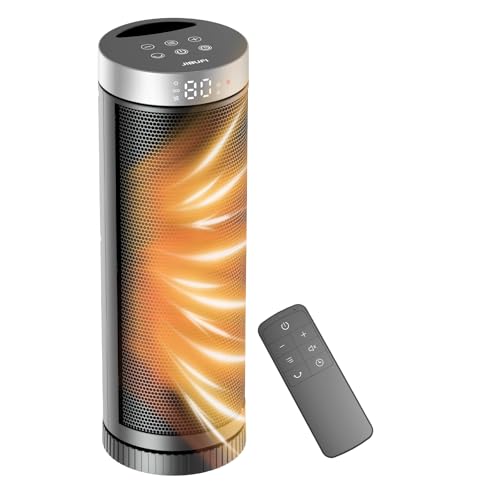
JIBUFI 17 in 1500W oscillating ceramic heater with remote
1500W PTC70 deg oscillationRemote12H timer
Check price on Amazon
Best for: Cabins, big frame tents and RVs with power.

The JIBUFI stands 17 inches tall and offers three power levels up to 1500W, 70 degree oscillation, a remote, a thermostat, a 12 hour timer and an ECO mode. Oscillation spreads warmth across a wider area, which helps in a larger tent or a cabin.

Oscillation does not add heat, it only distributes it, so the benefit is comfort instead of output. The tower shape also tips more easily than a compact box, so place it on a flat firm surface.

For camping it makes sense in a cabin, a large frame tent or an RV with a hookup. It is a household heater, so rain and wet ground are off limits. Use it on a dedicated circuit and keep cords short and heavy. The remote is handy from a sleeping bag, but batteries die in the cold, so carry a spare pair. Dust on the grille is the usual cause of a burning smell on the first night.

What works

  • 70 degree oscillation spreads the warmth
  • Remote, thermostat and 12 hour timer
  • ECO mode holds a target temperature
  • 1500W is the practical plug-in ceiling

Watch out for

  • Tall body tips more easily
  • Household unit needs dry placement

Spec sheet

Power
1500W (three levels)
Oscillation
70 degrees
Control
Remote and thermostat
Timer
12 hour
Mode
ECO
06
Amazon Basics 500W ceramic mini heater with tip-over
500WMiniTip-overCeramic
Check price on Amazon
Best for: Personal warmth for one sleeper on a hookup.

At 500W this mini heater makes roughly 1,700 BTU per hour, about a third of a 1500W unit. It measures 5.87 by 3.15 by 5.95 inches and includes tip-over protection. The size and wattage match a bunk, a tent vestibule or a small camper desk.

Because the draw is low, it can share a pedestal with other loads without tripping a breaker. That is the good side of low wattage, and the bad side is that it warms only a personal zone.

Compared with the 1500W units here it is the polite choice for a single sleeper on a hookup. It will not heat a tent on its own. Keep it dry, and plug it straight into the outlet. Aim it at your feet or your cot, since personal heaters work only within a short range. That honest limit is why it pairs well with a good sleeping bag rather than replacing one.

What works

  • 500W draw is light for shared pedestals
  • Tiny footprint fits any shelf
  • Tip-over protection included
  • No combustion gases or moisture

Watch out for

  • Heats only a personal zone
  • Needs shore power

Spec sheet

Power
500W
Size
5.87 x 3.15 x 5.95 in
Safety
Tip-over protection
Type
PTC ceramic
Needs
Hookup
07
Pasamic 2-in-1 propane heater and stove, 9,000 BTU with hose
9,000 BTUHose2-in-1Adjustable
Check price on Amazon
Best for: Base camps that want heat and a cook flame in one box.

The Pasamic adds a hose, an adjustable flame and a stove function to a 9,000 BTU propane heater. The hose lets you separate the cylinder from the heat, which suits a larger tank at a base camp. The stove side makes it a one-box solution for a cold camp kitchen.

It is made mainly for propane, which keeps working in deep cold, but it is not an indoor-listed unit in the same way as the Mr. Heater, so keep it in ventilated areas.

Against the Portable Buddy it matches the top output and adds cooking, though with less documented approval. Check the hose for cracks each season. It is the heaviest and bulkiest item here, so it rides in a truck bed or trailer instead of a pack. Wipe the stove surface after cooking to keep the burner ports clear.

What works

  • 9,000 BTU with adjustable flame
  • Hose keeps the cylinder at a distance
  • Also works as a stove
  • Propane holds up in cold

Watch out for

  • Less documented safety than the Mr. Heater
  • Open flame use needs ventilation

Spec sheet

Output
9,000 BTU (listing)
Hose
Included
Function
Heater and stove
Flame
Adjustable
Fuel
Propane

Spec sheet decoder

What the numbers on the box really mean

The specs manufacturers lead with, translated into what they tell you about real-world performance.

Watts and BTU

Electric heaters list watts. One watt makes about 3.4 BTU per hour, so 1500W is about 5,100 BTU.

Watch forDREO and JIBUFI at 1500W versus the 500W mini.

Runtime per canister

Hours of burn from one fuel container. It falls as output rises.

Watch forNaturehike quotes up to 240 minutes on one 8 oz canister.

Thermostat

A sensor that cycles heat to hold a target temperature.

Watch forDREO uses an NTC sensor; the 500W mini has none.

Oscillation

A swivel that spreads warmth across a wider arc without adding heat.

Watch forJIBUFI lists 70 degrees.

Tip-over protection

A switch that cuts power or fuel if the heater is knocked.

Watch forPresent on every model here by listing.

Methodology

How We Evaluated These Space Heaters for Camping

Power fit

We sorted heaters by whether they need a hookup or run off-grid. The Portable Buddy and Naturehike work anywhere, while the DREO and JIBUFI need a pedestal.

Safety design

We checked for tip-over shutoffs, thermostats and oxygen sensors named in each listing. The Mr. Heater and DREO scored well.

Heat versus camp size

We matched output to tent and shelter sizes, from 500W to 9,000 BTU.

Weather and handling

We considered rain exposure, weight and carry shape. Compact boxes and handled heaters scored higher.

Ownership

We looked at cords, hoses and igniters, which fail first. Simple designs earned better marks.

Decision guide

How to Choose the Right Space Heaters for Camping

By Campsite Power

SituationPickWhy
No hookup, big tent or vanMr. Heater Portable BuddyPropane with 4,000 and 9,000 BTU steps
Pedestal, comfort-focusedDREO 1500WThermostat and 34 dB mode
Pedestal, tight breakerAmazon Basics 500WDraws a third of a 1500W unit
No hookup, small tent in mild coldNaturehike butane heaterUp to 240 minutes per canister

By Budget

SituationPickWhy
Lowest outlayAmazon Basics 500WSimple ceramic mini
Mid-range electricAmazon Basics 3 lb ceramicThermostat and three settings
Feature-rich electricDREO 1500WQuiet mode and timer
Higher spend off-gridMr. Heater Portable BuddySupport and approvals

Propane vs Electric

Propane or butane

The Portable Buddy, Naturehike and Pasamic work anywhere but add moisture and carbon monoxide. They need venting and a CO alarm.

Electric

The DREO, JIBUFI and the Amazon Basics models add no combustion gases, but need shore power and dry placement.

If your site has power, choose electric; if it does not, choose propane with a vent plan.

By Coverage Style

SituationPickWhy
Wide frame tent or cabinJIBUFI oscillating70 degree sweep
Single cot or bunkAmazon Basics 500WPersonal zone
Table-top warmthNaturehike with shelfWarms a mug
Camp kitchenPasamic heater and stoveHeater and cook flame

For Sleeping Warm Specifically

Look for

A thermostat, a timer and tip-over protection, ideally on an electric unit with no combustion.

In this comparison

The DREO with its 12 hour timer and 34 dB mode is the best sleep-time heater here.

When to Spend More

Spend more if

You camp in winter often: the Portable Buddy and the DREO give real headroom.

Save if

You camp on hookups in mild weather: the Amazon Basics models do the job.

Ownership

Maintenance schedule

The upkeep that decides whether this machine lasts two seasons or ten.

TaskIntervalWhy it matters
Inspect cords and plugsBefore each tripA warm plug signals a poor connection. Replace damaged cords.
Check fuel fittingsBefore each tripGas leaks start at the threads. Test with soapy water.
Clean grillesEach seasonDust cooks on electric elements. Vacuum the grille.
Test CO alarmEach tripCombustion heaters need an alarm. Press test.
Store dryAfter every tripMoisture ruins electronics and burner tiles. Dry before boxing.

FAQ

Frequently Asked Questions

Can I use a household space heater in a tent?

Only with a hookup and out of the rain. Household units are not splash rated, so keep them dry and on a flat surface.

Which is safer, electric or propane?

Electric adds no combustion gases or moisture. Propane units have shutoffs but still release carbon monoxide, so they need venting.

How much power does a campsite give?

A standard 15A circuit supports about 1,800W continuous. A 1500W heater leaves little spare capacity, so a 500W unit is easier to share. Ask the campground what the pedestal is rated for, since some sites share a single breaker across several spots.

Does butane work in the cold?

Butane loses pressure near freezing, which weakens the flame. Propane is better for winter.

How long does the Naturehike run?

The listing quotes up to 240 minutes on one 8 oz butane canister. Real runtime depends on the setting and on how cold the canister is, so carry a spare for a full weekend.

Do I need a CO alarm with electric?

Not for the heater itself, but a battery alarm is still wise in any shared tent with a stove or lantern. Cooking and lighting with fuel add carbon monoxide even if the heater does not.

Bottom line

The short version

Browse more space heaters for campingon Amazon →
James Miller, Lead Machine Editor

About the author

James Miller

Lead Machine Editor, MachineFanatic

James Miller leads MachineFanatic's buying guides, turning spec sheets, manuals and owner feedback into clear verdicts on power tools, outdoor power equipment, shop machines and kitchen machines.

More from James →

Keep reading

Related guides