


Amazon affiliate links - we earn a commission.Affiliate disclosure

Buying guide · 12 min read · Updated 2026-11-14

Best Space Heaters for Sunrooms (2026)

Six space heaters for glass-walled sunrooms and enclosed porches, compared on radiant versus fan heat, oil-filled warmth storage and fit for a draughty space.

James MillerBy James MillerLead Machine Editor6 machines comparedSpec-sheet verified
Best Space Heaters for Sunrooms

At a glance

Our top picks

Side by side

Spec comparison

A sunroom is two rooms in one. By day, sunlight through the glass can make it the warmest space in the house, and by night those same panes shed heat faster than any wall, so the temperature swing is large and the heater needs to cope with both.

That mix favours heaters that either hold warmth after they cycle off or warm people directly instead of the air. This guide compares fan, radiant and oil-filled designs on how well they handle a glass-heavy space, and says where a portable unit simply cannot keep up.

Before you buy

6 Criteria to Look For Before Buying a Space Heater for Sunrooms

  1. 01

    Heat storage versus fast heat

    A sunroom loses heat through glass faster after dark. An oil-filled radiator like the PELONIS keeps releasing heat after it cycles off, which suits an evening. A fan heater like the DREO tower warms fast but stops the moment the element does. Choose by when you use the room.

  2. 02

    Radiant warmth for seated people

    Glass walls constantly cool the air, so heating air is a losing game. The Dr. Infrared DR-968 warms people and furniture directly with infrared quartz. A seated person feels it at once, which is why radiant units suit sunroom sofas.

  3. 03

    Realistic coverage

    Coverage claims such as the DR-968's 1000 square feet assume an insulated room. A sunroom with single glazing needs far more. By the 10 watts per square foot rule, 1500W warms about 150 square feet of insulated space, so expect less.

  4. 04

    Sun, plants and placement

    A sunroom brings direct sun and often plants. A dark cabinet in afternoon sun gets hot on its own, and a hot airstream can scorch leaves. Aim the airflow past plants and keep the heater out of direct sun, as with the VEVOR's adjustable 40 degree angle.

  5. 05

    Damp air and condensation

    Glass in winter collects condensation, and plants add moisture. A heater that moves air, like the VEVOR with its fan, helps prevent stagnant damp. Keep any heater off wet tile and away from drips.

  6. 06

    Sensor accuracy near glass

    A thermostat near a cold window reads low and keeps the heater running. Place thermostat heaters like the AUBKN and the DREO towers away from the glass edge, in the middle of the seating zone.

Detailed reviews

The 6 best space heaters for sunrooms, explained

01
PELONIS 1500W Oil-Filled Radiator with Dual Knobs and 3 Heat Modes
1500WOil-filledFanless3 modes
Check price on Amazon
Best for: Sunrooms used into the evening where glass walls drain heat after dark.

In a sunroom, the case for an oil-filled radiator is thermal mass. The PELONIS holds a column of oil that stays hot after the element cycles off, so it keeps releasing heat while a cold glass wall pulls it out. The listing describes three heating modes starting near 600W, dual knobs for control and a fanless, whisper-quiet design.

A radiator suits the daily swing of a sunroom. In the afternoon sun you can switch it off and let the stored warmth carry the room, and in the evening it ramps up gently. The slow response is the cost, because it takes a while to bring a cold room to temperature, and it will never feel instant.

Move it on a hard floor, away from curtains and plant pots, and give the fins clear air. Beside the DREO 25 inch tower, it is silent but slow. It suits a sunroom you use in the evening. Switch it on in the late afternoon, while there is still sun on the glass, and the oil will be fully hot by the time the room starts to cool. Setting it to the middle mode and leaving it is a better habit than switching between settings every half hour.

What works

  • Oil stores heat after the element cycles off
  • Fanless, whisper-quiet operation
  • Three heat modes and dual knobs
  • No fan to stir up pollen or dust

Watch out for

  • Slow to bring a cold room up
  • Heavy and awkward to move on tile

Spec sheet

Power
1500W
Type
Oil-filled radiator
Modes
Three, from 600W upward
Control
Dual knobs
Noise
Fanless, whisper quiet
02
DREO 25-Inch Tower Heater with Thermostat, 11.5 ft/s Airflow, 25dB Fan
25 in tower11.5 ft/s25dB listedThermostat
Check price on Amazon
Best for: Sunrooms used for morning coffee and short sessions.

Cold mornings in a sunroom call for a heater that reacts quickly, and the DREO tower is the fast one here. It lists 11.5 ft/s airflow, a fan as quiet as 25dB and a thermostat in a V0 flame-retardant housing.

Fast air matters because a sunroom is often long and narrow, with the seating at one end. A tower pushes warm air along the room before it hits the cold glass, and the thermostat then holds the target without a lot of fan noise. A fan heater does not store heat, so once it switches off the room cools quickly.

Sunrooms are bright, so check where the sun falls on the heater: a dark plastic cabinet in direct afternoon sun gets hot on its own. Keep the intake clear and the base on a level floor. Beside the PELONIS radiator, it warms faster but holds nothing. Best for a morning sunroom you use in short sessions. Set the thermostat a few degrees below your usual target and let the early sun do the rest, then switch it off once the glass has warmed. Because the cabinet is tall, tuck it beside a wall corner rather than in the middle of the floor where a foot or a vacuum cleaner could catch it.

What works

  • 11.5 ft/s airflow carries warmth along a long room
  • Listed fan noise as low as 25dB
  • Thermostat holds the target
  • V0 flame-retardant housing

Watch out for

  • Stores no heat once it cycles off
  • Dark cabinet heats in direct sun

Spec sheet

Height
25 inches
Airflow
11.5 ft/s
Noise
Listed as low as 25dB
Control
Thermostat
Housing
V0 flame-retardant
03
Dr. Infrared DR-968 1500W Dual Infrared Quartz and PTC Heater
1500W5,200 BTUInfrared + PTC1000 sq ft claim
Check price on Amazon
Best for: Sunroom sofas and reading chairs where people sit in the evening.

Radiant heat reaches people without first warming the air, which is useful where the air is constantly being cooled by glass. The DR-968 pairs an infrared quartz tube with a PTC element, and the listing quotes 1500W, up to 5,200 BTU and a coverage claim of up to 1000 square feet.

The coverage figure assumes an insulated room, and a sunroom is the opposite. Read it as a ceiling. What the radiant element does well is warm a sofa and the people on it, which is what you want in a room with glass on three sides. The wood-effect cabinet suits a living space.

Keep it away from plant leaves and curtains, because the quartz tube runs hot at the front. Beside the PELONIS, it warms immediately. It suits a sunroom seating area where people sit still in the evening. Position it a few feet from the sofa and angle it at the seats, then leave it, because radiant heat falls off with distance and a heater parked on the far side of the room does little. Pull cushions, throws and wicker furniture back from the front of the cabinet.

What works

  • Infrared quartz warms people directly
  • Quartz and PTC elements work together
  • Tip-over and overheat protection
  • Cabinet suits a living space

Watch out for

  • Coverage claim assumes an insulated room
  • Hot front is a risk near plants and curtains

Spec sheet

Power
1500W, up to 5,200 BTU
Heating
Infrared quartz plus PTC
Coverage claim
Up to 1000 sq ft
Safety
Tip-over and overheat protection
Finish
Cherry wood cabinet
04
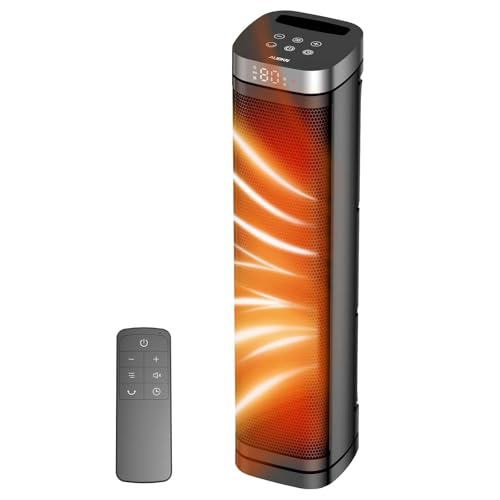
AUBKN X-Large 24-Inch 1500W Tower Heater with ECO, Timer and Remote
24 in tower70° sweepECO mode1-12 hr timer
Check price on Amazon
Best for: Budget sunroom heating with a timer and remote.

A feature-rich tower for the money, the AUBKN lists a 24 inch body, 1500W ceramic heat, a thermostat, 70 degree oscillation, ECO modes, a remote and a 1 to 12 hour timer. On paper it matches heaters that cost noticeably more.

In a sunroom, the timer and ECO mode are the useful features: you can pre-warm the room before you sit down and let the heater trim its output once the sun has done its share. The sweep spreads warmth along a seating area. It does not publish a noise figure or a dual-motor design, so expect it to be less refined than the DREO tower.

Place it out of direct sun and away from the glass edge, where drafts will confuse its sensor. Vacuum the intake each month. Beside the DREO tower, it has more modes and less documentation. Choose it as the budget way to add a fan heater to a sunroom. A light-coloured room reflects sun onto a dark cabinet, so watch the casing temperature in the afternoon and move it into shade if it feels hot to the touch. The remote is worth keeping on a table beside the sofa.

What works

  • Thermostat, ECO modes and remote
  • 1 to 12 hour timer
  • 70 degree oscillation spreads warmth
  • 24 inch tower stands beside a sofa

Watch out for

  • No published noise figure
  • Sensor can be confused by drafts from glass

Spec sheet

Height
24 inches
Power
1500W ceramic
Sweep
70 degrees
Timer
1 to 12 hours
Control
Thermostat, ECO and remote
05
VEVOR 1500W Greenhouse Heater with Fan, Low/High Modes and 40° Adjustable Angle
1500W PTCFanLow/high modes40° angle
Check price on Amazon
Best for: Sunrooms that double as plant rooms or potting spaces.

A greenhouse heater is a reasonable fit for a sunroom full of plants. The VEVOR lists 1500W PTC heating with a fan, low and high heat modes, a 40 degree adjustable angle and overheat protection, and it is marketed for damp greenhouses as well as workspaces.

The adjustable angle lets you aim the airflow along a bench or a row of pots, and the fan keeps air moving, which helps in a damp space where still air breeds mould. The listing mentions circulation as a benefit. It is a utilitarian body, not a living-room one.

Plants do not like a hot blast, so aim the stream past them and not at them. Keep the unit off damp tile and check that its rating matches your conditions before relying on it. Beside the DREO tower, it is less polished. Best for a sunroom that doubles as a plant room. Spend an evening with a thermometer at plant height to see the real temperature there, because the air at a window sill can be several degrees colder than the air in the middle of the room. Do not let water from watering cans or misters reach the cabinet or the cord.

What works

  • Fan keeps air moving in a damp room
  • 40 degree angle aims along benches
  • Low and high heat modes
  • Overheat protection listed

Watch out for

  • Utilitarian body is not for a living space
  • Hot airflow can scorch plants it points at

Spec sheet

Power
1500W PTC
Modes
Low heat and high heat, plus fan
Angle
40 degrees adjustable
Safety
Overheat protection
Target
Greenhouses and workspaces
06
DREO Atom One 1500W Heater with 70° Sweep, ECO, Remote and 12H Timer
1500W PTC70° sweepECO mode12H timer
Check price on Amazon
Best for: Sunrooms that are warm by day and cold at night.

Sunrooms swing from warm afternoon sun to a cold night, and the Atom One's ECO mode is designed for that kind of change. The listing says it adjusts the heat level automatically, alongside a 70 degree oscillation, a remote, a 12 hour timer and a Shield360 protection set.

An automatic mode helps because the room's own temperature changes while you sit in it. In the afternoon the heater idles, and as the light fades it works harder. The remote means you do not have to cross a cold tile floor to change the setting.

A fan heater cools the room quickly when it stops, so it is not a stored-heat design. Place it where the sweep covers the seating, and keep it away from the glass. Beside the PELONIS, it is faster and noisier. It suits a sunroom where the sun does half the work. Set the timer to bridge the gap between sunset and bedtime so the heater is not left running long after you have gone inside. When the room is empty, switch it off at the wall, since a heater that idles in a glass room all night has little to heat.

What works

  • ECO mode adapts to the room's swings
  • Remote avoids crossing cold tile
  • 70 degree sweep along the seating
  • 12 hour timer

Watch out for

  • Stores no heat after it stops
  • Fan noise is audible in a quiet room

Spec sheet

Element
1500W Hyperamics PTC
Sweep
70 degrees
Mode
ECO, auto power
Timer
12 hours
Safety
Shield360 protection

Spec sheet decoder

What the numbers on the box really mean

The specs manufacturers lead with, translated into what they tell you about real-world performance.

Oil-filled thermal mass

Oil in the radiator stores heat and releases it slowly after the element stops.

Watch forOnly the PELONIS here is oil-filled.

Infrared quartz

A glowing tube emitting infrared that warms objects directly.

Watch forThe DR-968 pairs it with PTC.

Coverage claim

The floor area a maker says the heater can warm. It assumes insulation.

Watch forA glass-walled room will fall short of the DR-968's 1000 square feet.

Adjustable angle

A tilting head that aims the airflow.

Watch forThe VEVOR lists 40 degrees.

ECO mode

An automatic setting that adjusts output to hold a target.

Watch forThe AUBKN and Atom One list it.

Methodology

How We Evaluated These Space Heaters for Sunrooms

Handling of glass loss

We favoured heaters that cope with heat lost through windows. The PELONIS stores heat and the DR-968 warms people directly.

Coverage realism

We treated each coverage claim as a ceiling and assumed single-glazed glass would reduce it. We noted which heaters are best as zone heaters.

Plant and damp suitability

We read for fans, angle adjustment and damp-room marketing. The VEVOR is the only one aimed at greenhouses.

Controls for swings

We looked at ECO modes, timers and remotes. The Atom One and AUBKN led on automatic adjustment.

Noise

We compared stated noise levels. The DREO tower lists 25dB and the PELONIS is fanless.

Decision guide

How to Choose the Right Space Heaters for Sunrooms

By How You Use the Sunroom

UsePickWhy
Evening reading and TVPELONIS Oil-Filled RadiatorStored heat after the element stops
Morning coffeeDREO 25-Inch Tower HeaterFast, quiet warm-up
Sofa and chairsDr. Infrared DR-968Radiant warmth on people
Plants and pottingVEVOR Greenhouse HeaterFan and adjustable angle
Warm days, cold nightsDREO Atom OneECO mode adapts

By Budget

TierPickWhy
Lowest hereAUBKN 24-Inch Tower HeaterFull features for the money
Low to midVEVOR Greenhouse HeaterUtilitarian and plant-friendly
MidPELONIS Oil-Filled RadiatorSilent stored heat
UpperDr. Infrared DR-968Dual-element radiant heat

Oil-Filled vs Fan Heater

Oil-filled

The PELONIS stores heat and releases it slowly, which suits a glass room at night. It is silent but slow and heavy.

Fan heater

The DREO tower, AUBKN, Atom One and VEVOR warm fast and stop when switched off. They suit short sessions and are quicker to move.

Pick oil for evenings; pick a fan heater for short morning sessions.

Radiant vs Air Heating

PreferencePickWhy
Warm people, not airDr. Infrared DR-968Infrared quartz
Warm the whole zoneDREO 25-Inch Tower Heater11.5 ft/s airflow
Hold heat after cycling offPELONIS Oil-Filled RadiatorOil thermal mass
Circulate damp airVEVOR Greenhouse HeaterFan and low/high modes

For Plant-Filled Sunrooms Specifically

Look for

A fan to move damp air, an angle you can aim past leaves and a heater you can keep off wet tile. Never point hot air at foliage.

In this comparison

The VEVOR is built for it, with a 40 degree angle and a fan. The PELONIS suits plants too, since it blows no air at all.

When to Spend More

Spend more if

You use the room every evening. The PELONIS or DR-968 repays the cost with comfort that a basic fan cannot provide.

Save if

You use the room occasionally. The AUBKN is enough.

Ownership

Maintenance schedule

The upkeep that decides whether this machine lasts two seasons or ten.

TaskIntervalWhy it matters
Dust the fins or grilleMonthly in seasonSunrooms collect dust and pollen. A clogged grille or dusty fins reduce output.
Check the base for dampEach autumnCondensation can pool on tile. Keep the heater on a dry platform.
Wipe the quartz tube coldEach seasonDust on the DR-968 tube burns off with a smell. Wipe it when cool.
Check the plugEvery few weeksA warm plug is a warning sign. Never use an extension cord.
Inspect castors on the radiatorEach autumnStiff castors make a heavy radiator awkward to move on tile.

FAQ

Frequently Asked Questions

Can a space heater warm a whole sunroom?

Not usually in winter. A 1500W heater covers about 150 square feet in an insulated room, and a glass room loses far more. Expect to warm a seating zone, and add a thick curtain or cellular blind across the glass at night to cut the loss. Those cost far less than extra watts and help every heater in this guide perform better.

Is an oil-filled radiator better for a sunroom?

It holds heat after the element stops, which suits evenings. It is slower to start. A fan heater suits short sessions.

Is infrared good for a sunroom?

It warms people directly, which helps where air is constantly cooled by glass. The DR-968 combines infrared and PTC.

Can I use a heater near plants?

Keep hot airflow away from leaves and avoid wet floors. A fan heater like the VEVOR can circulate damp air.

Why does my heater keep running?

A thermostat near a cold window reads low and keeps the heater on. Place it away from the glass in the middle of the room.

Do I need a dehumidifier too?

Possibly. A glass room collects condensation. A heater helps dry the air, but a dehumidifier may be needed in a damp room.

Bottom line

The short version

Browse more space heaters for sunroomson Amazon →
James Miller, Lead Machine Editor

About the author

James Miller

Lead Machine Editor, MachineFanatic

James Miller leads MachineFanatic's buying guides, turning spec sheets, manuals and owner feedback into clear verdicts on power tools, outdoor power equipment, shop machines and kitchen machines.

More from James →

Keep reading

Related guides