
Amazon affiliate links - we earn a commission.Affiliate disclosure

Buying guide · 13 min read · Updated 2026-11-14

Best Space Heaters for Workshops (2026)

Six workshop space heaters, from plug-in 1500W units to hardwired and propane designs, compared on output, dust tolerance and circuit needs for shop use.

James MillerBy James MillerLead Machine Editor6 machines comparedSpec-sheet verified
Best Space Heaters for Workshops

At a glance

Our top picks

Side by side

Spec comparison

A workshop asks more of a heater than a bedroom does. The space is large and poorly insulated, the floor is usually concrete, and the air carries dust, shavings and sometimes solvent vapour that a living-room heater was never designed for.

That changes the choice. Output, the electrical circuit behind it and how the heater tolerates dirt matter more than looks. This guide covers plug-in fan heaters, a hardwired ceiling unit and a propane forced-air heater, and says which kinds of shop each suits.

Before you buy

6 Criteria to Look For Before Buying a Space Heater for Workshops

  1. 01

    Circuit capacity first

    A 1500W plug-in heater draws 12.5 amps, which is most of a 15 amp circuit. Put a table saw on the same line and the breaker trips. The Dura Heat and DAHTEC both need a dedicated outlet. For more heat, you need 240V, as on the Comfort Zone 5000W or InoKraft 7500W.

  2. 02

    Dust and debris tolerance

    Sawdust is combustible and clogs fan intakes. A steel body like the Dura Heat and DAHTEC resists knocks but not dirt, so vacuum the grille often. Avoid placing any heater downwind of a sander or planer.

  3. 03

    Damp floors and splashes

    A concrete floor sweats and a hose can splash. The DAHTEC lists an IP24 rating, which covers splashing water, unlike plain indoor heaters. It is not waterproof, but it is a sensible extra for a basement shop.

  4. 04

    BTU versus floor area

    1500W gives 5,120 BTU, roughly 150 square feet in an insulated room. A leaky garage needs far more. The Comfort Zone 5000W gives about 17,000 BTU, and the InoKraft about 25,600. Match output to the space and insulation, not the sticker coverage.

  5. 05

    Flame versus element

    Propane heaters like the Remington burn fuel and need ventilation. Electric elements do not use oxygen but still get hot enough to ignite dust. Keep shavings, rags and solvent cans clear of any heater.

  6. 06

    Mounting and aim

    A ceiling mount, as on the Comfort Zone 5000W and InoKraft, frees the floor but needs a downward airflow. A stand-mounted unit like the Dura Heat can be aimed at a bench. Choose based on whether you stand in one place or move around.

Detailed reviews

The 6 best space heaters for workshops, explained

01
Dura Heat EUH1500 5,120 BTU Forced-Air Workspace Heater, Steel Body
5,120 BTUSteel bodyThermostat250 sq ft
Check price on Amazon
Best for: Single-car workshops and basement shops that run on a standard outlet.

A steel body and an adjustable stand mark the Dura Heat as a tool, not a living-room appliance. The listing gives 5,120 BTU, the figure for a 1500W electric element, a coverage claim of up to 250 square feet, a built-in thermostat and an overheat shut-off. The stand lets you aim the airflow at a bench or at your feet.

Steel is the right material for a shop, where a plastic cabinet would crack or warp near a hot surface. A forced-air design moves warm air in a stream, which helps in a cold concrete room where radiant heat is absorbed by the floor. The coverage claim is generous for an uninsulated garage, so treat it as a figure for a well-sealed 250 square foot room.

Keep the intake clear of sawdust, and vacuum it before each season. Because it plugs into a standard outlet, it needs a dedicated 15 amp circuit, and a shop with a table saw on the same line will trip a breaker. Against the DAHTEC, which adds an IP24 rating, the Dura Heat is the simpler steel workhorse. Stand it on a bench or a sturdy box at about knee height and angle the airflow across your working area, never into a pile of offcuts. Switch it off and let it cool before you sweep or blow down the shop.

What works

  • Steel body shrugs off shop knocks
  • Adjustable stand aims the airflow
  • Built-in thermostat and overheat shut-off
  • Plugs into an ordinary outlet

Watch out for

  • 1500W class struggles in an uninsulated large shop
  • Needs its own circuit away from power tools

Spec sheet

Output
5,120 BTU, 1500W class
Body
Steel
Coverage claim
Up to 250 sq ft
Control
Built-in thermostat
Mount
Adjustable stand
02
DAHTEC 5120 BTU Portable Fan Heater, 1500W, IP24 Damp-Rated, Steel Body
5120 BTUIP24 damp-ratedTilts 45-60°ETL
Check price on Amazon
Best for: Damp basements and garages where splashes are likely.

IP24 is the figure that sets the DAHTEC apart: a rating that describes protection against splashing water from any direction. For a shop with a damp concrete floor, a wet basement or a bench near a hose, that is a more relevant spec than another extra heat step. The listing also states ETL certification and 5120 BTU of fan-forced heat.

The steel body tilts 45 to 60 degrees and holds the angle, so you can aim it like a tool. It offers high or low heat and a circulate mode that moves air without heat, which is useful for spreading warmth already in the room. IP24 does not make it waterproof, and it is not a licence to place it in a puddle.

Ownership means blowing sawdust out of the grille and checking the cord for nicks from a rolling cart. Like the Dura Heat, it draws 1500W, so keep it on a dedicated outlet. Choose it over the Dura Heat when the floor or the air is damp. The circulate mode deserves more credit than it gets in a shop, because warm air collects near the ceiling and a gentle stir brings it back down to bench height. Run it that way after the room has warmed, and you will use less heat to hold the same comfort.

What works

  • IP24 damp rating listed
  • ETL certified
  • Steel body tilts 45 to 60 degrees
  • Circulate mode moves air without heat

Watch out for

  • Same 1500W limit as other plug-in units
  • Damp-rated is not waterproof

Spec sheet

Output
5120 BTU, 1500W
Rating
IP24 damp-rated
Certification
ETL listed
Body
Steel, tilts 45 to 60 degrees
Modes
High, low and circulate
03
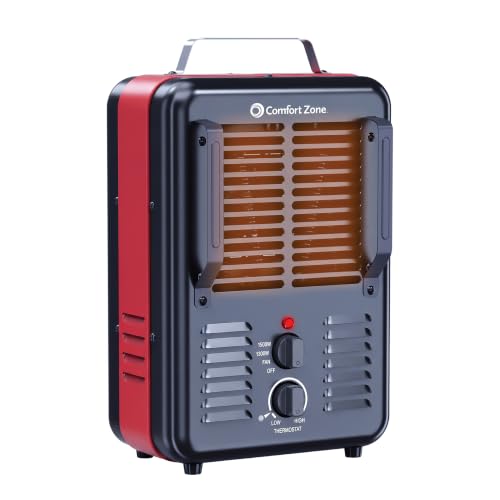
Comfort Zone Milkhouse Utility Heater with Thermostat, 2 Heat Settings and Fan
Milkhouse style2 heat settingsFan onlyMetal housing
Check price on Amazon
Best for: Bench areas, sheds and small shops where toughness counts.

Milkhouse heaters began life warming dairy sheds, and the shape survives because it works: a rugged metal box with a carry handle and a simple dial. This Comfort Zone version has two heat settings, a fan-only mode and a thermostat, in a metal housing built for rough treatment.

The design suits a bench or a small shed more than a whole shop. It does not have the adjustable aim of the Dura Heat or the damp rating of the DAHTEC, but it is the easiest to throw in a truck and plug in. The two heat settings let you balance output against the circuit, and the fan-only mode keeps air moving in summer.

Maintenance is minimal: knock out dust, check the cord and keep the dial clear of grease. It is the lowest-cost route to a thermostat in a working space. Pick it for a bench you stand at for an hour, not a shop you heat for a day. Put it on a bench or a metal shelf instead of the floor, where it will suck up shavings, and keep the cord out of the path of a rolling cart. Because the dial is mechanical, expect the temperature to wander a few degrees.

What works

  • Metal housing takes knocks
  • Thermostat and two heat settings
  • Fan-only mode for summer
  • Easy to carry and stow

Watch out for

  • Fixed aim, no tilting stand
  • Too small to heat a large shop

Spec sheet

Style
Traditional milkhouse utility
Housing
Durable metal
Heat settings
Two, plus fan only
Control
Adjustable thermostat
Use
Bench, shed or small shop
04
Comfort Zone 5000W 240V Ceiling-Mount Garage Heater, 3 Heat Settings
5000W max240V hardwiredCeiling mount3 heat steps
Check price on Amazon
Best for: Dedicated shops where the owner can run a 240V circuit.

Moving up to 240V hardwired changes what a workshop heater can do. This Comfort Zone offers 3,000W, 4,000W and 5,000W steps, which is more than three times a plug-in unit, and it mounts to the ceiling so floor space stays free for tools. The listing states that it needs a hardwired connection.

At 5,000W the conversion is roughly 17,000 BTU an hour, enough to meaningfully warm a two-car shop where a plug-in struggles. The cost is installation: it needs a 240V circuit and proper wiring, and that is a job for a licensed electrician. A ceiling mount puts hot air near the ceiling, where heat naturally rises, so a fan-forced design that pushes it down is essential.

Once installed, it is maintenance-light: vacuum the grille and check the mounting hardware each year. Keep wood dust from building up on top of it. Choose it when you own the shop and plan to heat it every winter. Ask the electrician about a wall switch or a thermostat on the line, since a heater of this size with no off switch within reach invites a forgotten, humming night. Keep the clearances in the manual between the unit, the ceiling and any stored lumber above it.

What works

  • Three steps up to 5,000W
  • Ceiling mount frees floor space
  • Fan-forced commercial design
  • Far more output than a plug-in unit

Watch out for

  • Needs a hardwired 240V installation
  • Not portable

Spec sheet

Output
3,000W, 4,000W or 5,000W
Voltage
240V hardwired
Mount
Ceiling
Type
Fan-forced commercial heater
Installation
Needs a hardwired electrical connection
05
InoKraft 7500W 240V Ceiling-Mount Garage Heater with Remote and NEMA 14-50P Plug
7500WNEMA 14-50P plugRemoteDigital thermostat
Check price on Amazon
Best for: Large shops that already have a 14-50 receptacle.

A NEMA 14-50P plug is the interesting detail on the InoKraft: it is the plug used by electric ranges and many EV charger outlets, so a shop that already has such a receptacle can use this heater without hardwiring. At 7,500W it is the most powerful heater in this guide, with a remote, a digital thermostat and an ECO mode.

Power is the whole story. 7,500W works out to about 25,600 BTU an hour, which suits a larger or leakier shop. The catch is that the outlet must be on a circuit rated for it, so confirm the breaker and wiring before you buy rather than after.

A remote on a ceiling-mounted unit is the practical touch, because you cannot reach the panel from the floor. Check the mount annually and keep dust off the housing. It is the right pick for a large shop with an existing 14-50 outlet. If that outlet currently feeds a welder or a charger, remember that both cannot run together, so decide which one owns the circuit. Mount it above the work zone with a clear metre of space around the front.

What works

  • 7,500W is the most output here
  • Plugs into a 14-50 receptacle
  • Remote reaches a ceiling-mounted unit
  • Digital thermostat and ECO mode

Watch out for

  • Needs a suitable 240V circuit
  • Overkill for a small bench area

Spec sheet

Output
7,500W
Voltage
240V
Plug
NEMA 14-50P
Control
Remote with digital thermostat
Mode
ECO
06
Remington 60,000 BTU LP Portable Forced-Air Propane Heater, Electric Ignition
60,000 BTUPropaneForced airElectric ignition
Check price on Amazon
Best for: Large, ventilated barns and garages with no dust or vapour hazard.

Sixty thousand BTU is nearly twelve times the output of a 1500W electric heater, and the Remington gets there by burning propane. The listing describes a lightweight portable forced-air design with electric ignition for garages, barns and workshops. It is the heater for a space you cannot warm electrically.

Open-flame heating has rules that electric does not. It consumes oxygen and gives off combustion products, so the space needs ventilation, and the fuel is incompatible with flammable vapours from solvents and finishes. Sawdust and flame are also a poor mix. If your shop is dusty or you spray finish, an electric heater is the safer answer.

Ownership means managing propane cylinders and hoses, checking connections for leaks and storing cylinders outdoors. For a large barn or a half-empty garage where ventilation is easy, it is the only choice here with enough punch. Point it away from walls, doors and anything that can melt, and keep the cylinder well away from the hot exhaust side. Never leave it running unattended in a closed space, and never move it while it is hot.

What works

  • 60,000 BTU heats a very large space
  • Electric ignition avoids a match
  • Portable and lightweight
  • Runs without a high-amp circuit

Watch out for

  • Open flame is unsuited to dusty shops
  • Needs ventilation and propane handling

Spec sheet

Output
60,000 BTU
Fuel
Liquid propane
Type
Portable forced-air
Ignition
Electric
Use
Garages, barns, workshops

Spec sheet decoder

What the numbers on the box really mean

The specs manufacturers lead with, translated into what they tell you about real-world performance.

BTU per hour

A measure of heat output. 1 watt equals about 3.412 BTU an hour.

Watch forThe Dura Heat and DAHTEC list 5,120 BTU, and the Remington lists 60,000.

IP24

An ingress rating that covers splashing water and objects larger than 12 mm. It is not waterproof.

Watch forOnly the DAHTEC lists it.

240V hardwired

A connection direct to a 240V circuit without a plug. It needs an electrician.

Watch forThe Comfort Zone 5000W requires it.

NEMA 14-50P

A four-prong 50 amp plug used by ranges and EV chargers.

Watch forThe InoKraft ships with this plug.

Forced air

A fan pushes warmed air out of the heater in a stream. It heats quickly but moves dust.

Watch forAll six use a fan.

Methodology

How We Evaluated These Space Heaters for Workshops

Electrical fit

We looked at circuit demands first. The Dura Heat and DAHTEC run on a standard outlet, the Comfort Zone 5000W is hardwired and the InoKraft uses a 14-50 plug.

Shop hardiness

We read body material, damp rating and certification. The steel bodies, the DAHTEC's IP24 and ETL listing scored highest.

Output versus space

We converted watts to BTU and matched it to likely shops. 1500W suits a bench, 5000W a two-car garage and 7500W a large shop.

Safety around dust

We weighed open flame against elements, and noted overheat shutoffs on the electric models. The propane unit scored lower for dusty shops.

Ease of use

We noted thermostats, remotes and stands. The InoKraft remote and the Dura Heat stand were the standout conveniences.

Decision guide

How to Choose the Right Space Heaters for Workshops

By Shop Size

ShopPickWhy
Bench or shedComfort Zone Milkhouse HeaterRugged and portable with a thermostat
Single-car shopDura Heat EUH15005,120 BTU on a standard outlet
Damp basement shopDAHTEC 5120 BTU HeaterIP24 damp rating
Two-car shop with 240VComfort Zone 5000W Ceiling HeaterUp to 5,000W from the ceiling
Large shop with a 14-50 outletInoKraft 7500W Garage Heater7,500W with remote
Large ventilated barnRemington 60,000 BTU Propane HeaterHighest output, open flame

By Budget

TierPickWhy
Lowest hereComfort Zone Milkhouse HeaterSimple bench heater
Low to midDura Heat EUH1500Steel plug-in workhorse
MidDAHTEC 5120 BTU HeaterDamp rating and ETL
UpperInoKraft 7500W Garage HeaterHigh output with remote

Plug-In vs Hardwired 240V

Plug-in 120V

The Dura Heat, DAHTEC and milkhouse heater go anywhere there is an outlet, but are capped near 1500W. They suit benches and small shops.

240V

The Comfort Zone 5000W and InoKraft 7500W deliver three to five times the heat. They need a suitable circuit, and the first requires hardwiring.

Pick 120V for a bench; pick 240V for a whole shop you heat every winter.

Electric vs Propane

PreferencePickWhy
No flame near dustDura Heat EUH1500Electric element with overheat shutoff
Maximum heat, ventilated spaceRemington 60,000 BTU Propane HeaterHighest output
No combustion productsInoKraft 7500W Garage HeaterElectric with remote
Damp conditionsDAHTEC 5120 BTU HeaterIP24 rating

For Woodworking Shops Specifically

Look for

An electric element, a steel body, an overheat shutoff and a position away from sanding dust. Never use solvents near any heater.

In this comparison

The Dura Heat is the best fit for a small shop, and the Comfort Zone 5000W suits a large one. Avoid the propane unit where fine dust hangs in the air.

When to Spend More

Spend more if

You heat the shop every winter and the space is large. The 240V units repay the installation with real output.

Save if

You work at one bench for an hour. The milkhouse heater is enough.

Ownership

Maintenance schedule

The upkeep that decides whether this machine lasts two seasons or ten.

TaskIntervalWhy it matters
Blow out the grilleBefore each season and monthly in useSawdust builds on the intake and is combustible. Compressed air or a vacuum clears it.
Inspect the cordEvery monthShop cords get nicked by carts and tools. A damaged cord is a fire risk.
Check mounting hardwareEach autumnCeiling units vibrate over time. Tighten brackets and check clearance.
Check the circuitEach autumnA heater that trips a breaker is a sign of overload. Do not swap in a bigger breaker.
Inspect propane connectionsEach useCheck hoses and fittings for leaks with soapy water on the Remington.

FAQ

Frequently Asked Questions

How much heater does a workshop need?

It depends on insulation and size. A 1500W heater covers about 150 square feet if the room is sealed. A two-car garage usually needs 5,000W or more.

Can I run a space heater and a table saw on the same circuit?

Usually not. A 1500W heater uses most of a 15 amp circuit. Use a dedicated outlet for the heater.

Is a propane heater safe in a workshop?

Only with good ventilation and no flammable dust or vapour. Open flames and sawdust or solvents are a dangerous combination.

Do I need an IP rating?

Not for a dry shop, but a damp basement benefits. The DAHTEC lists IP24, which covers splashing.

Can I hardwire a heater myself?

Hardwired 240V work should be done by a licensed electrician. A plug-in 240V unit like the InoKraft still needs a suitable outlet.

Where should I mount a ceiling heater?

Follow the clearances in the manual. Mount it where the airflow reaches you and away from dust sources and combustible materials.

Bottom line

The short version

Browse more space heaters for workshopson Amazon →
James Miller, Lead Machine Editor

About the author

James Miller

Lead Machine Editor, MachineFanatic

James Miller leads MachineFanatic's buying guides, turning spec sheets, manuals and owner feedback into clear verdicts on power tools, outdoor power equipment, shop machines and kitchen machines.

More from James →

Keep reading

Related guides