
Amazon affiliate links - we earn a commission.Affiliate disclosure

Buying guide · 11 min read · Updated 2026-11-14

Best Space Heaters with Timer (2026)

Five ceramic space heaters with a built-in timer, compared on timer range, thermostat control and remotes so you can heat a room and let it switch itself off.

James MillerBy James MillerLead Machine Editor5 machines comparedSpec-sheet verified
Best Space Heaters with Timer

At a glance

Our top picks

Side by side

Spec comparison

A timer turns a space heater from something you must remember into something that looks after itself. It shuts the element off after a set number of hours, which matters most at bedtime, before leaving the house and in rooms you rarely visit.

Not every timer works the same way. Some count down to off, some pair with a thermostat so the heater cycles until the clock runs out, and a few hide the setting behind a remote. This guide compares how each one is actually controlled.

Before you buy

6 Criteria to Look For Before Buying a Space Heater with Timer

  1. 01

    Countdown versus clock timers

    Most timers on household heaters are countdowns: you set the hours and the heater turns off when they expire. A few offer clock scheduling, which is what a weekly routine needs. The DREO, VOCRS, WINHL and AUBKN all list a 12 hour range. If you want the heater to start at 5 a.m. every weekday, none of these will do it; look at a smart wall heater instead.

  2. 02

    Thermostat beside the clock

    A timer controls how long the heater runs; a thermostat controls how hard. The DREO uses an NTC sensor, and the JIBUFI adds an ECO mode, so both cycle the element during a 12 hour session. A timer on a heater with no thermostat will run flat out until the clock expires, which wastes electricity and dries the air.

  3. 03

    Remote or panel for the timer

    The timer is the setting you change most. The VOCRS, WINHL and JIBUFI put it on the remote, so a change from bed takes seconds. The DREO keeps it on the panel, which is simpler but means reaching the unit. Decide based on where the heater sits relative to where you rest.

  4. 04

    Power steps for long runs

    For an overnight session you rarely need 1500W. The VOCRS and JIBUFI offer 700W and 1000W steps, which draw roughly half to two thirds of the top step, and they leave room on the circuit for a lamp or a phone charger. A heater with only high and low makes you pick too much or too little.

  5. 05

    Noise during a 12 hour run

    A timer is mostly used at night, so fan noise matters more than on a daytime heater. The DREO lists 34dB. Others do not publish a figure, so assume they are louder than that. A listed decibel number is a better signal than the word quiet.

  6. 06

    Placement while unattended

    A timer lets you leave a heater running after you fall asleep, but the clearance rules still apply: 3 feet from bedding and curtains, plugged straight into the wall and standing on a hard, flat surface. Oscillating models like the WINHL sweep 70 degrees, so check what that sweep reaches before bed.

Detailed reviews

The 5 best space heaters with timer, explained

01
DREO 2026 Upgraded Ceramic Heater with 12H Timer and NTC Thermostat
1500W Hyperamics12H timer34dBNTC sensor
Check price on Amazon
Best for: Bedrooms where steady temperature and a quiet fan matter most.

What separates this DREO from the other timer heaters is the sensor behind the clock. An NTC chipset reads room temperature and lets the thermostat hold a target instead of blasting until the timer expires, so a 12 hour run is a series of short cycles rather than a long burn. The Hyperamics 1500W ceramic element heats quickly and the fan is rated at 34dB, a level you can sleep through.

The pairing is the point. A timer alone only decides when the heater stops; the thermostat decides how hard it works until then, which is what keeps the bill and the dry air in check. On the downside, the remote-free panel makes you reach the unit to set the clock, and a 12 hour ceiling is shorter than the full night plus the morning warm-up some people want.

Ownership is easy: wipe the intake monthly and replace the plug if it ever feels warm. Next to the WINHL, which adds a remote and 70 degree oscillation, the DREO keeps things simpler and quieter, and it is the one to buy if you value steady temperature over a wide throw.

What works

  • NTC sensor holds a target instead of running flat out
  • Timer runs up to 12 hours
  • Listed 34dB suits a sleeping room
  • Quick-warming Hyperamics ceramic element

Watch out for

  • Panel-only control means walking over to set the clock
  • No oscillation to spread the warmth

Spec sheet

Element
1500W Hyperamics PTC
Timer
Up to 12 hours
Noise
Listed 34dB
Sensor
NTC chipset thermostat
Standards
Overheat and tip-over cutouts
02
VOCRS 1500W PTC Heater with 1-12 Hour Timer, Remote and Thermostat
700/1000/1500W1-12 hr timerRemoteThermostat
Check price on Amazon
Best for: Spare rooms and offices that need a cheap, remote-friendly timer.

Three steps, 700W, 1000W and 1500W, give the VOCRS a finer ladder than the two or three coarse settings on most ceramic units. That matters for a timer heater, because you can pick the lowest power that holds a room and let the clock end the session. The listing quotes a 1 to 12 hour timer and a remote that adjusts temperature and modes.

The remote is where this model earns its place, since the timer is the setting you change most often and the one most buried in menus on other brands. The trade-offs are the usual ones for a budget ceramic: the plastic cabinet is simply moulded and the exact noise figure is not given, so a very light sleeper may want the DREO.

Treat the 700W step as the normal night setting, around half of what the 1500W step draws from the wall, and reserve the top step for a cold start. Keep the remote battery fresh and check the plug monthly. For a guest room it is the sensible default; for a nursery, the DREO is quieter.

What works

  • Three power steps from 700W up to 1500W
  • Remote reaches the timer from bed
  • Timer spans 1 to 12 hours
  • Built-in thermostat sits alongside it

Watch out for

  • Noise level is not stated on the listing
  • Plain moulded cabinet feels basic

Spec sheet

Power steps
700W, 1000W, 1500W
Timer
1 to 12 hours
Control
Remote plus panel
Element
PTC ceramic
Thermostat
Built in
03
WINHL 1500W PTC Heater with 70° Oscillation, Remote and 12H Timer
1500W PTC70° sweep12H timerRemote
Check price on Amazon
Best for: Living rooms and bedrooms where warmth should reach a seating area.

Where the VOCRS aims at a single spot, the WINHL sweeps warm air through 70 degrees and pairs that with a 12 hour timer. The listing says the 1500W PTC element starts blowing warm air within seconds, and the remote handles temperature, heating modes and the clock. The effect is a heater that covers a corner of a living room and shuts itself off.

Oscillation has a cost: the moving head is another part to wear, and it sprays heat across furniture that a fixed unit would miss. Check where the airflow lands before you leave the timer running, because 70 degrees of sweep can take in a couch cushion or a stack of papers.

For year three, dust the louvres, since the sweeping mechanism collects lint. Against the JIBUFI with its ECO mode, the WINHL has a plainer set of settings but a clearer remote. It is the right pick when the room has a seating area rather than a single chair.

What works

  • 70 degree oscillation spreads the heat
  • 12 hour timer on the remote
  • Warm air within seconds of starting
  • Thermostat and modes on the same remote

Watch out for

  • Moving head collects lint over time
  • Sweep can reach furniture you want clear

Spec sheet

Element
1500W PTC ceramic
Oscillation
70 degrees
Timer
12 hours
Control
Remote with thermostat
Start-up
Warm air within seconds
04
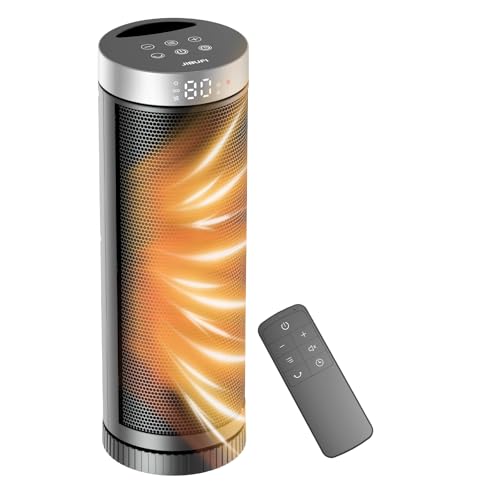
JIBUFI 17-Inch Heater with ECO Mode, Timer, Remote and 70° Sweep
17 in tallECO modeTimer70° sweep
Check price on Amazon
Best for: People who want the heater to pick its own power step before the timer ends.

The JIBUFI stands 17 inches tall and the ECO mode is its distinguishing feature. In ECO the heater picks the power step itself to reach your target temperature, so a timer session becomes an automatic taper instead of a fixed burn. The listing describes a built-in intelligent thermostat, three power levels of 700W, 1000W and 1500W and a timer function.

The design favours people who set it once and walk away. The downside of any ECO mode is that it chooses for you, so on a bitter morning it may run a lower step longer than you would like. Move to a fixed 1500W when you want a quick warm-up.

As a 17 inch tower it takes less floor than a wide fan unit, though that height also makes it easier to nudge than the flatter VOCRS. Clean the back mesh every month and keep it off thick rugs. Choose it if automatic power selection appeals; choose the WINHL for a bigger oscillating sweep.

What works

  • ECO mode tapers power automatically
  • Three steps from 700W to 1500W
  • Slim 17 inch body takes little floor
  • Remote and thermostat included

Watch out for

  • ECO mode can run lower than you want on cold mornings
  • Tall body is easier to knock over

Spec sheet

Power steps
700W, 1000W, 1500W
Height
17 inches
Timer
Built in, 12H listed
Oscillation
70 degrees
Extras
ECO mode, remote
05
AUBKN Digital Ceramic Heater with 12H Timer, 5 Modes and Remote
Digital display12H timer5 modesRemote
Check price on Amazon
Best for: Offices and living rooms where you want to read the timer at a glance.

A digital display is the AUBKN's selling point: the listing shows five modes, three heating settings, a built-in thermostat and a 12 hour timer all read out on a screen. When a timer is running you want to see the remaining hours and the target temperature at a glance, and a readout does that better than a row of dim indicator lights.

That extra clarity comes with more buttons. Five modes means a short learning curve before the remote makes sense, and the screen's brightness can be annoying in a dark bedroom if it cannot be dimmed. Check the listing for a display-off option before you rely on it overnight.

Ownership is routine: wipe the screen, vacuum the grille and keep the remote in the same spot. Set against the DREO at 34dB, its noise is less documented, so treat the AUBKN as a living-room and office heater first and a bedroom unit second.

What works

  • Digital readout shows timer and target
  • Five modes on a single remote
  • 12 hour timer with built-in thermostat
  • Straightforward ceramic heating

Watch out for

  • Bright display may bother a dark bedroom
  • More modes means a longer learning curve

Spec sheet

Heat levels
Three heating settings
Timer
12 hours
Modes
Five listed
Display
Digital readout
Control
Remote and thermostat

Spec sheet decoder

What the numbers on the box really mean

The specs manufacturers lead with, translated into what they tell you about real-world performance.

Timer range

The longest duration you can set before the heater shuts off. A 12 hour ceiling covers a night but not a full day.

Watch forThe DREO, WINHL and AUBKN list 12 hours; the VOCRS lists 1 to 12.

NTC sensor

A temperature sensor that lets a digital thermostat read the room. It makes cycling more accurate than a mechanical dial.

Watch forOnly the DREO names the NTC chipset.

ECO mode

An automatic setting that chooses a power step to hold the target. It reduces overshoot at the cost of manual control.

Watch forThe JIBUFI is the one here that highlights it.

Oscillation

A sweeping head that spreads warm air through an arc. It improves coverage but adds a moving part.

Watch forThe WINHL and JIBUFI list 70 degrees; the DREO and VOCRS do not oscillate.

Power steps

Fixed output stages, such as 700W, 1000W and 1500W. More steps mean finer control over draw.

Watch forThe VOCRS and JIBUFI offer the three-step ladder.

Methodology

How We Evaluated These Space Heaters with Timer

Timer range and reach

We read the timer range from each listing and whether it can be set from the remote. The DREO, WINHL and AUBKN reach 12 hours, and the VOCRS spans 1 to 12. Models that put the timer on the remote gained marks.

Thermostat pairing

A timer without a thermostat wastes power, so we looked for a sensor or ECO mode beside the clock. The DREO and JIBUFI scored highest here. We also noted which units use a digital sensor versus a plain dial.

Overnight fitness

We checked for a stated noise figure and a way to dim lights. The DREO at 34dB set the benchmark. Units without a figure received a cautious score.

Power ladder

We counted how many steps each heater offers. The VOCRS and JIBUFI give 700W, 1000W and 1500W, which matter for long, low-power sessions.

Coverage versus fuss

Oscillation adds range but also a moving part. We weighed the 70 degree sweep on the WINHL and JIBUFI against the fixed head on the DREO and VOCRS.

Decision guide

How to Choose the Right Space Heaters with Timer

By Where the Timer Will Be Used

SituationPickWhy
Bedroom overnightDREO 12H Timer Heater34dB and an NTC sensor hold a target quietly
Guest room or spare roomVOCRS 1-12 Hour HeaterRemote timer and a 700W low step at an easy price
Living room seating areaWINHL Oscillating Heater70 degree sweep and a 12 hour remote timer
Home officeAUBKN Digital HeaterReadout shows the timer at a glance
Narrow corner or hallwayJIBUFI 17-Inch HeaterSlim body and an ECO mode

By Budget

TierPickWhy
Lowest hereVOCRS 1-12 Hour HeaterTimer, remote and three power steps in a basic body
Low to midAUBKN Digital HeaterA digital display adds clarity without a premium tag
MidWINHL Oscillating HeaterOscillation and a remote timer broaden coverage
UpperDREO 12H Timer HeaterNTC thermostat and quiet running justify the step up

Remote Timer vs Panel Timer

Remote timer

The VOCRS, WINHL and JIBUFI let you change the clock from bed. That is what makes a timer used rather than ignored. A lost remote is the usual cost, and a dead battery means the panel buttons become the backup.

Panel timer

The DREO keeps its timer on the unit itself, which means fewer parts to lose and a cleaner interface. You set it once when you plug in at bedtime, then leave it for the night.

Pick remote models if you change the timer often; pick the DREO if you set it once and forget.

Fixed Head vs Oscillating Head

PreferencePickWhy
Quiet and aimed at one spotDREO 12H Timer HeaterFixed head, 34dB listed
Spread across a seating areaWINHL Oscillating Heater70 degree sweep
Narrow floor space, some sweepJIBUFI 17-Inch HeaterSlim tower with oscillation and ECO
Fixed aim and simple controlsVOCRS 1-12 Hour HeaterStraightforward remote and three steps

For Overnight Use Specifically

Look for

A listed noise level, a timer that ends the session after you are asleep, a thermostat that cycles the element and a body that stays stable on a hard floor. Keep the heater 3 feet from bedding.

In this comparison

The DREO is the strongest overnight choice with a 34dB rating and an NTC thermostat. The VOCRS is the budget alternative, using its 700W step as a gentle night setting.

When to Spend More

Spend more if

You will sleep with the heater running or share a bedroom with someone light-sleeping. The DREO's sensor and noise figure are worth the step up. You also spend more if you need the readout of the AUBKN to avoid waking up and squinting.

Save if

The heater lives in a spare room or office. The VOCRS covers the timer, remote and thermostat for the lowest cost here.

Ownership

Maintenance schedule

The upkeep that decides whether this machine lasts two seasons or ten.

TaskIntervalWhy it matters
Replace the remote batteryEach autumnThe remote holds the timer on most of these units. A dead coin cell leaves you with the panel buttons only.
Vacuum the intakeMonthly in seasonDust slows the fan and can trip the overheat cutout. A soft brush is enough.
Check the plugEvery few weeksA warm plug after an hour on high is a warning sign. An extension cord has no place in this setup; use the wall.
Wipe oscillation louvresEvery two monthsLint builds up around the sweeping head on the WINHL and JIBUFI and can slow the motor.
Test the timerStart of each seasonSet a short countdown and confirm the unit shuts off. A timer you never test may fail the night you rely on it.

FAQ

Frequently Asked Questions

Is a timer safer than just unplugging the heater?

A timer reduces the chance of leaving a heater running by accident, but it does not replace safe placement. Keep 3 feet of clearance and plug straight into the wall. Unplugging remains the surest way to stop a heater.

How long should I set the timer for overnight?

Many people set 4 to 8 hours and let a thermostat cycle the element. The DREO and JIBUFI both pair a timer with a thermostat, so a long session is a series of short cycles. Shorter is cheaper.

Does a timer save electricity?

Only if it stops the heater earlier than you would have. A 1500W heater draws 1.5 kWh each hour on high, so every hour you cut saves that amount. The thermostat saves more than the clock does.

Are 12 hour timers really clocks that schedule start times?

No. Most are countdowns to off. If you want the heater to start before you wake, you need a smart heater with scheduling, which is a different product category.

Which timer heater is quietest?

The DREO lists 34dB, the only stated noise figure in this guide. Others do not publish one, so assume they are louder. A fan-free oil radiator is quieter, but it has no oscillation.

Can I leave a timer heater on a power strip?

No. A 1500W heater uses nearly all of a 15 amp circuit, and strips and extension cords can overheat. Plug it directly into a wall outlet that is not shared with other high-draw devices.

Bottom line

The short version

Browse more space heaters with timeron Amazon →
James Miller, Lead Machine Editor

About the author

James Miller

Lead Machine Editor, MachineFanatic

James Miller leads MachineFanatic's buying guides, turning spec sheets, manuals and owner feedback into clear verdicts on power tools, outdoor power equipment, shop machines and kitchen machines.

More from James →

Keep reading

Related guides