
Amazon affiliate links - we earn a commission.Affiliate disclosure

Buying guide · 12 min read · Updated 2026-11-25

Best Steam Irons Under $30 (2026)

Three steam irons and travel steamers priced at or under $30, ranked by heat, steam and storage, with honest notes on what a cap this low cannot do.

James MillerBy James MillerLead Machine Editor3 machines comparedSpec-sheet verified
Best Steam Irons Under $30

At a glance

Our top picks

Side by side

Spec comparison

A steam iron at the bottom of the price range is a simple machine: a heating element, a small water tank, a stamped soleplate and a thermostat. What separates the good ones from the frustrating ones is how steadily the plate holds heat and whether the steam vents spit water instead of vapor.

Prices move daily, and the $30 cap here reflects Amazon listing prices when this guide was updated. A cap this low rules out boiler-style stations and heavy ceramic plates, so the honest question is which compromise suits your closet: a compact full iron, a cord-reel iron, or a pocket-size steamer.

Before you buy

6 Criteria to Look For Before Buying a Steam Iron Under $30

  1. 01

    Soleplate material and glide

    The plate is the part that touches the cloth, and its coating decides whether the iron glides or drags. Non-stick coatings, as on the Impress, feel smooth out of the box but scratch from zippers and metal buttons, while stainless or ceramic plates last longer and usually cost more. At this cap you will almost always get a coated aluminum or non-stick plate, so treat it as a consumable. A common mistake is ironing over a sticker or a plastic button, which melts onto the plate and leaves a rough patch that snags later.

  2. 02

    Wattage and steam recovery

    Wattage controls how fast the plate heats and how quickly it recovers after a steam burst. Full-size irons in this price band sit well below the 1700W stations in the upper tiers, so recovery is slower and steam fades when you press the burst button repeatedly. The Quuejenl travel unit is rated 1000W, which is enough for a small tank but not for sustained pressing. Do not buy on peak wattage alone: a high number on a tiny reservoir only means it empties sooner. If you want steam that lasts through a whole shirt, look one price tier up for irons rated above 1500W, since that is where output stops fading mid-sleeve.

  3. 03

    Tank size and refill habits

    A small tank forces a refill mid-session, and each refill means a cooldown, which costs minutes. The BLACK+DECKER reel iron has a typical household tank, while the travel steamer's reservoir is only a few ounces. Check that the fill opening is wide enough to pour from a cup without spilling, since a narrow port makes people overfill and leak. If you iron more than five items a time, tank size matters more than anything else on the spec sheet. A good habit is filling to the mark before you start, so the iron never runs dry in the middle of a sleeve and leaves a dry, scorched streak on delicate cotton.

  4. 04

    Cord handling and storage

    A short or stiff cord is the daily annoyance on a cheap iron. The BLACK+DECKER cord reel solves tangling but adds a spring that can jam, while the Impress uses a swivel cord that you wrap by hand. Look for a cord at least 6 feet long if the outlet is not next to your board. Avoid yanking the cord out sideways from a reel, because that bends the ratchet teeth and is the usual failure.

  5. 05

    Anti-drip and scale tolerance

    Spitting at low temperature happens when water leaves the vents before it flashes to steam. Anti-drip valves, found on the BLACK+DECKER, reduce this, but they clog with mineral scale if you use hard tap water. Hard water turns into white flakes that rust-stain pale shirts. Using distilled water or a half-and-half mix doubles the time between flushes on any iron in this lineup.

  6. 06

    Safety shutoff and handle comfort

    Auto shutoff protects you from a scorched board when you walk away, but it also makes an iron feel dead if you pause too long. Check that the handle clears your knuckles when you press a cuff, since cheap molds can be cramped. A heavy iron presses better, but over three pounds it tires wrists on a full basket. For occasional ironing, a lighter iron with a clear temperature dial is easier to live with than a heavy one with extra settings. Hold each candidate by the handle in your mind: the Impress is the lightest full plate, the BLACK+DECKER carries the extra reel hardware, and the Quuejenl fits one hand entirely, so wrist comfort is a real tiebreaker between them.

Detailed reviews

The 3 best steam irons under $30, explained

01
BLACK+DECKER Cord Reel Steam Iron with Anti-Drip
Cord reel storageBurst of steamVertical steamAnti-drip
Check price on Amazon
Best for: Households that iron a few shirts a week and want a normal iron without a tangled cord.

This is a conventional full-size iron with one design twist: a spring-loaded reel that pulls the cord back into the body. The soleplate, spray mist button and burst-of-steam button follow the layout every household iron uses, so there is no learning curve. Vertical steaming is included, which lets you knock creases out of a hanging blouse without laying it flat.

Measured against the Impress at the bottom of this cap, the extra money buys a larger water tank, a proper steam button and the reel. Next to the Quuejenl, it buys a real flat soleplate that can press a collar or a pleat, which no handheld steamer manages. The reel is the feature to judge honestly: it is a spring and a ratchet, which means it is also the most likely part to jam after a couple of years if the cord gets pulled out at an angle.

Daily care is simple. Fill the tank with distilled water if your tap water is hard, empty it after use and let the plate cool upright. Wind the reel in slowly with a hand on the cord so it does not snap into the housing and slap the plug against the case, a habit that cracks plugs well before the spring itself gives out. The anti-drip valve stops the spitting that cheap irons do at low heat, but only while the vents are clean, so run a descale flush every month or two. Treat the cord reel gently and this iron is a three to four year appliance, which is typical for this class.

What works

  • Real full-size soleplate for collars and pleats
  • Cord reel keeps the drawer tidy
  • Spray and burst buttons on the handle
  • Vertical steam works on hanging shirts

Watch out for

  • Reel mechanism can jam if yanked sideways
  • Steam output is modest next to a 1700W iron
  • Tank is small, so long sessions need refills

Spec sheet

Type
Full-size steam iron
Cord
Automatic retracting reel
Steam
Burst, spray, vertical
Drip control
Anti-drip valve
Best use
Weekly shirts and trousers
02
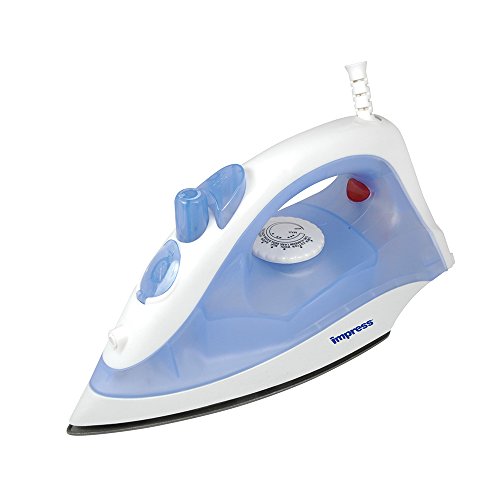
Impress Basic Non-Stick Clothing Iron with Spray
Non-stick plateAdjustable steamFabric selectorSwivel cord
Check price on Amazon
Best for: Students, guest rooms and anyone who irons only now and then.

The Impress is a no-frills compact iron: non-stick soleplate, a fabric selector dial, a steam control and a front spray nozzle. It sits at the very bottom of the price ladder in this lineup, and the design reflects that, with a plain plastic shell and a basic cord that swivels at the base. Nothing here is surprising, which is the point for a dorm drawer or a spare iron.

The non-stick plate glides easily over cotton and synthetics when new, but that coating is also its weak point because zippers, rivets and a stray hot pass over a sticker can scratch it. Compared with the BLACK+DECKER pick, you give up the cord reel and the vertical-steam convenience, and the smaller footprint means shorter strokes on a big tablecloth. For two or three shirts a week the compact size is actually easier to handle and lighter on the wrist.

Upkeep is minimal: fill, iron, empty, cool. The small plate also means a ten-inch cotton cuff gets pressed in one or two strokes, which is a genuine advantage over bulky irons when your ironing board is a towel on a desk. Check the dial against a scrap of fabric the first time, because dial markings on budget irons are approximate and the real plate temperature can run hotter than the label suggests. Wrap the swivel cord loosely so the strain relief at the body does not crack. Plan on a short life if the iron gets daily use, and buy distilled water if your supply is hard, because a plate this basic has little scale tolerance in the vents.

What works

  • Lowest cost entry in this lineup
  • Light enough for long strokes without fatigue
  • Fabric selector covers cotton to synthetics
  • Swivel cord avoids a twisted lead

Watch out for

  • Non-stick coating scratches over time
  • No cord storage or vertical steam extras
  • Spec detail is thin, so heat-up is unverified

Spec sheet

Type
Compact steam iron
Soleplate
Non-stick coated
Controls
Fabric dial, steam slider
Spray
Front mist nozzle
Cord
Swivel, manual wrap
03
Quuejenl 1000W 2-in-1 Travel Steamer and Mini Iron
1000W5s heat-up1.1 lbDry and steam modes
Check price on Amazon
Best for: Frequent travelers who need to smooth a shirt in a hotel room.

This is a handheld device that works in two ways: leave the steam button alone and the plate acts as a small dry iron, press it and it releases steam through the plate. At 1000W and roughly a pound in the hand, it is a travel tool built to fit a backpack side pocket. The head rotates 180 degrees, so you can press a collar flat or steam a hanging sleeve from the same grip.

It cannot replace a full iron, and the reason is physics: the plate is small and the tank holds only a few minutes of steam. Set beside the BLACK+DECKER pick, it trades pressing area and sustained output for size, so a pair of trousers takes many short passes. The quoted five-second heat-up refers to a partially filled tank, and a full fill takes longer, which is worth planning for in a hotel room.

Hold it a few inches from the cloth and let steam do the work instead of pressing hard, since the plate is too small to benefit from force. Upkeep matters more than usual because the tiny reservoir scales quickly. A few drops of scale in a reservoir this small is a larger share of the water than in a full tank, which is why vents clog after only a handful of trips on hard water. Use distilled water on the road, empty it before packing and keep the plate wrapped so it does not mark other clothing in a case. Expect a shorter service life than a full-size iron, and check the voltage plate before plugging into foreign outlets.

What works

  • Weighs about a pound and packs flat
  • Dry and steam modes in one tool
  • Rotating head reaches collars and sleeves
  • Fast warm-up on a small fill

Watch out for

  • Tiny tank gives short steam sessions
  • Small plate makes trousers slow work
  • Scales quickly with hard water

Spec sheet

Power
1000W
Heat-up
About 5 seconds claimed
Weight
1.1 lb
Size
6.1 x 3 x 4.2 in
Head
180 degree rotating

Spec sheet decoder

What the numbers on the box really mean

The specs manufacturers lead with, translated into what they tell you about real-world performance.

Wattage

Wattage tells you how much heating power the element has. More watts means a faster warm-up and quicker recovery after steam, but only if the tank can feed it.

Watch forThe 1000W Quuejenl heats a small fill quickly, yet it empties its tank faster than a full-size iron.

Soleplate coating

The coating is a thin layer over aluminum that reduces friction and sticking. Non-stick wears and scratches, while ceramic and stainless are harder.

Watch forThe Impress uses a non-stick plate, so avoid zippers and rivets to keep it smooth.

Steam type

Burst steam is a short blast from the tank, vertical steam is a continuous output held upright, and variable steam is a slider. Budget irons make vertical steam by letting water boil upright.

Watch forThe BLACK+DECKER lists burst and vertical steam, but expect gentler output than a station.

Cord reel

A spring-loaded drum winds the cord back into the iron body. It keeps storage tidy but adds a mechanical wear point.

Watch forPull the BLACK+DECKER cord straight out, not at an angle, to protect the ratchet.

Dual voltage

Dual voltage units accept both 120V and 240V power, which matters abroad. Single-voltage appliances can fail instantly on the wrong supply.

Watch forCheck the label on any travel steamer, including the Quuejenl, before using it overseas.

Methodology

How We Evaluated These Steam Irons Under $30

Heat and steam design

We evaluated each iron on how its listed wattage, tank and steam controls fit its intended job. The 1000W travel steamer is judged on short sessions, while the full-size irons are judged on sustained pressing. Where the listing gave no hard numbers, as with the Impress, we scored conservatively.

Soleplate and pressing area

The plate decides what a tool can actually press. The BLACK+DECKER and Impress offer a real flat surface, and the Quuejenl a small one. We weighed how well each plate would resist scratches given its coating type.

Portability and storage

Weight and size separated the lineup: the Quuejenl at 1.1 pounds against a full iron at about three pounds. We looked at cord storage, tank draining and whether the design fits in a drawer or a bag.

Owner feedback patterns

We read the patterns in owner feedback for each type, such as cord reels jamming, travel tanks scaling and non-stick coatings wearing. This guided the cons for every pick.

Fit at the cap

Every item was checked against the live listing at or under the cap. We then ranked by what the money buys: a full iron with reel, a bare compact iron, or a pocket steamer.

Decision guide

How to Choose the Right Steam Irons Under $30

By Ironing Volume

SituationPickWhy
Five or more shirts a weekBLACK+DECKER Cord Reel Steam IronFull plate and steam burst handle repeated passes
Two or three shirts a weekImpress Basic Clothing IronLight and cheap for occasional use
One shirt before a tripQuuejenl Travel SteamerPacks flat and warms in seconds
Pleated trousersBLACK+DECKER Cord Reel Steam IronA flat soleplate creates the crease

By Budget

TierPickWhy
Cheapest in the lineupImpress Basic Clothing IronLowest listing price with a real plate
Slightly above the floorQuuejenl Travel SteamerSpends the difference on a second mode and portability
Top of the capBLACK+DECKER Cord Reel Steam IronAdds the reel, anti-drip and vertical steam

Full Iron vs Travel Steamer

Full iron

The BLACK+DECKER and Impress press cloth flat against a heated plate, which sets creases and flattens collars. They are bulkier and need an ironing surface.

Travel steamer

The Quuejenl removes wrinkles in hanging clothes and weighs a pound, but its small plate cannot press pleats.

Choose a full iron if you press cotton shirts weekly; choose the steamer only if you travel often and wear knits or blends.

Storage and Cord Style

PreferencePickWhy
Tidy drawer, no tanglesBLACK+DECKER Cord Reel Steam IronReel winds the cord away
Simple and lightImpress Basic Clothing IronSwivel cord, no spring parts to fail
Fits in a bagQuuejenl Travel SteamerAbout 6 inches long

For Dorm and Small Spaces Specifically

Look for

A light body, short warm-up and an auto shutoff, since dorm rules often ban unattended appliances. Choose something you can slide into a drawer without a cord tangle.

In this comparison

The Impress is the lightest full-plate option, and the Quuejenl is the smallest. The BLACK+DECKER reel iron tidies best but is the largest of the three.

When to Spend More

Spend more if

You iron work shirts every week and need stronger steam than the BLACK+DECKER provides, or a plate that will not scratch. A higher wattage iron saves minutes every session.

Save if

You press a few items a month, in which case the Impress or Quuejenl is enough and a premium iron would sit idle.

Ownership

Maintenance schedule

The upkeep that decides whether this machine lasts two seasons or ten.

TaskIntervalWhy it matters
Empty the tank after useAfter every sessionStanding water breeds scale and leaks through the vents when stored. Emptying also lowers the weight when you lift the iron.
Descale the steam ventsEvery month or twoMineral scale narrows the vent holes and causes spitting. A self-clean flush or a diluted vinegar rinse clears loose deposits.
Wipe the soleplateWhen cool, as neededStarch and melted fibers build up and stick to cloth. A damp cloth on a cool plate removes them without scratching.
Check the cord and reelEvery few monthsA frayed cord is a fire risk, and a reel that sticks needs a straight pull. Stop using any iron with exposed wire.
Store upright and coolEvery timeResting an iron on its plate leaves drips that stain linen. Upright storage keeps remaining water away from the vents.

FAQ

Frequently Asked Questions

Is a travel steamer or a small iron better at this cap?

A travel steamer like the Quuejenl is better for hanging clothes and trips. A flat iron like the Impress or BLACK+DECKER is better for pressing collars and pleats. If you only get one, the full iron covers more tasks.

What can I expect to pay and does the $30 cap move?

Listing prices move daily, and the cap reflects prices when this guide was updated. If an item has crept over the cap, check the neighboring tiers, since a short rise rarely changes the ranking.

How long does a budget iron last?

Most irons at this level give three to four years of weekly use. The weak points are non-stick wear, scale in the vents and, on the reel model, the cord ratchet.

Does higher wattage mean better steam?

Not by itself. Wattage helps the iron heat faster and recover between bursts, but tank design and vent size set how much steam you actually get. A small tank at 1000W will empty quickly.

Can I use tap water in these irons?

Soft tap water is usually fine. Hard water leaves scale that spits and stains, so distilled water or a mix extends the life of any iron here.

Is it safe to leave one plugged in?

Never leave a hot iron unattended, even with auto shutoff. Unplug it after use and let it cool upright before you store it.

Bottom line

The short version

Browse more steam irons under $30on Amazon →
James Miller, Lead Machine Editor

About the author

James Miller

Lead Machine Editor, MachineFanatic

James Miller leads MachineFanatic's buying guides, turning spec sheets, manuals and owner feedback into clear verdicts on power tools, outdoor power equipment, shop machines and kitchen machines.

More from James →

Keep reading

Related guides