
Amazon affiliate links - we earn a commission.Affiliate disclosure

Buying guide · 15 min read · Updated 2026-11-06

Best Table Saws Under $300 (2026)

Five table saws under $300 compared on rip capacity, fence design, safety features and portability, with what a budget saw cannot do that a cabinet saw can.

James MillerBy James MillerLead Machine Editor5 machines comparedSpec-sheet verified
Best Table Saws Under $300

At a glance

Our top picks

Side by side

Spec comparison

A table saw is a blade projecting through a flat table, with a fence that guides the board past it. It makes straight, repeatable rips and crosscuts that a handheld saw cannot match, and it is also the machine behind more shop injuries than any other, which is why the details of the guard, riving knife and fence matter.

This guide explains how fence design, blade guarding and motor type decide whether a budget saw is accurate and safe, which compromises a homeowner can accept and which are dangerous.

Before you buy

6 Criteria to Look For Before Buying a Table Saw Under $300

  1. 01

    Fence design

    A fence that stays parallel to the blade is the difference between a clean rip and a burned, binding cut. A rack-and-pinion fence, like the SKIL's, keeps both ends moving together as you slide it. A bare slide fence can skew, and a skewed fence pinches the board against the blade. Budget saws fail here more than anywhere else, so check the fence for play by pushing it sideways at the far end before you lock it. A fence that locks only at the front can drift a sixteenth of an inch over a 24-inch rip.

  2. 02

    Blade guard and riving knife

    Kickback happens when the board pinches the back of the blade and the teeth throw it at you. A riving knife, sitting just behind the blade, keeps the kerf open. The Evolution R8MTS lists a riving knife and a guard that stays covered until contact. If a saw has no splitter, do not use it for rips.

  3. 03

    Motor type and amps

    Jobsite and benchtop saws use universal motors at 10 to 15 amps, which are loud and powerful for their weight. A 15-amp motor, like the SKIL's and MarvTool's, keeps its speed in 2x lumber. Induction motors on cabinet saws are quieter and smoother and cost far more than this cap.

  4. 04

    Rip capacity and depth of cut

    Rip capacity is how far the fence can sit from the blade. Depth at 90 degrees decides how thick a board you can cut, and it falls at 45 degrees. The MarvTool lists 3.4 inches at 90 and 2.1 at 45. The Evolution lists a 1-1/2 inch rip capacity in table mode.

  5. 05

    Stand and portability

    A saw on a stand is the right working height, and one that folds is easy to store. The SKIL has an integrated stand, and the MarvTool is a benchtop saw that needs a bench. A heavy saw is stable and a light one is easy to move.

  6. 06

    Dust collection

    Table saws throw dust in all directions. A dust port that fits a shop vacuum helps, but no budget saw captures all of it. Wear a dust mask when you rip, and plan on a shop vacuum with a cyclone separator if you cut a lot of MDF or plywood, since the fine dust from those boards loads filters quickly.

Detailed reviews

The 5 best table saws under $300, explained

01
SKIL TS6307-00 15-Amp 10 in Jobsite Table Saw with Folding Stand
15 amp10 in bladeRack and pinionFolding stand
Check price on Amazon
Best for: Homeowners who want one capable jobsite saw with a stand and an accurate fence.

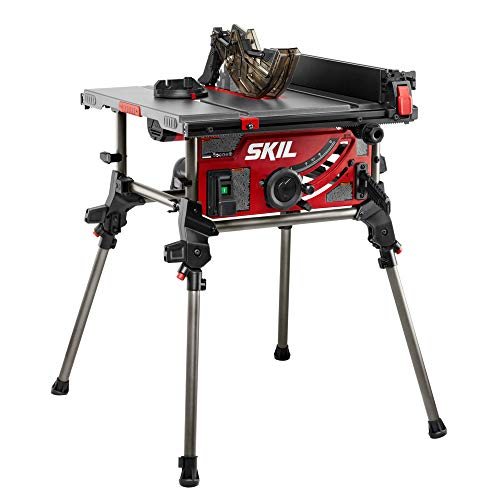
The SKIL TS6307 is the budget jobsite table saw to beat. A 15-amp motor drives a 10-inch blade, and a rack-and-pinion fence keeps the fence parallel to the blade as you slide it, which is the feature that decides whether a rip comes out straight. The integrated folding stand brings the table to working height and folds away when you are done.

Compared with the MarvTool, the SKIL adds the rack-and-pinion fence and the stand and makes a stronger case for accuracy. A micro-adjustment lets you align the blade parallel to the miter slot, and a quick-release bevel lever finds positive stops at 0 and 45 degrees. It handles a 4x4 at 90 degrees, which covers deck posts and thick lumber.

Ownership is about setup. Check blade-to-slot alignment when the saw arrives, because shipping can knock it out, and use a riving knife or splitter every time. Add a push stick and a featherboard, replace the stock blade with a good ripping blade, and accept that a universal motor is loud. This is the saw for a homeowner building shelves, a workbench or a deck.

What works

  • Rack-and-pinion fence stays parallel
  • Folding stand sets working height
  • 4x4 cutting capacity at 90 degrees
  • Blade micro-adjustment for alignment

Watch out for

  • Universal motor is loud
  • Stamped table is smaller than a cabinet saw's

Spec sheet

Motor
15 amp
Blade
10 inch
Fence
Rack and pinion rails
Cut capacity
4x4 at 90 degrees
Bevel
2 to 47 degrees, stops at 0 and 45
02
MarvTool 15-Amp 10 in Portable Benchtop Table Saw
15 amp4,600 RPM3.4 in depth28.3 lb
Check price on Amazon
Best for: Small-shop owners who want a light benchtop saw at a low cost.

The MarvTool is a benchtop saw that weighs 28.3 pounds, which is light enough to move by hand and lift onto a workbench. A 15-amp motor spins a 36-tooth, 10-inch blade at about 4,600 RPM, and the maker lists a depth of 3.4 inches at 90 degrees and 2.1 inches at 45. It cuts hardwood, plywood and thin aluminum sheets.

It lacks the SKIL's stand and rack-and-pinion fence, so you need a stable bench and a careful hand on the fence. Depth at 90 degrees is about 3.4 inches, which means you can rip a 2x4 and many 4x4s in one pass if the blade is sharp. A transparent blade guard, a dust port and a push rod are included, which helps safety.

For ownership, clamp the saw down, square the fence to the blade before first use and add a riving knife if the guard does not include one. Replace the 36-tooth blade with a good ripping blade for clean cuts. A lesser-known brand means thin parts support, so treat this as a light-duty tool for DIY furniture and shelving.

What works

  • Light enough to lift onto a bench
  • 15-amp motor with 3.4 in depth
  • Transparent guard and push rod included
  • Dust port for a shop vacuum

Watch out for

  • No stand and a basic fence
  • Thin brand support

Spec sheet

Motor
15 amp, 4,600 RPM
Blade
10 in, 36-tooth
Depth
3.4 in at 90, 2.1 in at 45
Weight
28.3 lb
Kit
Guard, push rod, wrenches
03
Evolution R8MTS 8-1/4 in Convertible Miter/Table Saw
12 amp8-1/4 in blade2-in-1Multi-material
Check price on Amazon
Best for: Small-space woodworkers and makers who want a miter saw and a small table saw in one tool.

The Evolution R8MTS is a combination tool. The same 12-amp motor and 8-1/4-inch TCT blade serve as a compound miter saw and as a table saw, and you switch modes with locking pins. It cuts wood, plastic, mild steel and aluminum with the same blade, which is unusual at this cap.

The limits are in the numbers. Rip capacity in table mode is 1-1/2 inches, which makes it a small-stock saw for strips, trim and hobby work. Compared with the SKIL TS6307's 4x4 capacity, the Evolution cuts a much thinner board in rip mode, and it has no stand. The crosscut capacity in miter mode is 4-3/4 inches by 2-3/16 inches.

Safety design includes a blade guard that stays covered until contact, a riving knife and a table saw blade guard. For ownership, remember the saw's multi-material blade is a different blade than the one that cuts finished hardwood, and that switching modes means resetting the guard each time. If you have a small apartment workshop, it is the one saw that does two jobs.

What works

  • Two saws in one body
  • Cuts wood, plastic, aluminum and mild steel
  • Blade guard covers the blade until contact
  • Includes riving knife and rip fence

Watch out for

  • Only 1-1/2 in rip capacity
  • Mode changes take time

Spec sheet

Motor
12 amp
Blade
8-1/4 in TCT, multi-material
Miter range
45 degrees left to 45 right
Rip capacity
1-1/2 in in table mode
Crosscut
4-3/4 x 2-3/16 in
04
Hoteche 8-1/4 in 2-in-1 Compound Miter and Table Saw
10 amp4,500 RPM8-1/4 in blade24 teeth
Check price on Amazon
Best for: People who want a basic miter-and-table convertible at a low outlay.

The Hoteche is another convertible, with a 10-amp motor at 4,500 RPM, an 8-1/4-inch, 24-tooth blade and a single 45-degree bevel. The maker lists a miter crosscut capacity of 120 by 55 mm at 0 by 0 degrees, about 4.7 by 2.2 inches, and 80 by 25 mm at 45 by 45 degrees. It is aimed at wood, plastic and some metal.

Next to the Evolution R8MTS it has less motor current (10 vs 12 amps) and a 24-tooth blade that cuts faster and rougher than a fine blade. The capacity numbers are almost the same, so the choice comes down to the motor, the blade and the maker's support. It is a basic tool in either role.

Ownership notes are about discipline. Use the guard and push stick, support long boards and swap to a finer blade for finish cuts. The 24-tooth blade is a framing-style blade, so expect tear-out in plywood. For someone who needs a miter saw and occasionally rips strips, it is a lower-cost alternative to the Evolution.

What works

  • Miter saw and table saw in one body
  • 8-1/4 in blade is a common size
  • Single bevel to 45 degrees
  • Compact for small shops

Watch out for

  • 24-tooth blade tears plywood
  • Less motor current than the Evolution

Spec sheet

Motor
10 amp, 4,500 RPM
Blade
8-1/4 in, 24-tooth
Bevel
Single bevel, 45 degrees
Miter capacity
120 x 55 mm at 0/0
Modes
Miter saw and table saw
05
Nicklaua Mini Table Saw with Dual Motors
200 W63 mm blade15 mm depth4 blades
Check price on Amazon
Best for: Hobbyists and model makers who cut thin wood, plastic and PCB boards.

The Nicklaua is a hobby table saw, not a lumber saw. Dual 795 motors drive a 63 mm blade, one for the saw and one for grinding and polishing, with separate switches that prevent the two functions starting at once. Maximum cutting depth is 15 mm, about 5/8 inch, and the blade spins up to 15,000 RPM.

It is the only saw in this lineup that fits on a desk. The four blades cover PCB boards, wood sticks, plastic sheets, thin boards and aluminum or copper tube. Compared with the SKIL TS6307, it cuts far less stock and costs a fraction. It is meant for model-making, crafts and electronics, and it is not for framing lumber.

For ownership, wear eye protection, keep fingers well clear of a small blade, and use it for the thin stock it is rated for. A dust outlet and a blade compartment keep the motor clean, and a small window makes blade changes quick. Choose it only if your work is small and precise.

What works

  • Fits on a desk or workbench
  • Four blades for wood, plastic, PCB and metal tube
  • Dual-motor interlock prevents running both at once
  • Quick blade change through a small window

Watch out for

  • 15 mm maximum depth
  • Not a tool for lumber

Spec sheet

Power
Dual 795 motors, 200 W
Speed
Up to 15,000 RPM
Blade
63 mm, 16 mm bore
Depth
0 to 15 mm
Kit
4 blade types

Spec sheet decoder

What the numbers on the box really mean

The specs manufacturers lead with, translated into what they tell you about real-world performance.

Rack and pinion

A gear system that moves both ends of the fence together. It keeps the fence parallel to the blade.

Watch forCheaper fences use a simple rail and can skew.

Rip capacity

The maximum distance between the fence and blade. It decides the widest board you can rip.

Watch forSome saws list it with the fence extension in place.

Depth of cut

The tallest board the saw can cut at 90 degrees. The MarvTool lists 3.4 inches.

Watch forDepth shrinks at 45 degrees.

Riving knife

A thin plate behind the blade that rises and falls with it and keeps the kerf open.

Watch forA fixed splitter is not the same, and some budget saws only offer one.

Kickback

The sudden throwing of a board back at the user, caused by pinching or a skewed fence.

Watch forIt is the main cause of table saw injuries, and a push stick is a basic defense, and so is standing to the side of the blade line instead of directly behind the board.

Methodology

How We Evaluated These Table Saws Under $300

Fence and accuracy

We compared fence designs, from the SKIL's rack-and-pinion system to simple slides, because fence accuracy decides cut quality.

Guarding and safety features

We looked at blade guards, riving knives and push sticks, and noted the Evolution's guard that stays covered until contact.

Motor and depth

We compared amps and cutting depth, from the 15-amp SKIL and MarvTool to the 10-amp Hoteche.

Portability and setup

We considered stands, weight and storage. The SKIL has a folding stand, the MarvTool weighs 28.3 pounds and the Nicklaua fits on a desk.

Fit for the cap

Every saw has a live price at or below the cap. We ranked each by how much accuracy and safety a homeowner gets for the money.

Decision guide

How to Choose the Right Table Saws Under $300

By Project

ScenarioPickWhy
Shelves, benches and deck lumberSKIL TS63074x4 capacity and a stand
Plywood and small furnitureMarvTool 15-AmpLight and 15 amps
Miter cuts and small rips in one toolEvolution R8MTSTwo saws in one
Occasional trim and stripsHoteche 2-in-1Convertible, lower cost
Models and thin stockNicklaua MiniDesk size

By Budget Tier

TierPickWhy
LowestNicklaua MiniHobby saw
LowHoteche 2-in-1Convertible
MidMarvTool 15-AmpLight bench saw
UpperEvolution R8MTSMulti-material convertible
Top of the capSKIL TS6307Stand and fence

Jobsite Saw vs Convertible

Jobsite saw

A dedicated table saw with a bigger table and a real fence. The SKIL and MarvTool are in this group.

Convertible

A miter saw that converts to a table saw with a smaller capacity. The Evolution and Hoteche are in this group.

Choose a jobsite saw for lumber and a convertible for small spaces.

Fence and Stand

PreferencePickWhy
Best fenceSKIL TS6307Rack and pinion
Stand includedSKIL TS6307Folding stand
Bench onlyMarvTool 15-Amp28.3 lb
DeskNicklaua MiniCompact

For Plywood Specifically

Look for

A fine blade, a flat table, a fence that stays parallel and support for the sheet. Cut with the good face up.

In this comparison

The SKIL's fence and stand make it the plywood pick. The MarvTool is acceptable with a better blade. The convertibles are too small for sheets.

When to Spend More

Spend more if

You rip lumber weekly or need flesh-sensing safety. A higher-end jobsite saw is safer and more accurate.

Save if

You cut a few boards a year. The MarvTool or a convertible is enough.

Ownership

Maintenance schedule

The upkeep that decides whether this machine lasts two seasons or ten.

TaskIntervalWhy it matters
Check blade alignmentOn arrival and yearlyA blade out of parallel with the slot causes burns and kickback.
Replace the stock bladeWhen cuts burnA dull blade pushes the board and invites kickback.
Clean the table and apply waxMonthlyA slick table lets the board slide smoothly.
Check the riving knifeBefore each useA misaligned knife defeats its own purpose.
Inspect the cordBefore each useA cut cord on a saw is a shock and fire hazard.

FAQ

Frequently Asked Questions

Are budget table saws safe?

They can be, with discipline. Use a riving knife, push sticks and a fence that stays parallel, and never stand in line with the blade.

What causes kickback?

A board that pinches the back of the blade, a skewed fence or a blade that is not parallel to the slot. Check alignment and use a riving knife.

Do I need a stand?

A saw should sit at working height. The SKIL has a folding stand, and benchtop saws need a bench.

Can I cut plywood on these?

Yes, with a fine blade and good support. A sheet is too large for the convertibles.

What does a 10-inch blade give me?

About 3 inches of depth at 90 degrees, enough for most lumber. Smaller blades cut less.

Is a convertible saw a good idea?

For small spaces, yes. For rips in 2x lumber, a dedicated table saw is better.

Bottom line

The short version

Browse more table saws under $300on Amazon →
James Miller, Lead Machine Editor

About the author

James Miller

Lead Machine Editor, MachineFanatic

James Miller leads MachineFanatic's buying guides, turning spec sheets, manuals and owner feedback into clear verdicts on power tools, outdoor power equipment, shop machines and kitchen machines.

More from James →

Keep reading

Related guides