
Amazon affiliate links - we earn a commission.Affiliate disclosure

Buying guide · 13 min read · Updated 2026-11-07

Best Tent Heaters Under $100 (2026)

Five tent heaters under $100, led by a two-setting radiant propane heater approved for ventilated indoor use, with CO and ventilation rules for winter camping.

James MillerBy James MillerLead Machine Editor5 machines comparedSpec-sheet verified
Best Tent Heaters Under $100

At a glance

Our top picks

Side by side

Spec comparison

A hundred dollars buys the first heaters that were designed with enclosed use in mind. They add sensing and shutoff hardware that cheaper units skip, which is exactly the part that matters in a small fabric room.

Even so, ventilation, a carbon monoxide alarm and clearance from fabric remain your responsibility. The $100 cap reflects listing prices on the date this guide was updated, and prices move.

Before you buy

6 Criteria to Look For Before Buying a Tent Heater Under $100

  1. 01

    Approval for enclosed use

    The Portable Buddy is listed as designed and approved for indoor and outdoor use. Many cheaper heaters do not say so. In a tent that difference is a safety feature. For a family cabin tent of 100 square feet or more, the 9,000 BTU step of the Portable Buddy is useful for the first twenty minutes, then drop to 4,000. A quick sizing guide is to match 30 to 40 BTU per square foot for light camping heat, so a 60 square foot tent needs only a couple of thousand BTU for comfort, and anything more is overkill. Plan where the cold air enters: a door vent low and a roof vent high lets fresh air sweep through as the heater runs.

  2. 02

    Two heat settings

    The Portable Buddy offers 4,000 and 9,000 BTU, and the CAMPLUX has two speeds. A low setting avoids overheating a small tent and saves fuel. A tent warms unevenly with radiant heat, so place the heater where people sit, not where they sleep. Look for a heater whose manual explicitly mentions tents, since a manual that bans enclosed use is a clear answer. Check that your sleeping area is far enough from the heater that a rolled bag or a boot cannot touch it.

  3. 03

    CO and ventilation

    Every fuel heater here needs two vents and a battery CO alarm. Electric units like the BEYOND HEAT avoid the issue entirely. Use two vents at different heights, because warm air rises and fresh air sinks. Use a hose and bulk cylinder where possible, because one pound cylinders add cost and waste.

  4. 04

    Weight and base

    The CAMPLUX weighs 4.2 lb and has a tripod, while the Buyplus is top-heavy. Use a flat board on soft ground. Check the cylinder seat for debris before each connection, because a poor seal is the usual leak. Know your tent: a double-wall tent with a rainfly traps heat better than a single-wall shelter, which affects how much heater you need.

  5. 05

    Fuel type and cylinders

    A one pound cylinder on the Little Buddy lasts a few hours. A hose to a larger tank saves money and trips. Do not hang wet clothes near a heater, which is both a fire and a moisture issue. Keep spare, fresh batteries for the alarm and put it where you sleep, not next to the heater.

  6. 06

    Power draw

    A 1500W heater draws 12.5 amps. Use a short heavy cord and a dedicated circuit. Stop using the heater and ventilate if the alarm sounds, you feel dizzy or the flame turns yellow. Learn the shut-off steps in daylight, so you can do it half-asleep and in the dark. If you are unsure between two heaters, choose the one whose manual you can actually understand.

Detailed reviews

The 5 best tent heaters under $100, explained

01
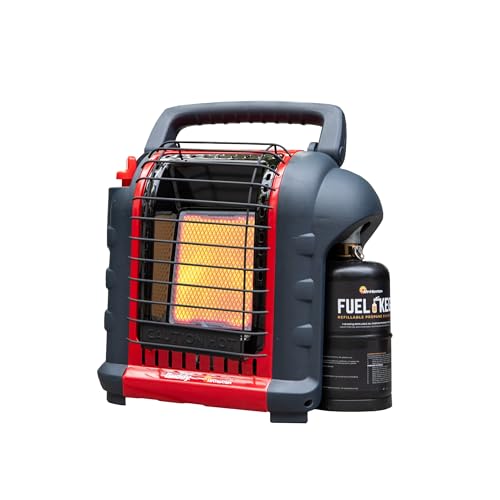
Mr. Heater 9,000 BTU Portable Buddy radiant propane heater
4,000 or 9,000 BTUApproved indoor/outdoor225 sq ftRadiant
Check price on Amazon
Best for: Medium tents and shelters with ventilation.

The Portable Buddy emits either 4,000 or 9,000 BTU per hour of radiant heat, and the listing says it is designed and approved for indoor and outdoor use and heats roughly 225 square feet. The two settings are the key advantage: the 4,000 BTU step suits a small tent, and the 9,000 BTU step is for a large shelter or a cold start. Mr. Heater builds it with an oxygen depletion sensor and tip-over shutoff.

It is a radiant design that warms objects and people, not the whole volume of air, so a tent warms unevenly and you feel it most in front of the heater. Compared with the Little Buddy at 3,800 BTU, it is stronger and more flexible. Compared with the CAMPLUX it is heavier but better documented.

Ventilation is still required, so open two vents, keep a battery carbon monoxide alarm at head height and keep the heater clear of fabric. Check hose and cylinder connections with soapy water, use the lower step in a tent, and switch it off before sleeping. Use the low step as your default and treat the high step as a ten-minute boost.

What works

  • Two settings, 4,000 and 9,000 BTU
  • Approved for indoor and outdoor use
  • Oxygen sensor and tip-over design
  • Radiant heat warms people directly

Watch out for

  • Still burns fuel, so ventilation is required
  • 9,000 BTU is too much for a small tent
  • Radiant heat is uneven

Spec sheet

Output
4,000 or 9,000 BTU/hr
Approval
Designed and approved for indoor and outdoor use
Coverage
About 225 sq ft
Type
Radiant propane
Safety
Oxygen sensor and tip-over shutoff (maker design)
02
CAMPLUX 8,500 BTU portable propane heater, tilt switch, tripod base
8,500 BTU2-speed4.2 lbTilt switch
Check price on Amazon
Best for: Vestibules and open-air campsites.

The CAMPLUX is an 8,500 BTU propane heater with two heat speeds, a safety tilt switch that shuts it off if it tips and a detachable tripod base for uneven ground. At 4.2 pounds it is light enough to carry on a camping trip. The listing positions it as an outdoor and patio heater, with dual safety protection.

Compared with the Portable Buddy, it is lighter and has a tripod, but the listing gives less indoor approval detail. In a tent, that matters. Treat it as an outdoor and vestibule heater unless the manual says otherwise.

Keep it three feet from fabric, always ventilate and carry a CO alarm. In practice, set it on a board, light it with the tent door open and let it run for ten minutes before closing vents to a gap. Keep the alarm testing habit, because it is the only thing that tells you the air has gone wrong. Pick up the heater only when it is cold, and let the cylinder cool before packing.

What works

  • Two heat speeds
  • Tilt switch shutoff
  • Detachable tripod base
  • Light at 4.2 lb

Watch out for

  • Less indoor approval detail
  • Combustion risks in tents
  • 8,500 BTU overshoots small tents

Spec sheet

Output
8,500 BTU, 2 speeds
Weight
4.2 lb
Base
Detachable tripod
Safety
Tilt switch auto shutoff
Use
Outdoor, patio and camping
03
BEYOND HEAT 1500W milkhouse heater with thermostat
1500WThermostatFan-only modeTip-over switch
Check price on Amazon
Best for: Powered sites and large tents.

The BEYOND HEAT is a milkhouse-style metal fan heater with a thermostat, fan-only mode, a lower step and a tip-over switch. It makes no combustion gases, which makes it the safest choice with power.

It draws 12.5 amps at 1500 watts, so use a short heavy cord and a dedicated circuit. Compared with the Portable Buddy, it cannot work off grid but removes the CO risk.

Keep it on a flat board and clear of fabric. If you choose this one, build the layout around the heater: put it off the walkway, keep pets and children away and make sure nothing hangs over it. The thermostat cycles the element, so you hear the fan stop and start through the night, which is normal. Owners like the quiet hum of a thermostat-cycled fan better than the hiss of a gas burner, and they like not worrying about a detector going off at 3 a.m. The cost is a cord and a campsite with power. Keep the unit off the groundsheet's wet patches and run the cord out of the door in a drip loop.

What works

  • No combustion gases
  • Thermostat
  • Heavy-duty metal body
  • Tip-over switch

Watch out for

  • Needs campsite power
  • 12.5 amp draw
  • Heavy

Spec sheet

Power
1500W, with a lower step
Modes
Fan only, low, high
Control
Thermostat
Safety
Tip-over switch
Build
Heavy-duty metal
04
Buyplus 10,000 BTU single-tank-top propane heater
10,000 BTUTank-topMesh guardSteel
Check price on Amazon
Best for: Large vented shelters.

The Buyplus is a tank-top propane heater with a steel body and mesh guard. Its title claims 10,000 BTU.

It is top-heavy and strong, suited to large shelters and outdoor use, not small tents.

Use it with ventilation and a CO alarm. Because the tank threads onto the top, a bump to the heater tips the whole assembly, so place it on a board where nobody walks. It suits a large screened shelter far more than a sleeping tent. Compared with the Portable Buddy it has no stated indoor approval and no variable output, so every decision falls on you. Cold air also makes the regulator behave differently, so test it at home in the cold before relying on it in the field. Wind and moisture are bigger enemies than temperature for this style, so keep the regulator dry and the burner out of drafts.

What works

  • Strong output
  • Steel guard
  • Simple
  • Portable

Watch out for

  • Top-heavy
  • Too strong for small tents
  • Combustion risks

Spec sheet

Output
10,000 BTU in the title
Fuel
Propane, tank-top
Guard
Safety mesh
Build
Heavy duty steel
Use
Camping, fishing
05
Mr. Heater Little Buddy 3,800 BTU radiant propane heater
3,800 BTUOne-button ignition8 in baseRadiant
Check price on Amazon
Best for: Small tents.

The Little Buddy is a 3,800 BTU radiant propane heater with one-button ignition and a compact base. It is the right size for a small tent.

It uses one pound cylinders, which run out fast.

Ventilate and use an alarm. Switching to a hose and a larger cylinder brings cost per hour down, and Mr. Heater sells an adapter hose. Store one pound cylinders upright and away from heat, and never refill disposable ones. In use, it is a tent heater for one or two people. Start it outside the tent or at the door, move it in once the flame is steady, and keep it at floor level on a board. Replace the cylinder in the open air, away from any flame or spark.

What works

  • Right size for small tents
  • One-button ignition
  • Compact
  • Known design

Watch out for

  • One pound cylinders run out fast
  • Combustion risks
  • Directional heat

Spec sheet

Output
3,800 BTU/hr
Fuel
Propane, 1 lb cylinder
Ignition
One button
Base
8 in round
Safety
Maker oxygen sensor design

Spec sheet decoder

What the numbers on the box really mean

The specs manufacturers lead with, translated into what they tell you about real-world performance.

Approved for indoor use

The maker states the heater meets standards for enclosed spaces with ventilation. It matters most in a tent.

Watch forPortable Buddy.

Radiant

Heat that warms objects and people directly. Radiant heat falls with distance.

Watch forBuddy line.

Tilt switch

A switch that cuts gas on tipping. It stops gas if the heater leans.

Watch forCAMPLUX.

BTU

Heat per hour. Choose by tent volume.

Watch forPortable Buddy 4,000 or 9,000.

Milkhouse

A rugged metal fan heater. It is a tough fan unit.

Watch forBEYOND HEAT.

Methodology

How We Evaluated These Tent Heaters Under $100

Enclosed-use approval

We scored stated approvals. The Portable Buddy led. Approval statements were weighed against what the manual would actually say. Approval wording was read closely, because 'outdoor and patio' and 'indoor approved' are very different claims.

Heat settings

We compared steps and outputs. Weight was compared with the carry distance a camper expects. The cost per hour of the fuel was noted as a practical factor.

Safety hardware

We counted sensors and tilt switches. Sensing hardware counted higher than marketing words. Whether a listing mentions tents specifically was counted as a plus.

Weight and stability

We compared bases and carry weight. Stability on soft ground was considered. Wind exposure of open burners was considered.

Owner feedback patterns

Based on spec sheets and listing feedback patterns, we weighed reports of tipping and leaks. Reports of ignition trouble in the cold were noted. We also considered how easy each unit is to light and shut off in the dark. Final scores leaned toward the units that tell you exactly what they are built to do.

Decision guide

How to Choose the Right Tent Heaters Under $100

By Tent Size

TentPickWhy
Small tentLittle Buddy3,800 BTU
Medium tentPortable Buddy low step4,000 BTU
Large shelterPortable Buddy high step9,000 BTU
Open vestibuleCAMPLUXTripod
Powered large tentBEYOND HEATNo fumes

Measure the tent and note the lowest expected temperature before you shop.

By Budget

TierPickWhy
Lowest in this capLittle BuddySmall
Low to midBuyplusStrong
MidBEYOND HEATElectric
UpperCAMPLUXLight
HighestPortable BuddyApproved

Prices move, so read the tiers as relative positions. Check the listing again before ordering, since prices and stock change quickly in camping season.

Fuel vs Electric

Fuel

The Buddy line and CAMPLUX work off grid but need ventilation and a CO alarm.

Electric

The BEYOND HEAT makes no fumes but needs power.

Choose electric if you have power. For most campers the real choice is electric if there is a hookup, otherwise the approved radiant unit. If your trip is a single weekend, rent or borrow before you buy.

By Stability

NeedPickWhy
Uneven groundCAMPLUXTripod
Flat baseLittle Buddy8 in
RuggedBEYOND HEATMetal
Big shelterPortable BuddyWide
Tank-topBuyplusNeeds care

On uneven ground, a flat board and a tripod matter more than extra BTU.

For Winter Camping Specifically

Look for

Approval, two settings and sensing hardware.

In this comparison

The Portable Buddy.

Layers and a pad beat any heater.

When to Spend More

Spend more if

You camp in winter and want approved enclosed use.

Save if

You camp in mild weather with power.

Spending more buys approvals and sensing, which are what you want in a small fabric room.

Ownership

Maintenance schedule

The upkeep that decides whether this machine lasts two seasons or ten.

TaskIntervalWhy it matters
Check hose and seatEach tripGas leaks are the biggest risk. Skipping this is how a small leak goes unnoticed on a trip. Do it with soapy water and no flame nearby.
Test the CO alarmEach tripA dead alarm protects nobody. Replace batteries every season. Replace the battery at the start of each season.
Clean the burnerEach seasonDebris cuts output. A clean burner has an even flame. Brush off dust, especially around the sensor and pilot area.
Inspect cordsEach tripA hot plug signals a poor connection. A hot plug is a reason to stop using the heater. Check the whole length of the cord.
Store dryOff-seasonMoisture damages igniters. Dry storage prevents rust. Pack with silica gel in a dry box.

FAQ

Frequently Asked Questions

Is the Portable Buddy tent safe?

It is approved for indoor use with ventilation, but you still need two vents and a CO alarm. Approved for indoor use does not mean approved for sleeping with it on, and the manual will say so.

Which setting should I use?

The low step in a tent. A CO alarm is cheap insurance and should be a battery model rated for portable use.

Is electric safer?

Yes, it makes no combustion gases. If you want zero risk of fumes, buy electric and camp where there is power.

Can I sleep with it on?

No. Cylinders last longer on the low step, and a bulk tank through a hose lowers the cost per hour.

How long does a cylinder last?

A one pound cylinder lasts a few hours. If wind picks up, stop and shelter the heater, because a gust can blow out a flame. If the flame looks yellow, shut it off and get fresh air, because a yellow flame means poor combustion.

What about wind?

Shield open burners from gusts. Cold weather also drains batteries, so keep spare alarm batteries warm in a pocket. Keep children out of the heater's reach and never use it to dry boots. Practise lighting and shutting off the heater at home first, so the field routine is automatic.

Bottom line

The short version

Browse more tent heaters under $100on Amazon →
James Miller, Lead Machine Editor

About the author

James Miller

Lead Machine Editor, MachineFanatic

James Miller leads MachineFanatic's buying guides, turning spec sheets, manuals and owner feedback into clear verdicts on power tools, outdoor power equipment, shop machines and kitchen machines.

More from James →

Keep reading

Related guides