
Amazon affiliate links - we earn a commission.Affiliate disclosure

Buying guide · 13 min read · Updated 2026-11-07

Best Thermal Laminators (2026)

Six thermal laminators compared by width, warm-up time, jam protection and pouch thickness, from 9 inch home units to wide-format and roll machines.

James MillerBy James MillerLead Machine Editor6 machines comparedSpec-sheet verified
Best Thermal Laminators

At a glance

Our top picks

Side by side

Spec comparison

A thermal laminator pushes a pouch of heat-activated adhesive film between warm rollers, melting the glue so the film bonds to the paper and seals its edges. Warm-up time, roller quality and pouch thickness control whether the result is clear or clouded, flat or wrinkled.

Most problems come from three habits: feeding the open edge first, using the wrong pouch thickness for the machine and pushing a pouch through before the rollers are fully warm. A machine that guides you away from those mistakes is worth more than extra features.

Before you buy

6 Criteria to Look For Before Buying a Thermal Laminator

  1. 01

    Width

    Width sets the largest sheet you can laminate. The Scotch Rapid and Bonsaii take 9 inch letter-size sheets, the Scotch TL1302X and the 11 by 17 kit take 13 inches, and the GBC roll handles 27 inches. Measure the biggest thing you will laminate, add a quarter inch of border on each side and make sure that dimension fits the inlet, since a sheet that overhangs cannot be sealed. A wide laminator can still take small items, but it uses more desk space and costs more, so do not buy width you will not use.

  2. 02

    Warm-up time

    The Scotch Rapid warms up in about a minute and the Bonsaii in about three. For occasional jobs, a short warm-up is a convenience. For classrooms with repeated runs, it saves minutes every day. Remember that a ready light is more reliable than the clock: rollers need to reach temperature all the way through, and feeding a pouch a few seconds early is the most common cause of cloudy, bubbled results. If your machine has no indicator, give it an extra minute beyond the stated warm-up before the first pouch.

  3. 03

    Jam protection

    Jams happen when a pouch feeds crooked or the rollers are cold. The Scotch Rapid and Bonsaii list jam-prevention designs. A release lever or button helps clear a stuck pouch without damage.

  4. 04

    Pouch thickness

    Thickness is in mils. The Bonsaii lists 3 to 5 mil, and the Scotch TL901X and Rapid have two temperature settings for different thickness. Thicker pouches protect more but need more heat. A thin 3 mil pouch is flexible and good for papers you will fold or handle, while a 5 mil pouch is stiff enough for badges, menus and signs. Buying a pack of the wrong thickness is the commonest waste, so check the range in the specification before you order pouches in bulk, and keep a few of each thickness on hand if you laminate varied items.

  5. 05

    Hot and cold modes

    Cold laminating uses pressure-sensitive pouches for heat-sensitive items. The Crenova and the 13 inch kit offer cold modes. Never use thermal pouches in cold mode.

  6. 06

    Roller count and finish

    Two-roller machines are fine for everyday sheets. Four-roller or commercial roll machines give smoother, more even bonding for photos and posters. Match the machine to the quality you need. The two-roller design in most of this lineup squeezes and heats at once, which works for documents, but a thicker photo can show faint streaks. If you laminate photos or art, consider a machine with a slower speed and test on a copy first, because laminating an original is irreversible and any bubble becomes a permanent part of the print.

Detailed reviews

The 6 best thermal laminators, explained

01
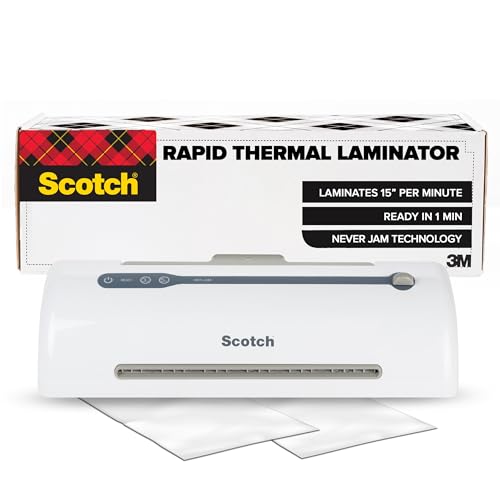
Scotch Rapid 9 inch thermal laminator, one-minute warm-up
9 inch1 min warm-upJam prevention2 temp settings
Check price on Amazon
Best for: Homes, classrooms and small offices laminating letter-size sheets.

The Scotch Rapid is the practical home laminator. It warms up in about a minute, laminates at 11.5 inches per minute and has two heated rollers with two temperature settings. The maker's jam-prevention system is its headline feature, aimed at the most common frustration with entry laminators.

Speed matters in classrooms and offices because warm-up is the longest part of a small job. Compared with the Scotch TL901X in the same family it warms up faster and adds jam protection, and compared with the 13 inch TL1302X it takes only standard letter-size work.

Laminate with the sealed edge of the pouch leading, let the pouch cool flat after it exits and never feed a pouch that is wrinkled or the wrong thickness. Turn the machine off after use and let it cool with the rollers free of residue. Do not laminate thermal paper receipts, which blacken in the heat. Two temperature settings are a practical help: use the lower one for thin 3 mil pouches and the higher one for thicker film, since too much heat on a thin pouch causes clouding and too little leaves a bubbled surface. After a long session the housing stays warm for several minutes, so leave it on a heat-safe surface away from curtains and paper stacks. A cardboard carrier sheet or a folded sheet of plain paper can guide very small items through, but check the manual first because some machines are designed to run without one.

What works

  • About one minute warm-up
  • Jam-prevention design
  • Two temperature settings for different pouch thickness
  • 11.5 inches per minute

Watch out for

  • Nine inch width only
  • Two-roller design, not a four-roller finish

Spec sheet

Width
9 inches
Warm-up
About one minute
Speed
11.5 inches per minute
Rollers
Two heated rollers, two temperature settings
Jam protection
Never Jam technology
02
Scotch TL1302X 13 inch thermal laminator
13 inch input1 min warm-upTeachers and officesPhotos and documents
Check price on Amazon
Best for: Teachers and offices laminating posters and larger sheets.

The TL1302X widens the input to 13 inches, enough for legal-size pages, A3-style sheets and bigger posters. A one-minute warm-up keeps it efficient for small jobs.

Width is the reason to buy it: a classroom that laminates large charts or a business that protects wide notices cannot use a 9 inch machine. Compared with the Scotch Rapid it takes bigger sheets but sits higher in the price tiers.

Larger pouches need steadier feeding, so guide the sheet straight and keep the exit area clear so the pouch does not fold. Check that the pouch size and thickness match the machine, and let the rollers cool fully before storing. Keep a lint-free cloth to clean the rollers. A wide input also magnifies a small feeding error: a crooked sheet that would only wrinkle at 9 inches can fold over completely at 13. Square the paper inside the pouch, trim ragged edges and leave a border of about a quarter inch around the paper so the film seals on all sides. Posters often curl after lamination as they cool, so lay them under a book or a flat board and give them a few minutes before you hang them. If you laminate thick card, step down to a slower setting.

What works

  • Thirteen inch input handles large sheets
  • One-minute warm-up
  • Fits documents and photos
  • Established brand

Watch out for

  • Higher tier than 9 inch models
  • Takes more desk space

Spec sheet

Width
13 inches
Warm-up
About one minute
Use
Documents, photos and larger sheets
Audience
Teachers, small offices, homes
Position
Upper-middle tier
03
Bonsaii 9 inch laminator, anti-jam, 3 to 5 mil
9 inchAnti-jam3-5 mil50 sheets
Check price on Amazon
Best for: Home users who want pouches included and jam protection.

Bonsaii's 9 inch model leads with patented anti-jam technology and handles 3 to 5 mil pouches. It needs about three minutes to preheat, laminates at 270 millimeters per minute or more and ships with 50 laminating sheets.

The pouch thickness range is the useful number: 3 mil is flexible for everyday papers, while 5 mil is stiffer and protects photos and ID cards better. Compared with the Scotch Rapid it warms up more slowly, but it comes with pouches in the box and a wider stated thickness range.

Wait for the ready signal before the first pouch, keep papers flat and avoid feeding a stack of pouches back to back until the rollers have recovered temperature. If a pouch stalls, use the release function rather than pulling it out by hand. Pulling a half-laminated pouch drags molten adhesive across the rollers and leaves streaks that show on every later sheet. The stated speed of 270 millimeters per minute is slower than the Scotch, which gives the adhesive more time to melt and tends to produce clearer results with thicker 5 mil film. For photos, choose the thicker setting and let the sheet cool flat so the print does not curl, and keep fingerprints off the paper before it goes in.

What works

  • Patented anti-jam design
  • Handles 3 to 5 mil pouches
  • Fifty laminating sheets included
  • Fits letter-size paper

Watch out for

  • About three minutes of warm-up
  • Slower start than the Scotch Rapid

Spec sheet

Width
9 inches
Pouch thickness
3 to 5 mil
Warm-up
About 3 minutes
Speed
270 mm per minute or more
Included
50 laminating sheets
04
Crenova A4 laminator, hot and cold modes
A4, 9 inchHot and cold1-2 min warm-up10 sheets
Check price on Amazon
Best for: Occasional laminating, including heat-sensitive items.

Crenova's laminator offers both hot and cold modes with a 230 millimeter inlet that fits A4. It warms up in one to two minutes and includes ten pouches.

Cold mode is the feature that matters for items that cannot take heat, such as some old photos, with cold laminate pouches that use pressure-sensitive adhesive. Compared with the Scotch Rapid it offers that flexibility and a lower position in the price tiers, but fewer details on jam protection.

Use cold mode with cold pouches only and hot mode with thermal pouches, never mix them. Let the machine cool fully before storing and keep the inlet clear of dust. Check that the pouch edges are aligned before feeding. A hot-and-cold machine is most useful for things that dislike heat, such as certain inkjet prints, stickers and some old photographs, but cold pouches have a thicker adhesive layer and can leave a slightly cloudier finish than a hot seal. Test a scrap before committing a treasured print. Because inexpensive machines have a shorter heat cycle, avoid back-to-back runs of large batches and give the rollers a short rest every twenty pouches or so.

What works

  • Hot and cold modes
  • One to two minute warm-up
  • Lowest price tier
  • Ten pouches included

Watch out for

  • Fewer jam-protection details
  • Basic build for heavy use

Spec sheet

Width
9 inch A4 inlet (230 mm)
Modes
Hot and cold
Warm-up
1 to 2 minutes
Included
10 laminating pouches
Position
Lowest tier here
05
13 inch laminator for 11x17 sheets, with cutter and 50 pouches
13 inch95 s warm-upCold and thermalPaper cutter
Check price on Amazon
Best for: Hobbyists and schools laminating posters and small cards.

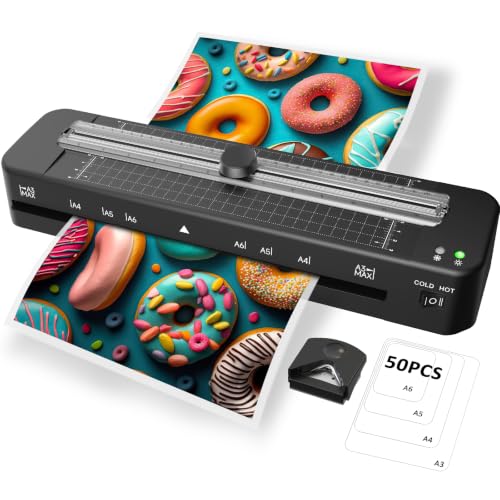
This 13 inch kit takes 11 by 17 inch sheets, warms up in about 95 seconds and offers cold and thermal modes with a two-roller system. The package includes 50 pouches in four sizes and a built-in paper cutter.

The kit is the draw: pouches in A3, A4, A5 and A6 sizes cover posters, documents and small cards, and the cutter trims paper before it goes into the pouch. Compared with the Scotch TL1302X it comes with consumables but is a less established brand.

Line up the paper with the sealed edge, keep the sheet centered so the pouch does not skew and let the output cool flat. Use cold mode only with cold pouches, and avoid forcing oversized items through. The built-in cutter is a sensible touch for classroom use, because trimming paper to size before sealing keeps the pouch edge clean. Choose the pouch that is just larger than the sheet: a pouch that is too big wastes film and leaves floppy margins, while a pouch that is too small cannot seal. A cutter blade dulls with use, so replace it or switch to a separate trimmer when cuts begin to fray. Store spare pouches flat and dry because humidity makes them cloud.

What works

  • Takes 11 by 17 inch sheets
  • Warm-up of about 95 seconds
  • Cold and thermal modes
  • Fifty pouches and a cutter included

Watch out for

  • Less established brand
  • Two-roller system

Spec sheet

Width
13 inches, takes 11 x 17
Warm-up
95 seconds
Modes
Cold and thermal
Kit
50 pouches in A3, A4, A5 and A6
Extras
Built-in paper cutter
06
GBC Ultima 65 thermal roll laminator, 27 inch width
27 inch rollAutoSpeedEZ Load filmUnder 10 min warm-up
Check price on Amazon
Best for: Schools and print shops laminating wide, high-volume work.

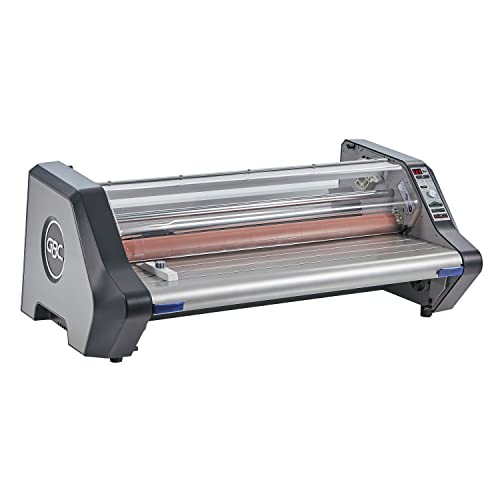
The Ultima 65 is the commercial option in this guide. It laminates from rolls up to 27 inches wide, warms up in under ten minutes and has a one-touch AutoSpeed feature that selects a speed for the film you load.

Roll lamination suits handouts, posters, bus tags and teaching aids at volume, since a roll costs less per sheet than pouches. Compared with the pouch machines it is bigger, slower to set up and requires you to handle film threading, so it is not a home appliance.

Load film carefully, keep the rollers clean and let the machine cool before moving it. Plan a work table at its output and a trimmer, because a roll laminator creates long sheets that need cutting to size. Threading film is the learning step: the top and bottom rolls must feed with the adhesive side facing the item, and a twisted roll leaves wrinkles that repeat along every sheet. The AutoSpeed feature picks a speed for the film you load, which removes a lot of guesswork but still deserves a test run on a scrap before the first real job. Keep spare film cores and a blade nearby, and let the rollers idle at temperature rather than cycling the machine on and off all day.

What works

  • Twenty-seven inch maximum width
  • AutoSpeed selects speed for the film
  • Roll film lowers cost per sheet
  • EZ Load compatibility

Watch out for

  • Large and expensive compared with pouch machines
  • Warm-up up to ten minutes

Spec sheet

Type
Thermal roll laminator
Maximum width
27 inches
Warm-up
Under 10 minutes
Speed control
Variable with one-touch AutoSpeed
Film
EZ Load or 1 inch core film up to 3 mil

Spec sheet decoder

What the numbers on the box really mean

The specs manufacturers lead with, translated into what they tell you about real-world performance.

Mil

A thousandth of an inch, used for pouch thickness. Higher means stiffer and more protective.

Watch forThe Bonsaii lists 3 to 5 mil and the Amazon Basics pouches list 2.8 mil.

Warm-up time

The time before the rollers reach lamination temperature.

Watch forThe Scotch Rapid lists one minute and the GBC lists under ten minutes.

Inches per minute

Laminating speed.

Watch forThe Scotch Rapid lists 11.5 inches per minute.

AutoSpeed

The machine selects a speed suited to the film.

Watch forThe GBC Ultima 65 lists it.

Cold mode

Laminating with pressure-sensitive pouches and no heat.

Watch forThe Crenova and 13 inch kit list it.

Methodology

How We Evaluated These Thermal Laminators

Width and capacity

We compared inlet widths, from 9 inches on the Scotch Rapid to 27 inches on the GBC roll machine.

Warm-up and speed

We read warm-up times, one minute on the Scotch Rapid and 95 seconds on the 13 inch kit, and speeds such as 11.5 inches per minute.

Jam protection

We looked for anti-jam and release features on the Scotch Rapid and Bonsaii.

Modes and thickness

We noted cold modes and pouch thickness ranges such as 3 to 5 mil.

Value

We placed machines by price tier and counted included pouches.

Decision guide

How to Choose the Right Thermal Laminators

By Use

SituationPickWhy
Home and classroomScotch Rapid 9 inchOne-minute warm-up
Posters and large sheetsScotch TL1302X13 inch input
Pouches included, jam controlBonsaii 9 inchAnti-jam and 50 sheets
Heat-sensitive itemsCrenova A4Cold mode
11x17 kit13 inch laminatorCutter and pouches
High volumeGBC Ultima 65Roll film

By Budget

TierPickWhy
Lowest tierCrenova A4Hot and cold
Low tierBonsaii 9 inchPouches included
Low-middle tier13 inch laminator kitKit
Middle tierScotch RapidFast warm-up
Upper tierScotch TL1302XWide
Top tierGBC Ultima 65Roll

Pouch vs Roll

Pouch

The Scotch, Bonsaii, Crenova and kit machines use pouches. They are simple and suit occasional jobs.

Roll

The GBC Ultima 65 uses roll film, which costs less per sheet at volume but needs setup.

Pick pouch for homes and small offices; pick roll for schools and print shops.

Mode

PreferencePickWhy
Thermal onlyScotch RapidHeated rollers
Hot and coldCrenova A4Two modes
Cold and thermal wide13 inch laminator kit11x17
RollGBC Ultima 65Commercial

For Classroom Use Specifically

Look for

Fast warm-up, jam protection and width for posters. Many sheets are laminated in a session.

In this comparison

The Scotch Rapid warms in a minute and prevents jams, and the TL1302X adds 13 inch width.

When to Spend More

Spend more if

You laminate posters or high volume: the TL1302X or GBC Ultima 65.

Save if

You laminate occasionally. The Bonsaii or Crenova is enough.

Ownership

Maintenance schedule

The upkeep that decides whether this machine lasts two seasons or ten.

TaskIntervalWhy it matters
Let rollers cool before storingAfter each sessionHot rollers can warp pouches left inside and bake residue.
Feed sealed edge firstEvery pouchIt prevents adhesive from oozing into the rollers.
Clean rollersWhen residue appearsAdhesive buildup causes wrinkles and jams.
Use the right pouch thicknessEvery jobWrong thickness causes jams or poor bonding.
Keep out of dustAlwaysDust in the inlet scratches the film.

FAQ

Frequently Asked Questions

What mil pouch should I use?

Use 3 mil for everyday papers and 5 mil for photos and ID badges, if the machine supports it.

Why does my laminator jam?

Usually a crooked feed, cold rollers or the wrong thickness. Wait for warm-up and feed the sealed edge first. If a jam happens, switch off, wait a moment and use the release lever or button as the manual directs. Do not pull the pouch backward through the rollers, and wipe any adhesive with a soft cloth while the machine is still slightly warm but safe to touch.

Can I laminate receipts?

No. Thermal paper blackens under heat.

Is hot or cold laminating better?

Hot is standard. Cold is for heat-sensitive items such as some photos.

Do I need a carrier sheet?

Some pouches use one. Follow the pouch instructions and machine manual.

How long does warm-up take?

One minute on the Scotch Rapid, about 95 seconds on the 13 inch kit and several minutes on the Bonsaii.

Bottom line

The short version

Browse more thermal laminatorson Amazon →
James Miller, Lead Machine Editor

About the author

James Miller

Lead Machine Editor, MachineFanatic

James Miller leads MachineFanatic's buying guides, turning spec sheets, manuals and owner feedback into clear verdicts on power tools, outdoor power equipment, shop machines and kitchen machines.

More from James →