
Amazon affiliate links - we earn a commission.Affiliate disclosure

Buying guide · 13 min read · Updated 2026-11-07

Best Tile Saws (2026)

Six wet tile saws from 7 to 10 inch compared by rip capacity, motor, blade and water system, with advice on large-format tile and dust control.

James MillerBy James MillerLead Machine Editor6 machines comparedSpec-sheet verified
Best Tile Saws

At a glance

Our top picks

Side by side

Spec comparison

A wet tile saw spins a diamond blade through a stream of water, which cools the blade, flushes slurry from the cut and keeps silica dust out of the air. The things that matter are how long a cut the table allows, how rigidly the table travels, and how well the water system survives a long day.

Blade size sets the saw's class. A seven inch saw handles small tile for a backsplash, a ten inch saw handles floors, and a rail or bridge saw handles the large panels now common in showers and floors. Buy for the biggest tile you expect to cut, not the typical one.

Before you buy

6 Criteria to Look For Before Buying a Tile Saw

  1. 01

    Blade size and class

    Ten inch saws like the DEWALT D24000S are the contractor standard, 8 inch units like the Hoteche step down and 7 inch saws like the EliteEdge suit small tile. Pick the size for your largest regular tile. The blade also sets the maximum cut depth, so thick pavers and stone veneer favor the 10 inch saws, with the D24000S listing a 3-1/8 inch depth. Remember that a bigger blade is heavier and spins slower at the rim speed you need, so a 10 inch blade cuts cleaner on thick material than a 7 inch blade pushed hard.

  2. 02

    Rip capacity

    The D36000S rips 37 inches and the RUBI cuts 48 inches, while 7 inch saws are far shorter. If you set 24 inch tiles or larger, rip capacity is the only spec that matters.

  3. 03

    Motor and drive

    Motors are listed in horsepower, amps or RPM, which makes comparison messy. The D24000S lists 1.5 horsepower peak and the VEVOR lists 15 amps. Induction motors run quieter, universal motors are cheaper.

  4. 04

    Table travel and accuracy

    Rigid frames and rollers keep cuts straight. The D36000S lists accuracy to 1/32 inch over 30 inches. A wobbly table makes a wandering cut.

  5. 05

    Water and dust control

    A pump and reservoir cool the blade and suppress dust. The RUBI uses a dust system certified by TNO. Silica dust is a health hazard, so water use and protection matter.

  6. 06

    Stand and weight

    The D24000S weighs 69 pounds and includes a stand, and the D36000S is heavier. A saw you cannot move gets used poorly. Plan how it gets to the job. A saw with a folding stand fits in a hatchback, but a heavier model needs a ramp or a second person, and carrying a wet saw with water in the tray is how backs get hurt. Drain the tray first, fold the stand and lift with your legs, and tie the saw down in a truck so the table does not slide and bend a rail.

Detailed reviews

The 6 best tile saws, explained

01
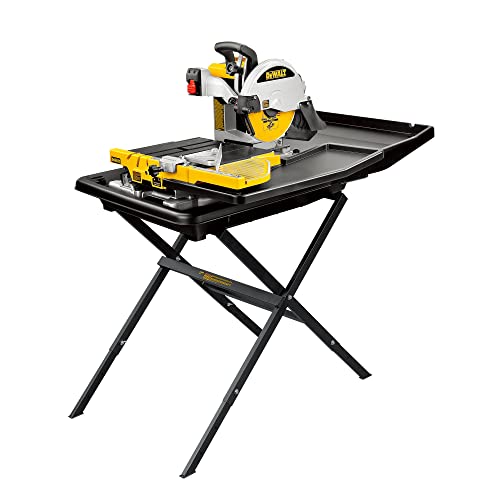
DEWALT D24000S 10 inch wet tile saw with stand, 1.5 HP
10 inch blade1.5 HP18 inch diagonalStand included
Check price on Amazon
Best for: Tilers and serious DIYers cutting floor tile up to about 18 inches.

The D24000S is a complete tiler's saw: a 10 inch blade, a 1.5 horsepower motor at peak, a folding stand and an included XP4 porcelain blade. Its diagonal capacity is 18 by 18 inches and its maximum cut depth is 3-1/8 inches, which covers floor tile, pavers and thick stone veneer.

The saw weighs 69 pounds, so it is movable by one person but not light, and its footprint of 36 by 29 inches on a 24 inch height is manageable in a garage or a bathroom. Compared with the larger D36000S it gives up rip length but costs less and carries easier. Compared with the VEVOR 10 inch it brings a proven rolling table and a name with parts and blades widely available.

Ownership is about water and blades. Change the tray water often so slurry does not clog the pump, never run the pump dry, and clean the table rails before they gum up. Match blade type to material, using a continuous rim for porcelain and glass and a segmented one for thick stone. Dress a glazed blade on an abrasive block and keep a GFCI outlet between the saw and the wall. Before the first cut of a job, run a scrap tile of the same material through at the planned angle, because glazes and bodies vary and a blade that suits one porcelain can chip another. Mark the cut line on the tile with a soft pencil, align it with the blade edge rather than its center and feed steadily with both hands on the tile.

What works

  • Includes a stand and an XP4 porcelain blade
  • Ten inch blade with 3-1/8 inch cut depth
  • Eighteen by eighteen inch diagonal capacity
  • Replacement blades and parts are easy to find

Watch out for

  • Rip capacity is shorter than the high-capacity D36000S
  • Sixty-nine pounds is awkward to carry upstairs

Spec sheet

Blade
10 inch, 5/8 inch arbor
Motor
1.5 HP peak, 120 volts
Diagonal capacity
18 x 18 inches
Max depth
3-1/8 inches
Weight
69 pounds
02
DEWALT D36000S 10 inch saw, 37 inch rip, 15 amp
37 inch rip41 inch plunge15 amp1/32 inch accuracy
Check price on Amazon
Best for: Contractors cutting large-format porcelain and slab tile.

The D36000S is the high-capacity version for large tile. A 37 inch rip capacity, extending to 41 inches with plunge cuts, and 18 inches of clearance left of the blade let you rip a 36 by 36 inch tile, and the 8-1/2 inch crosscut capacity handles sills and long planks cut at an offset.

A cut-line indicator, a rigid frame and stainless steel rollers deliver accuracy within 1/32 inch over 30 inch cuts, which is what makes large-format tile land square in the field. Compared with the D24000S it takes much larger pieces and weighs more, so plan for two people when moving it.

This saw rewards a setup routine: level the stand, check the rail movement before each job and wipe the rollers clean. Keep the blade sharp, because large tile makes any wandering obvious, and feed slowly through the middle of the cut so the tile does not bind. Use a support table for the outfeed when ripping long pieces. Large-format tile is fragile along its length, so support both ends and avoid letting the offcut hang, which can snap the tile at the end of the cut and leave a ragged edge. The 8-1/2 inch crosscut capacity matters for long planks and window sills, and the 18 inches of clearance to the left of the blade is what allows a 36 inch tile to pass. Check the rollers for slurry buildup every few cuts, because a gritty roller will leave faint scratches on polished porcelain.

What works

  • Thirty-seven inch rip capacity, 41 inches with plunge
  • Accuracy to 1/32 inch over 30 inch cuts
  • Stainless steel rollers and rigid frame
  • Eight and a half inch crosscut for planks

Watch out for

  • Heavy and large for small jobs
  • Higher tier than the 10 inch peers

Spec sheet

Blade
10 inch
Motor
15 amp
Rip capacity
37 inches, 41 inches with plunge
Crosscut
8-1/2 inches
Accuracy
1/32 inch over 30 inch cuts
03
RUBI DC-250 Python 1200 electric tile cutter, 48 inch
48 inch cut33 inch diagonal2790 RPMZero Dust
Check price on Amazon
Best for: Tilers who cut large tile and want better dust control.

The RUBI Python is a rail cutter with a 48 inch cut length and a 33 inch diagonal cut. The motor assembly rides on sliding bearings, the machine folds at 45 degrees for miters and the maker's Zero Dust system is certified by TNO to reduce silica exposure.

Its value is in long, straight cuts and in dust management: a motor that slides on bearings gives smooth travel, and the dust system matters in an enclosed bathroom. Compared with the DEWALT saws it is a different machine for long cuts and miters, and it is built around the blade passing over the tile.

Rail cutters reward careful setup: lock the guides, support long tiles at both ends and let the blade do the work. Clean the bearings and keep the water system flowing, since a dry blade overheats and scars porcelain. A rail machine is also more sensitive to table flatness, so work on a level surface. Because the tile stays still and the motor moves, cuts avoid the table-edge chipping that plagues tile pushed across a metal tray, and a 33 inch diagonal capacity means a 24 inch square tile can be cut on the diagonal for diamond layouts. Rinse the bearings and rails after a wet day and keep the Zero Dust system serviced as the manual directs, since a clogged water path undermines the dust protection that you paid for.

What works

  • Forty-eight inch cut length
  • Zero Dust system certified by TNO
  • Sliding bearings for smooth travel
  • Folds at 45 degrees for miters

Watch out for

  • Different workflow from a standard table saw
  • Highest tier in this lineup

Spec sheet

Cut length
48 inches
Diagonal cut
33 inches
Speed
2790 RPM
Power supply
120 volts, 60 hertz
Dust system
Zero Dust, TNO certified
04
VEVOR 10 inch wet tile saw with stand, 15 amp
10 inch15 amp4500 RPM0-45 bevel
Check price on Amazon
Best for: A one-project remodel needing a 10 inch saw at a lower tier.

VEVOR's 10 inch saw is the value alternative to the DEWALT. It lists a 15 amp motor at 4500 RPM, a 0 to 45 degree adjustable cutting angle marked at 0, 22.5 and 45, a detachable polypropylene water reservoir and a pump system, plus a stand.

The detachable reservoir is a good design choice because it makes cleaning slurry easier. Compared with the D24000S it is a lower-tier option with less brand support, so replacement blades and parts need a little more searching.

Check the table for flatness and the fence for square before the first cut, and keep water flowing at all times. Replace the water often and wipe the rails after use. Treat it as a good saw for a bathroom remodel and be realistic about long daily use. The listing refers to a steel blade, so confirm it is a diamond-rim blade suited to porcelain before cutting hard tile, and keep a spare diamond blade from a known maker in the box in case the supplied one chips. Adjusting the angle between 0 and 45 degrees is quick, but re-check the fence square after every change since a loose lock lets the tile creep.

What works

  • Fifteen amp motor and 10 inch blade
  • Detachable reservoir for easy cleaning
  • Zero to 45 degree bevel marked at 22.5 and 45
  • Stand included

Watch out for

  • Less brand support than DEWALT
  • Not designed for daily pro use

Spec sheet

Blade
10 inch 65Mn steel
Motor
15 amp, 4500 RPM
Bevel
0 to 45 degrees
Water
Detachable PP reservoir and pump
Stand
Included
05
Hoteche 8 inch wet tile saw with stand, 8 amp
8 inch8 amp3550 RPMTilting body
Check price on Amazon
Best for: DIYers wanting a step up from a 7 inch saw.

Hoteche's 8 inch saw sits between the 7 and 10 inch classes, with an 8 amp motor at a no-load speed of 3550 RPM. The saw body tilts from 45 to 90 degrees for bevel cuts, and a stand and a roomy table are included.

The tilting body means the blade moves rather than the table, which keeps the tile flat during bevel cuts. Compared with the 7 inch saws it gives more cut depth and a bigger table, and compared with the 10 inch saws it costs less and carries more easily.

Be realistic about capacity: an 8 inch blade handles standard floor tile and mosaic, not large panels. Keep the pump submerged, clean the reservoir and use a blade rated for porcelain on hard tile. Because the body tilts rather than the table, bevel cuts on a wet tile look the same as straight ones to the operator, and that makes it easy to forget the angle setting after a series of bevels. Check the scale before each new piece and lock the tilt firmly, since an eight inch blade moves quickly through a tile that is not held flat on the table.

What works

  • Eight inch blade for deeper cuts
  • Body tilts 45 to 90 degrees
  • Stand included
  • Eight amp motor

Watch out for

  • Not suited to large-format tile
  • Less brand support

Spec sheet

Blade
8 inch
Motor
8 amp, 3550 RPM no load
Tilt range
45 to 90 degrees
Stand
Included
Table
Spacious
06
EliteEdge 7 inch wet tile saw, 3450 RPM induction
7 inch3450 RPMInduction motor0-45 bevel
Check price on Amazon
Best for: Backsplashes and small tile jobs at a low tier.

The EliteEdge is a 7 inch saw with a 3450 RPM no-load induction motor and a 0 to 45 degree bevel. A water reservoir dampens dust and debris and keeps the blade cool.

Induction motors run quieter than universal motors and are better suited to sustained cuts, which is good for a bench saw. Compared with the 10 inch saws it takes smaller tile and has a shorter rip, so it suits backsplashes and small bathroom jobs.

Check cut capacity before buying and avoid large tiles. Keep the reservoir clean and wear eye and ear protection. A small saw is best used for narrow cuts and mosaics, where the shorter rip is not a limit, and its bench-mounted design means you should clamp or weight the base so vibration does not walk the saw across the table. Keep spare blades on hand, because a seven inch blade is a consumable that wears quickly on hard porcelain, and a dull blade makes a small saw feel underpowered.

What works

  • Induction motor runs quieter than universal types
  • Zero to 45 degree bevel
  • Water reservoir controls dust
  • Low position in the price tiers

Watch out for

  • Limited rip capacity
  • Not for large tile

Spec sheet

Blade
7 inch
Motor
3450 RPM induction
Bevel
0 to 45 degrees
Water
Reservoir dampens dust
Position
Low price tier

Spec sheet decoder

What the numbers on the box really mean

The specs manufacturers lead with, translated into what they tell you about real-world performance.

Rip capacity

The longest straight cut across the table.

Watch forThe D36000S lists 37 inches and the RUBI lists 48 inches.

Diagonal capacity

The largest square tile that can be cut on a diagonal.

Watch forThe D24000S lists 18 x 18 inches.

Peak horsepower

A short-term power rating, not continuous power.

Watch forThe D24000S lists 1.5 HP peak.

Bevel range

The angle range for angled cuts.

Watch forThe VEVOR and EliteEdge list 0 to 45 degrees.

Zero Dust

A system that reduces airborne silica.

Watch forThe RUBI lists it as TNO certified.

Methodology

How We Evaluated These Tile Saws

Capacity

We compared rip and diagonal capacities, from 18 inch diagonal on the D24000S to 37 and 48 inch rips on the D36000S and RUBI.

Motor and cutting

We read motor ratings and RPM figures but treated peak numbers cautiously.

Accuracy

We noted rollers, frames and the 1/32 inch accuracy claim on the D36000S.

Water and dust

We weighed pump and reservoir design and the RUBI dust system.

Value

We placed each saw by price tier and asked what each tier adds.

Decision guide

How to Choose the Right Tile Saws

By Tile Size

SituationPickWhy
Small tile and backsplashesEliteEdge 7 inchCompact
Standard floor tileDEWALT D24000S18 inch diagonal
Large-format porcelainDEWALT D36000S37 inch rip
Long straight cuts and dust controlRUBI DC-250 Python48 inch cut
One-off remodelVEVOR 10 inchLower tier
Step up from 7 inchHoteche 8 inchTilting body

By Budget

TierPickWhy
Lowest tierEliteEdge 7 inchEntry
Low tierHoteche 8 inchStand included
Low-middle tierVEVOR 10 inch10 inch
Middle tierDEWALT D24000SStandard
Upper tierDEWALT D36000SLarge format
Top tierRUBI DC-250 PythonRail cutter

Table Saw vs Rail Cutter

Table saw

The DEWALT, VEVOR, Hoteche and EliteEdge saws move the tile on a table past the blade. They are familiar and versatile.

Rail cutter

The RUBI moves the motor over a stationary tile. It handles long cuts and dust well but is a different workflow.

Pick a table saw for general work; pick a rail cutter for long tile.

Bevel and Angles

PreferencePickWhy
Tilting bodyHoteche 8 inch45 to 90 degrees
Marked bevelVEVOR 10 inch0, 22.5, 45
Folds for mitersRUBI DC-250 Python45 degrees
StandardDEWALT D24000SStraight cuts

For Large Porcelain Specifically

Look for

Long rip capacity, rigid rails and a blade made for porcelain. Large tile magnifies any wobble.

In this comparison

The D36000S and RUBI Python are the two with true large-format capacity.

When to Spend More

Spend more if

You cut large tile or work daily: the D36000S or RUBI.

Save if

You have one bathroom to tile. The VEVOR or EliteEdge is enough.

Ownership

Maintenance schedule

The upkeep that decides whether this machine lasts two seasons or ten.

TaskIntervalWhy it matters
Change the waterEvery few hours of cuttingSlurry clogs the pump and dulls the blade.
Clean the railsAfter each jobDried slurry gums rails and spoils cut accuracy.
Dress a glazed bladeWhen cuts slowAn abrasive block exposes fresh diamond.
Never run the pump dryAlwaysA dry pump overheats and fails.
Use a GFCI outletEvery useWater and electricity together require protection.

FAQ

Frequently Asked Questions

Is a 7 inch tile saw enough?

For small tile and backsplashes, yes. Larger floor tile needs a 10 inch saw.

What does rip capacity mean?

The longest straight cut across the table. It decides the largest tile you can cut.

Can I cut dry?

Not on a wet saw. Dry cutting overheats the blade and creates dangerous silica dust.

What blade for porcelain?

A continuous rim blade made for porcelain gives clean, chip-free cuts.

Why does my cut chip?

Usually a dull or wrong blade or feeding too fast. Slow down and check the blade. Chipping on the underside of a glazed tile often means the tile is entering the blade from the wrong side, so cut with the glazed face up on a table saw and keep a steady, unhurried feed. A continuous-rim blade made for porcelain reduces chipping further, and a cracked or wobbling blade should be replaced at once instead of tolerated.

Do I need a stand?

Yes, for stability. The DEWALT and VEVOR saws include one.

Bottom line

The short version

Browse more tile sawson Amazon →
James Miller, Lead Machine Editor

About the author

James Miller

Lead Machine Editor, MachineFanatic

James Miller leads MachineFanatic's buying guides, turning spec sheets, manuals and owner feedback into clear verdicts on power tools, outdoor power equipment, shop machines and kitchen machines.

More from James →

Keep reading

Related guides