
Amazon affiliate links - we earn a commission.Affiliate disclosure

Buying guide · 14 min read · Updated 2026-11-09

Best Track Saws (2026)

Corded and cordless track saws compared by plunge depth, rail system, dust port and splinter control, so you can pick one that fits your shop and sheet goods.

James MillerBy James MillerLead Machine Editor6 machines comparedSpec-sheet verified
Best Track Saws

At a glance

Our top picks

A track saw is a plunge-cut circular saw that rides on an aluminum rail, so the blade follows a fixed line instead of your hand. The rail has a rubber strip that presses on the surface and prevents tear-out, which is why the cut edge is clean enough to glue without a second pass.

The spec sheet hides most of what matters: how deep the blade really cuts when it sits on the rail, how the rail is joined, and how well the dust port works.

Before you buy

6 Criteria to Look For Before Buying a Track Saw

  1. 01

    On-rail cutting depth

    A track saw sits on top of the rail, which lifts the blade and reduces depth. Makita rates the SP6000J1 at 2-3/16 inches at 90 degrees and the DeWalt DWS520K at 2-1/8 inches on the track, while the WEN CT1065 rips up to 2-1/3 inches. A common mistake is to buy on the free-hand number and then discover that a 2x6 needs two passes. Look for at least 2 inches on the rail if you cut structural lumber.

  2. 02

    Rail interface and play

    Accuracy comes from how tightly the saw sits on the rail, not the motor. Premium systems like the Festool TS 55 use adjustable guides that remove play, and the Milwaukee has an adjustable cam for the same job. Test by pushing the saw sideways on the rail: any visible movement becomes a wavy cut. A budget saw like the WEN CT1065 can be shimmed, but it needs checking each time.

  3. 03

    Corded versus cordless power

    A corded 10 to 12 amp motor, like the Makita SP6000J1 at 12 amps, delivers steady power all day. Cordless units, like the Milwaukee M18 FUEL and Makita XPS01PTJ, trade runtime for mobility, and a 36V pair of batteries on the Makita comes close to corded performance. Buy cordless only if you already own the battery platform. Otherwise the bare-tool price hides the cost of batteries and a charger.

  4. 04

    Splinter control and rail strip

    The rubber strip on the rail edge supports the surface fibers and is what makes a track saw cut clean. It wears out, and a nicked strip lets tear-out through on veneered plywood. The Festool has a replaceable guard on both sides, and the DeWalt includes a zero-clearance system. Plan to replace strips as consumables and check them before expensive material.

  5. 05

    Dust port and vacuum fit

    A track saw throws a lot of fine dust when it plunges into sheet goods. A vac port that fits a standard hose and a vacuum with auto-start turns a messy job into a mostly clean one. The Milwaukee and Festool both emphasize the port, and the WEN has one too. Mixed port sizes are a common frustration, so check that your hose fits before you buy.

  6. 06

    Rail length and joining

    A 55 inch rail is enough for a crosscut on a sheet but not for an 8 foot rip. The Makita SP6000J1 and Festool ship with 55 inch rails, and the WEN CT1065 and Dekopro style bundles use two shorter rails that join. Joining rails adds a small alignment risk at the seam. If you rip full sheets weekly, budget for a long rail or a reliable connector.

Detailed reviews

The 6 best track saws, explained

01
Makita SP6000J1 6-1/2 in Plunge Saw Kit with 55 in Rail
12 amp corded2,000-5,200 RPM55 in guide railStackable case
Check price on Amazon
Best for: Woodworkers who want a proven corded track saw kit that cuts full-size sheet goods.

The SP6000J1 is a plunge saw built around a 12 amp motor with electronic speed control and a dial that sets the blade between 2,000 and 5,200 RPM. Electronic feedback holds blade speed under load, which matters when you push through dense hardwood or a laminate-faced panel. The kit includes a 55 inch rail and a stackable case, so it is ready to cut a full sheet lengthwise.

5 and 45 degrees. It is a cord tool, so you trade the freedom of the Milwaukee for a motor that never runs out of charge.

Ownership is simple: wipe the rail strip clean, keep the plunge column free of dust and replace the splinter strip when it gets chewed. A 55 inch rail is short for a 96 inch ripping line, so budget for a second rail and connector if you break down full sheets often.

What works

  • Electronic speed control holds RPM under load
  • Wide 2,000 to 5,200 RPM speed range
  • Includes 55 inch rail and stackable case
  • Bevel stops at 22.5 and 45 degrees

Watch out for

  • 55 inch rail needs a second rail for 8 foot sheets
  • Corded, so cord management matters on a job site

Spec sheet

Motor
12 amp, electronic speed control
Speed range
2,000 to 5,200 RPM
Depth at 90 degrees
2-3/16 in
Depth at 45 degrees
1-9/16 in
Bevel range
-1 to 48 degrees
Kit
55 in rail and case
02
Festool TS 55 FEQ Plunge Track Saw with 55 in Rail
1,200 W corded55 mm depthSplinter guard47 degree bevel
Check price on Amazon
Best for: Cabinetmakers and finish carpenters who cut veneered or melamine panels all day.

The TS 55 is the saw most other track saws are measured against. Festool designed the rail and saw as one system: the saw locks onto the rail with adjustable guides so there is no play, and a replaceable splinter guard supports the wood fibers on the cut line. The result is a cut that looks like it came off a panel saw, even on veneered plywood.

The bevel runs up to 47 degrees, and the cut line stays on the rail edge as the saw tilts, which means you do not have to recalibrate when you switch from straight to angled cuts. The Makita has a bigger motor and a lower cost of entry.

The ownership upside is that the system is shared across sanders and routers, and the dust port connects directly to a vacuum with a standard hose. Rail strips and splinter guards are replaceable, and a worn one is easy to see.

What works

  • Zero-play rail and saw interface
  • Replaceable splinter guard on both sides
  • Cut line holds through the full bevel range
  • Ports directly to a shop vacuum

Watch out for

  • Priced as a premium tool, far above the others here
  • 55 inch rail is short for 8 foot sheets

Spec sheet

Motor
1,200 W, electronically regulated
Cut depth
55 mm (about 2-3/16 in)
Bevel
Up to 47 degrees
Rail
55 inch FS rail included
Splinter guard
Replaceable, both sides
Dust
Vac port for hose
03
DEWALT DWS520K 6-1/2 in TrackSaw Kit
Corded2-1/8 in on-track depthDual-edge trackZero clearance
Check price on Amazon
Best for: Remodelers who want a ready-to-cut kit from a familiar job-site brand.

The DWS520K is a 6-1/2 inch plunge saw sold as a kit with a track, designed to deliver zero-clearance cuts along a rail. Its dual-edged track lets you cut from either side, so you can place the rail on the good side of the stock or the reverse side without turning the panel around.

On the track it cuts 2-1/8 inches deep at 90 degrees and 1-5/8 inches at 45 degrees, and the depth scale shows the setting. It lacks the speed range of the Makita, so thin laminate or plastics are easier to cut cleanly on the Makita.

The cord is the usual limit, and the track should be stored flat so it does not bow. Check the rubber strip for nicks, because a damaged strip lets splinters through.

What works

  • Dual-edge track cuts from either direction
  • Depth scale shows the exact setting
  • Zero-clearance cut system reduces tear-out
  • Plunges cleanly for pocket cuts

Watch out for

  • Slightly shallower on-track depth than the Makita
  • No wide speed dial for laminates and plastics

Spec sheet

Power
Corded
Depth on track, 90 degrees
2-1/8 in (54 mm)
Depth on track, 45 degrees
1-5/8 in (41 mm)
Track
Dual-edge, cuts both directions
Cut system
Zero clearance
Depth scale
Indicates exact depth
04
Milwaukee M18 FUEL 2831-20 6-1/2 in Plunge Track Saw (Bare)
M18 FUEL brushlessPOWERSTATE motorVariable speed dialBare tool
Check price on Amazon
Best for: M18 owners who want a cordless track saw for jobs without power.

The M18 FUEL track saw puts a brushless POWERSTATE motor on a 6-1/2 inch plunge saw and runs on the M18 battery system. It has a variable speed dial, a quick-lock blade change, a vac port and a smooth plunge action, plus an adjustable cam to take play out of the rail interface.

The key buying detail is the word bare. Compared with the corded Makita, it gives you freedom from the cord and a lighter swing, but you have to manage battery life on long rips.

Ownership comes down to battery planning: for sheet goods, keep a charged high-output pack in reserve, because a brushless saw pulls hard in thick hardwood. Keep the rail strip clean and check the cam adjustment if you feel any wobble.

What works

  • Brushless motor cuts without a cord
  • Quick-lock blade change speeds up swaps
  • Variable speed dial for different materials
  • Adjustable cam removes rail play

Watch out for

  • Bare tool needs a battery and a rail bought separately
  • Long rips drain packs faster than a corded motor

Spec sheet

Platform
M18 FUEL
Motor
POWERSTATE brushless
Blade size
6-1/2 in
Speed
Variable speed dial
Blade change
Quick-lock system
Kit
Bare tool, battery and rail separate
05
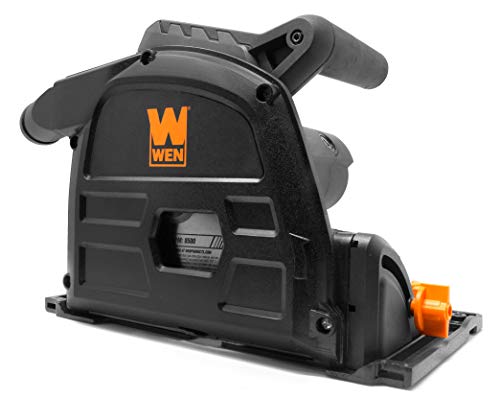
WEN CT1065 10 Amp 6-1/2 in Plunge Track Saw
10 amp corded6-1/2 in blade2-1/3 in rip depth45 degree bevel
Check price on Amazon
Best for: Hobbyists who want to try track sawing at the lowest entry cost.

The WEN CT1065 is the least expensive track saw in this guide and a sensible way to try the format. It has a 10 amp motor and a 6-1/2 inch blade, rips boards up to 2-1/3 inches thick and makes 45 degree bevel cuts in stock up to 1-5/8 inches. It also plunges for internal cuts.

The tradeoffs are visible next to the Makita SP6000J1: a smaller motor, less refined rail interface and no electronic speed feedback. If you plan to use it every week, the Makita and Festool will hold their accuracy longer.

Check the rail seating before the first cut and use a sharp, higher-tooth-count blade for veneered sheets. Store the rail flat and keep the plunge mechanism free of dust.

What works

  • Lowest cost of entry in the lineup
  • Rips up to 2-1/3 in thick stock
  • 45 degree bevel up to 1-5/8 in
  • Plunge action for internal cuts

Watch out for

  • Smaller motor than the Makita or Festool
  • Rail interface is less precise than premium systems

Spec sheet

Motor
10 amp
Blade
6-1/2 in
Rip depth
Up to 2-1/3 in
Bevel depth
1-5/8 in at 45 degrees
Cut type
Plunge and rip
Price tier
Least expensive pick here
06
Makita XPS01PTJ 36V X2 LXT Brushless Plunge Saw Kit
Two 18V LXT packs6,300 RPMBrushless5.0Ah kit
Check price on Amazon
Best for: LXT owners who want cordless power close to a corded track saw.

The XPS01PTJ uses two 18 volt LXT batteries in series to deliver 36 volts to a brushless motor that turns the blade at 6,300 RPM. Makita's automatic speed change technology adjusts speed and torque during the cut, so the saw works harder when it senses load.

The benefit is corded power without the cord, as well as battery compatibility with the many LXT tools sold. 0Ah batteries, which suits cabinet breakdowns but drains quickly on thick, wet lumber.

Ownership centers on the batteries: keep both packs at similar charge and store them out of heat. The rail must be bought as the plunge saw kit is meant to work with Makita guide rails, so confirm compatibility before you buy.

What works

  • Two 18V packs give 36V of power
  • Brushless motor with automatic speed change
  • Runs without a cord on remote jobs
  • Included 5.0Ah batteries

Watch out for

  • Heavier than corded and single-battery saws
  • Guide rail must be matched and bought separately

Spec sheet

Power
Two 18V LXT batteries (36V)
Motor
Brushless
Speed
6,300 RPM
Blade
6-1/2 in
Battery
5.0Ah packs in kit
Feature
Automatic speed change

Spec sheet decoder

What the numbers on the box really mean

The specs manufacturers lead with, translated into what they tell you about real-world performance.

Amps

Amps describe how much current the motor draws, which is a rough proxy for power. A 12 amp motor, like the Makita, can sustain load better than a 10 amp one.

Watch forA 10 amp saw like the WEN CT1065 is fine for plywood but slower in thick hardwood. Do not assume more amps means a better rail system.

No-load RPM

This is the blade speed with nothing in the cut. Speed drops under load, and good motors hold it with electronics.

Watch forA 6,300 RPM figure on the cordless Makita is a no-load number. Check whether the saw holds speed in thick stock.

Depth at 90 and 45 degrees

Depth tells you how thick a board the blade clears. At 45 degrees the blade tilts and the cut depth falls, which is why 1-9/16 inches is common at that setting.

Watch forSome listings quote a free-hand depth. Compare on-track depth, as the DeWalt and Makita do.

Bevel range

Bevel range is how far the saw tilts for angled cuts. Makita lists -1 to 48 degrees and the Festool reaches 47.

Watch forA saw that tilts but moves the cut line off the rail edge forces you to recalibrate. The Festool design keeps the line constant.

Brushless motor

A brushless motor uses electronics to commutate instead of carbon brushes, which reduces friction and heat and extends runtime on batteries. It also removes brush replacement from maintenance.

Watch forBrushless does not mean powerful by itself. A brushless saw with a small pack will still run out of charge in thick stock.

Methodology

How We Evaluated These Track Saws

Cut depth on the rail

We compared the rated depth at 90 and 45 degrees for each saw, favoring figures given with the saw on the track. The Makita SP6000J1 at 2-3/16 inches set the top of the corded range, and the DeWalt DWS520K at 2-1/8 inches was close behind. Saws that quote only free-hand depth were treated with caution.

Rail system and accuracy

We looked at how each saw locks to its rail, whether play can be adjusted and whether the splinter strip is replaceable. The Festool TS 55 and Milwaukee have the most adjustment, and the WEN CT1065 has the least. This matters more than motor size for finish work.

Power and speed control

We compared motor ratings and speed control: the 12 amp Makita with electronic control, the 10 amp WEN and the brushless cordless units. A variable speed dial earned credit because it lets you cut laminate and plastic cleanly.

Dust collection

We checked for a vac port, how it connects and whether the design contains chips at the plunge. A saw that makes the shop clean is easier to use for long jobs. Festool and Milwaukee emphasize their ports.

Ownership and platform

We weighed the kit contents, whether a rail is included and which battery platform a cordless saw requires. The Milwaukee 2831-20 ships as a bare tool, while the Makita XPS01PTJ ships with batteries. This changes the real cost and who should buy each pick.

Decision guide

How to Choose the Right Track Saws

By Type of Work

Match the saw to the material you cut most.

ScenarioPickWhy
Veneered plywood and cabinet panelsFestool TS 55Adjustable guides and replaceable splinter guard
Mixed remodeling lumber and sheet goodsMakita SP6000J112 amp motor, 2-3/16 in depth, ready kit
Framing and 2x stock on siteDEWALT DWS520KDual-edge track and 2-1/8 in depth
Roofing or driveway jobs with no powerMakita XPS01PTJ36V cordless with 5.0Ah packs
Occasional shop breakdownsWEN CT1065Low cost and 2-1/3 in rip depth

By Budget

Relative tiers rather than prices.

TierPickWhy
EntryWEN CT1065Least expensive way to try a track saw
Mid-range cordedDEWALT DWS520KKit with track from a familiar brand
Upper mid-rangeMakita SP6000J1Larger motor and speed range
Cordless investmentMilwaukee 2831-20Brushless, but bare tool
PremiumFestool TS 55Best rail interface and finish quality

Corded vs Cordless

Corded

A corded motor gives constant power and no battery planning. The Makita SP6000J1, DEWALT DWS520K, WEN CT1065 and Festool TS 55 all run this way, and they are the better choice for a shop with outlets.

Cordless

A cordless saw frees you from the cord and extension leads. The Milwaukee 2831-20 and Makita XPS01PTJ fit this group, and they make sense when you already own the batteries and work on sites without power.

Pick corded for shop use and cordless only if you already own the platform.

Kit Contents

PreferencePick
Rail and case includedMakita SP6000J1
Batteries includedMakita XPS01PTJ
Bare tool for existing batteriesMilwaukee 2831-20
Track includedDEWALT DWS520K
Budget bundleWEN CT1065

For Breaking Down Plywood Specifically

Look for

Look for a clean rail strip, a rail long enough for the sheet and a dust port that works with your vacuum. Cutting speed should be adjustable for laminate.

In this comparison

The Festool TS 55 gives the best edge on veneer, while the Makita SP6000J1 is the best all-round kit. The WEN CT1065 handles plywood for hobby use.

When to Spend More

Spend more if

Spend more on the Festool TS 55 if you cut finish panels daily, or on the Makita XPS01PTJ if you need corded-like power without a cord.

Save if

Save with the WEN CT1065 if you cut a few sheets a month, or the DEWALT DWS520K if you want a familiar brand without premium cost.

Ownership

Maintenance schedule

The upkeep that decides whether this machine lasts two seasons or ten.

TaskIntervalWhy it matters
Clean the rail stripBefore each projectSawdust under the strip lifts it and causes tear-out. Wipe it with a dry cloth.
Replace the splinter stripWhen nicked or wornA damaged strip stops supporting the fibers. Replacement is inexpensive compared with ruined plywood.
Check blade squarenessAfter every blade changeA blade a degree off the rail edge cuts out of square. Check with a square on a test cut.
Clear the plunge columnMonthly with heavy useFine dust stiffens the plunge spring and slows the return. Blow it out and wipe the column.
Store rails flatAlwaysA rail that bows will cut a curved line. Store it on a flat shelf or in its case.

FAQ

Frequently Asked Questions

Is a track saw better than a circular saw with a straightedge?

A track saw is more accurate and safer because the saw is locked to the rail and the splinter strip prevents tear-out. A clamped straightedge works for occasional cuts but has more play and no dust control.

Do I need a cordless track saw?

Only if you work away from outlets or already own the battery platform. A corded saw like the Makita SP6000J1 gives steady power with no battery planning.

Why is the rated depth lower than my circular saw?

The rail lifts the saw, so the blade clears less material. Compare on-rail depth, such as the 2-1/8 inches on the DeWalt DWS520K, rather than free-hand depth.

Can I use a universal guide like the Milescraft with my saw?

A universal guide can improve accuracy on a standard circular saw, but it does not plunge or collect dust like a dedicated track saw. It is a budget alternative, not a substitute.

What blade should I use?

Use a thin-kerf blade with a high tooth count, around 48 teeth for veneered plywood. A 24 tooth blade is fine for rough lumber but leaves a coarser edge.

Do I need a dust collector?

A vacuum with a hose that fits the port is enough. Fine sheet-good dust is a health concern, so wear a mask even with a vacuum attached.

Bottom line

The short version

Browse more track sawson Amazon →
James Miller, Lead Machine Editor

About the author

James Miller

Lead Machine Editor, MachineFanatic

James Miller leads MachineFanatic's buying guides, turning spec sheets, manuals and owner feedback into clear verdicts on power tools, outdoor power equipment, shop machines and kitchen machines.

More from James →

Keep reading

Related guides