
Amazon affiliate links - we earn a commission.Affiliate disclosure

Buying guide · 12 min read · Updated 2026-11-14

Best Window Cleaning Robots With Water Spray (2026)

Window cleaning robots that spray their own water: how ultrasonic mist, pressurised jets and manual spray differ, plus tank sizes for six picks.

James MillerBy James MillerLead Machine Editor6 machines comparedSpec-sheet verified
Best Window Cleaning Robots With Water Spray

At a glance

Our top picks

Side by side

Spec comparison

The spray is what turns a window robot from a duster into a washer. A cloth that is evenly damp lifts film and fingerprints, while a dry or patchy cloth only pushes dust around and can leave tracks that are harder to remove than the original dirt.

Not every robot sprays the same way. Some atomise water into a fine mist, some push it out through a pressurised jet, and some let you switch the spray off. Six machines are sorted here by what their spray systems actually do on glass and how long the tank lasts.

Before you buy

6 Criteria to Look For Before Buying a Window Cleaning Robot With Water Spray

  1. 01

    Mist versus jet

    Ultrasonic atomisers on the FMART T11 and AGORVIO create a fine fog that wets the cloth without runs. A pressurised jet, as on the HOBOT-SP10, throws more water and resists wind. Mist suits film and fingerprints, and a jet suits dirtier or breezier conditions.

  2. 02

    Tank volume

    The HUTT A1 carries 150 ml and the iMESA only 35 ml, a gap of more than four times. A big pane can drain a small tank before the robot has finished, leaving a dry cloth to drag dust. Match the tank to the glass area and the number of panes per run.

  3. 03

    Even dampness across the cloth

    Streak-free glass depends on a cloth that is wet from edge to edge. The T11's four-zone layout and the HUTT A1's four nozzles address that directly, while single-nozzle robots leave dry stripes. Look at nozzle count and angle, not only tank size.

  4. 04

    Control over when it sprays

    Spray on dusty glass makes mud on the cloth. The KADSKAN lets you start dry and switch the water on afterward, which protects the cloth on neglected panes. Fully automatic systems give you less say.

  5. 05

    Drying and finish

    Wet glass dries to a film unless the water is removed. The HOBOT-SP10 scrapes it off, and the others rely on the cloth absorbing it. If streaks bother you, a scraper or a second dry pass is worth more than a bigger tank.

  6. 06

    Water quality

    Hard tap water leaves spots and scales fine nozzles over time. Fill with filtered or distilled water when you can, and rinse nozzles regularly. More nozzles mean more places to scale.

Detailed reviews

The 6 best window cleaning robots with water spray, explained

01
HUTT A1 Window Robot, 4 Water Sprays, 150 ml Tank
4 water sprays150 ml tank6000PaLaser edge sensor
Check price on Amazon
Best for: Large panes that would run a small tank dry.

When spray is the whole question, the A1 answers it with volume. The maker added two nozzles to bring the count to four, and a 150 ml tank sits behind them, so the cloth stays wet across a full large pane instead of drying out on the last third. That is the largest reservoir in this guide.

A wide wet cloth is only useful if the robot holds on, and 6000Pa suction gives it a reasonable margin. A laser edge sensor handles the pane border, and the listing says frameless glass is not a problem, though that is a claim without independent proof. Compared with the HOBOT-SP10 it relies on wetting alone for the finish, with no scraper.

A full 150 ml tank adds weight on the seal, so on tall glass start with a part fill. Rinse the four nozzles with clean water regularly, wash the cloths after every job and always use the rope. Because a wide cloth soaked from four nozzles can drip at the lower edge, lay a towel on the sill before you start, and wipe the track afterward so the runoff does not stain the frame or pool where a child or a pet can reach it.

What works

  • 150 ml tank is the largest in the group
  • Four nozzles spread water across the cloth
  • 6000Pa suction for a steady hold
  • Laser edge sensor for pane borders

Watch out for

  • Full tank adds weight on the suction seal
  • Frameless claim has no independent evidence

Spec sheet

Nozzles
4, upgraded with 2 extra
Tank
150 ml
Suction
6000Pa
Edge sensing
Laser edge detection
Glass types
Frameless listed
02
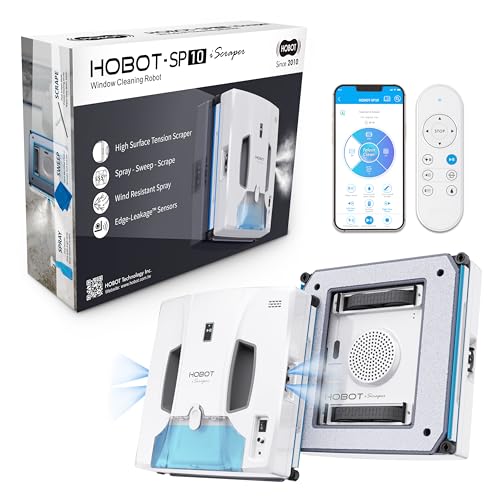
HOBOT-SP10 iScraper, Pressurised Spray and Scrape
Pressurised nozzlesSpray, sweep, scrape6000PaApp and remote
Check price on Amazon
Best for: Breezy balconies and glass that streaks as it dries.

The SP10 does not mist; it sprays. Dual nozzles on each side are fed by a pressurised pump and cover an ultra-wide angle, so the water arrives with some force and does not drift in a breeze. That is the design to look at for windows near an open balcony door, where a fine fog would blow away.

The wet glass is then swept and scraped, which pulls the water off as well as putting it on. Compared with the A1 it carries less water but uses it more purposefully, and it ends with a drier surface, which reduces drying streaks. It costs more, and the scraper edge needs checking for grit.

Inspect the scraper blade for nicks, wash the cloth after every job and keep the nozzles clear of scale. Use the rope and an anchor, and avoid running it in rain or on damp glass. A pressurised pump is louder than a mist system and has more moving parts, so listen for a change in its note after a season of use, since a pump that starts to labour often needs the nozzles flushing before anything more serious is wrong.

What works

  • Pressurised spray holds up in a breeze
  • Scraper removes water after the wipe
  • App and remote control
  • Wide-angle dual side nozzles

Watch out for

  • Scraper edge needs inspection for grit
  • Higher tier than the mist-only robots

Spec sheet

Spray
Dual side nozzles, pressurised pump
Method
Spray, sweep, scrape
Suction
6000Pa
Control
App and remote
Glass
Framed and frameless listed
03
FMART T11 Slim Window Robot, 4 Ultrasonic Sprays, 5300Pa
4 ultrasonic sprays5300PaUnder 60 dB60 mm thin
Check price on Amazon
Best for: Quiet use on films and fingerprints in apartments.

The T11 spreads its spray across four wide-angle ultrasonic nozzles aimed at different zones of the cloth. Ultrasonic atomising breaks water into a fine mist that wets the fibres without droplets that run down the glass, and four zones keep the dampness even from edge to edge.

Because mist is gentle, it is better at film and fingerprints than at baked-on dirt, and the 5300Pa suction is the lowest rating in this guide. What it adds is quiet running, under 60 dB, and a slim 60 mm body that clears frames. Next to the HUTT A1 it carries less water but costs less.

Rinse the four nozzles with clean water every few weeks and wash the cloths after each use. Keep the rope on and wipe the seal ring before every run. Mist systems are sensitive to water quality, so a bottle of distilled water on the shelf next to the robot is the cheapest way to keep the four nozzles from furring up with scale and leaving a dry stripe on the cloth.

What works

  • Four ultrasonic nozzles wet the cloth evenly
  • Under 60 dB running is quiet
  • 60 mm slim body clears frames
  • Lower tier than the HUTT and HOBOT picks

Watch out for

  • Mist is gentle on baked-on dirt
  • 5300Pa leaves a small grip margin

Spec sheet

Spray
Four-zone ultrasonic nozzles
Suction
5300Pa
Noise
Under 60 dB
Thickness
60 mm
Layout
Wide-angle nozzles, precision angles
04
KADSKAN Window Robot, 5600Pa, Automatic or Manual Spray
5600PaAuto or manual sprayDouble spiral headFibre cloth
Check price on Amazon
Best for: Dusty glass where a dry first pass saves the cloth.

The KADSKAN is the one to pick if you want to decide when the water flows. Spray can run automatically or be triggered manually, so you can start with a dry pass over dusty glass to lift loose grit, then switch the water on for the film. That order protects the cloth from clogging with wet dust.

A double spiral head and an ultra-fine fibre cloth do the scrubbing, and it is marketed for tiles and glass doors as well as windows. Its 5600Pa is mid-range, and it is the cheapest of the six, so the compromise is documentation and tank detail, which the features do not give.

Check the tank size with the seller, wash the cloth after every run and wipe the seal ring. Smooth, flat tiles only, and stay beside it on any wall tile. For a truly neglected window, do the dry pass twice before any water goes on, because the first pass lifts the loose dust and the second picks up what the first disturbed, leaving the wet pass a far cleaner job.

What works

  • Spray can be switched between auto and manual
  • Double spiral head scrubs thoroughly
  • Lowest tier of the six
  • Works on windows, tiles and glass doors

Watch out for

  • Tank size is not stated in the features
  • 5600Pa is mid-range grip

Spec sheet

Spray
Automatic or manual
Suction
5600Pa
Head
Double spiral
Cloth
Ultra-fine fibre
Surfaces
Windows, tiles, glass doors
05
iMESA Window Robot, 5600Pa, 35 ml Precision Sprayer
5600Pa35 ml sprayer5-layer microfibrePath planning
Check price on Amazon
Best for: Small panes and first-time owners at a low tier.

The iMESA pairs a modest automatic sprayer with a thick cloth. A 35 ml precision sprayer is the smallest tank in this guide, but a five-layer thickened microfibre cloth holds water well and spreads it, so it stretches a small reservoir further than a thin cloth would.

At 5600Pa it is a plain mid-range robot, and the 35 ml tank means it suits small panes best: on a large window it will run out and the cloth will go dry. It sits well below the HUTT A1 on capacity, but its low tier and plain operation make it a reasonable trial robot.

Swap the cloth when it stops absorbing, rinse the sprayer and keep an eye on the water level during longer runs. Wipe the seal ring before each use and keep the rope attached. Because the tank is so small, refill it before each pane rather than each room, and set the robot on the glass only after the cloth has soaked through, otherwise the first minute is spent dragging a half-dry cloth across dust.

What works

  • 5-layer cloth holds and spreads water
  • Automatic precision sprayer
  • 5600Pa suction
  • Low tier among the six

Watch out for

  • 35 ml tank is the smallest in the group
  • Large panes will run the cloth dry

Spec sheet

Spray
35 ml automatic precision sprayer
Suction
5600Pa
Cloth
5-layer thickened microfibre
Navigation
Smart path planning
Tier
Low
06
AGORVIO Window Robot, Ultrasonic Atomiser, Brushless DC Motor
Brushless DC motorUltrasonic atomiserSmart chipAuto spray
Check price on Amazon
Best for: Buyers who want a quiet, long-lived motor with fine mist.

The AGORVIO leans on its motor and its chip. A brushless DC motor runs the pump with less noise and wear than a brushed unit, and a smart chip with sensors steers the path. The spray is an ultrasonic atomiser fed from a built-in tank, so the mist is fine and even.

The listing gives no tank volume or pascal figure in the features, which is a gap compared with the HUTT A1 or the iMESA. It suits people who value a quiet, long-lived motor and are willing to ask the seller for the numbers.

Wash the cloth after each run and rinse the atomiser with clean water. Keep the rope on, and note the model name for any warranty claim. A brushless motor does not cure a clogged atomiser, so run clean water through it after every few sessions, and if the mist turns patchy, remove the cloth and look for white mineral crust on the outlet before blaming the pump.

What works

  • Brushless DC motor with less wear and noise
  • Ultrasonic atomiser gives a fine mist
  • Smart chip with precision sensors
  • Automatic spray needs no setting

Watch out for

  • No tank volume or suction figure in the features
  • Limited brand history to judge by

Spec sheet

Spray
Built-in tank with ultrasonic atomiser
Motor
Brushless DC
Navigation
Smart chip with precision sensors
Control
Automatic spray
Tier
Low to middle

Spec sheet decoder

What the numbers on the box really mean

The specs manufacturers lead with, translated into what they tell you about real-world performance.

Ultrasonic atomiser

A vibrating element breaks water into a fine mist that wets the cloth evenly without droplets. It uses little water and runs quietly.

Watch forFMART T11 and AGORVIO both list one.

Pressurised nozzle

A pump pushes water through a jet with force, so the spray carries and resists wind. It uses more water than a mist.

Watch forHOBOT-SP10 lists dual side pressurised nozzles.

Tank in ml

The volume of water the robot carries. It sets how large a pane one fill can cover.

Watch forHUTT A1 lists 150 ml and iMESA 35 ml.

Four-zone spraying

Four nozzles aimed at different parts of the cloth so dampness is even across its width.

Watch forFMART T11 lists it, as does the HUTT A1 with four sprays.

Auto and manual spray

The spray can fire on its own or be triggered by you. Manual control lets you clean dry first.

Watch forKADSKAN lists both modes.

Methodology

How We Evaluated These Window Cleaning Robots With Water Spray

Spray system design

We compared mist, jet and manual systems on what each does to the cloth and to the glass. Four nozzles on the HUTT A1 and FMART T11 and pressurised nozzles on the HOBOT-SP10 stood out. The aim was an evenly damp cloth for the whole run.

Tank against pane size

Tank volumes were set against typical pane areas. The HUTT A1's 150 ml and the iMESA's 35 ml sit at opposite ends. A robot that runs dry halfway scored low regardless of its other features.

Finish

Scrapers, absorbent cloths and double spiral heads were compared for what is left on the glass. Owner feedback patterns on drying streaks shaped the ordering, with the scraper design ahead.

Documentation

We noted which listings state tank volume and suction. The AGORVIO and KADSKAN leave the tank unstated, which counted against them. Clear numbers helped a model.

Value by tier

Relative tiers run from the KADSKAN and iMESA at the bottom to the HOBOT-SP10 at the top. A step up had to bring more water, a better finish or quieter running.

Decision guide

How to Choose the Right Window Cleaning Robots With Water Spray

By Pane Size

SituationPickWhy
Large panes, one fillHUTT A1150 ml tank
Medium panes in a flatFMART T11Four-zone mist, quiet
Small panes onlyiMESA35 ml with a thick cloth
Dusty glass needing a dry passKADSKANManual spray option
Windy balcony glassHOBOT-SP10Pressurised jets

By Budget

TierPickWhy
Lowest tierKADSKANAuto and manual spray
Low tieriMESAThick cloth and precision sprayer
Lower-middle tierAGORVIOBrushless motor and atomiser
Middle tierFMART T11Four ultrasonic zones
Upper tierHUTT A1 or HOBOT-SP10Big tank or scraper finish

Mist vs Pressurised Jet

Mist

The FMART T11 and AGORVIO create a fine fog from ultrasonic atomisers. It wets evenly, uses little water and runs quietly. It struggles on heavy grime and in wind.

Pressurised jet

The HOBOT-SP10 throws water with force across a wide angle. It handles wind and heavier dirt, and the scraper finishes the job. It uses more water and costs more.

Mist for indoor film and fingerprints, jet for breezy or dirtier glass.

Control Over the Spray

PreferencePickWhy
Start dry, then wetKADSKANManual spray
Set and forgetAGORVIOAutomatic atomiser
Even coverageHUTT A1Four nozzles
Remote and app controlHOBOT-SP10App and remote

For Streak-Prone Glass Specifically

Look for

Even wetting plus a way to remove the water. A scraper, a thick absorbent cloth or a second dry pass all help. Hard water makes streaks worse, so use filtered water.

In this comparison

The HOBOT-SP10 is the strongest answer thanks to its scraper. The HUTT A1 and FMART T11 give even wetting, and the iMESA's thick cloth helps on small panes.

When to Spend More

Spend more if

Your panes are large or your glass streaks. The HUTT A1 and HOBOT-SP10 spend money on water volume and finish.

Save if

You have a few small panes with light film. The KADSKAN or iMESA is enough.

Ownership

Maintenance schedule

The upkeep that decides whether this machine lasts two seasons or ten.

TaskIntervalWhy it matters
Rinse nozzles or the atomiserEvery few weeksMinerals clog fine outlets. Use clean or distilled water.
Wash and dry clothsAfter every jobGrit in a damp cloth scratches glass. Dry cloths last longer.
Empty the tank after useAfter each sessionStale water turns cloudy and sprays onto clean glass at the next start.
Inspect the scraper edgeMonthlyA nicked blade scratches glass. Replace it at once.
Wipe the seal ring and check the ropeBefore each useDust weakens the grip and a frayed rope removes the safety margin.

FAQ

Frequently Asked Questions

Why does my window robot leave streaks?

A wet film dries before the cloth removes it, or the cloth is dirty or too damp. A scraper, even wetting and filtered water all help. Wash the cloth after every job.

Is mist better than a jet?

Mist wets evenly and quietly and suits film and fingerprints. A jet carries in wind and handles dirtier glass. The best one depends on where the window is.

How big a tank do I need?

For a large pane, 100 ml or more avoids running dry, and the HUTT A1 offers 150 ml. A 35 ml tank is fine for small panes with a thick cloth.

Can I switch the spray off?

On the KADSKAN, yes. Starting dry on dusty glass protects the cloth from turning to mud.

Does hard water matter?

Yes. It leaves spots and scales fine nozzles over time. Use filtered or distilled water and rinse the nozzles regularly.

Can I use window cleaner in the tank?

Follow the maker's guidance. Soap can foam in the pump and leave film, so plain water is the safe default.

Bottom line

The short version

Browse more window cleaning robots with water sprayon Amazon →
James Miller, Lead Machine Editor

About the author

James Miller

Lead Machine Editor, MachineFanatic

James Miller leads MachineFanatic's buying guides, turning spec sheets, manuals and owner feedback into clear verdicts on power tools, outdoor power equipment, shop machines and kitchen machines.

More from James →

Keep reading

Related guides