
Amazon affiliate links - we earn a commission.Affiliate disclosure

Buying guide · 13 min read · Updated 2026-11-07

Best Wire Free Robot Lawn Mowers (2026)

Six wire-free robot mowers compared by navigation method, lawn size, edge trimming and obstacle handling, so you pick the right way to map your yard.

James MillerBy James MillerLead Machine Editor6 machines comparedSpec-sheet verified
Best Wire Free Robot Lawn Mowers

At a glance

Our top picks

Side by side

Spec comparison

MachineCoveragePositioningVisionMapping
WORX WR320 Landroid Vision Cloud robot mower, half acreBest OverallWORX WR320 Landroid Vision Cloud robot mower, half acreUp to 1/2 acreRTK delivered via cloudAI obstacle recognitionAutomatic mapping
ECOVACS GOAT A2000 LiDAR PRO dual-LiDAR robot mowerBest LiDAR PickECOVACS GOAT A2000 LiDAR PRO dual-LiDAR robot mowerUp to 1/2 acren/an/aWire-free auto mapping
Segway Navimow i110N RTK and vision robot mowerBest Quarter-Acre PickSegway Navimow i110N RTK and vision robot mowerUp to 1/4 acreEnhanced RTK (EFLS 2.0)Vision system for obstaclesn/a
Segway Navimow i105N RTK and vision robot mowerBest Small-Lawn ValueSegway Navimow i105N RTK and vision robot mowerUp to 1/8 acreRTK and visionn/an/a
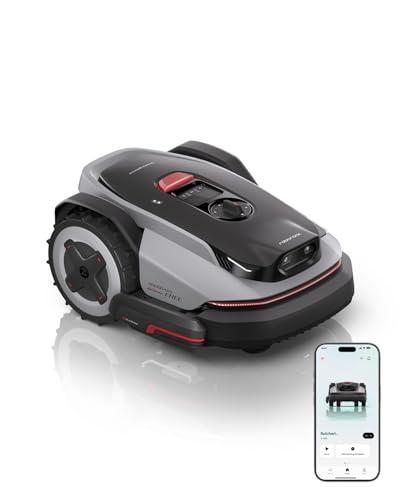
Roborock RockNeo Q110H full-band RTK and VSLAM robot mowerBest Dual-Camera PickRoborock RockNeo Q110H full-band RTK and VSLAM robot mowern/aFull-band RTKVSLAM, dual-camera AIDual mapping modes
HOOKII Neomow X2 Air 3D LiDAR robot mower, 0.37 acreBest No-Antenna OptionHOOKII Neomow X2 Air 3D LiDAR robot mower, 0.37 acreUp to 0.37 acren/aAI vision, camera expansion portn/a

A wire-free robot mower replaces the old boundary cable with a map the machine builds itself, and that single change is what made robotic mowing practical for ordinary yards. How the mower builds and uses its map is therefore the most important thing to understand before buying one.

The three common approaches are satellite positioning, camera-based vision and laser scanning, and each has a different weakness. Your lawn's tree cover, shape and lighting decide which of those weaknesses you will actually meet, so the navigation system matters more than the headline coverage number.

Before you buy

6 Criteria to Look For Before Buying a Wire Free Robot Lawn Mower

  1. 01

    RTK, LiDAR or vision

    RTK gives centimetre-level position from satellites but needs a clear sky and a correction source. LiDAR scans the surroundings with laser and does not care about trees. Vision uses cameras and depends on light. The WORX WR320 blends RTK with vision, while the ECOVACS GOAT A2000 and HOOKII X2 Air lean on LiDAR.

  2. 02

    Tree and building cover

    Heavy canopy and tall walls reduce satellite accuracy, causing drift or stops on RTK-only mowers. Full-band RTK on the Roborock Q110H holds better, and LiDAR models such as the HOOKII avoid the problem altogether. Walk your lawn in summer when leaves are full to judge it.

  3. 03

    Lawn area claim

    Claimed coverage runs from an eighth of an acre on the Navimow i105N to half an acre on the WORX and ECOVACS. Treat the number as a maximum for open, simple lawns, since beds, trees and slopes slow a robot down. Pick one size above your real area.

  4. 04

    Edge trimming

    Most robot mowers leave a strip of grass along fences and paths because the blade sits inside the body. The ECOVACS GOAT A2000 adds an integrated TruEdge trimmer. Others will need a string trimmer for borders as part of your routine.

  5. 05

    Obstacle recognition

    Bumper sensors only notice an obstacle when they hit it. Vision systems on the WORX, Roborock and Navimow recognize objects before contact, which matters for pets, toys and hoses. Look for stereo or AI vision if the lawn is not always tidy.

  6. 06

    Connectivity

    App control needs a link. Wi-Fi may not reach the far end of a big lawn, while the HOOKII X2 Air uses 4G. Check how the mower behaves when the connection drops and whether it keeps mowing on a stored schedule.

Detailed reviews

The 6 best wire free robot lawn mowers, explained

01
WORX WR320 Landroid Vision Cloud robot mower, half acre
RTK CloudVision AIUp to 1/2 acreNo perimeter wire
Check price on Amazon
Best for: Half-acre lawns with mostly open sky and a mix of garden obstacles.

Worx delivers its satellite correction data through the cloud rather than through a dedicated antenna on the lawn, which cuts setup to a few steps, and pairs it with a camera system that the listing says recognizes and understands objects instead of just bumping into them. That combination is the practical sweet spot: RTK gives centimetre-level position when the sky is clear, and vision fills in where it is not.

The tradeoff is dependence on a connection and a clear sky view. Where trees cover most of the lawn, satellite accuracy drops, and the vision system then carries the load. Compared with the ECOVACS GOAT A2000, the Worx uses RTK plus vision where the ECOVACS uses LiDAR, so the Worx will behave better in open sun and the ECOVACS better under canopy.

As with all robots, ownership is a maintenance routine: replace the blades before they dull, clean the wheels and underbody, and clear sticks that could jam the cutting disc. Keep the firmware updated, and give it a mapped area with no steep drop-offs. For a typical half-acre suburban lawn it is the most balanced choice.

What works

  • RTK plus vision for flexible positioning
  • AI obstacle recognition, not just bump sensing
  • Automatic mapping with no buried wire
  • Covers up to about half an acre

Watch out for

  • Satellite accuracy suffers under dense tree cover
  • Relies on a cloud service for RTK data

Spec sheet

Coverage
Up to 1/2 acre
Positioning
RTK delivered via cloud
Vision
AI obstacle recognition
Boundary
No wire
Mapping
Automatic mapping
02
ECOVACS GOAT A2000 LiDAR PRO dual-LiDAR robot mower
Dual LiDARUp to 1/2 acreTruEdge trimming32V platform
Check price on Amazon
Best for: Lawns with trees and hedges that block satellite signals and many border edges to trim.

ECOVACS uses dual LiDAR, which scans the surroundings with laser rather than relying on satellites, so tree cover and tall hedges do not blind it the way they can an RTK-only machine. It also adds an integrated TruEdge trimmer, which cuts along borders where most robot mowers leave a strip of uncut grass against a fence or path.

The 32V platform is described as built for thick American grasses such as Bermuda, Zoysia, Fescue and St. Augustine, which suggests more motor headroom than light-duty models. The weakness of LiDAR-led navigation is cost and the way scanning can be confused by unusual structures like open lattices, though it handles most yards well. Against the Worx, it trades satellite precision for canopy tolerance.

Ownership centres on keeping the LiDAR windows and sensors clean, replacing blades and the edge-trimming line, and clearing debris. Because the edge trimmer is an extra wear item, plan to replace its line or blade periodically, and check that it is clear of wrapped grass.

What works

  • LiDAR navigation is unaffected by canopy
  • Integrated trimmer cuts border edges
  • 32V platform for thick grass types
  • Up to about half an acre

Watch out for

  • Edge trimmer adds another wear part
  • LiDAR can be confused by unusual structures

Spec sheet

Coverage
Up to 1/2 acre
Navigation
Dual LiDAR
Edges
Integrated TruEdge trimming
Power
32V platform
Mapping
Wire-free auto mapping
03
Segway Navimow i110N RTK and vision robot mower
Up to 1/4 acreRTK and visionAI mappingNo wires
Check price on Amazon
Best for: Quarter-acre flat lawns where an app-mapped, systematic cut is the goal.

Navimow pairs customized RTK positioning with a vision system under the name EFLS 2.0, aimed at complex lawns where satellite signals alone drop out. Setup is by app: you trace or define the boundary on your phone and the mower builds the map, with planned mowing paths that give a tidy systematic cut rather than random zigzags.

It is sized for a quarter acre, which is half of what the Worx and ECOVACS claim, so it suits a modest suburban lawn more than a large property. The step up to the X430 adds acreage and all-wheel drive, but the i110N is the sensible choice if your lawn is moderate and mostly flat.

Keep an eye on blade wear and wheel cleanliness, and give it a charging dock location on firm, level ground with a clear sky view. Because it follows planned lines, a bump in the lawn that throws the machine off line is a sign to fix the ground or add a no-go zone.

What works

  • RTK plus vision tuned for complex lawns
  • Planned mowing patterns give systematic cuts
  • App-based mapping in a few taps
  • Sized to match a quarter acre

Watch out for

  • Limited to about a quarter acre
  • Needs a clear sky view for best RTK accuracy

Spec sheet

Coverage
Up to 1/4 acre
Positioning
Enhanced RTK (EFLS 2.0)
Vision
Vision system for obstacles
Setup
App-based, a few taps
Pattern
Planned mowing paths
04
Segway Navimow i105N RTK and vision robot mower
Up to 1/8 acreRTK and visionNarrow corridorsAI mapping
Check price on Amazon
Best for: Small, shaded lawns and narrow corridors where size and cost matter.

The i105N is the smaller sibling of the i110N, rated for about an eighth of an acre, and the listing stresses its ability to handle lawns covered by trees and narrow corridors. That makes it the right size for a townhouse yard or a front lawn broken up by beds.

Its limits are plain: an eighth of an acre is a small lawn, and if yours is bigger you will need the i110N or a larger model. The vision half of its RTK-plus-vision design is what lets it keep going where trees disrupt satellite positioning, which is a real advantage on small shaded plots.

Ownership is standard robot care. Replace the blades regularly, keep the charging contacts clean and the dock on level ground, and use no-go zones around flowerbeds and delicate planting. Because the lawn is small, the machine finishes quickly and spends most of its time docked, which keeps wear low.

What works

  • Aimed at lawns with trees and narrow corridors
  • RTK and vision work together
  • Planned mowing paths
  • Low outlay in the Navimow range

Watch out for

  • Only about an eighth of an acre
  • Too small if the lawn grows

Spec sheet

Coverage
Up to 1/8 acre
Positioning
RTK and vision
Target
Small, tree-covered lawns
Setup
App mapping, no wires
Pattern
Planned mowing paths
05
Roborock RockNeo Q110H full-band RTK and VSLAM robot mower
Full-band RTKVSLAMDual-camera AIDual mapping modes
Check price on Amazon
Best for: Yards near buildings and trees where a stronger satellite fix and stereo cameras help.

Roborock combines full-band RTK, which listens on more than one satellite frequency to hold a fix under partial cover, with visual SLAM and a dual-camera AI system that the listing says identifies obstacles in stereo. Two mapping modes give you a choice of how to build the lawn map.

Full-band RTK is the more robust cousin of the single-band systems on some rivals, so it should hold position better near buildings and trees, though not under dense canopy. The listing does not give a claimed area in the data provided, so check the maker's stated lawn size before you rely on it for a specific yard. Compared with the Worx, it leans harder on camera hardware.

Expect to keep camera lenses clean, replace blades yearly and update firmware. Make sure the lawn is free of low-light dead spots if the cameras are to work, since vision systems can struggle in deep shade or at dusk.

What works

  • Full-band RTK holds a fix under partial cover
  • Dual-camera stereo obstacle avoidance
  • Two mapping modes
  • No buried wire

Watch out for

  • Lawn size claim should be checked before purchase
  • Camera systems need clean lenses and decent light

Spec sheet

Positioning
Full-band RTK
Vision
VSLAM, dual-camera AI
Mapping
Dual mapping modes
Obstacles
Stereo vision avoidance
Boundary
No wire
06
HOOKII Neomow X2 Air 3D LiDAR robot mower, 0.37 acre
3D LiDAR0.37 acreNo RTK antenna4G app control
Check price on Amazon
Best for: Lawns with trees or no easy antenna position where LiDAR beats satellite mapping.

The Neomow X2 Air skips satellite positioning and relies on a 360 degree 3D LiDAR combined with AI vision, so there is no antenna to place and no sky view to worry about. The listing also gives it 4G connectivity, which means app control works without depending on your home Wi-Fi reaching the far end of the lawn.

A reserved port allows a triple-vision camera to be added later, which is sold separately, so the base unit relies on LiDAR plus its standard vision. At 0.37 acre it sits between the Navimow i110N and the half-acre models. Compared with the ECOVACS, it also uses LiDAR but is sized slightly smaller and emphasizes the no-antenna setup.

The usual robot upkeep applies: sharp blades, clean sensors and a firm, level dock position. Because it relies on scanning, keep the LiDAR window clear of dirt and spider webs, and check the lawn boundary map after any landscaping change.

What works

  • No RTK antenna to install
  • 360 degree 3D LiDAR is unaffected by canopy
  • 4G app control away from Wi-Fi
  • Camera expansion port for later

Watch out for

  • Extra camera is sold separately
  • Smaller than the half-acre models

Spec sheet

Coverage
Up to 0.37 acre
Navigation
360 degree 3D LiDAR SLAM
Antenna
No RTK antenna needed
Connectivity
4G app control
Vision
AI vision, camera expansion port

Spec sheet decoder

What the numbers on the box really mean

The specs manufacturers lead with, translated into what they tell you about real-world performance.

RTK

Real-time kinematic positioning. It corrects satellite signals to centimetre-level accuracy when it has a clear view.

Watch forFull-band RTK on the Roborock uses more than one frequency, which holds better under partial cover.

LiDAR

A laser scanner that builds a 3D map of the surroundings. It works without satellites.

Watch forThe ECOVACS uses dual LiDAR and the HOOKII a 360 degree 3D unit.

VSLAM

Visual simultaneous localization and mapping, where cameras build a map and locate the mower in it.

Watch forThe Roborock Q110H uses it; it needs decent light.

Coverage (acres)

The maximum lawn area the maker claims the mower can manage in normal conditions.

Watch forFrom about 1/8 acre on the i105N to 1/2 acre on the WORX and ECOVACS.

No-go zones

Virtual areas you mark on the app map where the mower must not go.

Watch forAll of these support them; use them around beds, ponds and soft edges.

Methodology

How We Evaluated These Wire Free Robot Lawn Mowers

Navigation method

We classified each mower as RTK, LiDAR, vision or a blend, and matched that to typical yard problems such as trees and walls. A method that fails in your yard cannot be rescued by other specs. We relied on listing descriptions.

Lawn size fit

We compared claimed areas from an eighth of an acre to half an acre against typical suburban lawns. We treated the figure as a ceiling. A mower sized too close to the lawn will struggle.

Obstacle handling

We looked at whether each robot recognizes objects with AI or stereo vision, or only bumps into them. This matters on messy lawns with pets and toys. Judgments come from spec sheets and owner feedback patterns.

Setup and connectivity

We compared app mapping, antenna requirements and connectivity such as 4G on the HOOKII. Less hardware to place scored higher. We noted when extras are sold separately.

Edge and finish

We noted whether the mower trims borders, as on the ECOVACS, or leaves an edge strip. We also considered planned mowing patterns on the Navimow models, which give a more even finish.

Decision guide

How to Choose the Right Wire Free Robot Lawn Mowers

By Lawn Condition

SituationPickWhy
Open sky, half acreWORX WR320RTK with vision AI
Trees and hedgesECOVACS GOAT A2000Dual LiDAR ignores canopy
No antenna positionHOOKII Neomow X2 AirLiDAR with no RTK antenna
Partial cover, buildingsRoborock Q110HFull-band RTK and stereo vision
Quarter acre, flatNavimow i110NPlanned paths, app mapping
Small shaded corridorsNavimow i105NAimed at trees and narrow gaps

By Budget

TierPickWhy
Lowest outlayNavimow i105NSmallest, simplest in the group
Low to midNavimow i110NQuarter-acre capacity
Mid tierRoborock Q110HFull-band RTK and dual cameras
Mid to upperHOOKII Neomow X2 Air3D LiDAR and 4G
Upper tierWORX WR320 or ECOVACS GOAT A2000Half-acre capacity

Satellite vs LiDAR

Satellite (RTK)

The WORX WR320, Navimow models and Roborock Q110H use RTK, which gives precise paths in the open and needs a clear sky. Dense canopy or tall buildings can cause drift.

LiDAR

The ECOVACS GOAT A2000 and HOOKII X2 Air scan with lasers, so trees do not matter. The price is that scanning can be confused by unusual structures and the sensor must stay clean.

Pick RTK for open lawns and LiDAR for shaded or tree-dotted ones.

By Extra Feature

PreferencePickWhy
Edge trimming built inECOVACS GOAT A2000TruEdge trimmer
Control without Wi-FiHOOKII Neomow X2 Air4G app control
Best object recognitionWORX WR320AI vision
Systematic stripesNavimow i110NPlanned mowing paths

For Shaded Lawns Specifically

Look for

LiDAR or full-band RTK with vision backup, and a mower that keeps working when satellite signals weaken. Check how the maker describes tree-covered lawns.

In this comparison

The ECOVACS GOAT A2000 and HOOKII X2 Air use LiDAR, and the Navimow i105N is aimed at tree-covered lawns. The WORX relies more on open sky.

When to Spend More

Spend more if

The lawn is near half an acre or has tricky shade. The WORX WR320 or ECOVACS GOAT A2000 give the largest area and the most robust navigation.

Save if

The lawn is small and simple. The Navimow i105N or i110N covers it without paying for half-acre capacity.

Ownership

Maintenance schedule

The upkeep that decides whether this machine lasts two seasons or ten.

TaskIntervalWhy it matters
Replace the cutting bladesEvery few monthsRobot blades are thin and dull quickly. A dull blade tears the lawn and drains the battery.
Clean sensors and lensesWeeklyDirt on a LiDAR window or camera lens degrades navigation and causes stops.
Wipe charging contactsMonthlyCorroded or dirty contacts stop the robot docking. A clean contact keeps it running on schedule.
Clear sticks and stonesBefore each run periodDebris jams the cutting disc and trips obstacle sensors. Walk the lawn periodically.
Update firmware and review the mapAfter landscaping changesNew beds, trees or paths change the map. Re-check no-go zones and boundaries.

FAQ

Frequently Asked Questions

Do I need to bury a wire?

Not for the models here. They build a virtual map by satellite, vision or LiDAR, which you adjust in an app.

Which navigation is best under trees?

LiDAR, as on the ECOVACS GOAT A2000 and HOOKII X2 Air, since it does not rely on satellites. Full-band RTK holds better under partial cover than single-band RTK.

How big a lawn can these handle?

Claims run from about an eighth of an acre on the Navimow i105N to half an acre on the WORX WR320 and ECOVACS GOAT A2000. Pick one size above your real lawn.

Will a robot mow in the rain?

Most have rain sensors that send them home, but wet grass clumps and cuts poorly. Check the maker's weather guidance.

Do robot mowers trim the edges?

Usually not, since the blade sits inside the body. The ECOVACS adds a TruEdge trimmer, otherwise keep a string trimmer for borders.

Are robot mowers safe for pets?

They stop blades on lift or tilt and use obstacle sensing. Vision models recognize objects, but keep pets and toys off the lawn while it runs as a precaution.

Bottom line

The short version

Browse more wire free robot lawn mowerson Amazon →
James Miller, Lead Machine Editor

About the author

James Miller

Lead Machine Editor, MachineFanatic

James Miller leads MachineFanatic's buying guides, turning spec sheets, manuals and owner feedback into clear verdicts on power tools, outdoor power equipment, shop machines and kitchen machines.

More from James →

Keep reading

Related guides