
Amazon affiliate links - we earn a commission.Affiliate disclosure

Buying guide · 14 min read · Updated 2026-11-09

Best Wood Routers (2026)

Wood routers compared by horsepower, collet size, speed range, fixed versus plunge base and depth adjustment, for edge profiles, joinery and router tables.

James MillerBy James MillerLead Machine Editor6 machines comparedSpec-sheet verified
Best Wood Routers

At a glance

Our top picks

Side by side

Spec comparison

A router spins a bit at 8,000 to 25,000 RPM to cut edge profiles, grooves, dados, mortises and hinge recesses. It is the single most versatile woodworking power tool, because changing the bit changes the cut, and a good router can sit in a table or ride on a template.

Horsepower claims, speed range and base type decide what a router can do and how safely.

Before you buy

6 Criteria to Look For Before Buying a Wood Router

  1. 01

    Horsepower and amps

    Horsepower claims vary, so use amps. The Bosch 1617 runs 12 amps for 2.25 HP, the DeWalt DW616 runs 11 amps for 1-3/4 HP and the SKIL RT1323 runs 10 amps for 2.0 HP. A 1-1/4 HP, 7.7 amp router handles edge work but struggles with large bits. Match power to your biggest bit. A cheap router with high claimed horsepower will bog before a rated 11 amp tool.

  2. 02

    Fixed versus plunge base

    A fixed base holds the bit at a set height, which suits edge profiles and router tables. A plunge base lets you lower the spinning bit into the work for mortises and stopped grooves. The Bosch 1617EVSPK ships with both, and the DW616 is fixed only. Pick a combo kit if you want one tool for everything. Combo kits save money over buying a plunge base later if you will use both.

  3. 03

    Speed range

    Large bits must run slowly, since rim speed climbs with diameter. The Bosch dial runs 8,000 to 25,000 RPM, which covers large panel bits and small straight bits. A router locked at 22,000 RPM is not safe with a 3 inch bit. Always match speed to bit size. Check the bit manufacturer's maximum RPM, which is printed on the bit or the package.

  4. 04

    Collet size and quality

    The collet grips the bit. Full-size routers use a 1/2 inch collet, which resists vibration and deflection, while trim routers use 1/4 inch. A cheap collet leaves runout, which shows as chatter on the edge. Replace worn collets rather than overtightening. Replace a collet that shows scoring or rust, since runout ruins finishes.

  5. 05

    Depth adjustment

    The DeWalt DW616 adjusts in 1/64 inch steps with a micro-fine ring. Coarse depth adjustment makes it hard to set a precise reveal or fit a joint. Look for a ring or rack-and-pinion system. Deep cuts should be made in several passes of about 1/4 inch.

  6. 06

    Soft start and electronics

    A big motor can twist the router when you switch it on. Soft start, as on the DeWalt DWP611 and SKIL RT1323, ramps up speed gradually. Constant response circuitry on the Bosch holds speed as load changes. These features make a router safer. Soft start is an inexpensive feature that makes the tool much easier to control.

Detailed reviews

The 6 best wood routers, explained

01
Bosch 1617EVSPK 2.25 HP Combination Plunge and Fixed-Base Router Kit
12 amp, 2.25 HP8,000-25,000 RPMPlunge and fixed basesConstant response
Check price on Amazon
Best for: Woodworkers who want one router for edge work, joinery and a router table.

The 1617EVSPK combines a 12 amp, 2.25 horsepower motor with both a plunge base and a fixed base in one kit. Its speed dial runs from 8,000 to 25,000 RPM, so you can slow down for large bits and run fast for small ones.

Constant response circuitry stabilizes start-up torque and holds speed under load, which prevents the bit from bogging in hardwood. Two bases mean the same motor handles edge work in the fixed base and mortises or stopped cuts in the plunge base. Compared with the DeWalt DW616 at 1-3/4 HP, the Bosch has more power and a plunge base, and it is the standard choice for router tables.

It is a big tool, and the weight shows in overhead or one-handed use. Keep the collet clean and replace it when it wears, since a worn collet lets a bit slip. Changing between bases takes a minute, and a routine of checking collet cleanliness and bit seating keeps the cuts clean. Budget for quality bits, since a sharp carbide bit matters more than the motor.

What works

  • 12 amp, 2.25 HP motor
  • Fixed and plunge bases in the kit
  • 8,000 to 25,000 RPM speed range
  • Constant response holds speed under load

Watch out for

  • Heavy for overhead or one-handed work
  • Large kit costs more than single-base models

Spec sheet

Motor
12 amp, 2.25 HP
Speed
8,000 to 25,000 RPM
Electronics
Constant response circuitry
Bases
Plunge and fixed
Collet
1/4 and 1/2 in
Table use
Threaded three-hole base pattern
02
DEWALT DWP611 1-1/4 HP 7.7 Amp Variable Speed Compact Router
1-1/4 HP, 7.7 ampVariable speedSoft startFixed base
Check price on Amazon
Best for: General edge work and trim in a light, easy-to-handle router.

The DWP611 is a 1-1/4 horsepower fixed-base router with a 7.7 amp motor, variable speed and a soft-start motor with full-time electronic feedback that maintains speed through the cut. It sits between a palm trim router and a full-size 2 HP machine.

Soft start prevents the torque jerk that twists a router out of your hands when you pull the trigger, and electronic feedback keeps the bit turning when the cut gets tough. A 1-1/4 HP motor handles most edge profiles, rabbets and hinge mortises in hardwood, though large panel-raising bits want more power. It is lighter than the Bosch 1617 and easier to control one-handed.

Check the collet size, since many smaller routers use a 1/4 inch collet only, and confirm that the model takes the bit shank you plan to use. Because the base is a fixed type, set depth with test cuts on scrap, and take shallow passes of about 1/4 inch in hardwood rather than one deep pass.

What works

  • Soft start for safer startup
  • Electronic feedback holds speed
  • Variable speed control
  • Lighter than full-size routers

Watch out for

  • Limited power for big profile bits
  • Fixed base only

Spec sheet

Motor
1-1/4 HP, 7.7 amp
Speed control
Variable
Start
Soft start with electronic feedback
Base
Fixed
Power
Corded
03
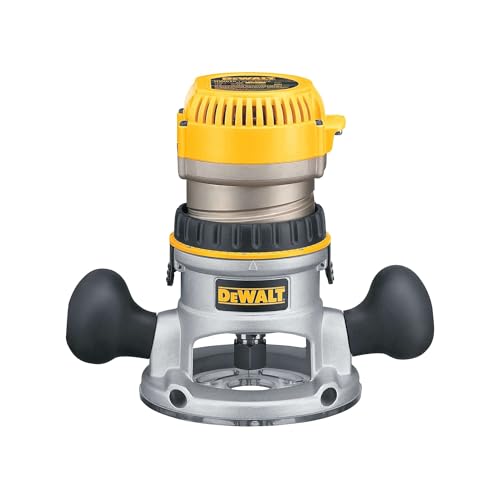
DEWALT DW616 1-3/4 HP 11 Amp Fixed-Base Router
1-3/4 HP, 11 ampFixed base1/64 in depth stepsTool-free cam lock
Check price on Amazon
Best for: Router table setups and edge profiling with precise depth control.

The DW616 is a fixed-base router with a 1-3/4 horsepower, 11 amp motor built to cut through hardwoods. A micro-fine depth adjustment ring changes the bit height in 1/64 inch steps, and a tool-free steel motor cam lock makes depth adjustment and base changes quick.

Fine depth steps are what you want for precise rabbets and for setting a profile bit exactly, because a router that jumps in 1/8 inch steps cannot set a clean reveal. Compared with the Bosch 1617EVSPK, the DeWalt gives up some horsepower and the plunge base, but it is a simpler tool. It is a good fit for a router table or a dedicated edge-profiling station.

Because it is fixed-base only, you cannot make plunge cuts without an extra base. A tool-free lock is faster than a wrench, but check that the cam holds tight under vibration, and recheck after the first few minutes of use.

What works

  • 1-3/4 HP, 11 amp motor
  • 1/64 inch micro-fine depth ring
  • Tool-free cam lock
  • Solid in hardwoods

Watch out for

  • No plunge base in this kit
  • Heavier than 1-1/4 HP routers

Spec sheet

Motor
1-3/4 HP, 11 amp
Base
Fixed
Depth adjustment
1/64 in increments, micro-fine ring
Lock
Tool-free steel cam lock
Power
Corded
04
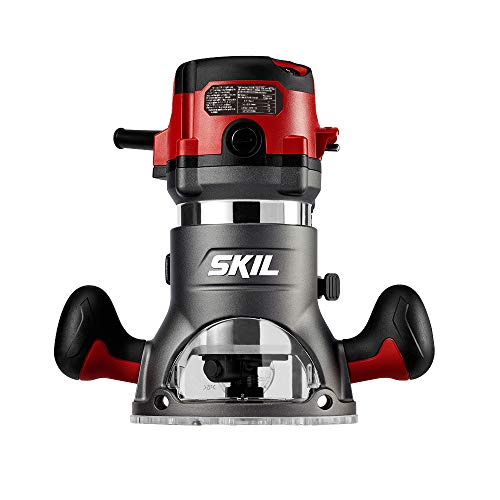
SKIL RT1323-00 10 Amp 2.0 HP Fixed-Base Router
10 amp, 2.0 HPVariable speedSoft startFixed base
Check price on Amazon
Best for: Hobbyists who want a full-size motor at a lower cost.

The SKIL RT1323 is a 10 amp, 2.0 HP fixed-base router with speed control and a soft start. It is the least expensive full-size router in this guide, aimed at hobbyists who want power without a premium price.

A 10 amp motor matches the 2 HP class that handles larger bits, and the soft start protects both the tool and the user. The tradeoff versus the DeWalt DW616 is refinement: depth adjustment, collet quality and vibration are less polished. It suits home workshops that use a router a few times a month.

Check bit runout when it arrives, and replace the collet if a bit shows wobble. Take shallow passes and keep the base flat, because a budget router transmits more vibration through the handles than a premium one.

What works

  • 10 amp, 2.0 HP motor
  • Soft start for control
  • Speed adjustment by material
  • Lower cost of entry

Watch out for

  • Less refined depth adjustment
  • Fixed base only

Spec sheet

Motor
10 amp, 2.0 HP
Speed control
Adjustable by material
Start
Soft start
Base
Fixed
Power
Corded
05
Bosch 1617EVS 2.25 HP 12 Amp Electronic Fixed-Base Router
12 amp, 2.25 HPConstant responseThree-hole base patternFixed base
Check price on Amazon
Best for: Router table builds that need a powerful fixed-base motor.

The 1617EVS is the fixed-base-only version of the Bosch router, with the same 12 amp, 2.25 HP motor and constant response circuitry. A threaded three-hole base pattern lets you mount it quickly and securely in a router table.

When you plan to use the router mostly in a table, the plunge base in the 1617EVSPK is wasted money, and this version saves it. The motor is the same, so you still get constant torque in hardwood. Compared with the DeWalt DW616 at 1-3/4 HP, the Bosch is more powerful and holds speed better.

If you later want plunge cuts, you can buy a plunge base separately. Mount it under a table with a lift or a simple plate, and use a feather board and a fence to keep your hands clear of the bit.

What works

  • 12 amp, 2.25 HP motor
  • Constant response holds speed
  • Three-hole pattern for table mounting
  • Microfine depth adjustment

Watch out for

  • No plunge base in the box
  • Heavy for handheld work

Spec sheet

Motor
12 amp, 2.25 HP
Electronics
Constant response circuitry
Base pattern
Threaded three-hole
Depth
Microfine adjustment
Base
Fixed
06
DEWALT DCW600B 20V MAX XR Brushless Cordless Router (Tool Only)
20V MAX XRBrushlessDual LEDsDepth ring
Check price on Amazon
Best for: Job-site trim and hinge work without a cord.

The DCW600B is a cordless brushless router with a variable speed dial, dual LEDs that light the work surface and a depth adjustment ring. It runs on 20V MAX batteries and is sold as a tool only.

Cordless routing is handy for job-site trim, hinge mortises and edges on installed cabinets, where a cord is in the way. It is a compact tool, closer to a trim router than to a 2 HP table router, so it suits light edge work rather than large profile bits. The dual LEDs help because a router spins a bit under the base where you cannot see the cut.

Buy it if you already own 20V MAX batteries. Use a 4.0Ah or larger pack for longer cuts. Cordless routers draw heavily on the pack, so plan short passes and swap batteries, and avoid long profile cuts that need steady power.

What works

  • Cordless with a brushless motor
  • Dual LEDs light the cut
  • Variable speed dial
  • Quick depth adjustment ring

Watch out for

  • Not built for large profile bits
  • Tool only, battery sold separately

Spec sheet

Platform
20V MAX XR
Motor
Brushless
Speed control
Variable speed dial
Light
Dual LEDs
Depth
Adjustment ring
Kit
Tool only

Spec sheet decoder

What the numbers on the box really mean

The specs manufacturers lead with, translated into what they tell you about real-world performance.

Horsepower

Router horsepower is often a peak or marketing figure, because motors are rated by amps. Roughly, 12 amps at 120 volts is about 1,440 watts input. It affects how the tool behaves in a real cut more than the number suggests.

Watch forA 3.25 HP claim on a 15 amp circuit is peak. Check amps for real comparisons.

RPM range

RPM is the bit speed. Large bits need a slow speed to stay under a safe rim speed, and small bits need a fast speed to cut cleanly. It affects how the tool behaves in a real cut more than the number suggests.

Watch forA fixed-speed router cannot safely run large bits.

Collet

The collet is the sleeve that clamps the bit shank. A 1/2 inch collet fits bigger, stiffer shanks than a 1/4 inch collet. It affects how the tool behaves in a real cut more than the number suggests.

Watch forDo not use a 1/2 inch bit in a 1/4 inch collet. Adapters reduce rigidity.

Constant response

This Bosch circuitry senses load and adjusts power to hold speed. It keeps the bit from slowing in a tough cut. It affects how the tool behaves in a real cut more than the number suggests.

Watch forSimilar features go by different names on other brands.

Plunge base

A plunge base lets the motor slide down on spring-loaded posts so you can lower a spinning bit into the work. It affects how the tool behaves in a real cut more than the number suggests.

Watch forPlunge depth stops matter, so check that the stop is repeatable.

Methodology

How We Evaluated These Wood Routers

Motor power

We compared amps and horsepower, from the SKIL at 10 amps to the Bosch at 12 amps, noting where claims are peak figures.

Base options

We favored kits with both fixed and plunge bases, like the Bosch 1617EVSPK, over single-base models.

Speed range and control

We checked speed dials and soft start, from the Bosch 8,000 to 25,000 RPM range to the DeWalt soft start.

Depth and adjustment

We looked at depth rings and cam locks. The DeWalt DW616 with its 1/64 inch ring stands out.

Cordless and table use

We separated cordless tools like the DeWalt DCW600B from table-ready fixed bases like the Bosch 1617EVS.

Decision guide

How to Choose the Right Wood Routers

By Type of Work

ScenarioPickWhy
One router for everythingBosch 1617EVSPKBoth bases
Router tableBosch 1617EVSThree-hole base
Light edge workDEWALT DWP6111-1/4 HP and soft start
Hardwood profilesDEWALT DW6161-3/4 HP, fine depth
Cord-free trimDEWALT DCW600BCordless

By Budget

TierPickWhy
EntrySKIL RT1323Full-size motor at low cost
Mid-rangeDEWALT DWP611Compact and refined
UpperDEWALT DW616Fine depth control
Premium kitBosch 1617EVSPKTwo bases
CordlessDEWALT DCW600BNeeds batteries

Fixed Base vs Plunge Base

Fixed base

Holds bit height and suits edge profiles and tables. The DeWalt DW616, DWP611, SKIL RT1323 and Bosch 1617EVS are fixed.

Plunge base

Plunges into the work for mortises and grooves. The Bosch 1617EVSPK adds one.

Pick a combo kit if you want both, and fixed only for table or edge use.

Motor Size

PreferencePick
Large bitsBosch 1617EVSPK
Medium bitsDEWALT DW616
Small bits and trimDEWALT DWP611
Hobby useSKIL RT1323

For Router Tables Specifically

Look for

Look for a fixed-base motor with a threaded base pattern, variable speed and a collet that holds 1/2 inch shanks.

In this comparison

The Bosch 1617EVS is the best fit, and the DeWalt DW616 works too.

When to Spend More

Spend more if

Spend more on the Bosch 1617EVSPK if you want one router for tables and handheld work.

Save if

Save with the SKIL RT1323 if you use a router occasionally.

Ownership

Maintenance schedule

The upkeep that decides whether this machine lasts two seasons or ten.

TaskIntervalWhy it matters
Clean the colletEach bit changePitch and dust cause slip. Wipe the collet and nut.
Inspect the bitBefore each useA dull or bent bit burns wood and vibrates. Replace it.
Check the brushesAnnuallyWorn brushes cause power loss. Replace in pairs.
Clean the ventsMonthlyDust clogs vents and overheats the motor.
Lubricate the plunge postsEvery few monthsDry posts stick. Use a dry lubricant.

FAQ

Frequently Asked Questions

What is the difference between a router and a trim router?

A trim router is smaller, lighter and uses 1/4 inch bits. A full-size router is more powerful and takes 1/2 inch bits. Many woodworkers buy a trim router first for edges and add a full-size router later for tables and joinery.

Do I need a plunge base?

Only for mortises and stopped cuts. A fixed base is enough for edges and tables. Plunge cuts are also safer for stopped grooves, since you control the entry instead of tipping the base in.

What speed should I use?

Use slow speed for large bits and fast speed for small ones. Check the bit's maximum RPM. Large bits over 2 inches should run near the bottom of the speed range, often 10,000 RPM or lower.

Which direction do I feed the router?

Feed against the rotation of the bit, left to right on an outside edge. Climb cuts are risky. Feeding with the rotation, a climb cut, can grab and run, so use it only for a light first pass on tear-out prone edges.

Is cordless good enough?

For light trim and edges, yes. For large bits, corded is stronger. A cordless router is closer to a trim router in power, so check bit size before relying on it.

What safety gear do I need?

Eye and hearing protection and a dust mask. Clamp the work firmly. Also wear a dust mask, since router dust is fine, and clamp small pieces so your hands stay far from the bit.

Bottom line

The short version

Browse more wood routerson Amazon →
James Miller, Lead Machine Editor

About the author

James Miller

Lead Machine Editor, MachineFanatic

James Miller leads MachineFanatic's buying guides, turning spec sheets, manuals and owner feedback into clear verdicts on power tools, outdoor power equipment, shop machines and kitchen machines.

More from James →

Keep reading

Related guides