
Amazon affiliate links - we earn a commission.Affiliate disclosure

Buying guide · 12 min read · Updated 2026-11-07

Best Yamaha Podcast Mixers (2026)

Six Yamaha AG and MG mixers compared for podcasting: loopback boards, USB analog desks, mic preamp counts and the right size for your show.

James MillerBy James MillerLead Machine Editor6 machines comparedSpec-sheet verified
Best Yamaha Podcast Mixers

At a glance

Our top picks

Side by side

Spec comparison

Two very different families of mixer are popular with podcasters. One is a small streaming board with loopback and onboard effects, and the other is an analog desk that was designed for stages and was then adapted with a USB connection.

Which family suits you depends on whether remote guests and computer audio are central to the show or whether you mostly want faders, a clean preamp and a simple monitor path. Start with how many microphones must work at the same time.

Before you buy

6 Criteria to Look For Before Buying a Yamaha Podcast Mixer

  1. 01

    Count real microphone preamps

    A mixer advertising 10 or 12 inputs may only have a handful of microphone preamps, with the rest being stereo line channels. The MG06X has just two microphone preamps despite six inputs, and the AG03MK2 offers one XLR. Count the preamps against your headcount before looking at anything else.

  2. 02

    USB: stereo mix or loopback

    A USB link can carry a plain stereo mix or support loopback for computer audio. The MG10XU, MG12XU and MG20XU send a stereo mix, while the AG03MK2 and AG08 add loopback. If remote guests join through a conferencing app, loopback is worth more than extra channels.

  3. 03

    Analog versus digital effects

    Yamaha mixes analog preamps with digital effects. The MG range uses SPX effects and the AG range uses DSP presets that can be adjusted in an app. Reverb is rarely used in speech, so prioritize compression and EQ over effect count.

  4. 04

    Phantom power coverage

    Condenser microphones need 48V from the XLR input. The AG08 provides it on two XLR inputs, while the AG03MK2 offers it on one. Check that the mixer supplies phantom power to every channel you plan to use for a condenser.

  5. 05

    Desk space and bus power

    The AG08 is bus powered over USB-C while the MG20XU needs a mains adapter and a stable table. Measure your desk and think about cable length. A large mixer on a small table often gets knocked and cabled badly.

  6. 06

    Recording method

    A USB stereo mix is fixed once recorded, so mistakes cannot be separated later. If you need separate tracks, use the mixer's direct outputs into a multitrack recorder or choose a dedicated recorder instead. Decide how much editing you expect before choosing a desk.

Detailed reviews

The 6 best yamaha podcast mixers, explained

01
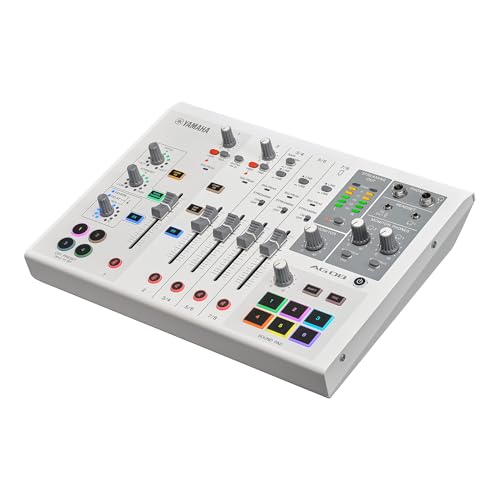
Yamaha AG08 8-channel USB-C streaming mixer
2 XLR inputsUSB-C interfaceLoopbackAssignable faders
Check price on Amazon
Best for: Two hosts who record or stream to a computer and want loopback.

The AG08 is built around a streaming workflow, so the engineering emphasis is on routing instead of raw input count. It is a USB-C audio interface with loopback, which means computer audio such as a remote caller or music can be sent back into the mix without creating a feedback loop. Three assignable faders let you decide whether a fader controls line or USB sources, and four FX preset buttons store voice treatments you can recall instantly.

The limitation is that only two XLR inputs offer phantom power, so it is a two-host show at most with proper microphones. Compared with the AG03MK2 below, you gain a second XLR input and more routing flexibility. Compared with the MG10XU, you lose the larger analog channel count but gain the digital effects and loopback that make the AG08 a better tool for Zoom-style interviews.

Ownership is easy. It is bus powered over USB-C, so you can run it from a laptop, and there are no moving parts beyond the faders and knobs. Keep the Yamaha controller software updated, use a short quality USB cable, and plan on a spare USB-C port so you do not have to share the line with a hub.

What works

  • Two phantom-powered XLR inputs for condenser mics
  • Loopback keeps remote guests out of echo trouble
  • Three assignable faders handle line and USB sources
  • USB-C bus power keeps the desk tidy

Watch out for

  • Only two XLR inputs limits growth
  • Digital effects need the controller app to tweak

Spec sheet

Channels
8
Mic inputs
2 XLR with +48V
Connection
USB-C audio interface
Faders
3 assignable
Effects
DSP with 4 FX presets
02
Yamaha AG03MK2 3-channel loopback streaming mixer
3 channelsLoopbackDSP effectsMute button
Check price on Amazon
Best for: A solo creator who streams or records and wants one good mic path.

The AG03MK2 is the compact version of the same idea. It gives a streamer one phantom-powered XLR input, a line or instrument path and a stereo input, all routed to a USB interface that supports loopback. A dedicated mute button and DSP effects such as compression and EQ are on the front panel, so a live host can cut the mic quickly without opening software.

Its compromise is obvious from the channel count: one XLR microphone is all it can power. It suits a solo host who also wants to play music or take a console input, but it falls behind the AG08 the moment a guest sits next to you. In exchange, its footprint is small enough to share a desk with a keyboard and monitor.

In ownership terms, the AG03MK2 is a low-maintenance board that draws power from the USB port. The knob caps and faders are plastic, so travel with a pouch if you carry it. Update the controller software occasionally, and keep any phantom-powered condenser unplugged while you connect the microphone.

What works

  • Phantom-powered XLR with loopback in a tiny chassis
  • Mute button gives an instant cut for live hosts
  • DSP effects reduce the need for plugins
  • Bundled recording software makes first setup easy

Watch out for

  • Only one XLR microphone input
  • Plastic controls feel light under heavy use

Spec sheet

Channels
3 (6-input)
Mic input
1 XLR with +48V
Loopback
Yes
Interface
USB with Steinberg software
Control
AG Controller app
03
Yamaha MG06X 6-input analog mixer with effects
2 mic preamps4 stereo lineBuilt-in effectsAnalog
Check price on Amazon
Best for: A two-person show that records through an existing interface or recorder.

The MG06X is a small analog console with two microphone preamps and four dedicated stereo line channels. Analog mixers have no digital latency in the monitoring path, so you hear yourself instantly in headphones, and the faders feel direct. It is the least expensive way to get a Yamaha preamp and a set of faders on a desk.

Its limitation is that it has no USB, so you need a separate interface or recorder to get audio into a computer. Compared with the MG10XU, you save space and money but lose the USB connection, and compared with the AG08 you lose loopback and the flexible routing. It suits a person who records through a dedicated recorder or plugs the mixer outputs into an existing interface.

The longevity is excellent because there is no firmware, and the knobs and faders can be cleaned. Add a headphone amplifier if two people want separate levels, and plan to buy balanced cables so the two microphone channels stay free of hum.

What works

  • Two microphone preamps with no digital latency
  • Four stereo line channels for music and phones
  • Built-in effects add polish without a computer
  • Simple controls need almost no learning

Watch out for

  • No USB audio, so an interface is required
  • Only two microphones can be recorded at once

Spec sheet

Inputs
6
Mic preamps
2
Line inputs
4 stereo
USB
No
Effects
Onboard digital
04
Yamaha MG10XU 10-input stereo mixer with USB
10 inputsUSB audioSPX effects3-band EQ
Check price on Amazon
Best for: A three person show that wants a full analog desk with a stereo USB recording.

The MG10XU brings a USB interface to a ten-input analog desk. Its discrete class-A D-PRE microphone preamps, three-band EQ and high-pass filters give a warm, forgiving signal, and the high-pass filter cuts low rumble before it reaches the recording. SPX digital effects add reverb and compression-style treatment without a computer.

The tradeoff is that the USB link only sends a stereo mix, so you cannot record each voice on a separate track. That makes editing less flexible than a multitrack recorder, and compared with the AG08 you lose loopback unless you set up a separate mix bus on the desk. In return you get more analog channels, which suits a three or four person table with microphones, a music source and a phone.

It is a proper desk, so allow room on your table. Keep the faders dust-free, route a dedicated mix to a remote guest using the aux buses, and use balanced cables for every connection.

What works

  • Discrete class-A preamps with a warm sound
  • Three-band EQ and high-pass filters on the channels
  • Stereo USB output records straight to a computer
  • SPX effects add finishing treatment

Watch out for

  • USB sends a single stereo mix, not separate tracks
  • Needs desk space and careful cable routing

Spec sheet

Inputs
10
Preamps
D-PRE class-A
USB
Yes
Effects
SPX digital
EQ
3-band with high-pass
05
Yamaha MG12XU 12-input 4-bus mixer with USB
12 inputs4 busesUSB audioSPX effects
Check price on Amazon
Best for: A four-person show that needs a separate mix for a remote guest.

The MG12XU adds two more inputs and four mix buses to the formula. More buses allow you to send a custom mix to a remote guest or a separate recording device without touching the main mix. It keeps the same class-A D-PRE preamps and EQ as the smaller desks, so the sound is consistent across the line.

The tradeoff is bulk. Compared with the MG10XU, you gain buses and channels that matter only if you need independent mixes, and compared with the MG20XU you lose capacity but save space and cost. If your show regularly hosts four microphones, this is the size that gives breathing room without a full stage desk.

Ownership is straightforward. Clean the faders, use a power supply that stays plugged in rather than a daisy chain, and consider a rack shelf for stability. A USB cable that stays attached to one computer prevents driver confusion.

What works

  • Four buses allow independent monitor or guest mixes
  • Same class-A preamps as the rest of the MG range
  • USB audio for direct recording to a computer
  • Enough channels for mics, phone and music

Watch out for

  • Larger than most podcast desks need
  • USB still sends only a stereo mix

Spec sheet

Inputs
12
Buses
4
USB
Yes
Preamps
D-PRE class-A
Effects
SPX
06
Yamaha MG20XU 20-input 6-bus USB mixer
20 inputs6 buses24 SPX effectsUSB audio
Check price on Amazon
Best for: A permanent studio with many sources and several independent mixes.

The MG20XU is a full studio desk with 20 inputs, six buses and 24 SPX effects. It is the choice when a podcast room doubles as a rehearsal or live-stream space, with several microphones, instruments and playback sources. The same discrete preamps run through the desk, so tone stays predictable from channel to channel.

Its size is both strength and weakness. For a three person show, a smaller desk such as the MG12XU is quieter to manage and less likely to overwhelm a new user. A person who wants a permanent studio centre that never needs to be re-patched is the buyer for the MG20XU, and it grows with the room.

Give it a stable surface, a clean power source and dedicated cabling. Faders and knobs are numerous, so periodic cleaning matters more here than on smaller desks. Treat the USB link as a convenience rather than a multitrack tool.

What works

  • 20 inputs and six buses cover a complex studio
  • Twenty-four SPX effects for finishing treatments
  • Consistent class-A preamps across channels
  • USB audio simplifies computer recording

Watch out for

  • Oversized for a typical two or three person show
  • Many controls mean more cleaning and a longer learning curve

Spec sheet

Inputs
20
Buses
6
Effects
24 SPX
USB
Yes
Preamps
D-PRE class-A

Spec sheet decoder

What the numbers on the box really mean

The specs manufacturers lead with, translated into what they tell you about real-world performance.

D-PRE preamp

This is Yamaha's discrete class-A preamp design with an inverted Darlington circuit. It aims for a warm tone and low distortion at moderate gain.

Watch forIt appears on the MG10XU, MG12XU, MG16XU and MG20XU but is not part of the AG board design.

Buses

A bus is a path that carries a mix to an output, such as the main mix, a monitor or a recording. More buses allow independent mixes.

Watch forThe MG12XU has four buses and the MG20XU six, which matters only if you need separate mixes.

Loopback

Loopback sends computer audio back into the mix for streaming, so a caller or music can be heard by the audience. It avoids feedback by design.

Watch forThe AG03MK2 and AG08 offer it, while the plain MG desks do not.

High-pass filter

This cuts low frequency rumble below a set point, often 80 Hz, from desk bumps and air movement. It cleans speech without affecting its clarity.

Watch forThe MG range puts one on the microphone channels, and the AG08 does through its DSP.

Stereo input

Stereo line channels take left and right signals but cannot accept a microphone. They suit phones, music players and computers.

Watch forThe MG06X gives four stereo line channels, so do not count them as microphone slots.

Methodology

How We Evaluated These Yamaha Podcast Mixers

Microphone path

We compared the number of real microphone preamps and phantom-powered XLR inputs on each model. The AG03MK2 has one XLR while the MG20XU has many. Mic count decided suitability for group shows.

Computer connection

We looked at whether USB supports loopback or only a stereo mix. The AG08 and AG03MK2 support loopback, and the MG10XU only sends a mix. We scored loopback higher for remote guests.

Routing flexibility

We compared buses and assignable faders. The MG12XU has four buses and the MG20XU six, while the AG08 offers three assignable faders. Flexibility mattered for complex shows.

Footprint and power

We weighed desk space and whether the unit runs from USB or needs mains. The AG08 is bus powered, while the MG20XU needs a stable table. Smaller footprints scored better for home rooms.

Longevity

We considered whether the design is analog, which tends to age well, or relies on software that needs updates. Owner feedback patterns on faders and knobs informed this. Fewer failure points scored higher.

Decision guide

How to Choose the Right Yamaha Podcast Mixers

By Number of Microphones

SituationPickWhy
One host, one micAG03MK2One XLR with loopback in a tiny body
Two hosts on condensersAG08Two XLR inputs with +48V
Two mics through an interfaceMG06XTwo preamps and no USB
Three to four voicesMG12XUMore preamps and four buses
Large studioMG20XU20 inputs and six buses

By Budget

SituationPickWhy
Lowest tierMG06XCheapest desk with two preamps
Entry streaming boardAG03MK2Compact with loopback
Mid tier with USBMG10XUTen inputs and stereo USB
Upper tier streamingAG08USB-C, two XLR and routing
Premium studioMG20XULargest channel count

Streaming Board vs Analog Desk

Streaming board

The AG03MK2 and AG08 include loopback and software control, so computer audio mixes cleanly. They are compact and bus powered, but have few microphone inputs.

Analog desk

The MG06X, MG10XU, MG12XU and MG20XU use real faders and stable preamps with no latency. They need more space, and USB sends only a stereo mix.

Remote-heavy shows should pick the AG08, and in-room panels should pick an MG desk.

Connection Style

SituationPickWhy
Laptop only, bus powerAG08USB-C powered interface
Existing interface or recorderMG06XAnalog outputs only
Desktop with stereo USBMG10XUUSB mix with SPX effects
Multiple monitor mixesMG12XUFour buses for separate feeds

For Remote Guests Specifically

Look for

Look for loopback, or a bus that sends a mix without the guest's own voice. Without one of these, the guest hears an echo of themselves and the call degrades quickly.

In this comparison

The AG08 handles it through USB loopback. The MG12XU can do it using a bus, but takes extra setup. The AG03MK2 does it for a single host.

When to Spend More

Spend more if

Spend more if you have three or more regular voices or want independent mixes. The MG12XU and MG20XU add buses and channels, and the AG08 adds a second XLR input.

Save if

Save if you only record one or two microphones. The MG06X and AG03MK2 cover that need at lower cost, with simple controls.

Ownership

Maintenance schedule

The upkeep that decides whether this machine lasts two seasons or ten.

TaskIntervalWhy it matters
Clean faders and knobsTwice a yearDust causes crackle and scratchy fader travel. A short burst of contact cleaner restores smooth movement.
Check USB and XLR cablesEvery few monthsA failing cable mimics a bad preamp. Swap cables before assuming the mixer is at fault.
Update the AG controller softwareTwice a yearUpdates keep the loopback and DSP controls compatible with new operating systems. Only update between shows.
Cover the desk when idleDailyA dust cover reduces dirt in the faders. It costs very little and extends life.
Inspect power adaptersYearlyA small switch mode adapter can add hiss or hum. Replace with the original rating if noise appears.

FAQ

Frequently Asked Questions

Is a Yamaha MG or AG better for podcasting?

The AG range suits streaming and computer audio thanks to loopback. The MG range suits in-room shows with several microphones. Choose by whether remote guests or local voices dominate.

What is the cheapest way to start?

The MG06X is the lowest tier here and the AG03MK2 is the next step up. Pick the MG06X if you already own an interface, and the AG03MK2 if you want USB and loopback.

Will a bigger mixer sound better?

Not by itself. The same class-A preamp design runs through the MG range, so tone is similar from the MG10XU to the MG20XU. Extra channels only help if you use them.

Do these mixers record separate tracks?

No. USB sends a stereo mix, so each voice cannot be separated later. For separate tracks, add a multitrack recorder or use a dedicated podcast unit.

How long do these mixers last?

Analog desks with sealed faders last many years with regular cleaning. The wear items are faders and knobs, not the circuitry.

Do I need phantom power?

Only for condenser microphones. Dynamic microphones do not need it, and the AG08 supplies it to two XLR inputs when you do.

Bottom line

The short version

Browse more yamaha podcast mixerson Amazon →
James Miller, Lead Machine Editor

About the author

James Miller

Lead Machine Editor, MachineFanatic

James Miller leads MachineFanatic's buying guides, turning spec sheets, manuals and owner feedback into clear verdicts on power tools, outdoor power equipment, shop machines and kitchen machines.

More from James →

Keep reading

Related guides