
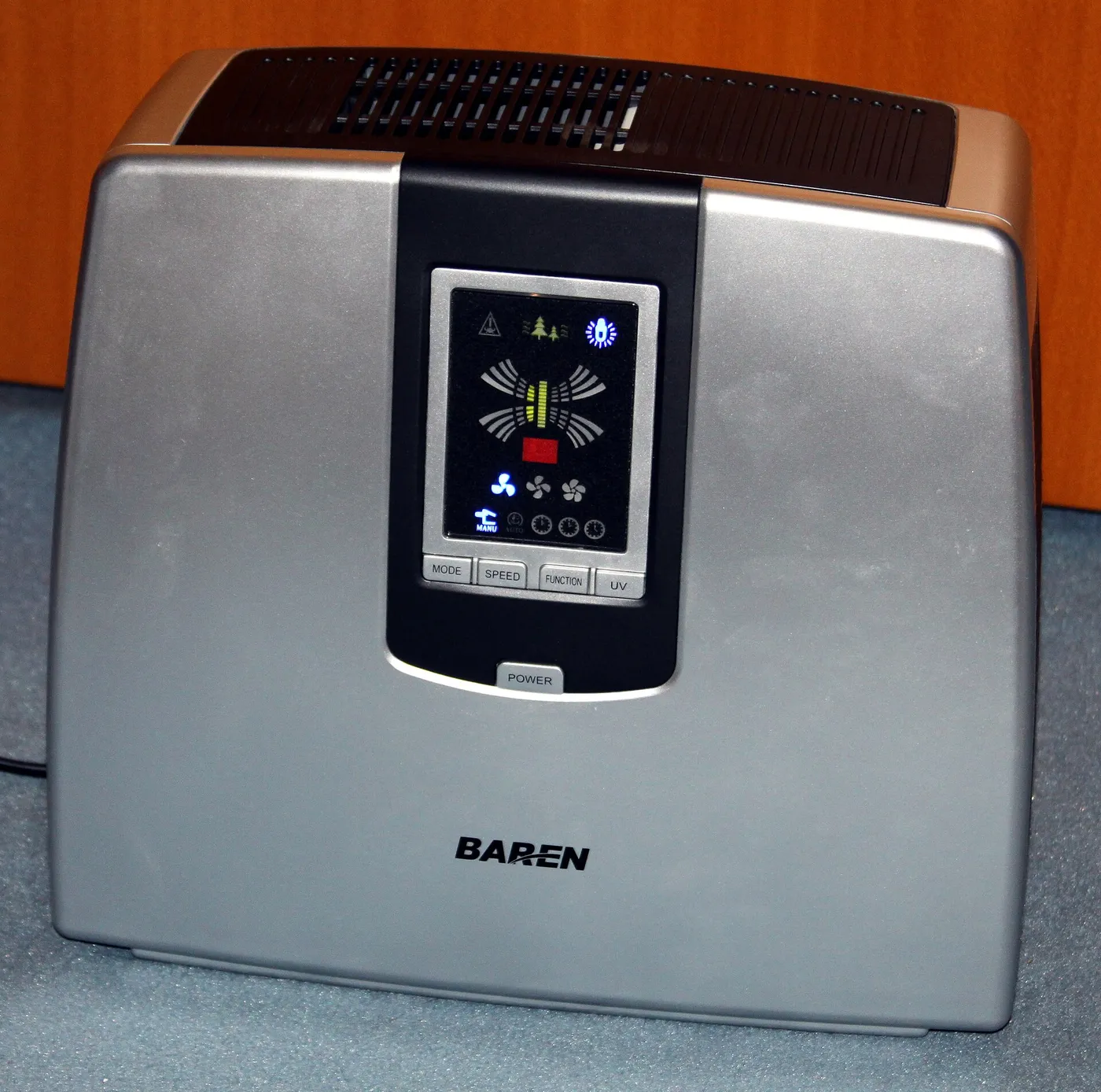
The smell that survives the HEPA filter
You cook fish, run the purifier all evening and the house still smells of it the next morning. The machine had a HEPA filter and a high delivery rate, and the particles are gone, yet the odor remains. That is not a defect. It is a category mismatch.
Odors are mostly gas molecules, and they pass through a HEPA filter as easily as air does. Catching them requires a different material and a different mechanism. That material is usually activated carbon, and the way it works is quite different from a particle filter.
Gases versus particles
A particle filter is a physical barrier, a mat of fibers that traps solid and liquid particles as air flows through. A gas molecule is far smaller than a particle and is not stopped by the fibers at all. It stays dissolved in the airstream and travels straight through.
That is why particle ratings such as CADR, explained in our CADR article, say nothing about odors. A machine can be superb at one job and useless at the other. Treat particles and gases as two separate problems, each needing its own filter stage.
What activated carbon is
Activated carbon is carbon, commonly made from coconut shell, coal or wood, that has been treated to develop an enormous network of microscopic pores. The result is a material with a very large internal surface area packed into a small volume. A spoonful offers a surface area that is hard to picture.
It works through adsorption, not absorption. A gas molecule drifts into a pore and sticks to the surface through weak attractive forces. The molecule is held there, so the air that leaves the filter contains fewer of them. Nothing is destroyed or chemically changed in the usual case. The molecule is parked on the carbon.
What VOCs are
VOCs, or volatile organic compounds, are carbon-based chemicals that evaporate easily at room temperature. They come from paint, adhesives, new furniture, cleaning products, cooking, printed material and many other everyday sources. Some have a smell, and some do not.
Carbon is useful against many VOCs, but not equally against all of them. Larger, heavier molecules tend to stick to carbon more readily, and very small, light molecules can pass through. Because the family of VOCs is huge, no filter handles every compound, and a general claim of removing all VOCs is not something you should accept without evidence.
The quantity of carbon is the main spec
The biggest difference between carbon filters is how much carbon they contain. A thin sheet of carbon-dusted fabric, sometimes sold as a carbon filter, holds a tiny amount and saturates quickly. A thick bed of granular carbon holds far more, gives the air more contact and lasts longer.
| Carbon design | Typical behavior |
|---|---|
| Thin carbon-coated sheet | Light odor reduction, saturates fast |
| Carbon-impregnated foam or fabric | Modest capacity, short life in a smelly room |
| Granular carbon bed | Higher capacity, better contact time, heavier filter |
| Carbon with added chemical treatment | Targets specific gases, varies by product |
A simple clue is weight. A filter with a substantial carbon bed is noticeably heavy, and manufacturers who use a lot of carbon often state its weight. If a product mentions a carbon filter but gives no amount, assume it is a light layer.
Contact time and airflow
Adsorption takes time. If air blows through a thin bed too fast, many molecules do not have a chance to stick. A deeper bed, or a slower airflow through it, gives better capture. This is a design tradeoff that a small purifier with a thin carbon layer and a strong fan cannot escape.
That is also why running a purifier at a lower speed can improve odor removal even while it reduces particle delivery. If odors are your main goal, a unit with a deep carbon bed and a moderate fan speed is a better match than a unit built for maximum particle delivery with a token carbon layer.
Saturation: carbon has a limit
Every pore can hold only so many molecules. As the carbon fills, fewer sites remain and the filter's performance declines, and eventually odors pass through. This is saturation, and it is why carbon filters have a service life.
Life depends on the load. A bedroom with light everyday odors may keep a carbon filter working for many months. A room with strong ongoing sources, such as a kitchen or a workshop with fumes, can saturate a thin filter in a short time.
A saturated filter can also release some of what it captured when conditions change, such as a swing in temperature or humidity. That is another reason to replace it on schedule instead of leaving it in place until it smells.
Humidity and temperature
Water vapor competes with other gases for pore space, so very humid air can reduce how much of a target gas the carbon holds. Higher temperatures tend to reduce adsorption and can encourage captured molecules to leave. In a damp basement, a carbon filter may saturate sooner than in a dry room.
This is one more reason to treat the stated filter life as a guideline. Real life depends on air quality, humidity and how long the unit runs.
What carbon filters do poorly
- Very small or light molecules: some pass through and are barely held.
- Carbon monoxide: carbon is not an effective answer to it. Use a certified carbon monoxide alarm for safety and follow your own appliance guidance.
- High, continuous gas loads: in a heavy-fume space the carbon saturates quickly and needs source control and ventilation first.
- Particles: carbon is not a particle filter, although a granular bed may catch some.
In short, carbon is a good tool for ordinary household odors and a poor tool for heavy chemical exposure. If you work with solvents, paints or fuels, ventilation and the safety data for the product matter far more than a purifier.
Putting carbon and HEPA together
A well-designed purifier stacks stages. A coarse pre-filter catches hair and lint, a HEPA stage catches particles, and a carbon stage handles odors. The order matters, since particles that reach the carbon can clog its surface. Putting the particle filter first protects the carbon bed.
Read the stack description on a product page. A product labeled as HEPA and carbon should state the carbon amount. See our HEPA label explainer for how to read the particle stage claims.
When carbon should be your priority
| Situation | Carbon priority |
|---|---|
| Cooking odors in an open kitchen | High, plus a range hood vented outdoors |
| New furniture or fresh paint | High for the first weeks, with ventilation |
| Pet odors | Medium to high |
| Wildfire smoke | Moderate, smoke includes gases as well as particles |
| Allergies from pollen and dust | Low, particles matter more |
For smoke events both particles and gases matter, so a unit that combines strong particle delivery with a real carbon bed is the sensible pick. Look for such designs in the best air purifiers guide.
Remove the source first
No purifier is as effective as stopping the source. Vent cooking fumes outdoors, store paints and solvents in a sealed container or outdoors, open windows when using strong products and allow new furniture to off-gas in a ventilated area. A purifier helps with what remains.
Think of carbon as a cleanup stage, not a replacement for ventilation. A space with a steady chemical source will overwhelm any home purifier's carbon bed.
Replacement and cost of ownership
Because carbon wears out, the replacement filter cost belongs in the purchase decision. A thin carbon layer built into a combined filter may be cheap to replace but lasts a short time. A large carbon bed may cost more but protects against odors for longer.
Read the manufacturer's recommended interval and consider your own conditions. If odors begin to appear after the filter is installed, it is likely saturated and should be replaced, even if the interval has not elapsed.
How to evaluate a carbon filter claim
When a product page says it removes odors or VOCs, ask four questions. How much carbon is in the filter, stated by weight? What form is it, a granular bed, a coated sheet or a treated fabric? How deep is the airflow path through it? And how often does the manufacturer say it should be replaced?
A manufacturer who answers these plainly is describing a real design. One who offers only the phrase activated carbon has told you almost nothing, because the phrase covers everything from a deep bed of granules to a thin dusting on a mesh. The first can run for months against kitchen smells. The second is a token layer.
- Look for a stated carbon weight and compare it between models in the same size class.
- Prefer a granular bed or a thick block over a coated sheet when odors are the goal.
- Check that a particle filter sits upstream of the carbon to protect it.
- Confirm that a replacement carbon filter is sold and not a one-time part.
Testing and what is actually standardized
Particle performance has a widely used test, the CADR. Gas removal has no equally simple, universal consumer figure. Some products publish results for specific test gases, and some standards exist for gas phase performance, but the numbers are not shown on most retail boxes and they do not translate neatly across products.
That gap is why careful buyers rely on the physical features: the carbon quantity, the bed depth and the airflow. If a product claims a specific result against a named gas and publishes how it was measured, treat that as stronger evidence than a general statement. If a figure is given without a method, treat it as marketing.
Everyday habits that help the filter
- Run the purifier during and after cooking, on a speed that gives the carbon contact time.
- Keep the particle pre-filter clean so airflow and carbon contact stay good.
- Use the range hood and open a window for a few minutes after heavy odors.
- Do not spray fragrance products near the intake, because they add gases for the carbon to absorb.
- Store chemical products outside the living area to cut the load on the filter.
Small habits like these extend the life of a carbon filter and often matter as much as the quality of the filter itself.
Where the carbon comes from
Activated carbon is made from several raw materials, including coconut shell, coal and wood. The raw material affects the pore structure. Coconut-based carbon tends to have many very small pores, which suits capturing small gas molecules, while some coal-based carbons have a wider mix of pore sizes. Manufacturers sometimes mention the source on the product page, and it is a useful clue to the design intent.
The activation process, which uses heat and steam or chemicals to open the pores, also matters, and it is not something a shopper can judge from the outside. What you can judge is whether the maker gives details. A page that names the carbon type, states the weight and shows the bed depth is describing a deliberate design.
Impregnated and blended media
Some filters add chemicals to the carbon, or blend carbon with another adsorbent, to improve capture of particular gases. A treated media may be aimed at acidic gases, formaldehyde or other specific targets. These blends can extend what the filter handles, but the claims are specific, and you should read which gases a particular product says it targets and how it was tested.
The trade-off is that specialized media often costs more and may have a shorter service life under heavy loads. For ordinary home odors, plain activated carbon in sufficient quantity is usually adequate. For a specific, known gas issue, speak to the manufacturer about which media they use and what evidence they have.
A simple way to judge whether it works
You do not need a laboratory to see whether a carbon stage is doing something. Run the purifier in a room with a mild, steady odor, such as a bag of coffee grounds or a slice of fruit left out, and compare how long the smell lingers with and without the unit running. A good carbon bed shortens the time, and a token layer changes little. Repeat the comparison after several months, and if the effect fades, the carbon is probably saturated.
Note this is a household sanity check and not a measurement of performance. It tells you whether the filter is still earning its place, which is the practical question.
Sizing a purifier for odors, not just particles
Odor control follows the same airflow logic as particle control, with one twist. The carbon needs contact time, so the turnover that matters is the one at a speed that gives the bed time to work. If you are matching a unit to a room, use the calculation in our air changes article, then favor models with a thick carbon bed and a fan that moves air gently through it.
A very powerful fan pushing air through a thin carbon sheet gives a lot of air changes and very little odor capture. A moderate fan through a deep bed gives fewer changes and much better capture. For a kitchen or a pet area, the second design is usually the better trade.
Frequently Asked Questions
Does a HEPA filter remove odors?
No. A HEPA filter traps particles, and gas molecules that cause odors pass through it. To reduce odors you need an adsorbent such as activated carbon.
How do I know if a carbon filter is any good?
Look for the amount of carbon stated by weight, a thick granular bed and a manufacturer that explains what it targets. A thin carbon-coated sheet with no stated quantity is a light layer.
How long does a carbon filter last?
It depends on the odor load, humidity and the quantity of carbon. Light household use may last many months, and heavy odors can saturate a small filter in a short time. Follow the manufacturer's interval and replace sooner if odors return.
Can activated carbon remove all VOCs?
No. It adsorbs many VOCs well and others poorly, depending on the molecule. Claims of removing all VOCs deserve skepticism, and ventilation remains important.
Can I wash or reuse a carbon filter?
Generally no. Washing does not restore the pore surface, and some designs are not intended to be reactivated at home. Replace the filter on schedule.
Does carbon in an air purifier help with wildfire smoke?
Smoke contains both particles and gases. A strong particle stage handles the particles, and a real carbon bed can reduce some of the smoky odor. Carbon alone is not enough.
Bottom line
Activated carbon works by adsorption, sticking gas molecules onto an enormous internal surface, which is why it reduces odors that a HEPA filter cannot. The quantity of carbon, the contact time and the odor load decide how well it works, and every carbon bed eventually saturates. Look for a stated carbon weight, treat VOC claims with care, remove the source where you can, and plan on replacing the filter. Pair it with a strong particle stage for a complete purifier.