
A cordless circular saw used to be the tool you bought for odd jobs and then replaced with a corded one for real work. That has changed. Brushless motors, better cells and smarter electronics mean a modern 18 V or 20 V saw can rip through a stack of framing lumber on a single charge and still be light enough to use all day. The question is no longer whether a cordless saw is good enough, but which one fits your work, your blade size preference and your battery platform.
This guide compares seven brushless cordless circular saws from DeWalt, Milwaukee and Makita. We evaluated them from their published specifications, the batteries they run on, the features they include and owner feedback. We did not run our own cutting trials, and where a listing gives very little data we say so. If your work is panels, doors and worktops, you may be better served by a plunge-cut model, which our plunge saw explainer covers.
The picks at a glance
| Rank | Model | Blade | Voltage / platform | Standout spec | Best for |
|---|---|---|---|---|---|
| 1 | DeWalt DCS565B | 6-1/2 inch | 20V MAX (FLEXVOLT compatible) | Rafter hook, electric brake, LED, 0 to 50 degree bevel | Best all-rounder |
| 2 | DeWalt DCS590B | 7-1/4 inch | 20V MAX XR | 5,500 RPM, 2-9/16 inch at 90 degrees | Best for framing power |
| 3 | Makita XSH06Z | 7-1/4 inch | 36V (two 18V LXT) | 6,000 RPM, up to 610 crosscuts in 2x4 | Best for long runtime |
| 4 | Makita XSH04ZB | 6-1/2 inch | 18V LXT | 6.4 lb with 2.0Ah battery, 10-5/8 inch long | Best lightweight |
| 5 | Makita XSH03Z | 6-1/2 inch | 18V LXT | 5,000 RPM, automatic speed change | Best for LXT owners |
| 6 | Milwaukee 2833-20 | 6-1/2 inch | M18 FUEL | Current M18 FUEL saw (thin listing detail) | Best for M18 owners |
| 7 | Milwaukee 2730-20 | 6-1/2 inch | M18 FUEL | M18 FUEL brushless (thin listing detail) | Budget M18 option |
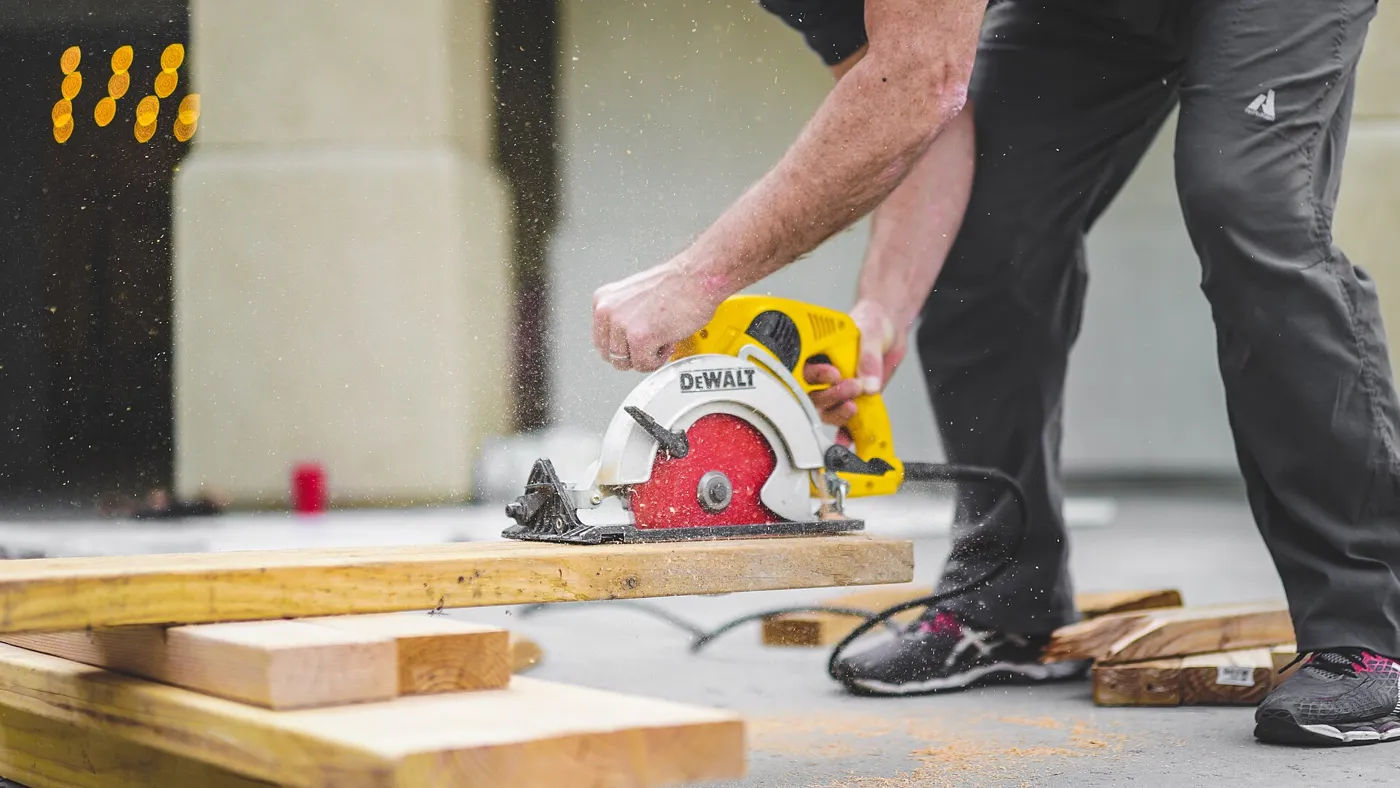
How we chose and ranked
The ranking leans on what the manufacturer specifies and what owners report, weighted toward the factors that decide whether you will like living with the tool:
- Cutting capacity and blade size. A 6-1/2 inch blade and a 7-1/4 inch blade are not just different diameters. The larger blade cuts through a nominal 2x lumber at 45 degrees with room to spare, while the smaller one trades depth for weight and runtime.
- Motor and electronics. All seven are brushless, which means no carbon brushes to wear, less heat and better battery efficiency. We looked for electric brakes, speed-adjusting electronics and LED lights.
- Battery platform. A saw is only as useful as the batteries you can share with your other tools. We note the platform for each model.
- Weight and handling. Cordless saws are heavier than their corded cousins once a battery is attached. We favored designs with compact bodies, balanced layout and rafter hooks.
- Dust and visibility. Dust chutes, LED lights and sight lines affect how accurately you follow a line.
One important limit applies to all of this: some listings, notably the two Milwaukee entries, carry very little spec detail. We have kept our claims for those to what the listings actually state and recommend confirming current specs on Milwaukee's own site before buying.
6-1/2 inch or 7-1/4 inch: the real tradeoff
This is the first decision, and the spec sheets bury the consequences.
The 6-1/2 inch saw
A 6-1/2 inch blade gives a depth of cut around 2-1/4 inch at 90 degrees on the Makita XSH04ZB, which is enough to cut through standard 2x dimensional lumber in one pass at 90 degrees. The blade is lighter and spins faster for the same torque, the motor is smaller, and the saw is shorter and lighter. It is the right size for trim, decking, sheathing, plywood and general carpentry. Battery runtime is longer for the same pack because less material is removed per cut.
The 7-1/4 inch saw
The 7-1/4 inch blade is the traditional framing size. The DeWalt DCS590B lists 2-9/16 inch depth at 90 degrees and 2 inch at 45 degrees, which clears a 2x in a bevel cut. It also matches the huge range of 7-1/4 inch blades available, including cheap framing blades and specialty ones. You pay in weight, size and, on the lower voltage saws, in runtime.
The saws in detail
1. DeWalt DCS565B: best overall
The DCS565B is a 20V MAX brushless 6-1/2 inch saw that gets the details right. The listing highlights a built-in rafter hook for hanging the saw on a joist, an electric brake that stops the blade quickly after you release the trigger, a bright LED for the cut line, and a tool-free bevel lever that adjusts from 0 to 50 degrees. An optional dust chute is compatible with the DeWalt airlock system or a standard 35 mm dust extractor, so you can connect it to a vacuum for indoor work.
It runs on all DeWalt 20V MAX and FLEXVOLT batteries, which is the real reason many people pick it. If you already own a DeWalt drill or impact driver, your batteries carry across. The motor is described as providing optimal cutting performance in a variety of materials, and the saw is positioned as compact and lightweight with high maneuverability.
Its limit is blade size. It does not have the 2-9/16 inch depth of the 7-1/4 inch DCS590B, so for heavy framing the larger saw is better. For general carpentry, decking, sheathing and sheet goods it is the balanced answer.
2. DeWalt DCS590B: best for framing and thick stock
The DCS590B is DeWalt's most powerful 20V MAX circular saw according to its listing, with up to 1,700 MWO (maximum watts out) and a brushless motor delivering up to 5,500 RPM no-load. The listing claims up to 368 cuts per charge (under the manufacturer's test conditions, which depend on the battery and material), a maximum depth of 2-9/16 inch at 90 degrees and 2 inch at 45 degrees, and an automatic electric brake.
The depth figures matter. A 2 inch depth at 45 degrees means the saw can complete a bevel cut through standard 2x lumber with margin, which many 6-1/2 inch saws cannot do. If you build decks, frame walls or cut treated lumber, this is the one that does not run out of blade. Expect more weight than the DCS565B, and use a higher capacity battery to get the best of it.
3. Makita XSH06Z: best for runtime
The XSH06Z runs on two 18 V LXT batteries, forming a 36 V system, and drives a brushless motor rated at 6,000 RPM. Makita's listing claims up to 610 crosscuts per charge in 2x4 spruce-pine-fir lumber and up to 320 crosscuts in 2x10, using two 5.0Ah batteries. Those are manufacturer figures, not independent measurements, but they show the intent: this is a saw built for people who do not want to swap batteries during a framing day.
The motor uses automatic speed change technology, which adjusts speed and torque as the load changes, and the brushless design runs cooler and extends life. The 7-1/4 inch size covers framing work. The tradeoff is that you need two batteries to run it, and the weight of two packs adds up. It is the right saw if you already own LXT batteries in pairs.
4. Makita XSH04ZB: best lightweight
The XSH04ZB is the sub-compact option. The listing quotes a length of only 10-5/8 inch and a weight of 6.4 lb with a 2.0Ah battery fitted. It is a blade-right design (the blade sits on the right of the motor), which helps right-handed users see the line. Capacity is 2-1/4 inch at 90 degrees, the bevel range is 0 to 50 degrees, and the 5,000 RPM brushless motor is electronically controlled for efficiency.
It ships with a 24 tooth carbide-tipped blade, a dust extracting attachment and a hex wrench, but no battery or charger. It is the saw for overhead work, long trim days, ladders and anyone who finds a standard saw tiring. It is not what you want for continuous heavy ripping, because a small pack and small motor limit sustained output.
5. Makita XSH03Z: best for LXT owners on a single battery
The XSH03Z is Makita's full-size 6-1/2 inch brushless saw on a single 18 V LXT battery. The listing highlights 5,000 RPM, automatic speed change that adapts speed and torque to the cut, and a brushless motor that runs cooler and uses battery energy more efficiently, with up to 50 percent longer runtime per charge compared with brushed designs (a manufacturer claim).
Where the XSH04ZB prioritizes weight, the XSH03Z is the more conventional size. It suits someone with a Makita battery collection who wants a straightforward saw. The listing is feature-focused rather than spec-heavy, so confirm depth and weight against Makita's own data if those matter.
6. Milwaukee 2833-20: best for M18 owners
The 2833-20 is an M18 FUEL 18 V brushless 6-1/2 inch saw sold as a bare tool. The listing we compared contains almost no specification detail beyond the platform and size, so we cannot responsibly claim figures for depth, weight or speed. What we can say is that the M18 FUEL line is Milwaukee's premium brushless tier and that the saw runs on the M18 battery family, which is one of the largest cordless platforms in the trade.
For contractors who already carry M18 batteries, this is a natural choice, and owner feedback on the line tends to focus on durability. For anyone not committed to M18, the DeWalt and Makita saws above come with fuller published specs.
7. Milwaukee 2730-20: budget M18 option
The 2730-20 is another M18 FUEL 6-1/2 inch brushless saw, tool only. Like the 2833-20 its listing is very sparse, stating only that it is an M18 FUEL saw and that it is durable. It appears to be an earlier model number than the 2833-20, but we could not confirm the generation difference from the data in front of us, so check Milwaukee's site for current availability and differences before choosing between them.
If you can find it and you are already on M18, it is a workable saw. If you are starting from scratch, spend your effort on a platform that suits your other tools, then choose the saw.
Spec comparison
Published figures from the listings. Blank cells mean the listing did not state the value, so verify with the manufacturer.
| Model | Blade | Motor speed | Depth at 90 degrees | Bevel | Weight / size | Platform |
|---|---|---|---|---|---|---|
| DeWalt DCS565B | 6-1/2 inch | Not stated | Not stated | 0 to 50 degrees | Compact, lightweight | 20V MAX, FLEXVOLT compatible |
| DeWalt DCS590B | 7-1/4 inch | 5,500 RPM no-load | 2-9/16 inch (2 inch at 45) | Not stated | Not stated | 20V MAX XR |
| Makita XSH06Z | 7-1/4 inch | 6,000 RPM | Not stated | Not stated | Not stated | 36V (2x 18V LXT) |
| Makita XSH04ZB | 6-1/2 inch | 5,000 RPM | 2-1/4 inch | 0 to 50 degrees | 6.4 lb with 2.0Ah, 10-5/8 inch long | 18V LXT |
| Makita XSH03Z | 6-1/2 inch | 5,000 RPM | Not stated | Not stated | Not stated | 18V LXT |
| Milwaukee 2833-20 | 6-1/2 inch | Not stated | Not stated | Not stated | Not stated | M18 FUEL |
| Milwaukee 2730-20 | 6-1/2 inch | Not stated | Not stated | Not stated | Not stated | M18 FUEL |
What to look for in a cordless circular saw
Brushless motor
Brushless is effectively standard on any saw worth buying now, and every model here has it. The benefit is practical: no brushes to replace, less heat, better efficiency and electronics that can sense load. Makita states up to 50 percent longer runtime per charge for its brushless saws compared with brushed equivalents, and DeWalt links its brushless motor to a high cut count per charge on the DCS590B. Treat those as manufacturer claims, but the direction is right.
Battery platform and voltage
The cheapest way to buy a good saw is to match the battery you already have. Some tools run on one battery, others on two (Makita's 36 V approach), and the higher voltage can deliver more sustained power for ripping and framing. If you are starting fresh, think about the other tools you will buy over the next few years and choose the platform with the range you need.
Electric brake
An electric brake stops the blade almost immediately after you release the trigger, rather than letting it coast for several seconds. It is a safety feature and a productivity feature, since you can set the saw down sooner. DeWalt lists it on both DeWalt models here.
Bevel capacity and depth at 45 degrees
A saw that cuts 2-1/4 inch at 90 degrees may only manage about 1-5/8 inch at 45 degrees. If you cut bevels in lumber, look at the depth at 45 degrees as well as at 90. The DCS590B lists 2 inch at 45, the best on this list.
Rafter hook and storage
A rafter hook is a small feature that saves time on a roof or in framing. The DCS565B includes one.
Dust management
Cordless saws throw dust back at the user and obscure the line. A dust chute or extraction port helps if you work indoors. The DCS565B offers an optional dust chute compatible with a standard 35 mm extractor hose, and the Makita XSH04ZB includes a dust extracting attachment.
Blade quality
The blade matters as much as the saw. A thin-kerf blade reduces effort and battery drain, while a higher tooth count gives a smoother finish in plywood. The XSH04ZB ships with a 24 tooth blade, which is a general purpose choice that is faster than a finishing blade but rougher on veneer.
Which saw for which job
| Your situation | Pick | Why |
|---|---|---|
| General carpentry, DIY, mixed jobs | DeWalt DCS565B | Balanced size, rafter hook, brake and LED |
| Framing, decks, thick lumber | DeWalt DCS590B | 7-1/4 inch, 2 inch depth at 45 degrees |
| All-day framing without swapping batteries | Makita XSH06Z | 36 V system, 610 crosscuts claimed in 2x4 |
| Overhead work, ladders, trim | Makita XSH04ZB | 6.4 lb and 10-5/8 inch long |
| Already own Makita LXT batteries | Makita XSH03Z | Single-battery brushless saw |
| Already own Milwaukee M18 batteries | Milwaukee 2833-20 | Stay on one platform |
| M18 owner looking for an older model | Milwaukee 2730-20 | Same platform, check differences |
For decking and outdoor projects
You want enough battery to finish a run of boards without stopping, and a blade that handles treated lumber. The DCS590B or XSH06Z suit this, with the DCS565B as a lighter alternative. If you are also planning outdoor work with cordless tools, our guide to cordless chainsaws covers the other big-draw battery tool.
For sheet goods and cabinet work
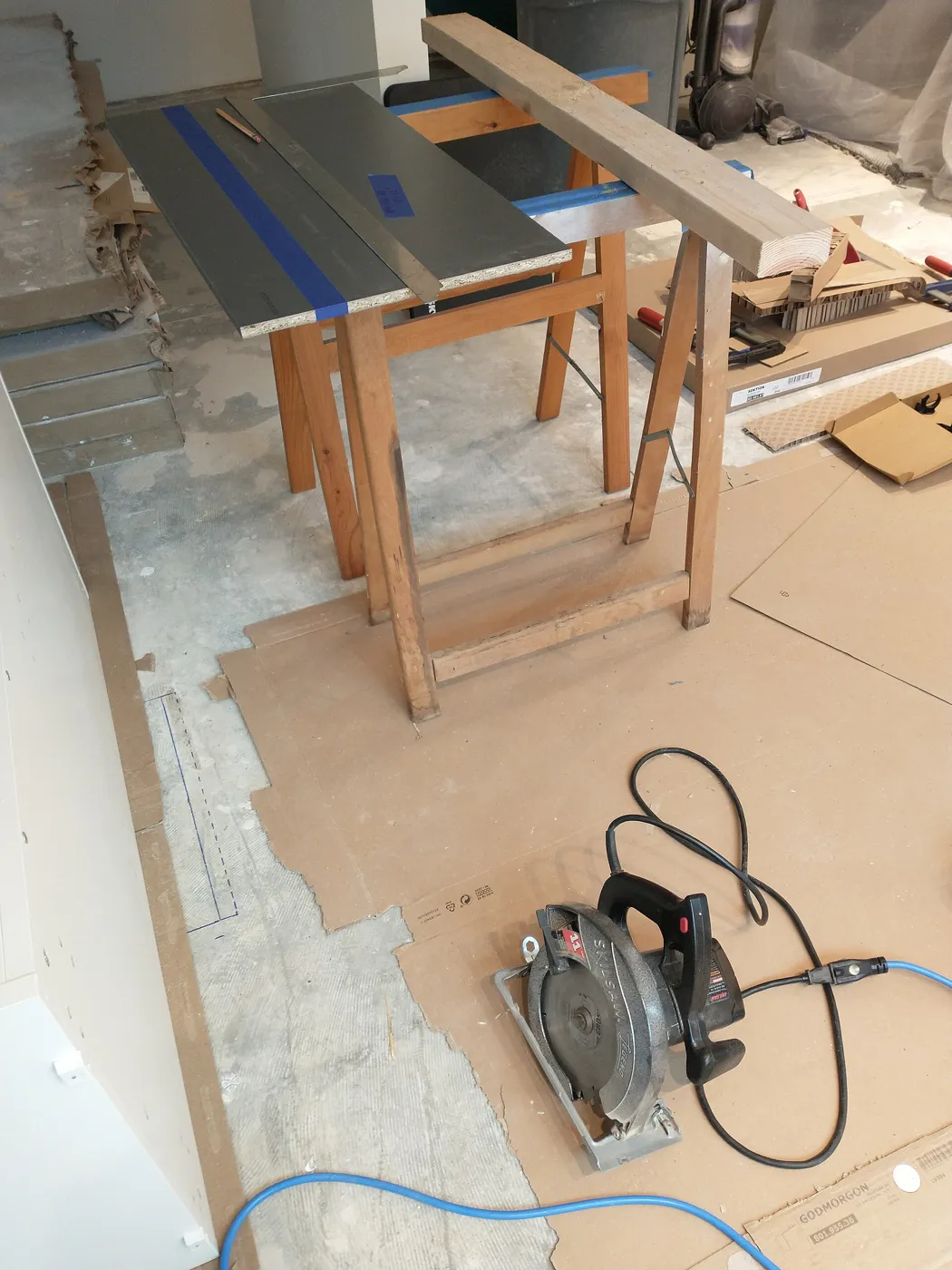
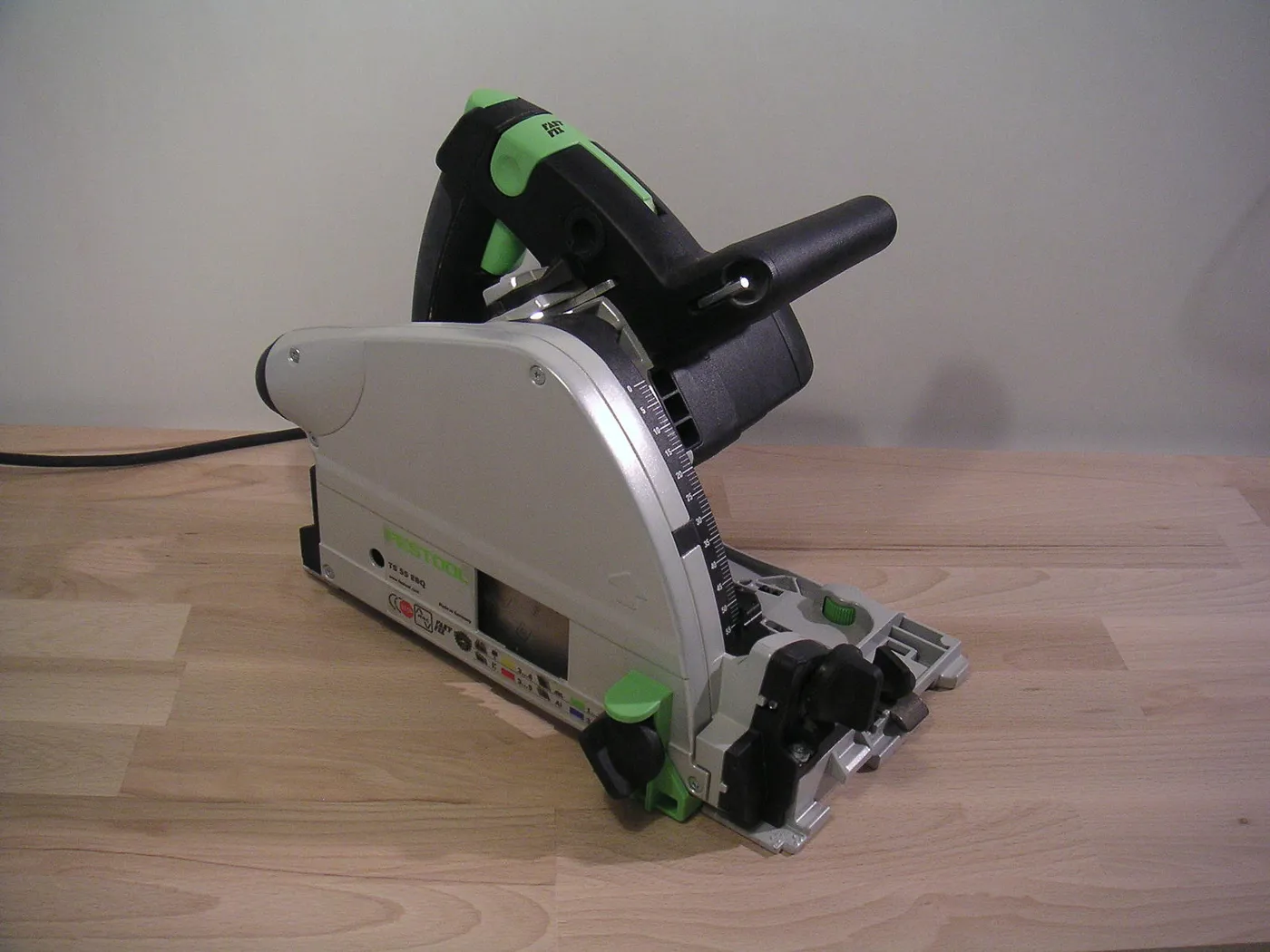
A standard circular saw is acceptable with a clamped straightedge, but for clean edges consider a plunge track saw. We explain the difference in our plunge saw guide, and the shop-side tools are listed under power tools.
For occasional home use
Pick a 6-1/2 inch saw on a battery platform you will use for other tools. The DCS565B and XSH03Z are both reasonable. Heavy framing saws are overkill if you build a shelf and a fence each year.
Safety and technique
- Set the blade depth about 1/4 inch deeper than the material. Too much blade exposed increases kickback risk.
- Support both sides of the cut so the offcut does not pinch the blade.
- Keep the cord of any extractor hose clear and both hands on the saw.
- Wait for the blade to stop before setting the saw down, unless the saw has an electric brake, and even then do not rely on it.
- Remove the battery before changing the blade.
- Use a guide for long rips. A clamped straightedge or rip fence keeps the line straight.
Ownership and maintenance
A brushless saw needs little maintenance beyond keeping it clean. Blow out the housing and the guard pivot after dusty work, check that the lower guard returns freely, and replace dull blades rather than forcing them, which drains batteries and increases kickback risk. Store batteries partly charged and out of extreme temperatures, and keep the shoe flat. A bent shoe causes angled cuts that look like a blade problem. For how we approach tool recommendations generally, see how we review.
Frequently Asked Questions
Are cordless circular saws as powerful as corded ones?
Modern brushless models come close for typical carpentry. Corded saws still win for sustained heavy ripping and for the lowest cost, but a 36 V system such as the Makita XSH06Z or a high-output 20V MAX saw like the DeWalt DCS590B handles framing work without trouble.
Is 6-1/2 inch or 7-1/4 inch better?
Neither is better in general. A 6-1/2 inch saw is lighter and runs longer on a battery, while a 7-1/4 inch saw cuts deeper, notably at 45 degrees. Choose by the thickest material you cut regularly.
What does a brushless motor do for me?
It removes carbon brushes, so there is less wear and heat, and the electronics can adjust speed and torque as the load changes. In practice that means more cuts per battery charge and a longer tool life.
How many batteries do I need?
All saws here are sold as bare tools, so you must supply batteries and a charger. For light use, a 4 to 5Ah pack is a good start. For framing, carry a spare. Makita's 36 V saws need two batteries on the tool at once.
Which brand has the best battery platform?
The honest answer is the one you already own. DeWalt, Milwaukee and Makita all have wide ranges and years of support. Check which platform offers the other tools you want before committing.
Can I use a circular saw for plywood and finish work?
Yes, with a fine tooth blade, a guide and masking tape or a scoring pass to limit tear-out. For repeated clean cuts in veneered panels, a plunge track saw is the better tool.
Do these saws include batteries?
No. Every model in this guide is a tool-only listing. Batteries and chargers are bought separately or as part of a kit.
Bottom line
The DeWalt DCS565B is the best cordless circular saw for most people: balanced size, sensible features and a broad battery platform. Step up to the DeWalt DCS590B when you need 7-1/4 inch capacity, or the Makita XSH06Z when runtime on a 36 V system matters most. Pick the Makita XSH04ZB if weight is your main enemy, and stay with Milwaukee's M18 FUEL saws if your batteries are already red. Whatever you choose, treat the blade as part of the purchase.
For wider tool shopping, see our power tools category and the electric pressure washer guide for other outdoor and shop gear.