
Open any cabinet maker's shop and you will find a saw that looks like a circular saw wearing a shroud, riding on an aluminum extrusion that lies across the board like a ruler. That is a plunge saw. It looks like a niche tool, but it has quietly replaced the table saw for a huge amount of sheet-good work, and it is one of the few power tools where the cut quality straight out of the saw can be better than what a bench machine gives you on a big, floppy panel.
This guide explains what a plunge saw is in mechanical terms, how the plunge action, riving knife and track actually work together, how it differs from a regular circular saw and a table saw, what you can and cannot do with one, and how to pick a first model. If you are comparing it with a regular handheld saw, our guide to the best cordless circular saws covers that side of the decision.
What a plunge saw actually is
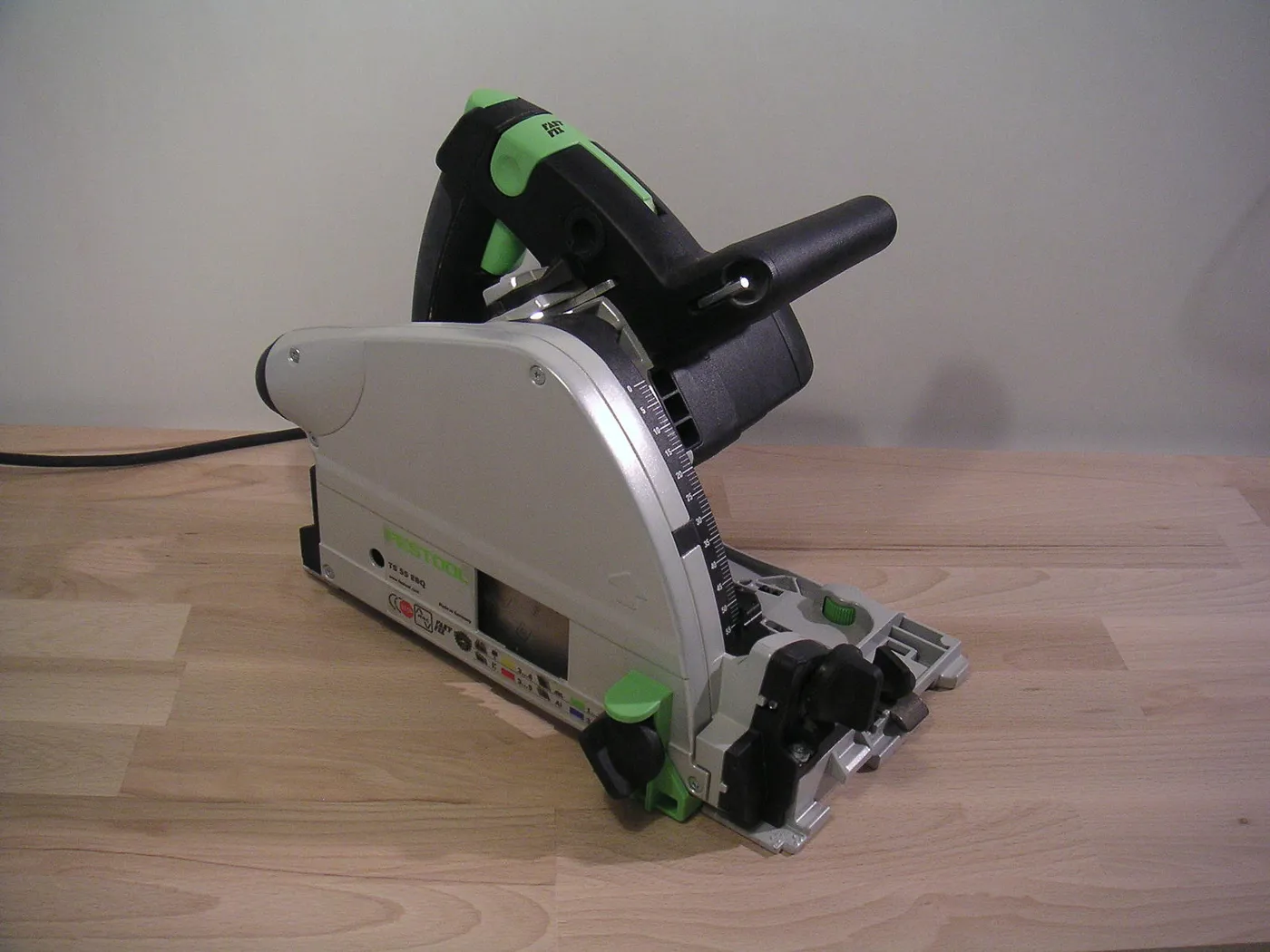
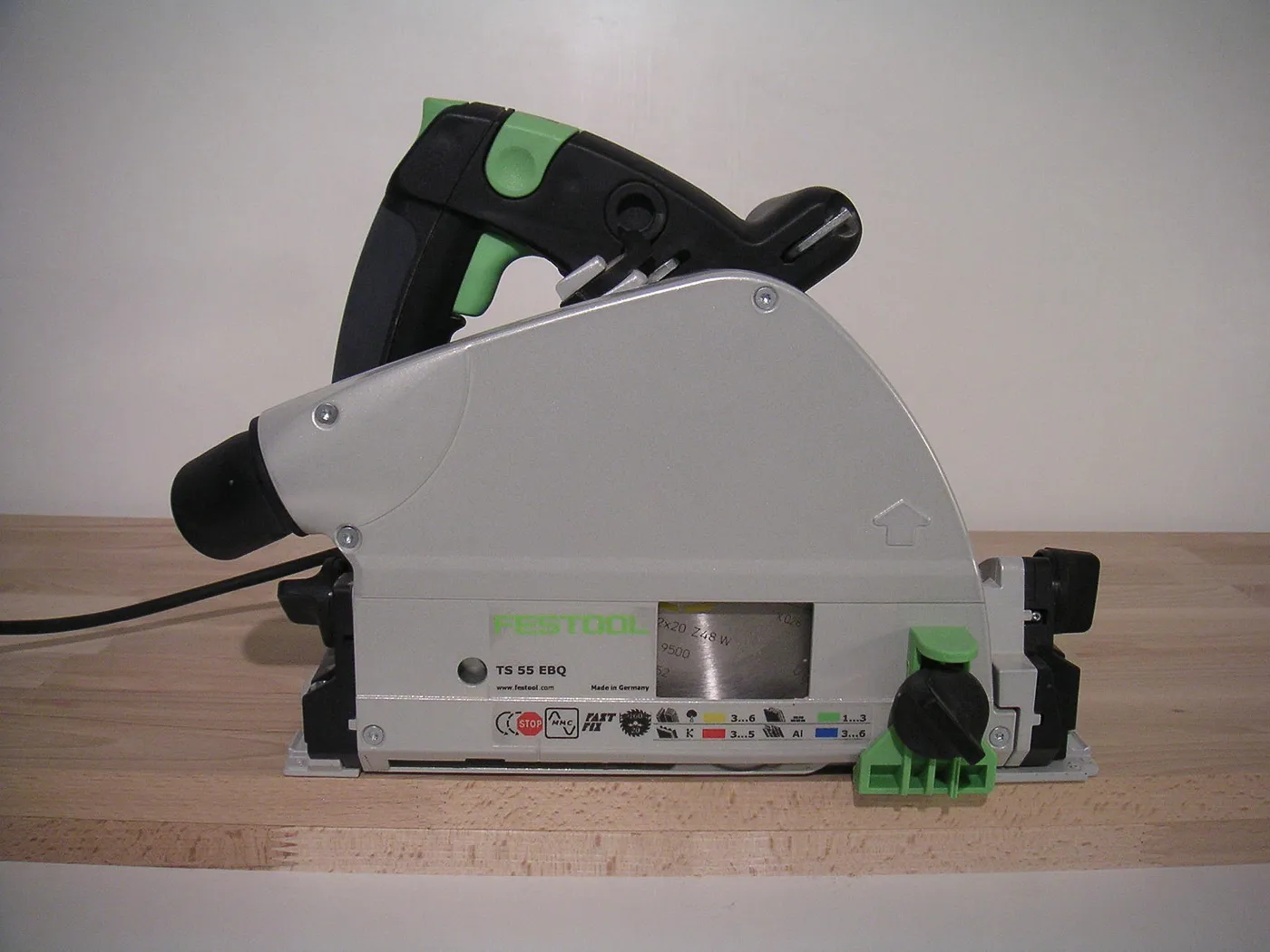
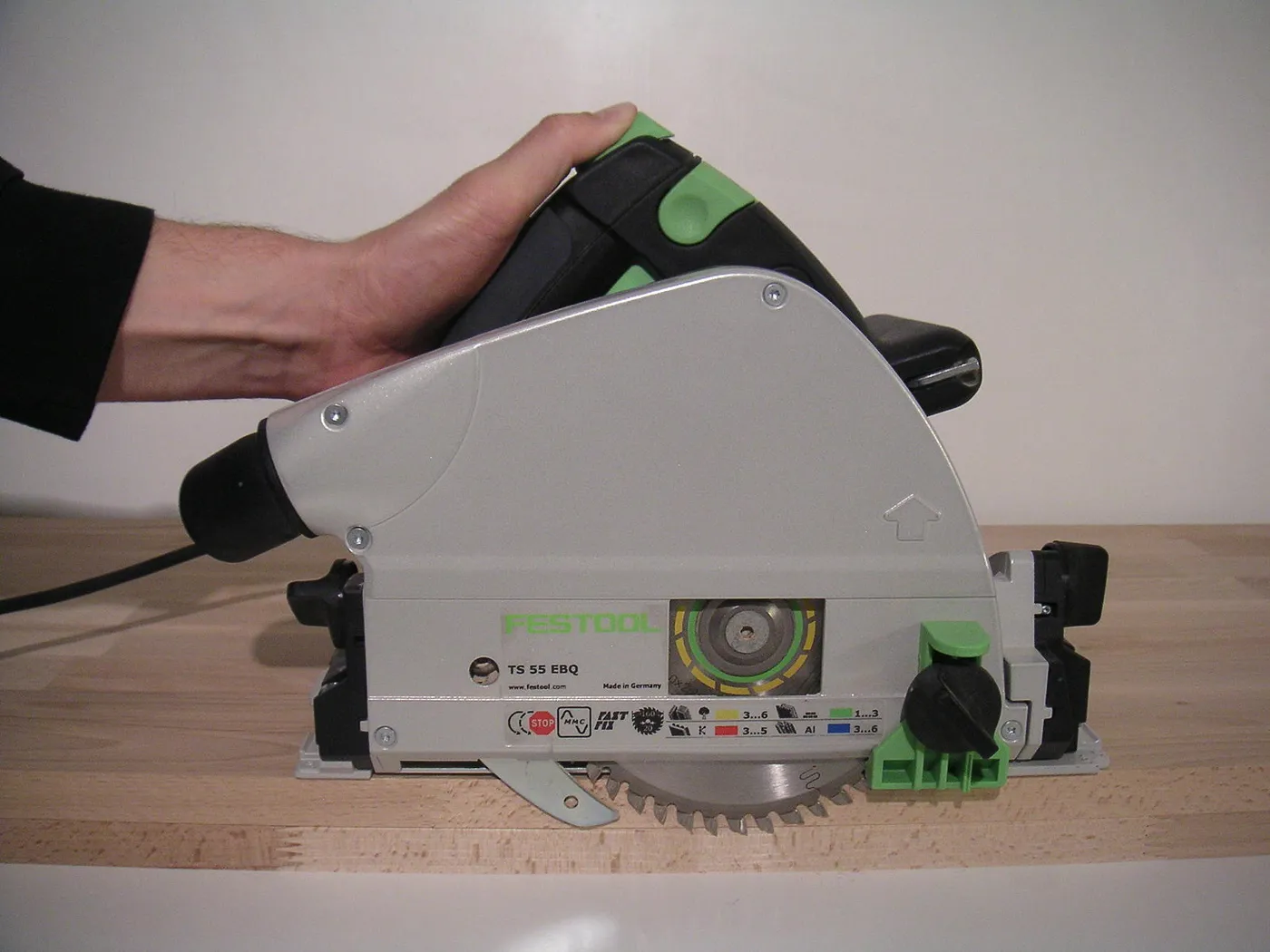
A plunge saw is a handheld circular saw in which the motor, blade and blade guard assembly is mounted on a hinge or slide above a flat base plate (the shoe). At rest the blade is fully retracted inside a housing, completely covered by the shoe. When you press the saw down, the blade swings or slides down through a slot in the base and emerges below it. Release the pressure and a spring returns the blade into the housing.
That single mechanical difference, a blade that lives inside the tool until you commit to a cut, is what separates a plunge saw from an ordinary circular saw, in which the blade is permanently exposed below the base and held in place by a depth-adjustment lock. It is also the reason the term "plunge" appears in the name: you plunge the blade into the material rather than feed the material into the blade.
The vocabulary around this tool is messy, so it helps to settle it early:
- Plunge saw and plunge-cut saw describe the mechanism. Any circular saw with a retracting blade qualifies, with or without a track.
- Track saw (or tracksaw) describes the system: a plunge saw that locks onto a rail. In practice, nearly every serious plunge saw is sold as part of a track system, so the two names are used interchangeably.
- Plunge-cut circular saw is how some manufacturers list freehand versions that are designed to be run along a clamped straightedge rather than a dedicated rail.
Typical blade diameters are around 160 mm in the European standard (the Festool TS 55 family) and 6-1/2 inch in the North American market. Depth capacity on the models in our shortlist runs from just over two inches at 90 degrees, which is enough to cut through standard 2x lumber and through a pair of stacked sheets of plywood in a single pass if you are patient.
How a plunge saw works
The tool is easier to understand once you break it into four cooperating systems: the plunge mechanism, the riving knife, the track interface and the dust path. Each solves a specific failure of the ordinary circular saw.
The plunge mechanism
Most plunge saws use a pivot at the rear of the saw body. The motor housing rotates down around that pivot like a drawbridge, and the blade passes through the base plate slot. A depth stop lets you set how far the blade can drop, typically with a scale and a micro-adjust knob (the Milwaukee 2831 describes a micro-adjust depth knob and a slide depth scale for exactly this reason). A spring pushes the motor back up, and a release catch or lock keeps it parked while you carry the tool.
A few designs, notably some Makita models, use a different arrangement in which the whole motor assembly rides vertically in guides. The practical effect is the same, but the pivot style gives a more natural arc under your hand while the vertical-slide style can feel stiffer and more mechanical. Either way, the safety value is identical: the blade is covered until you intentionally lower it.
Many saws also include a plunge lock that you can engage to hold the blade at depth. That is useful when you are making long rail cuts, because you do not want to hold the saw down against the spring pressure for the entire pass.
The riving knife
Kickback on a circular saw happens when the kerf closes behind the blade. Wood under tension squeezes the blade, the tooth gullets grab, and the saw is thrown back toward you. On a table saw, a riving knife sits directly behind the blade, at a fixed gap from it, to hold the kerf open. A plunge saw carries the same idea inside the blade housing.
On saws such as the Milwaukee 2831 and the DeWalt DWS520K, a riving knife is described in the feature list, and the DeWalt also lists a continuous anti-kickback mechanism that engages when the saw is on the track. Some plunge designs hold the knife slightly behind the blade and let it drop with the blade as you plunge, so it is always positioned correctly in the cut. Not every plunge saw has one, and some freehand plunge models rely on blade guard geometry instead, so check the spec sheet rather than assuming.
The track interface
The base plate of a track-compatible plunge saw has a machined channel on its underside. The guide rail has a matching tongue that the saw slides on, with no side play once the adjustment is set. The rail typically has two key features: a rubber or silicone anti-slip strip underneath, so the rail grips the workpiece without clamps for most cuts, and a replaceable splinter guard strip along the cutting edge.
That splinter guard is the heart of the system. The first time the blade runs, it cuts a fresh edge into the strip, so the rail edge becomes an exact copy of the cutting line. When you set the rail, you align the strip edge with the pencil mark, and the line you see is the line the blade will follow. It also supports the surface fibers right at the cut, which is why a veneered plywood or melamine panel comes off with almost no chipping on the top face. The Festool TS 55 listing describes a splinter-free cut on both sides of the board via an attachable splinter guard, and DeWalt describes its DWS520K as a zero-clearance system for the same reason.
Bevel cuts work differently on a track saw than on an ordinary circular saw. On a conventional saw, the bevel pivot lies away from the line, so the cut position changes as you tilt the shoe. Many track saws pivot the motor around the line itself, so the cut edge stays registered to the rail from 0 degrees all the way to the maximum bevel. The Festool listing highlights that its cutting edge from 90 degrees down to 47 degrees remains unchanged when the saw bevels, and the Milwaukee lists bevel stops at 22.5, 45 and 48 degrees.
The dust path
A plunge saw's blade runs inside a shroud, so the sawdust is thrown into a closed channel and out through a port at the rear. Connect that to a shop vacuum or dust extractor, and a large share of the dust is captured at the source. The Milwaukee 2831 specifically lists a compatible 1-7/8 inch vacuum hose connection plus a dust bag if you do not have a vacuum. Fully enclosed designs capture noticeably more dust than the open slot at the back of a standard saw, which makes them a pragmatic choice for indoor work, such as trimming a worktop in a finished kitchen.
What a plunge cut is, and why it matters
The reason the saw exists is the plunge cut itself. Imagine cutting a rectangular opening in the middle of a kitchen worktop for a sink or hob. With a standard circular saw, you cannot start inside the board, because the blade has to enter from an edge. You would use a drill and a jigsaw, which gives a rougher edge. A plunge saw starts with the blade retracted over your marked line, then you lower it into the work at the start of the cut, push forward to the end line, and lift out. You finish the corners with a jigsaw, but the long straight edges are crisp and fully supported.
A safe plunge cut follows a sequence:
- Set the depth stop to the thickness of the board plus a small allowance for the supporting surface.
- Rest the saw on the rail (or against the straightedge) with the blade fully retracted.
- Start the motor with the blade still up and let it reach full speed.
- Lower the blade smoothly into the work, with firm pressure on the front and rear of the saw.
- Feed forward at a steady rate. Let the saw do the work.
- At the end of the cut, release the trigger, hold the saw until the blade stops and then lift.
Plunging into the end of a cut in the wrong direction can cause the saw to jump back, so always plunge with the saw positioned so the cutting direction pulls the shoe against the work. When you cut into a line away from an edge, use the rail's anti-tip features and keep the saw firmly seated on the track.
Plunge saw vs circular saw
The honest answer to "which is better" is that they overlap but are not in competition. A regular circular saw is a fast, cheap, rugged site tool. A plunge saw is a precision tool that happens to be portable.
| Feature | Plunge / track saw | Standard circular saw |
|---|---|---|
| Starting a cut | Plunge into the middle of the board | Enter from an edge only |
| Straightness | Locked to a rail, very straight over long cuts | Depends on the operator and a clamped straightedge |
| Edge quality | Splinter guard supports the fibers, minimal tear-out | Often tears the top or bottom face |
| Kickback protection | Riving knife and anti-kickback features on many models | Blade guard only on most models |
| Dust collection | Enclosed shroud and hose port | Limited, often a basic chute |
| Weight and bulk | Heavier, needs rails to carry | Light, grab and go |
| Cost of ownership | Saw plus rails plus accessories | Saw only |
| Best on | Sheet goods, worktops, doors, finish work | Framing, decking, demolition, rough carpentry |
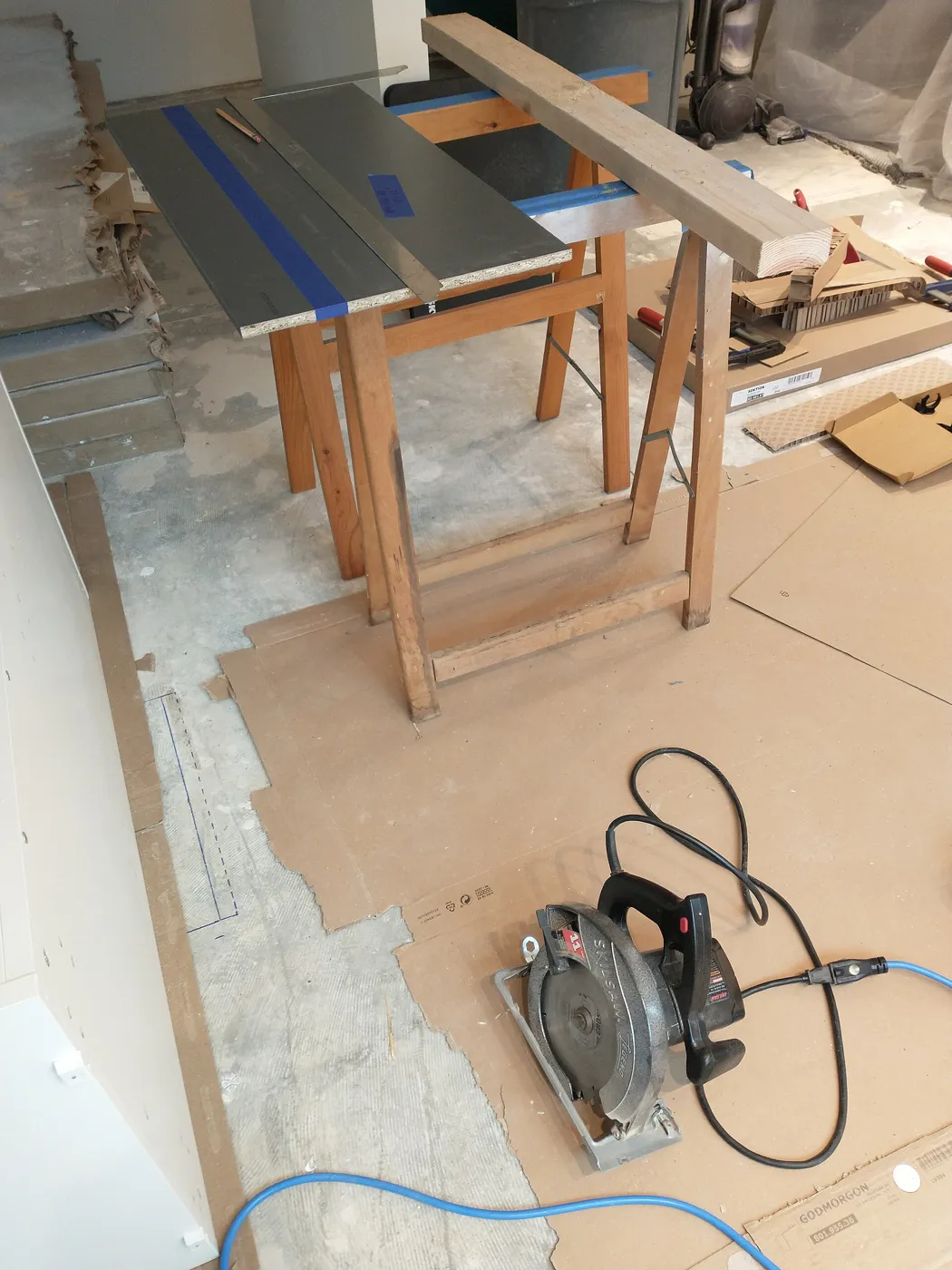
The usual advice is that a plunge saw is "like a table saw you can carry to the sheet". In shop terms, that is accurate. Pushing a full sheet of plywood across a table saw is awkward and risky for one person; laying it on foam board or sacrificial supports and running a rail across it is far easier and often safer. A standard circular saw can be set up to do something similar with a clamped straightedge, but the setup is slower, and the cut can wander because the saw's shoe is not captured by a tongue-and-groove interface.
If you mostly do rough carpentry and need to leave the tool in a truck, a regular saw is the better buy. If you build cabinets, fit kitchens, hang doors or cut laminate flooring where the edge shows, the plunge saw earns its place. We also cover the cordless options in our comparison of cordless circular saws, which helps if you are still deciding whether a standard saw is enough.
Plunge saw vs table saw
The table saw gives the best repeatability for narrow rip cuts, dados and small parts, because the fence locks the cut width and the blade is held firmly. But there are specific jobs where it falls short, and where a track saw takes over:
- Full sheets of plywood or MDF. Handling a four-by-eight sheet on a small table saw is an invitation to a bad cut. On a track, the sheet lies flat on the floor or on a support table and the saw does the moving.
- Finished workpieces. Cutting a pre-finished cabinet end or a veneered door is simpler when the work stays still.
- Tight spaces. You can carry a plunge saw to the job site, but a cabinet saw stays in the shop.
- Dust. A track saw with a hose gets more of the dust than a typical open table saw.
The table saw wins for repetitive cuts to the same width, narrow strips, joinery cuts and thick hardwood. A track saw generally struggles to cut very thick stock in one pass because of its limited depth, and it is poor at ripping a thin strip, since the rail needs room to sit on the board. For a small shop with one saw budget, the track saw plus a router table often covers more ground than a small contractor table saw.
What you can use a plunge saw for
Breaking down sheet goods
This is the headline use. Cut a sheet of plywood into manageable panels on a foam insulation board, and the rail gives a clean, straight edge that is ready for edge banding. The splinter guard keeps veneer from lifting on the show face, which is the problem that ruins cheap circular saw cuts.
Fitting kitchen worktops
A worktop is expensive, often laminate, and cannot be re-cut once it is wrong. A plunge saw makes cut-outs for sinks and hobs, and handles the long straight edge trims with a clean top face. Laminate chips easily, which is why the zero-clearance guard matters more here than in rough lumber.
Cutting doors to height
Trimming a solid or veneered door is one of the classic uses. The rail clamps across the door, and the saw runs a straight line with no chipping on the face veneer.
Bevels and miters on long panels
Because the rail registers the cut line even when the saw is tilted, you can cut long compound-angle edges for things like cabinet toe kicks, angled shelves or scarf joints on panel edges, which are a nuisance on a conventional saw.
Flooring and cladding
Laminate, engineered wood and wall cladding all benefit from dust-controlled, chip-free cuts, and the plunge action lets you cut around obstacles such as door frames in place.
Cutting materials other than wood
With the correct blade, a track saw will also cut plastics, solid-surface worktops, aluminum sheet and cement-bound boards. The dust control matters especially with fiber cement and mineral materials, which produce fine, hazardous dust. Always match the blade to the material and use proper extraction and respiratory protection.
What a plunge saw is not good at
- Thick timber. Depth capacity usually tops out around two inches at 90 degrees, and drops at 45 degrees. The Makita SP6000J lists 2-3/16 inch at 90 degrees and 1-9/16 inch at 45 degrees, which is typical for the class. For a 4x4 post you still need a larger saw.
- Rough, fast work. Setting a rail for every cut is slower than snapping a line and running a regular saw.
- Short cuts on narrow stock. A narrow board does not give the rail enough bearing surface, and you may need shims or a second support.
- Heavy abuse. The tight tolerances of the track interface do not like being thrown in a bin. Treat the rail as a measuring instrument.
Features that matter when choosing
Corded or cordless
Corded track saws offer continuous power and usually lower cost. The Festool TS 55, DeWalt DWS520K and Makita SP6000J are corded, with the DeWalt rated at 12 amps and 1300 W and the Makita at 12 amps. Cordless versions such as the Milwaukee M18 Fuel 2831 and the Makita XPS01Z (a pair of 18 V batteries making a 36 V system) trade some continuous capacity for convenience. A two-battery system like the Makita lists up to 6,300 RPM, so the performance gap is smaller than most people expect. If your work is on the shop floor, corded is simpler. If it is on site, cordless wins on convenience.
Rail compatibility
This is the most important feature that spec sheets bury. Festool's rail system is the reference, and some other brands design their saws around profiles that are compatible or similar, but compatibility varies by model, so confirm it before mixing brands. The DeWalt DWS520K uses its own dual-edged track, and the Milwaukee 2831 lists an adjustable cam system for fitting the saw to the rail. Always check that a rail is included or what you will need to buy, because many saws ship without one. The Festool listing says plainly that the guide rail is not included.
Bevel capacity and bevel stops
If you cut mitered panels, check the maximum bevel angle. The Festool TS 55 listing quotes a range down to 47 degrees, while the Milwaukee lists stops at 22.5, 45 and 48 degrees, and the Makita SP6000J lists 1-9/16 inch of capacity at 45 degrees.
Variable speed
Variable speed lets you slow the blade for plastics, laminates and non-ferrous metals. The Makita SP6000J lists a 2,000 to 5,200 RPM dial, the XPS01Z a 2,500 to 6,300 RPM dial, and the Milwaukee 2831 a variable speed dial as well. Constant-speed electronics, which Makita lists on the SP6000J, hold RPM under load so the cut stays smooth.
Riving knife and anti-kickback
Look for it explicitly. The DeWalt DWS520K and Milwaukee 2831 both list a riving knife, and the DeWalt adds a continuous anti-kickback mechanism. If a model does not mention one, ask before buying, especially for solid timber.
Dust port size
A port that matches your vacuum hose saves buying adapters. The Milwaukee lists compatibility with 1-7/8 inch hoses. Check the diameter of your existing extractor before buying.
Weight and handle position
Plunge saws are heavier than regular saws, partly because of the base and housing, and partly because of the battery on cordless models. Hold it if you can. A saw that balances well on the rail produces better cuts than one that you fight.
Plunge saws worth comparing
We evaluated these five saws based on their published specifications, the system around them (rail, accessories, battery platform) and owner feedback. This is not a performance test. For the models, features are quoted from the manufacturer or retail listings and may vary by region and kit.
| Model | Power | Blade size | Depth at 90 degrees | Notable feature |
|---|---|---|---|---|
| Festool TS 55 FEQ-F-Plus | Corded | 160 mm class (55 mm depth in the name) | Rail not included | Bevel registration to 47 degrees, splinter guard |
| Makita SP6000J | Corded, 12 A | 6-1/2 inch | 2-3/16 inch | 2,000 to 5,200 RPM dial, electronic speed control |
| DeWalt DWS520K | Corded, 12 A / 1300 W | 6-1/2 inch | 2-1/8 inch on track | Zero clearance, riving knife, anti-kickback |
| Milwaukee M18 Fuel 2831-20 | Cordless 18 V | 6-1/2 inch | Slide depth scale, micro-adjust | Brushless, riving knife, vac port and bag |
| Makita XPS01Z | Cordless 36 V (two 18 V) | 6-1/2 inch | Check the manufacturer | 2,500 to 6,300 RPM dial, automatic speed change |
The reference system: Festool TS 55
The TS 55 is the saw that defined the category for many woodworkers, and its design sets the benchmark for the others. The listing highlights a splinter guard giving a virtually splinter-free cut on both sides, bevel registration that remains constant down to 47 degrees, and a large accessory range. It is the saw you buy if you will use it every day and want the largest ecosystem of rails and add-ons. The cost is plain: you pay for the system, and the rail is sold separately.
The corded value pick: Makita SP6000J
The SP6000J is a straightforward corded plunge saw with a 12 amp motor, a variable speed dial from 2,000 to 5,200 RPM and 2-3/16 inch capacity at 90 degrees. It is one of the more affordable ways into the category and works well for shops that already own a compatible rail. Note that some comparisons point out it lacks a riving knife, so take extra care in solid timber.
The kit option: DeWalt DWS520K
The DWS520K is sold as a track saw kit with a corded 1300 W motor, zero-clearance cutting, an on-track depth of 2-1/8 inch at 90 degrees and 1-5/8 inch at 45 degrees. It lists a riving knife and anti-kickback mechanism, which makes it one of the more safety-minded corded options. It fits buyers who want one box with everything they need to start.
The cordless site saw: Milwaukee M18 Fuel 2831-20
The 2831-20 is a brushless cordless plunge track saw that sells as a bare tool. It lists a riving knife, bevel stops at 22.5, 45 and 48 degrees, a micro-adjust depth knob, a vac port and dust bag, and an adjustable cam to fit the saw to the rail. It is the pick for contractors already on M18 batteries.
The high-power cordless: Makita XPS01Z
The XPS01Z runs on two 18 V LXT batteries for a 36 V system, with a brushless motor rated at 6,300 RPM, an adjustable dial from 2,500 to 6,300 RPM, and automatic speed change that adjusts speed and torque during the cut. It ships with a 55 tooth blade intended for wood, MDF and laminate. Batteries are not included, so factor them in.
How to choose your first plunge saw
- Decide on the rail system first. The saw is replaceable, but the rails, clamps and accessories accumulate. If you want the broadest accessory choice, pick a Festool-compatible platform. If you want the cheapest all-in-one kit, look at the DeWalt DWS520K.
- Choose power source by workplace. Shop-bound: corded. On-site, ladders, no outlet: cordless. If you own Makita or Milwaukee batteries, that often decides it.
- Budget for the rail length you actually need. A shorter rail suits crosscuts and doors, a longer one suits full sheets. Many owners buy two lengths or a connector.
- Buy a decent blade. A fine tooth blade gives the best finish on laminate and veneer, while fewer teeth are faster in solid wood. The blade makes as much difference as the saw.
- Plan dust extraction. If your extractor hose does not fit, add an adapter to the shopping list.
Safety and set-up habits
A plunge saw is safer than a conventional saw in many respects, but the usual rules still apply.
- Wear eye and ear protection and a dust mask suited to the material.
- Keep both hands on the saw handles during the cut, and keep the cord or hose behind you.
- Never reach under the work to remove an offcut while the blade is spinning.
- Let the blade reach full speed before plunging and keep it fully retracted when carrying.
- Check the riving knife alignment if you change blades. A misaligned knife can bind in the kerf.
- Disconnect the power (or remove the battery) before changing blades.
Maintenance and ownership reality
Track saws are simple machines, but the tight tolerances mean small problems show up in the cut. Keep the underside of the rail clean, because dust and resin under it can lift it off the work. Wipe the tongue and channel with a dry cloth, and add a trace of dry lubricant if the saw begins to stick. Replace the anti-slip strip when it glazes over, and replace the splinter guard when it gets damaged or when you change to a different saw.
Adjust the play between saw and rail according to the manual. The plunge mechanism should return smoothly without sticking; if it is sluggish, clean the guides and check for resin buildup. Store the rails flat or hung from keyholes so they do not bow. A bent rail ruins a straight cut regardless of the saw. For general guidance on equipment we recommend and how we judge it, see our review process.
Frequently Asked Questions
Is a plunge saw the same as a track saw?
Almost. A plunge saw describes the retracting blade mechanism, while a track saw is a plunge saw used with a guide rail. In practice, nearly every plunge saw sold today is part of a track system, so most people use the terms interchangeably. A few freehand plunge saws exist for use against a clamped straightedge.
Can a plunge saw replace a table saw?
For breaking down sheet goods, trimming doors and cutting worktops, yes, and it often does the job better. For narrow rips, repeat cuts to a fixed width, dados and thick hardwood, a table saw is still more practical. Many small shops run a track saw alongside a modest table saw or a router table.
Do I need the guide rail?
You can run a plunge saw freehand or against a clamped straightedge, but you lose most of what makes it valuable, including the zero-clearance splinter guard and the precise line registration. If the saw is sold without a rail (as the Festool TS 55 listing makes clear), budget for one.
Is a plunge saw safer than a regular circular saw?
In several ways, yes. The blade is covered until you plunge, the housing encloses the blade, and many models include a riving knife and anti-kickback features. Safety still depends on technique, supported work and proper blade choice, and not every plunge saw has a riving knife, so check the specification.
What blade should I use?
For clean cuts in veneered ply, melamine and laminate, choose a fine tooth blade with a high tooth count, such as the 55 tooth blade supplied with the Makita XPS01Z for wood, MDF and laminate. For faster cutting in solid timber, use a lower tooth count. Use blades made for the material if you cut plastics or non-ferrous metal.
Can I use a plunge saw for framing lumber?
You can, but it is not the best tool. Depth capacity is limited, the setup is slower, and a standard circular saw or a miter saw is faster for rough carpentry. A plunge saw excels where finish and accuracy matter more than speed.
Corded or cordless plunge saw?
Corded saws keep full power with no battery to manage, and cost less. Cordless saws such as the Milwaukee 2831 or Makita XPS01Z remove the cord and suit job sites. The right choice mostly depends on whether you already own batteries from the same brand.
Bottom line
A plunge saw is a circular saw rebuilt around accuracy and control: a blade that stays covered until you plunge, a riving knife to hold the kerf open, a rail that locks the line, and a dust port that keeps the cut visible. It will not replace a framing saw or a heavy-duty table saw, but for sheet goods, worktops, doors and finish carpentry it is the tool that turns an average edge into a clean one.
If you want the most complete system, the Festool TS 55 sets the standard. If you want a corded entry point, the Makita SP6000J and DeWalt DWS520K cover the market, with the DeWalt offering a riving knife and kit format. If you work on site and run a battery platform, the Milwaukee 2831 and Makita XPS01Z are the cordless answers. For general-purpose cutting where a rail is overkill, see our cordless circular saw guide, or browse the wider power tools category.