
These two saws are rarely in the same conversation because they are built for different jobs, yet people keep comparing them because both are widely described as the best sliding compound miter saw you can buy. The DeWalt DWS780 is the saw you see on a thousand job sites. The Festool Kapex KS 120 REB is the saw you see in cabinet shops and high-end trim carpentry. Choosing between them is less about which is better and more about which compromises you can live with.
This comparison is based on the manufacturers' specification pages, retailer spec listings and published owner discussions among people who have used both. We evaluated the information rather than claiming to have run the saws ourselves, and where sources disagreed we say so. Owner comments are anecdotal, and we mark them that way.
The two saws side by side
| Specification | DeWalt DWS780 | Festool Kapex KS 120 REB |
|---|---|---|
| Blade diameter | 12 in. | 260 mm (about 10.2 in.) |
| Motor | 15 amp, 1,100 W, 3,800 RPM, brushed | 1,600 W, electronically controlled |
| Crosscut capacity | 2x14 dimensional lumber at 90 degrees | 305 mm wide by 88 mm deep at 90/90 (about 12 by 3-1/2 in.) |
| Bevel capacity | 2x10 dimensional lumber at 45 degrees | Not directly listed in the sources we checked |
| Nested crown molding | Up to 7-1/2 in. | About 6-5/8 in. per retailer listings |
| Vertical base molding | Up to 6-3/4 in. | Up to 120 mm (about 4-3/4 in.) in the special cutting position |
| Miter range | 60 degrees right, 50 degrees left, 10 detents | 60 degrees both sides |
| Cut line guide | XPS LED shadow line | Dual lasers |
| Dust collection claim | Over 75% | Up to 91%, with a 36 mm pivoting hose |
| Weight | Not on DeWalt's page; owners cite roughly 25 kg (mid 50s lb) | About 21.5 kg (about 47.4 lb) on most listings |
| Warranty | 3 year limited, 1 year free service, 90 day satisfaction guarantee | 3 year wear-and-tear warranty, 2-day standard repair time, 1 month satisfaction guarantee |
Treat the table as a map, not a verdict. Several of these numbers come from manufacturer and retailer pages that use different measurement conventions, and a few (the Kapex bevel capacity, the DWS780 weight) are not published in a form we could verify across multiple sources. We left those open rather than guess.
Two different design philosophies
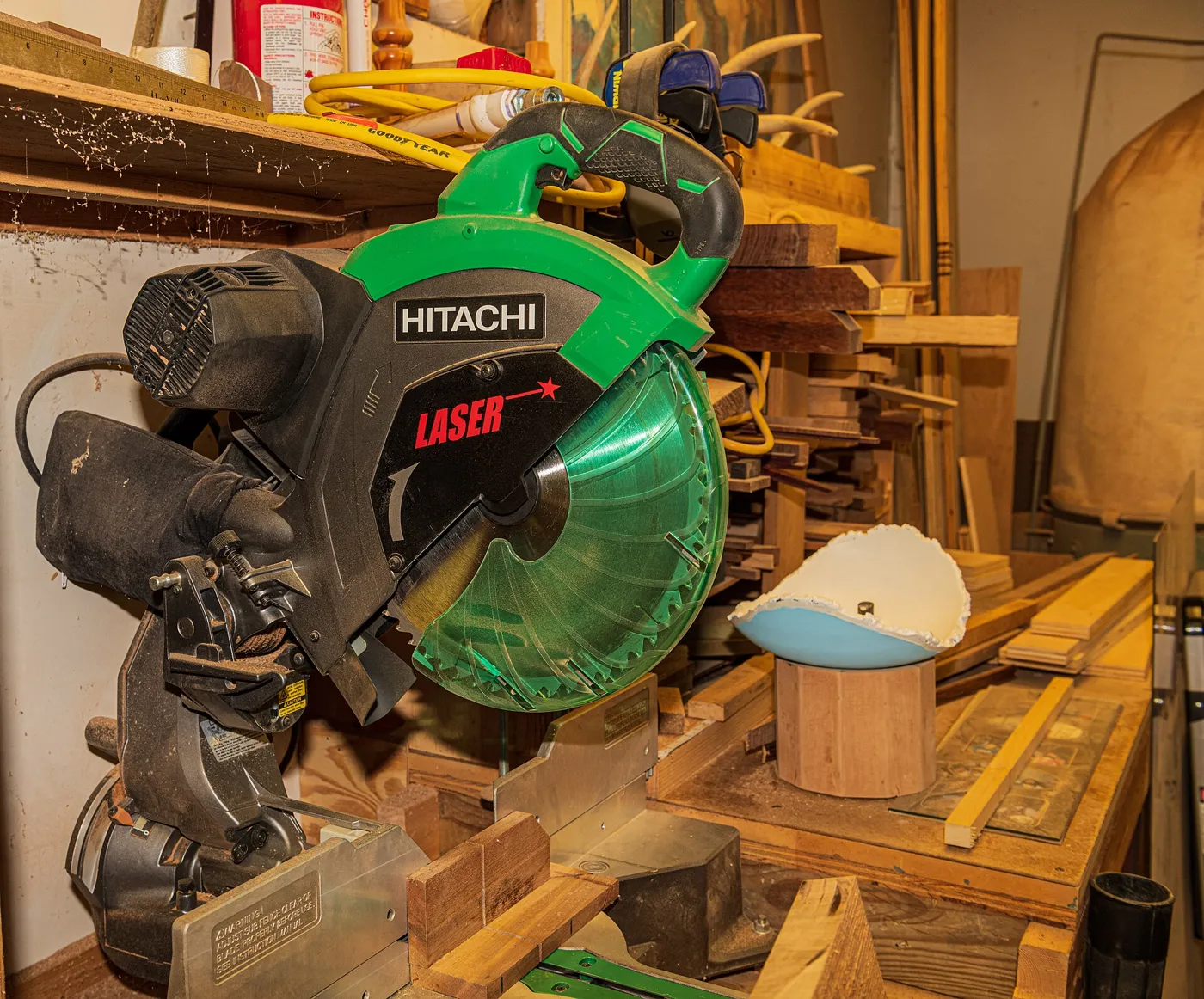
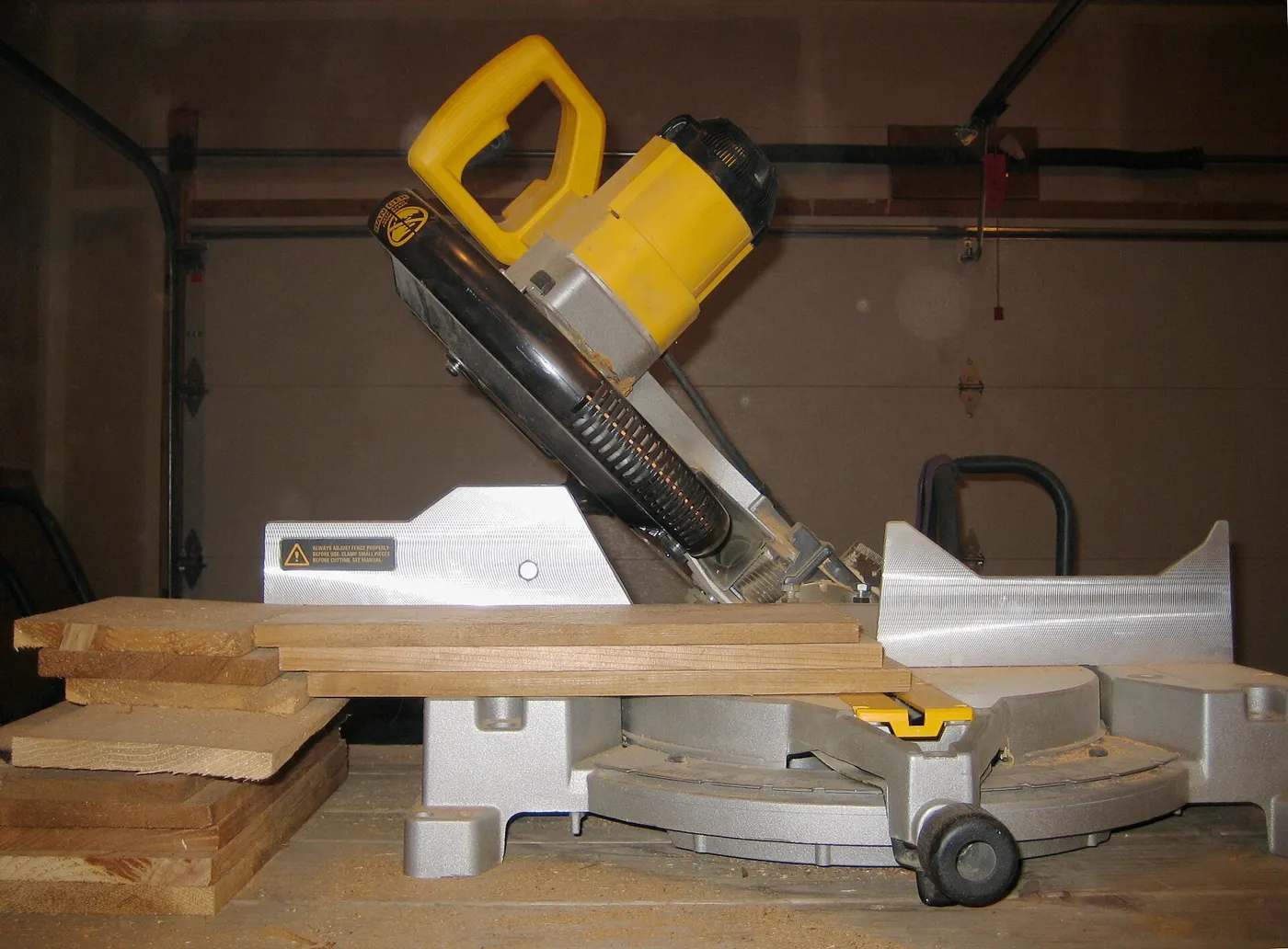
The DWS780 is a refined traditional sliding miter saw. Two steel rails extend behind the saw, the head slides along them, and the large 12 inch blade gives a wide cut at the price of a large footprint. DeWalt's engineering goes into making that layout accurate and convenient: an integrated cut line positioning system, an adjustable stainless steel detent plate with ten stops, and a large bevel scale.
The Kapex takes a different route. Festool describes it as a rail-forward design: the guide rails sit in front of the column rather than extending behind, which gives a more compact footprint and, according to Festool, prevents head play for accurate cuts. A twin-column guide, a behind-the-blade dust hood and a pivoting extraction hose are designed around the idea that cutting trim in a finished room should leave the room clean.
That philosophical split drives almost every difference below: DeWalt maximizes capacity and job-site practicality, Festool maximizes precision and cleanliness within a smaller cut envelope.
Cut capacity
This is where the 12 inch blade wins. The DWS780 is rated for 2x14 dimensional lumber crosscut at 90 degrees, and up to 2x10 at a 45 degree bevel. The Kapex's 260 mm blade supports a crosscut of 305 mm wide by 88 mm deep at 90 by 90. That is roughly a 12 inch wide crosscut, a respectable capacity for a 10 inch class saw thanks to the long slide, but the depth of 88 mm is shallower than what a 12 inch blade provides.
Crown and base molding
The DWS780 is listed for nested crown up to 7-1/2 inches and vertical base molding up to 6-3/4 inches. The Kapex handles about 6-5/8 inch crown nested, per retailer listings, and its special cutting position allows strip material up to 120 mm tall to be cut vertically against the fence. That special position is also designed for cutting coving and cornice in its original wall orientation, a feature that matters for ornate trim work.
In practice, if you routinely cut large crown, wide baseboard or thick framing, the DWS780 gives you more headroom. If your typical stock is 3 to 5 inch trim and you care more about cut quality than maximum size, the Kapex's capacity is enough.
Capacity rule of thumb: if you ever need to cut 2x12 or 2x14 stock in a single pass or large crown nested, buy the DWS780. If your widest board is 10 inches or less, the Kapex covers you.
Accuracy and calibration
Both saws can cut accurately. The difference is in how much effort it takes and how the saw behaves over time.
Owner reports describe the DWS780 as accurate out of the box, and its stainless steel detent plate with ten positive stops is designed to find common angles consistently. The plate is adjustable, so you can re-tune the detents if they drift. One owner noted that the shadow line was roughly 1/64 inch off on his saw, though other owners point out the shadow is the blade itself, so any discrepancy is usually a matter of sight line and blade thickness rather than a fault.
The Kapex earns its reputation for refinement: owners describe it as miles ahead in terms of feel, and the twin-column guide with a rail-forward layout is designed to remove head play. One owner who had both reported that the lasers on his new Kapex were visibly misaligned and took over half an hour to adjust close, so he now uses them only as a reference. The takeaway is that both saws benefit from a setup check before you trust them for finish work, regardless of price.
Calibration checklist for either saw
- Check that the fence is square to the blade at 0 degrees miter using a reliable square.
- Check the bevel at 0 degrees against the table using the blade, not the scale.
- Make a test cut on scrap and flip one piece to check for gaps at 45 degrees.
- Check the cut line guide against a real kerf, and adjust or ignore it if it disagrees.
- Re-check after transport, because jarring is the usual cause of drift.
Dust collection
This is the clearest difference between the two saws, and the one owners agree on most. The DWS780's collection is rated by DeWalt at over 75% of dust generated when used with the supplied bag. The Kapex is rated at up to 91% with a behind-the-cut dust hood and a pivoting 36 mm hose connected to an extractor.
Both figures are manufacturer claims, but owner discussion supports the gap. Owners who used both described the DeWalt's dust collection as poor in comparison, with one saying it was unworkable in his basement shop and another saying he swapped saws solely for dust extraction. Aftermarket dust hoods and shrouds can narrow the gap on the DeWalt, but they add cost and complexity.
Two practical points about dust matter more than the percentages. First, the Kapex's extraction relies on a connected dust extractor: the 91% figure assumes you attach a vacuum with suitable airflow, so the saw is only as clean as your extractor. Second, a miter saw's fine dust is a health issue for anyone cutting indoors or in a basement, which is why many trim carpenters treat extraction as a primary buying criterion rather than a bonus.
Footprint and weight
The Kapex's rail-forward design lets it sit near a wall because its slide does not extend behind the saw. Owners describe it as very portable and able to sit right up against a wall. The DWS780 uses a conventional sliding rail system, so you need clearance behind the saw to use the full cut width.
On weight, the Kapex is listed at about 21.5 kg (47.4 lb) by most retailers, although one retailer lists 28 kg, likely including accessories. DeWalt does not list the DWS780's weight on its page. One owner who had both said the DeWalt weighs about 25 kg compared to 17 kg for the Festool, which does not match the retail listing for the Kapex, so we treat the exact gap as uncertain. Directionally, the Kapex is lighter and more compact, which matters for hauling it up stairs or into a van.
- Shop with a permanent stand or bench: weight matters little, footprint matters a lot if the saw sits against a wall.
- Job site, moving daily: every pound counts, and the Kapex has an advantage, but the DWS780's wider stance and sturdy rails suit rough handling.
Dual lasers versus the XPS shadow line
This is a matter of taste. The DWS780 uses XPS, an LED shadow line that projects the blade's shadow onto the workpiece so you align your pencil mark to the real kerf. Because the shadow is cast by the blade itself, it needs no calibration beyond keeping the LEDs working. Owners who prefer it point out that it has no beam width to interpret.
The Kapex uses two lasers, one on each side of the blade, which define the material that will be removed. This lets you line up cuts from either side, but laser beams have a width, and they can be adjusted if they drift out of alignment. Some owners find them accurate once adjusted, others say they are fine but not perfect. A small number dislike them enough to recommend a different Festool model with a shadow line.
If you expect to use the guide as your primary alignment tool, the shadow line is simpler and more robust. If you mark both sides of a cut and trust your pencil, the lasers are perfectly usable.
Controls, bevel and clamping
The Kapex wins on ergonomics. Owners consistently praise its quick-release hold-down clamp as best in class, and its micro-adjustable bevel with an up-front rotary knob and large scale as a major step up from DeWalt's approach. One owner said the DeWalt's screw-style clamp was slow enough that he often skipped using it, which is a safety and accuracy problem rather than a mere inconvenience.
The DWS780 counters with a large bevel scale, a miter detent plate that can be adjusted, and a well-known, easy-to-service design. It is a saw people can fix and tune with parts that are widely available.
Motor power and blade quality
On paper, the Kapex's 1,600 W motor outguns the DeWalt's 1,100 W (15 amp) motor, but the blades differ: a 260 mm blade versus 12 inches, so a direct comparison of watts is misleading. The DeWalt spins its 12 inch blade at 3,800 RPM; the 12 inch diameter gives a higher blade-tip speed, which suits fast cutting through thick stock. The Kapex's electronic control and smaller blade are tuned for smooth, clean finish cuts.
Blade choice matters more than either motor. A fine-tooth blade with a high tooth count and a thin kerf will make either saw cut cleaner. The Kapex uses blades designed around its 260 mm diameter and wide arbor setup, so cost of replacement blades and availability matter if you cut a lot. The DWS780's 12 inch blades are available from nearly every manufacturer, in every tooth count and price tier.
Warranty and service
DeWalt lists a 3 year limited warranty, 1 year of free service and a 90 day satisfaction guarantee. Festool lists a 3 year wear-and-tear warranty, a 2-day standard repair time and a one-month satisfaction guarantee on the KS 120 listing we reviewed. Warranty terms vary by region and retailer, so confirm the exact terms at purchase. In general, the two are closely matched on paper, with Festool emphasizing fast turnaround and DeWalt offering a longer satisfaction window.
Cordless Kapex and other options
If you want Kapex precision without a power cord, Festool also sells the KAPEX KSC 60 cordless sliding compound miter saw. It is listed with miter angles up to 60 degrees on both sides, bevel angles up to 47 degrees, a twin-column guide with dual bearings, and an EC-TEC brushless motor running on a pair of 18V batteries. It is a smaller-capacity saw than the KS 120, so it suits trim and finish work rather than wide stock.
The saws in this comparison
Three things most comparisons miss
1. Blade size is the wrong way to compare these saws
Most pages treat the 12 inch versus 10 inch gap as the headline. The more useful number is the real cut envelope: a 305 mm by 88 mm crosscut on the Kapex versus 2x14 on the DeWalt. If your work fits inside the Kapex envelope, the blade size stops mattering, and what you feel is the quality of the guide system.
2. The dust extractor is part of the saw
The Kapex's 91% figure only counts if you buy an extractor to match, and the cost of that extractor belongs in your budget. Without one, you are paying for a feature you cannot use. By contrast, the DWS780 is designed to function with just its bag, with modest results.
3. Rail-forward design changes your shop layout
A saw that does not extend behind the base can sit against a wall, which frees floor space and makes a permanent bench station more practical. In a small shop that can matter more than any spec.
Who should buy which
| If you are | Buy | Why |
|---|---|---|
| A framer or remodeler cutting wide stock | DWS780 | 2x14 crosscut, 7-1/2 in. nested crown, rugged and easy to repair |
| A finish carpenter working in occupied homes | Kapex KS 120 | Best-in-class dust extraction and clamp, smooth guide system |
| A woodworker with a small shop | Kapex KS 120 | Rail-forward footprint, lighter weight, cleaner air |
| A DIYer building decks and sheds | DWS780 | Capacity and blade availability matter more than finish |
| Someone who wants a shadow line | DWS780 | XPS needs no calibration |
| Someone who needs cordless trim work | Kapex KSC 60 | Brushless, 18V, 60 degree miters both sides |
Frequently Asked Questions
Is the Festool Kapex worth the extra money over the DeWalt DWS780?
It depends on what you cut and where. If you work indoors, cut fine trim or are sensitive to dust, the Kapex's extraction, clamp and bevel controls give real daily benefits. If you cut framing lumber, work outdoors or need a 12 inch blade, the DWS780 gives more capacity for far less outlay.
Does the Kapex really have a smaller blade than the DeWalt?
Yes. The KS 120 uses a 260 mm blade, about 10.2 inches, and Festool does not offer a 12 inch miter saw. The DWS780 uses a 12 inch blade. The Kapex compensates with a long slide that provides a crosscut of about 305 mm.
Which saw has better dust collection?
The Kapex, by a wide margin. DeWalt claims over 75% capture, and Festool claims up to 91% with a connected extractor. Owner comparisons support a significant gap, though results depend on your vacuum and setup.
Are the Kapex lasers accurate?
They can be, but they need adjustment. At least one owner found his lasers visibly misaligned when new and used them only as a reference. If you prefer a guide that needs no calibration, the DWS780's shadow line is simpler.
Which saw is lighter and more portable?
The Kapex. Most retailer listings give about 21.5 kg (47.4 lb), and its rail-forward design reduces the footprint. The DWS780 is heavier according to owners, though DeWalt does not publish the weight on the product page we checked.
What is the warranty on each saw?
DeWalt lists a 3 year limited warranty with 1 year of free service and a 90 day satisfaction guarantee. Festool lists a 3 year wear-and-tear warranty with 2-day standard repair time and a one-month satisfaction guarantee. Confirm terms with your retailer.
Can the DWS780 cut crown molding as well as the Kapex?
For large crown, it can cut more: the DWS780 is listed for nested crown up to 7-1/2 inches against about 6-5/8 inches for the Kapex. The Kapex's special cutting position lets you cut coving and cornice in its original wall orientation, which many trim carpenters prefer for complex profiles.
Bottom line
Buy the DeWalt DWS780 if you need capacity, a 12 inch blade, a calibration-free shadow line and an easily serviced saw at a more modest investment. Buy the Festool Kapex KS 120 REB if you value dust extraction, ergonomic clamping and bevel controls, a compact footprint and lower weight, and you are willing to pair it with a good extractor and tune the lasers. Neither saw is wrong; each solves a different problem.
For related reading, see how a different saw type works in our best cordless circular saw guide, explore more machines under power tools and shop and garage, and read how we assess products on the how we review page. If you also own cordless tools, our Ryobi P516 vs P517 comparison covers the reciprocating saw side. Written by James Miller.