
Amazon affiliate links - we earn a commission.Affiliate disclosure

Buying guide · 13 min read · Updated 2026-11-07

Best 220W Foldable Solar Panels (2026)

Six 220W foldable solar panels compared on weight, bifacial and N-type cells, suitcase setups and station plug fit for weekend and van power.

James MillerBy James MillerLead Machine Editor6 machines comparedSpec-sheet verified
Best 220W Foldable Solar Panels

At a glance

Our top picks

Side by side

Spec comparison

MachineRated powerCellsWater ratingWeightFolded size
EcoFlow 220W N-Type Foldable Panel, IP68, Angle BracketBest OverallEcoFlow 220W N-Type Foldable Panel, IP68, Angle Bracket220WN-type, 25 percent claimIP68n/an/a
OPTISOLEX 220W N-Type Solar Bag, 9 lb, USB-C 45WBest for Low WeightOPTISOLEX 220W N-Type Solar Bag, 9 lb, USB-C 45W220WN-type, up to 25 percentn/a9.0 lbn/a
LETSFAB 220W Bifacial N-Type HJT Panel, 20BBBest BifacialLETSFAB 220W Bifacial N-Type HJT Panel, 20BB220W20BB N-type HJT, 25 percent claimn/aAbout 8.6 kg600 x 574 x 70 mm
Renogy 220W Foldable Suitcase Panel, 15.87 lb, IP68Best Suitcase BuildRenogy 220W Foldable Suitcase Panel, 15.87 lb, IP68220WA+ monocrystalline, ETFE coatingn/a15.87 lb27.17 x 18.11 x 3.15 in
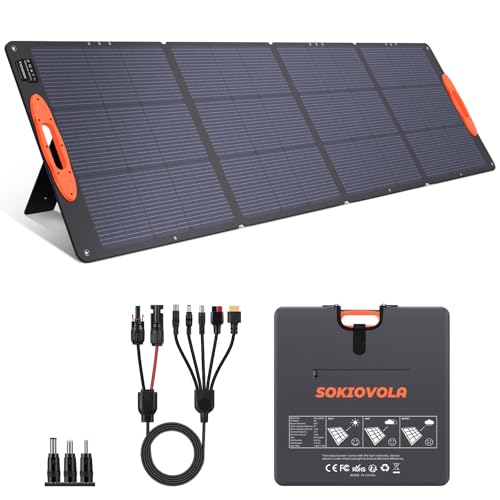
SOKIOVOLA 220W N-Type 16BB Panel, IP68, 17 lbBest Compatibility PitchSOKIOVOLA 220W N-Type 16BB Panel, IP68, 17 lb220WN-type 16BB, A+ gradeIP6817.08 lb23 x 22.24 in
MHPOWOS 220W 40V Folding Panel, IP67, 8.5 kgLowest Entry CostMHPOWOS 220W 40V Folding Panel, IP67, 8.5 kg220WMonocrystalline, 23.5 percent claimIP678.5 kgn/a

A panel in the low two hundreds is the standard partner for a mid-size station that you move between a car, a cabin and a campsite. It sits just above the 200W class, and the extra twenty watts matter less than the way the whole panel is built and packaged.

At this size, weight and plug compatibility decide more than efficiency claims. A panel that is awkward to carry stays home, and a panel whose plug does not match your station is a paperweight. Those two practical facts sort the field better than any percentage.

Before you buy

6 Criteria to Look For Before Buying a 220W Foldable Solar Panel

  1. 01

    Output voltage compatibility

    A 220W panel may output anywhere from 18V to 40V, and a station's solar input has a maximum. The MHPOWOS at 40V will not suit a 28V input, while the OPTISOLEX at 18V fits narrow windows. Check the input limit first, then pick the panel.

  2. 02

    Weight you can carry

    The OPTISOLEX is 9.0 lb, the Renogy 15.87 lb, the SOKIOVOLA 17.08 lb and the MHPOWOS about 18.7 lb. A 9 lb difference decides whether the panel leaves the car. Be honest about how far you will carry it.

  3. 03

    Cell technology

    N-type on the EcoFlow, OPTISOLEX and SOKIOVOLA resists heat, while LETSFAB uses HJT with twenty busbars. Plain monocrystalline on the MHPOWOS costs less but loses more in hot sun. In summer, the extra watts from better cells are real.

  4. 04

    Bifacial gain depends on ground

    The LETSFAB captures light on both faces, which helps over pale ground and adds little over grass. The gain claimed in listings is a best case. Assume a small bonus unless your campsite is bright.

  5. 05

    Aiming tools

    The EcoFlow includes a 30 to 60 degree bracket with an angle guide. Panels without one are aimed by eye, usually flat. A tilt toward the sun is worth a double-digit share of output at low sun angles.

  6. 06

    Daily harvest expectation

    A 220W label gives about 130 to 175 watts in good sun, adding roughly 800 to 1,000 watt-hours across a clear day. That refills a 1,000Wh station in about a day and a half. Cloud and angle stretch it quickly.

Detailed reviews

The 6 best 220w foldable solar panels, explained

01
EcoFlow 220W N-Type Foldable Panel, IP68, Angle Bracket
220W ratedN-type cellsIP6830-60 degree bracket
Check price on Amazon
Best for: Owners of a compatible station who want repeatable aiming and a sealed build.

The standout feature is not the cells, though N-type silicon helps in heat. It is the 30 to 60 degree adjustable bracket with a printed angle guide, which turns aiming into a measurable step instead of a guess. A panel angled correctly gives noticeably more than one lying flat, and a guide on the frame makes the right angle repeatable.

The maker builds stations as well, so the connector and voltage window are designed to match its own units, and the IP68 rating with ETFE coating covers weather. Used with a compatible station, you plug in and go. Used with another brand, you will need an adapter, which erodes the main advantage. The weight is not low, and a 220W frame is not a hiking panel.

Check the bracket pivots at the start of each season, since a hinge that loosens will let the panel sag in wind. Rinse the ETFE with fresh water when it gets salty, and store the panel flat. Keep the connector dry and coiled loosely, because a stressed lead is the usual long-term failure.

What works

  • 30 to 60 degree bracket with an angle guide
  • N-type cells hold output in heat
  • IP68 rating with ETFE coating
  • Connector matched to the maker's stations

Watch out for

  • Adapters needed for other brands of stations
  • Heavy for carrying beyond the car

Spec sheet

Rated power
220W
Cells
N-type, 25 percent claim
Water rating
IP68
Stand
30 to 60 degree adjustable bracket
Surface
ETFE coating
02
OPTISOLEX 220W N-Type Solar Bag, 9 lb, USB-C 45W
220W ratedN-type cells9.0 lbUSB-C 45W
Check price on Amazon
Best for: Buyers who want a big panel they can carry in one hand.

At 9.0 lb, this soft solar bag weighs roughly half of what the suitcase panels do, and that single fact dominates the discussion. A panel that a person can carry in one hand to a trailhead or a boat is used far more often than one that needs two trips. It is built with N-type cells and offers a 45W USB-C and dual USB-A ports on the panel itself.

The 18V optimum operating voltage is on the low side, which helps compatibility with stations that have narrow solar input windows, and a connector set that includes XT60 and Anderson ends covers many units. Compared with the SOKIOVOLA at 17.08 lb, you save about 8 lb, and in exchange accept a soft frame that needs propping and a lower stated environmental rating.

Soft bags wear at the folds, so check the stitching and the sleeve each season. Because USB ports are on the panel, keep them closed in dust and rain. Do not stand the bag upright in strong wind unsupported, and store it unfolded to a loose roll, not stuffed, to protect the cell seams.

What works

  • 9.0 lb weight is about half the suitcase panels
  • N-type cells with USB-C 45W built in
  • 18V optimum voltage suits narrow station inputs
  • Dual USB-A ports for direct device charging

Watch out for

  • Soft frame needs propping to hold an angle
  • Less rugged against drops than a hinged suitcase

Spec sheet

Rated power
220W
Weight
9.0 lb
Cells
N-type, up to 25 percent
USB-C
45W
Operating voltage
18V optimum
03
LETSFAB 220W Bifacial N-Type HJT Panel, 20BB
220W ratedBifacial20BB N-type HJT4-fold
Check price on Amazon
Best for: Camping on bright ground where rear-side gain is real.

HJT, heterojunction, is a premium cell architecture that pairs crystalline silicon with thin amorphous layers, and with twenty busbars LETSFAB tries to squeeze more output out of every cell. The design is bifacial, so the rear picks up reflected light over snow, sand or pale concrete. It folds four times to about 600 x 574 x 70 mm and weighs near 8.6 kg, which is 19 lb.

The cell technology is the most advanced in the lineup, but weight is the cost: it is roughly double the OPTISOLEX and noticeably more than the Renogy at 15.87 lb. The gain from the rear face depends on ground color, so on a dark campsite it is a smaller bonus. If you camp on bright surfaces and want maximum output from a fixed footprint, it is the interesting one.

Because the rear is active, do not place it face down and avoid mud splash on the back. HJT cells are a little more sensitive to cracking under sharp flex than thick monocrystalline wafers, so fold carefully and keep it flat in transit. Check kickstand locks each trip.

What works

  • 20BB N-type HJT cells with a 25 percent claim
  • Bifacial design harvests reflected light
  • Four folds to about 600 x 574 x 70 mm
  • High cell efficiency in a fixed footprint

Watch out for

  • Around 19 lb is heavy for the class
  • HJT cells need careful handling to avoid cracks

Spec sheet

Rated power
220W
Cells
20BB N-type HJT, 25 percent claim
Design
Bifacial
Folded size
600 x 574 x 70 mm
Weight
About 8.6 kg
04
Renogy 220W Foldable Suitcase Panel, 15.87 lb, IP68
220W ratedSuitcase case15.87 lbIP68 connectors
Check price on Amazon
Best for: Van and RV users who want a rugged, quick-setup suitcase panel.

Renogy designs this as a suitcase: a rigid fiberglass-backed panel with a carry case, rust-proof kickstands and IP68 connectors that the maker says set up in about a minute without tools. Fiberglass and ETFE with A+ monocrystalline cells give a rugged, long-lived panel, and the case protects it in a van or trunk.

At 15.87 lb it weighs nearly twice as much as the OPTISOLEX, and about 3 lb less than the SOKIOVOLA. It is built for vehicle-based use, where the weight is carried a few steps and the panel lives in a case between trips. The folded size of 27.17 x 18.11 x 3.15 inches is long, so check the space before buying.

A suitcase panel gets its longevity from care of the hinges and the case. Close the latches fully, keep the connectors capped, and avoid leaning the case against hot surfaces. Because the build is rigid, impacts matter more than flex, so do not toss it into a truck bed with loose tools.

What works

  • IP68 connectors and rust-proof kickstands
  • Fiberglass with ETFE and A+ monocrystalline cells
  • Carry case protects the panel in transit
  • Tool-free setup in roughly a minute

Watch out for

  • 15.87 lb is a real carry for hiking
  • Long folded size at 27.17 inches needs trunk space

Spec sheet

Rated power
220W
Weight
15.87 lb
Folded size
27.17 x 18.11 x 3.15 in
Cells
A+ monocrystalline, ETFE coating
Connectors
IP68 waterproof
05
SOKIOVOLA 220W N-Type 16BB Panel, IP68, 17 lb
220W ratedN-type 16BBIP6817.08 lb
Check price on Amazon
Best for: Owners of mainstream station brands who want N-type cells at a mid price.

SOKIOVOLA aims directly at buyers of EcoFlow, Jackery, Bluetti and Anker stations, and builds the panel with N-type 16BB cells and an ETFE coat rated IP68. That combination of cell tech and sealing is close to the premium end of the class, at a price nearer the middle.

The panel weighs 17.08 lb and folds to 23 x 22.24 inches, a squarer package than the long Renogy case. It sits between the OPTISOLEX and the LETSFAB for weight, and trades the Renogy's carry case for a simpler fold. If your station is one of the big four brands, the cable kit and voltage choice are designed to match.

The seventeen pounds are felt on every carry, so plan to leave it at camp. Inspect the cable and plug ends each season, and wipe the ETFE with a damp cloth. Because the panel is a plain hinged design, the hinges are the thing to look at: any fraying at the fabric seams means it is time to reinforce or replace.

What works

  • N-type 16BB cells with an A+ grade claim
  • IP68 rating with an ETFE coat
  • Cable and voltage chosen for big-brand stations
  • Squarer 23 x 22.24 inch fold stores easily

Watch out for

  • At 17.08 lb it is a heavy carry
  • No carry case advertised

Spec sheet

Rated power
220W
Cells
N-type 16BB, A+ grade
Weight
17.08 lb
Folded size
23 x 22.24 in
Water rating
IP68
06
MHPOWOS 220W 40V Folding Panel, IP67, 8.5 kg
220W rated40V outputIP678.5 kg
Check price on Amazon
Best for: Large-station owners with a high-voltage input who want the lowest cost.

MHPOWOS pitches this panel at the lower end of the lineup, using ordinary monocrystalline cells with a 23.5 percent claim, a 40V output and an IP67 rating. The weight of 8.5 kg is roughly 18.7 lb, making it one of the heavier options here.

The 40V output is the number to read carefully. It is much higher than the 20V panels in the lineup, and a station with a 28V solar input limit will not accept it. Only larger stations with a high-voltage input window can use it directly, so check the station's maximum before buying. That one spec decides whether the panel is a bargain or a mistake.

On the ownership side, treat it like any plain hinged panel: check the fold seams, rinse sand from the hinges and store it flat. A high-voltage output also deserves more respect in the cable department, so inspect connectors for damage before every use and never connect a cable with a cracked jacket.

What works

  • Lowest entry cost in this comparison
  • 40V output suits high-voltage station inputs
  • IP67 laminate with monocrystalline cells
  • Straightforward hinged build

Watch out for

  • 40V exceeds the input limit of many mid-size stations
  • Around 18.7 lb is the heaviest panel here

Spec sheet

Rated power
220W
Output
40V
Cells
Monocrystalline, 23.5 percent claim
Weight
8.5 kg
Water rating
IP67

Spec sheet decoder

What the numbers on the box really mean

The specs manufacturers lead with, translated into what they tell you about real-world performance.

N-type versus HJT

N-type is a silicon polarity that ages slowly and tolerates heat. HJT layers thin amorphous silicon on a crystalline cell for even higher efficiency.

Watch forThe LETSFAB lists 20BB N-type HJT, the most advanced cell in this lineup.

40V output

A higher voltage panel output, often from cells wired in series. Only stations with a high-voltage input accept it.

Watch forThe MHPOWOS lists 40V, which many mid-size stations cannot take.

18V optimum voltage

The voltage at which the panel delivers peak power. It sits well below the open-circuit voltage.

Watch forThe OPTISOLEX lists 18V, a friendly match for small input windows.

IP68 connectors

Waterproof rated plugs, not just the laminate. They matter in rain and at the cable junction.

Watch forThe Renogy lists IP68 connectors specifically.

Bifacial

Cells collect light on both faces. The rear adds output only when light reaches it.

Watch forThe LETSFAB is the one bifacial panel here, and gains vary with ground.

Methodology

How We Evaluated These 220W Foldable Solar Panels

Wattage class filter

Only panels rated at 220W stayed. We dropped 200W, 250W and 400W listings and kept a lineup with one size, since a panel twice the wattage would not belong in the comparison.

Voltage and plug fit

We compared voltage claims from the OPTISOLEX at 18V to the MHPOWOS at 40V, and which stations each could realistically feed.

Cells and sealing

We compared N-type, HJT and standard monocrystalline cells, plus ratings from IP67 to IP68. Heat behavior counted for as much as the efficiency claim.

Weight and format

We compared weights from 9.0 lb to about 18.7 lb and formats from soft bag to suitcase, noting folded dimensions where published.

Owner feedback patterns

We looked at repeated complaints about plug mismatch, hinge wear and exaggerated output. Where those complaints repeated, the panel lost ground.

Decision guide

How to Choose the Right 220W Foldable Solar Panels

By Primary Use

SituationPickWhy
Feeding an EcoFlow stationEcoFlow 220WMatched connector and angle bracket.
Carrying to a boat or trailheadOPTISOLEX 220W9.0 lb soft bag.
Van or RV with quick setupRenogy 220WSuitcase with a carry case.
Bright ground like sand or snowLETSFAB 220WBifacial HJT cells.
Big-brand stations at a mid priceSOKIOVOLA 220WN-type with IP68.

By Budget

TierPickWhy
Lowest costMHPOWOS 220WPlain panel, high voltage.
Lower midOPTISOLEX 220WN-type in a bag.
MidSOKIOVOLA 220WN-type with IP68.
Upper midRenogy 220WSuitcase build.
Top of lineupEcoFlow 220WMatched station and bracket.

Soft Bag vs Suitcase

Soft bag

The OPTISOLEX at 9.0 lb is easy to carry and store, but it needs propping and is less rugged. It suits boats, trails and apartment storage.

Rigid suitcase

The Renogy at 15.87 lb sets up in about a minute and survives rough van life. It is heavy and long, so it suits vehicle-based use.

Choose the bag if you carry it far, and the suitcase if it lives in a vehicle.

Station Voltage Window

PreferencePickWhy
Narrow input windowOPTISOLEX 220W18V optimum.
High-voltage inputMHPOWOS 220W40V output.
Mainstream big-brand stationsSOKIOVOLA 220WDesigned for EF, Jackery and Bluetti.
Maker-matched stationEcoFlow 220WSame-brand connector.

For Van and Cabin Use Specifically

Look for

A rigid or suitcase format that sets up fast, sealed connectors and a case that protects the panel in storage. Weight matters less than setup speed when the panel rides in a vehicle.

In this comparison

The Renogy 220W with its case and IP68 connectors is the best fit. The EcoFlow 220W is the better choice if your station is the same brand.

When to Spend More

Spend more if

You set up often or camp in heat. The EcoFlow 220W and Renogy 220W add faster setup, better seals and N-type or premium cells.

Save if

You use it a few weekends a year and your station accepts the voltage. The MHPOWOS 220W or OPTISOLEX 220W cuts cost.

Ownership

Maintenance schedule

The upkeep that decides whether this machine lasts two seasons or ten.

TaskIntervalWhy it matters
Inspect hinges and fabric seamsEach tripThe hinge is the first wear point on every hinged panel. A frayed seam on the SOKIOVOLA exposes cell edges.
Check connector sealsEach seasonIP68 connectors on the Renogy only work if the caps and gaskets are intact. A missing cap lets moisture into the plug.
Test the bracket or standStart of each tripThe EcoFlow's adjustable bracket pivots loosen with use and let the panel sag in wind.
Wipe both facesAfter dusty daysThe LETSFAB's rear collects output too, so dirt on the back costs watts.
Store flat and coolBetween seasonsHeat softens laminate adhesives and a folded bag stuffed under gear can crack cells.

FAQ

Frequently Asked Questions

How long to refill a 1,000Wh station with a 220W panel?

In good sun a 220W panel delivers roughly 130 to 175 watts, so a full refill takes about a day and a half. Cloud and angle stretch it to two days or more.

Why is output voltage important?

Stations have a maximum solar input voltage. A 40V panel such as the MHPOWOS may exceed a 28V input and refuse to charge, or damage the input.

Is a bifacial panel worth the premium?

Over snow, sand or pale concrete it adds a noticeable share from the rear. Over dark ground the gain is small, so it depends on where you camp.

Are soft bags less durable than suitcases?

They tolerate drops well but wear at fold lines and stitching. A rigid suitcase resists flex and weather but breaks on hard impact.

Do I need an angle bracket?

It helps. A panel tilted toward the sun gives more output than one lying flat, especially in morning and afternoon. A printed angle guide makes it repeatable.

Should I choose 220W or 400W?

Choose 220W for lighter carry and a mid-size station. Choose 400W for faster refills of a large station, accepting nearly double the weight and bulk.

Bottom line

The short version

Browse more 220w foldable solar panelson Amazon →
James Miller, Lead Machine Editor

About the author

James Miller

Lead Machine Editor, MachineFanatic

James Miller leads MachineFanatic's buying guides, turning spec sheets, manuals and owner feedback into clear verdicts on power tools, outdoor power equipment, shop machines and kitchen machines.

More from James →

Keep reading

Related guides