
Amazon affiliate links - we earn a commission.Affiliate disclosure

Buying guide · 16 min read · Updated 2026-11-06

Best 4Patriots Solar Generators and Alternatives (2026)

Seven 4Patriots-style solar generators and alternatives compared by capacity, inverter output, panel bundles and support, so you pick the right size.

James MillerBy James MillerLead Machine Editor7 machines comparedSpec-sheet verified
Best 4Patriots Solar Generators and Alternatives

At a glance

Our top picks

Side by side

Spec comparison

A solar generator is a lithium battery, an inverter and a solar charge controller in a single wheeled box, sold as a quiet and fume-free alternative to a gas generator. Brand-name kits often arrive with a short spec list and a bundled panel, and the headline numbers hide the details that decide whether the kit can actually run your refrigerator or recharge in a day.

This guide explains how to compare a 4Patriots-style solar generator with other stations by capacity, output, solar input and bundle contents, and which setup fits a given home. The top picks are above, and the reviews below explain what each unit can run, how it recharges and who should consider a smaller or larger class.

Before you buy

6 Criteria to Look For Before Buying a 4Patriots Solar Generators and Alternative

  1. 01

    Capacity is stored energy

    Watt-hours tell you how long a load can run. The OSCAL PowerMax 3600 PE holds 2,016 watt-hours, the EcoFlow DELTA 3 Ultra 3,072, the Jackery HomePower 3600 Plus 3,584, the ABOK Ark3600 3,840 and the OUKITEL P5000 Pro 5,120. A 150 watt refrigerator averaging about 60 percent duty uses roughly 1,500 watt-hours a day, so even the biggest unit is a few days of fridge, not a week. Divide the battery by your loads in watts and subtract 15 percent for losses, and be wary of any listing that does not state capacity, as with the 4Patriots Patriot Power Generator 1200 data.

  2. 02

    Inverter watts and surge

    The inverter sets what you can plug in at once. The PowerMax 3600 PE, DELTA 3 Ultra, Jackery HomePower 3600 Plus and ABOK Ark3600 all provide 3,600 watts, while the Jackery 1000 Plus v2 gives 1,800. Motors such as a compressor or a sump pump draw several times their running power for a second or two when starting. A surge rating, such as 7,200 watts on the PowerMax, covers that. The mistake is to buy on capacity alone and then trip the inverter when the well pump starts.

  3. 03

    Bundled panels are small

    A bundle with a 200 watt panel looks complete but can refill a 2 kWh battery in a day of strong sun at best. The PowerMax bundle's 200 watt panel, the DELTA 3 Ultra's 440 watts and the OUKITEL's 800 watts show the range. Real-world panel output is typically well below nameplate. Decide how many sun hours you have and buy panels for your recharge goal, and check each station's solar input ceiling, such as 1,600 watts on the PowerMax, 2,000 on the ABOK and 1,000 on the OUKITEL.

  4. 04

    Solar input voltage window

    Every station accepts panels within a voltage and current window. Series wiring raises voltage and parallel raises current, and a mismatch can limit input or trigger faults. The OUKITEL lists two 400 watt panels in series with a 1,000 watt MPPT, and the Jackery 1000 Plus v2 uses its own connector cable. Before buying third-party panels, check the open-circuit voltage against the station's limit, particularly in cold weather when voltage rises.

  5. 05

    Brand support and warranty

    The established names list longer terms, such as a 5-year warranty on the Jackery 1000 Plus v2, while the OUKITEL lists 2 years of customer service and the OSCAL and ABOK are newer. A battery product lives a decade, so the company's survival matters. Check that expansion batteries and replacement parts are sold, and read return terms. The 4Patriots listing gives limited data, so request the full spec sheet first.

  6. 06

    Quiet, safe indoor use

    A lithium station has no exhaust and can run indoors, but fans still run under load. The DELTA 3 Ultra claims 25 dB under load, and the heavy-draw units will be louder. Keep the unit on a hard, level, dry surface with clearance for vents, and avoid charging it in a closed hot space. Never back-feed the house with a cable that has two male ends.

Detailed reviews

The 7 best 4patriots solar generators and alternatives, explained

01
OSCAL PowerMax 3600 PE 2,016Wh 3,600W Power Station
2,016Wh LiFePO43,600W (7,200W peak)1,600W solar input52 lb
Check price on Amazon
Best for: Buyers who want about 2kWh with a 3,600W inverter that is light enough to move.

This is the closest match in the roundup to a roughly 2 kilowatt-hour solar generator, and it brings an unusual amount of inverter for that size. The 2,016 watt-hour LiFePO4 battery feeds a 3,600 watt inverter with a 7,200 watt peak, which is more output than most 2 kWh stations offer, so it can start a well-used window air conditioner, a power tool or a microwave without tripping its overload. The maker lists 1,500 watt AC charging that fills the pack in about 1.5 hours and a 1,600 watt solar input, and the listing says it supports solar, AC and car charging at the same time.

The bundle includes a 200 watt panel, which is modest for a 2 kWh battery: at 200 watts the panel would take well over a full sunny day to refill it, so treat the panel as a trickle option and plan a larger array if solar is your main recharge. At 52 pounds it is considerably easier to move than the 5 kWh units here, and it undercuts the Jackery HomePower 3600 Plus on weight and capacity but not on output. Against the Delta 3 Ultra at 3,072 watt-hours, you give up a third of the energy.

The LiFePO4 cells are described as automotive grade with more than 6,000 cycles, a vendor claim. A fast switchover supports computers and routers, and the app shows input and output, with firmware updates. Because it is a newer brand than the established names, check warranty terms and the seller's support path before purchase, and treat 14-device output claims as a count of ports, not a promise of simultaneous full load.

What works

  • 3,600W inverter with 7,200W peak is generous for a 2kWh unit
  • 1,500W AC charging fills the pack in about 1.5 hours
  • 1,600W solar input accepts a serious array later
  • Weighs about 52 lb, which is light for its class

Watch out for

  • Included 200W panel is slow to refill 2,016Wh by itself
  • Newer brand, so warranty and support need checking

Spec sheet

Battery
2,016Wh LiFePO4
AC output
3,600W, 7,200W peak
Solar input
Up to 1,600W
AC fast charge
1,500W, 100% in about 1.5 hr
Weight
24 kg (52 lb)
Switchover
Under 10 ms EPS
02
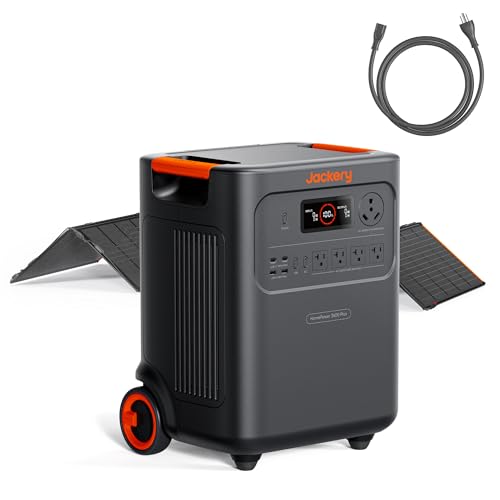
Jackery HomePower 3600 Plus 3,584Wh 3,600W with 500X Panels
3,584Wh LFP3,600W (7,200W parallel)Expands to 21kWh2 hr hybrid charge
Check price on Amazon
Best for: Households that prefer an established brand and want 3.6kWh with a path to 21kWh.

Jackery's HomePower 3600 Plus is the safe-brand choice for people who want a household-scale solar generator from a company with a long track record. It carries a 3,584 watt-hour LFP battery and a 3,600 watt inverter, and two units in parallel give 7,200 watts and 240 volts. The maker claims it is the lightest 3.6 kilowatt-hour LFP station, 34 percent smaller and 29.3 percent lighter than comparable models, using a battery-in-chassis design, and it states a full recharge in about 2 hours using hybrid AC and DC.

It stands above the PowerMax 3600 PE in battery size by roughly 78 percent, and it is the one to pick when you want to run a refrigerator overnight and a few loads through a day without solar. Against the ABOK Ark3600 at 3,840 watt-hours, the Jackery has slightly less capacity but a much higher expansion ceiling, 21 kilowatt-hours against 11.5. Pairing with a manual transfer switch gives a clean home connection that Jackery markets as plug and play.

Ceramic membrane cells tested to 302 degrees F speak to a safety design aimed at thermal runaway. The bundle here includes 500X solar panels, which ship separately from the station, so check what arrives in each box. As with any unit of this size, put it on a dry, level surface with airflow, and use a licensed electrician for any panel work.

What works

  • 3,584Wh battery runs a fridge and essentials through a night
  • Jackery claims it is among the lightest 3.6kWh LFP stations
  • Full recharge in about 2 hours via hybrid AC and DC
  • Expandable to 21kWh and pairs for 240V at 7,200W

Watch out for

  • 240V requires a second unit, which doubles the cost
  • Panels and station ship separately, so check the bundle contents

Spec sheet

Battery
3,584Wh LFP
AC output
3,600W, 7,200W in parallel
Voltage
120V, 120/240V in parallel
Expansion
Up to 21kWh
Charging
About 2 hr hybrid AC and DC
Safety
Ceramic membrane cells tested at 302F
03
EcoFlow DELTA 3 Ultra 3,072Wh 3,600W with 2x220W Panels
3,072Wh LFP3,600W (7,200W surge)25 dB under load<10 ms UPS
Check price on Amazon
Best for: Apartments and homes where quiet matters and 3kWh of essentials backup is enough.

The DELTA 3 Ultra is the best choice here for living-space use, because EcoFlow states a 25 dB noise level under load, quieter than the other stations in the roundup. A 3,072 watt-hour LFP battery and a 3,600 watt inverter with a 7,200 watt surge handle a refrigerator, microwave, router and lights at the same time, and a sub-10 millisecond switchover protects computers and a CPAP. It offers four ways to charge: a wall outlet, solar panels, a car input or EcoFlow's smart generator.

The bundle includes two 220 watt panels, 440 watts total, which is a more realistic starter array than a single 200 watt panel, though still well short of what a 3 kWh battery needs for a quick refill. Compared with the PowerMax 3600 PE, you get about 50 percent more energy, and compared with the ABOK Ark3600 you give up about 800 watt-hours but gain the app and ecosystem polish. EcoFlow lists the design as ten years of daily use with automotive-grade LFP.

The station and panels are delivered in separate packages, so do not assume a missing box is lost. Plan placement near a window or outdoor run for the panel leads, and keep vents clear. If you outgrow it, the broader EcoFlow range has larger models, but this one does not offer 240 volt output.

What works

  • Stated 25 dB under load is the quietest claim in the lineup
  • 3,600W inverter with 7,200W surge runs fridge and microwave
  • Four charging routes include solar, wall, car and generator
  • Under 10 ms switchover protects PCs and medical gear

Watch out for

  • No 240V output, so well pumps and dryers are out of range
  • Panels ship separately and 440W still refills slowly

Spec sheet

Battery
3,072Wh LiFePO4
AC output
3,600W, 7,200W surge
Noise
25 dB under load
Transfer time
Under 10 ms
Charging
Wall, solar, car, smart generator
Design life
10 years daily use
04
ABOK Ark3600 3,840Wh 3,600W with 400W Panel
3,840Wh LiFePO43,600W rated2,000W solar inputExpands to 11,520Wh
Check price on Amazon
Best for: Buyers who want a 3.8kWh expandable station with high solar input and an RV outlet.

The ABOK Ark3600 aims at buyers who want a large, expandable station without the premium brand. It pairs a 3,840 watt-hour LiFePO4 battery with EVE cells, a world-recognized cell maker, with a 3,600 watt inverter and a 2,000 watt solar input, the highest solar input among the 3 to 4 kWh units here. Combined AC and solar input of 3,500 watts can take it from empty to 80 percent in about 1.1 hours under ideal conditions, and expansion batteries bring the total to 11,520 watt-hours.

It has 15 ports, including a TT-30 RV outlet, which makes it a good fit for travel trailers, and an app that can schedule off-peak charging to save on electricity rates. Compared with the Jackery HomePower 3600 Plus, the ABOK has about 7 percent more battery and a higher stated solar input, but a shorter track record. The bundle here includes a 400 watt panel, a more useful size than a single 200 watt panel.

With a brand this new in the market, support and parts availability should be checked before you buy. Telescoping handle and wheels make it manageable on a level floor, though it is heavy. Keep the unit away from heat sources, and ensure solar leads match the input voltage window.

What works

  • 2,000W solar input is the highest among the 3 to 4 kWh units
  • EVE LiFePO4 cells and expansion to 11.5kWh give a growth path
  • TT-30 RV port and 15 outlets suit trailers and shops
  • App scheduling can shift charging to off-peak hours

Watch out for

  • Newer brand with less support history than the major names
  • Still heavy to move, even with a handle and wheels

Spec sheet

Battery
3,840Wh LiFePO4 (EVE cells)
AC output
3,600W rated
Solar input
Up to 2,000W
Expansion
Up to 11,520Wh
Ports
15, including a TT-30 RV port
Fast charge
0 to 80% in about 1.1 hr, 3,500W combined
05
OUKITEL P5000 Pro 5,120Wh 3,600W with 2x400W Panels
5,120Wh LiFePO45x3,600W AC outlets1,000W MPPT solar6,000 cycles to 70%
Check price on Amazon
Best for: Long outages and off-grid cabins where energy storage matters more than output.

The P5000 Pro is for buyers who care most about stored energy: 5,120 watt-hours is the biggest single battery in this roundup, larger than the Jackery 3,584 and ABOK 3,840. A 3,600 watt inverter with 6,000 watt surge feeds five AC outlets, and the pack is LiFePO4 with a stated 6,000 cycles to 70 percent capacity. It recharges in about 2.8 hours from a 1,800 watt wall outlet or in about 5 hours from two 400 watt panels in series, though the 1,000 watt solar limit caps what the panels can deliver.

The bundle includes two 400 watt panels, 800 watts total, a sensible starter array for the size. The company says it is about 25 kilograms lighter and 39 percent smaller than a conventional 5,100 watt-hour station, and it has a drawbar and two wheels. It offers UPS function, so a computer or server stays up through a grid failure. Compared with the Delta 3 Ultra it provides 67 percent more energy at the same 3,600 watt output.

The two-year customer service term is shorter than the 5-year coverage on some competitors, so factor it into your decision. With 5,120 watt-hours in one box, treat it as a stationary asset: put it where it will live and use extension runs for panels, not for the station.

What works

  • 5,120Wh is the largest single battery in the roundup
  • Five 3,600W AC outlets and 15 ports cover many devices
  • Included 2x400W panels are a sensible starter array
  • 6,000 cycles to 70 percent per the maker, with UPS function

Watch out for

  • 1,000W solar limit caps recharge speed from large arrays
  • Two-year service term is shorter than some competitors

Spec sheet

Battery
5,120Wh LiFePO4
AC output
3,600W across 5 outlets, 6,000W surge
Solar input
1,000W MPPT
AC charge
1,800W, about 2.8 hr
Solar charge
About 5 hr with 2x400W in series
Outlets
15 total ports
06
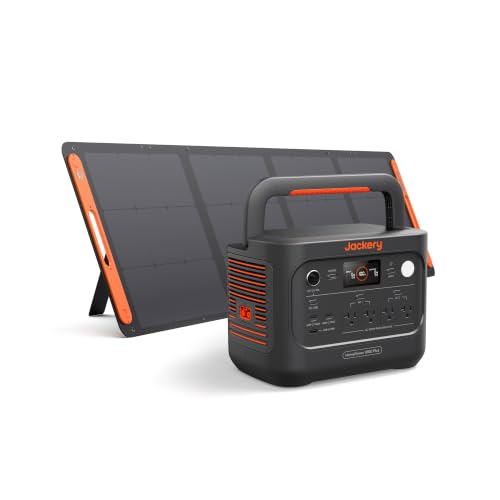
Jackery Solar Generator 1000 Plus v2 1,024Wh with 200W Panel
1,024Wh LiFePO41,800W (3,600W surge)Expands to 11kWh10 ms UPS
Check price on Amazon
Best for: People who want a small, expandable station with smart load management and a long warranty.

The 1000 Plus v2 is the compact end of this lineup and the best starting point for a system you intend to grow. It stores 1,024 watt-hours and delivers 1,800 watts with a 3,600 watt surge, and add-on packs can raise capacity to 11 kilowatt-hours by adding up to five batteries. Its four AC outlets are split across two independently controlled circuits, so you can set a cut-off battery level for non-essential loads and keep critical ones, such as a fridge, running longer.

A 10 millisecond UPS with 3 kV surge protection makes it a good desk or router backup, and the cells are rated for 6,000 cycles to 70 percent capacity, with operation down to 14 degrees F. At 1,024 watt-hours it is a fraction of the 2 to 5 kWh stations here, so it cannot carry a household overnight. It suits a CPAP, a small fridge, a work site or a van, and it pairs well with a 200 watt panel for gentle trickle charging.

The 5-year warranty is the longest in this roundup. Keep your expectations in line with the capacity: a 1 kWh unit is a bridge, not a whole-home backup. If you think you will want more, the 11 kWh expansion ceiling lets you start small, but battery packs add real cost, so compare the combined total with a larger single station.

What works

  • Two AC circuits can be prioritized with a battery cut-off level
  • Expandable to 11kWh with up to five add-on packs
  • 10 ms UPS and 3 kV surge protection suit electronics
  • Five-year warranty is the longest in this roundup

Watch out for

  • 1,024Wh cannot back up a household overnight
  • Add-on packs add real cost versus a larger single station

Spec sheet

Battery
1,024Wh LiFePO4
AC output
1,800W, 3,600W surge
Expansion
Up to 11kWh with 5 packs
Cycle life
6,000 cycles to 70%, 14F capable
Load management
Two independently controlled AC circuits
Warranty
5 years
07
4Patriots Patriot Power Generator 1200 Portable Solar Generator
Included solar panelSilent, fume-freeSolar, AC or car chargePortable design
Check price on Amazon
Best for: Brand-loyal buyers who want a small blackout kit and will verify the specs first.

The Patriot Power Generator 1200 is the 4Patriots model in this roundup, and it is a much smaller, simpler machine than the whole-home stations above. The listing describes a portable, silent and fume-free solar generator that recharges from the included solar panel, an AC wall outlet or a car charger, and it emphasizes blackout and travel use. It does not state a watt-hour capacity or inverter rating in the data we reviewed, so you should treat it as a light-duty unit and verify the specs on the live page before buying.

That limited data is why it ranks last. Next to the 1,024 watt-hour Jackery 1000 Plus v2, whose figures are fully published, we cannot say how much energy this unit holds, and next to the 3,600 watt PowerMax 3600 PE there is no claim it can run large appliances. The 4Patriots 2200X class is a larger product than this, and the stations ranked above are the better matches for that size.

If the brand matters to you, confirm the capacity, inverter rating, warranty and return terms before purchase. Fume-free, silent operation is true of every lithium station here and is not unique to this one. A small unit like this is suited to phones, a laptop, lights and a CPAP rather than a refrigerator or a power tool.

What works

  • Silent and fume-free, safe to use indoors during an outage
  • Includes a solar panel with solar, AC and car charging
  • Portable form suits blackout and travel use
  • Simple design aimed at non-technical buyers

Watch out for

  • Capacity and inverter ratings are not stated in the listing data
  • Too small to replace the 2kWh or larger stations ranked above it

Spec sheet

Brand
4Patriots Patriot Power
Charging
Included panel, AC wall outlet, or DC car charger
Operation
Silent and fume-free
Use
Blackout, camping, off-grid travel
Capacity
Not stated in the listing data
Class
Portable power bank style

Spec sheet decoder

What the numbers on the box really mean

The specs manufacturers lead with, translated into what they tell you about real-world performance.

Watt-hours

Stored energy in the battery, in watt-hours. Runtime equals watt-hours divided by load in watts, before conversion losses.

Watch forUsable energy is closer to 85 percent of the label. Some bundles do not state capacity at all.

Rated versus peak watts

Rated is the sustained inverter output and peak or surge is a brief overload for motor starts.

Watch forA 7,200W peak on a 3,600W inverter is for startup only. Do not plan to run 7,200W.

Solar input watts

The maximum solar power the charge controller will accept.

Watch forThe 1,600W figure on the PowerMax does not mean the 200W bundled panel will deliver it. Input is a ceiling.

MPPT

Maximum power point tracking, a charge controller method that adjusts to get the most from panels as light changes.

Watch forCheck the voltage window. The OUKITEL lists a 1,000W MPPT, so a larger array is wasted.

LiFePO4 cycles

Charge and discharge cycles before capacity drops to a stated percent, often 70 or 80.

Watch forThe OUKITEL states 6,000 cycles to 70 percent and the Jackery 6,000 to 70 percent. These are maker claims, and real life varies.

Methodology

How We Evaluated These 4Patriots Solar Generators and Alternatives

Capacity class and fit

We sorted the lineup by stored energy to find the closest matches to a roughly 2 kilowatt-hour solar generator, with the PowerMax 3600 PE at 2,016Wh as the nearest. We then ranked larger and smaller units by how well they suit different households.

Inverter and surge capability

We compared continuous and surge output, noting that four units share 3,600 watts, the Jackery 1000 Plus v2 offers 1,800 watts and the 4Patriots listing states no rating. We favored units whose surge covers common motor starts.

Solar input and bundle quality

We compared the stated solar input ceiling and the panels bundled in each listing, from 200 watts on the PowerMax to 800 watts on the OUKITEL, and judged how realistic the recharge is. Bundles with a larger array scored higher on practical recharge.

Brand maturity and support

Based on spec sheets and owner feedback patterns, we compared warranty terms, platform maturity and parts availability. Jackery and EcoFlow carry track records, while the OSCAL, ABOK and OUKITEL are newer, and the 4Patriots listing is the least documented.

Value and expandability

We looked at what each unit offers for its size class, including expansion ceilings such as 11 kWh on the Jackery 1000 Plus v2, 11.5 kWh on the ABOK and 21 kWh on the Jackery 3600 Plus. We kept pricing out of the ranking beyond relative tiers.

Decision guide

How to Choose the Right 4Patriots Solar Generators and Alternatives

By What You Need to Run

Start with the largest load you must run, then size the battery.

SituationPickWhy
Window air conditioner and fridgeOSCAL PowerMax 3600 PE3,600W with 7,200W peak in a 2kWh body
Overnight refrigerator plus essentialsJackery HomePower 3600 Plus3,584Wh and a trusted brand
Quiet indoor essentialsEcoFlow DELTA 3 Ultra25 dB under load and 3,072Wh
RV trailer with a TT-30 plugABOK Ark3600TT-30 port and 3,840Wh
Multi-day cabin storageOUKITEL P5000 Pro5,120Wh and 2x400W panels
CPAP, router and a small fridgeJackery Solar Generator 1000 Plus v21,024Wh and load priority circuits
Phones, laptop and lights4Patriots Patriot Power Generator 1200Small blackout kit, verify specs first

By Budget

Relative tiers only; check live prices.

TierPickWhat you give up
Entry level4Patriots Patriot Power Generator 1200Capacity not stated and light duty
Lower mid-rangeJackery Solar Generator 1000 Plus v2Only 1,024Wh
Mid-range valueOSCAL PowerMax 3600 PENewer brand and a small bundled panel
Mid-range storageABOK Ark3600Newer brand
Upper mid-rangeOUKITEL P5000 ProShorter service term
Premium brandJackery HomePower 3600 Plus or EcoFlow DELTA 3 UltraCost per watt-hour

Established Brand vs Newer Brand

Established brand

Jackery and EcoFlow publish detailed specs, offer long warranties and keep expansion batteries in stock. The Jackery HomePower 3600 Plus, Jackery 1000 Plus v2 and EcoFlow DELTA 3 Ultra are in this group. You pay for that certainty.

Newer brand

OSCAL, ABOK and OUKITEL pack more battery or output per unit of cost, with 2,016Wh at 3,600W and 5,120Wh respectively. The tradeoffs are shorter service terms and less proven parts supply, so read the warranty carefully.

Choose an established brand if you want a decade of support. Choose a newer brand if you want the most energy for your budget and accept some risk.

Solar Panel Plan

PreferencePickNote
Largest bundled arrayOUKITEL P5000 Pro2x400W, but a 1,000W MPPT ceiling
Highest solar inputABOK Ark36002,000W input, 400W panel included
High input for a 2kWh unitOSCAL PowerMax 3600 PE1,600W input but only a 200W panel bundled
Practical starter arrayEcoFlow DELTA 3 Ultra2x220W panels
Small portable panelJackery Solar Generator 1000 Plus v2200W panel, slow refill

For Home Backup Specifically

Look for

Enough watt-hours for the circuits you choose, an inverter with surge for motors, and a recharge plan that works without the grid. A manual transfer switch or inlet is safer than extension cords across the house.

In this comparison

The Jackery HomePower 3600 Plus is the most proven home-backup choice, the OSCAL PowerMax 3600 PE gives the most output for its size, and the OUKITEL P5000 Pro gives the longest runtime.

When to Spend More

Spend more if

You want a 5 to 10 year ownership path with strong support. The Jackery HomePower 3600 Plus and EcoFlow DELTA 3 Ultra are the safest choices, and they offer expansion.

Save if

You only need a few hundred watts or a short outage plan. The 4Patriots Patriot Power Generator 1200 or the Jackery 1000 Plus v2 may be enough, and a smaller battery avoids paying for unused capacity.

Ownership

Maintenance schedule

The upkeep that decides whether this machine lasts two seasons or ten.

TaskIntervalWhy it matters
Charge to 40 to 60 percent for storageEvery 3 to 6 monthsLFP cells age slowly when partly charged, but a long deep discharge can strain them.
Check ports and cablesEvery 6 monthsLoose connectors waste power and heat up. Replace damaged cords.
Keep vents clearAlwaysBlocked vents raise temperatures and trigger fan noise. Leave space on all sides.
Update firmwareWhen promptedUpdates refine charge control and safety features. Do it when you are not relying on the unit.
Test under loadTwice a yearA stored battery can hide faults. Run a real load for an hour.
Clean panels and check connectorsEach seasonDirt, shade and loose MC4 leads cut charging. A quick check keeps output near rated.

FAQ

Frequently Asked Questions

Is a 4Patriots solar generator worth buying?

It depends on the model and what the listing states. The Patriot Power Generator 1200 listing does not state capacity or inverter rating in the data we reviewed, so verify them before buying. Compare any kit against stations with published specs at the same capacity.

How big a solar generator do I need for a refrigerator?

A modern fridge uses roughly 1 to 2 kilowatt-hours a day. A 2,016 watt-hour unit like the PowerMax 3600 PE covers about a day, while 3,000 to 5,000 watt-hours covers two to four days with careful loads. Measure your fridge with a plug-in meter for a real number.

What does a 3,600 watt inverter run?

It runs a refrigerator, a microwave, a window air conditioner and lights at the same time, within the limit. It cannot run 240 volt loads such as a well pump or a dryer. Check the starting watts of motors, and use the surge rating as a guide.

How long to recharge from solar?

Divide the battery by the panel output and add losses. A 200 watt panel needs many hours of strong sun to refill 2,016 watt-hours, and winter or shade makes it slower. A larger array and a high solar input ceiling shorten the time.

Can I use it indoors?

Yes, lithium stations have no exhaust, but they need ventilation and a stable, dry surface. Avoid heat and closed spaces. Check the maker's operating temperature range.

Are newer brands like OSCAL and ABOK safe to buy?

They can offer strong specs for the price, but support history is shorter. Check the warranty, certifications and return policy, and prefer listings that state cell type and protections. For a long-term home backup, a more established brand reduces risk.

Bottom line

The short version

Browse more 4patriots solar generators and alternativeson Amazon →
James Miller, Lead Machine Editor

About the author

James Miller

Lead Machine Editor, MachineFanatic

James Miller leads MachineFanatic's buying guides, turning spec sheets, manuals and owner feedback into clear verdicts on power tools, outdoor power equipment, shop machines and kitchen machines.

More from James →

Keep reading

Related guides