
Amazon affiliate links - we earn a commission.Affiliate disclosure

Buying guide · 13 min read · Updated 2026-11-13

Best Aiper Robotic Pool Cleaners (2026)

Six Aiper cordless pool robots compared by pool type, filtration, runtime and waterline reach, from above-ground vacuums to solar skimmers and AI models.

James MillerBy James MillerLead Machine Editor6 machines comparedSpec-sheet verified
Best Aiper Robotic Pool Cleaners

At a glance

Our top picks

A cordless robotic pool cleaner trades a power cable for a battery, which frees you from tangled cords and an outlet near the water. The robot drives itself along the floor and walls, pulls water through a filter basket and returns to the surface or a dock when the job or the battery is done.

One maker can sell different machines for different problems: floor and wall vacuums for inground pools, a lighter unit for above-ground liners and a solar skimmer for surface debris. Choosing the wrong type is the usual mistake, so match the robot to the pool shape and the kind of dirt before looking at features.

Before you buy

6 Criteria to Look For Before Buying an Aiper Robotic Pool Cleaner

  1. 01

    Pool type decides the model

    Aiper makes inground floor and wall robots like the Scuba S1, S3, V3 and X1, an above-ground unit in the Seagull SE, and a surface skimmer in the EcoSurfer S2. Putting an inground robot in a flat above-ground pool wastes its climbing hardware, and the Seagull SE will struggle with a coved concrete wall. Start by matching pool type.

  2. 02

    Runtime against pool size

    A robot that cannot finish a pool in one charge leaves patches. The Scuba S1 lists up to 270 minutes, the Scuba V3 up to 240 in eco mode, and the Seagull SE about 100 on flat pools. Bigger pools need the longer figures, and runtime figures are usually quoted in the lightest mode.

  3. 03

    Filter fineness and clogging

    Fine filters such as the 3 micron media in the Scuba S1 and X1 clean silt and pollen but clog sooner, while a 150 micron skimmer filter passes fine particles. Pick the finest filter your pool and patience allow, and plan to rinse after every run.

  4. 04

    Waterline reach

    Scum and oil collect in a band at the waterline, which many robots do not reach. The Scuba S3 runs a lateral scrub about 2 inches higher, and the Scuba X1 lifts itself with WaveLine 2.0 to scrub for about a minute. If your pool has a visible ring, this feature matters more than extra runtime.

  5. 05

    Smart features and failure points

    AI cameras, wireless docks and app control add convenience, but also more things that can fail or change with software updates. The Scuba V3 uses a camera to find 20 plus debris types, and it can struggle when water is cloudy. Weigh convenience against reliability, and check that the robot still works with basic controls.

  6. 06

    Handling and retrieval

    A filled robot is heavy, and pulling one out of the deep end is a chore. Models that park at the waterline, like the Scuba S3 and V3, save you the effort. Check the weight, and make sure the handle or retrieval line suits your reach and your pool edge.

Detailed reviews

The 6 best aiper robotic pool cleaners, explained

01
Aiper Scuba S1 (2026), 270 minute floor, wall and waterline
270 min runtime11 sensorsDual filtration3 micron filter
Check price on Amazon
Best for: Owners of typical inground pools who want one robot to handle floor, walls and waterline.

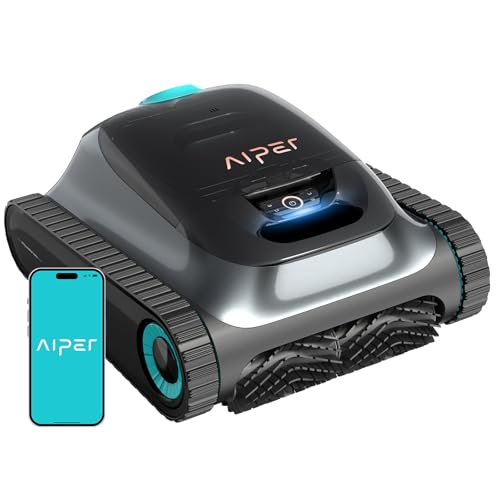
The Scuba S1 is the sensible centre of Aiper's inground line. Its runtime is up to 270 minutes, long enough to clean a typical backyard pool in one charge with margin to spare, and it covers the floor, walls, waterline and shallow steps. Eleven sensors feed a dual path navigation routine, which is meant to cut down on the random wandering that wastes battery in cheaper robots.

Filtration is the other strong point. A dual layer system with a replaceable 3 micron filter catches fine silt that coarse baskets pass through, so water looks clearer after a run. The tradeoff is that fine filters clog faster, so expect to rinse them often in a dusty yard. Compared with the Scuba S3, it lacks the S3's lateral waterline scrub and auto parking, but its long runtime gives it the edge for bigger pools.

Ownership is mostly about cleaning the filter after each run and charging before the next. Lift the robot out by its handle or retrieval line rather than by pulling on it, because water-filled filters are heavy. Store it out of direct sun, and avoid leaving it floating for days, since sun and chlorine age the plastic over a few seasons.

What works

  • Up to 270 minutes of runtime per charge
  • Floor, wall and waterline coverage
  • Fine 3 micron replaceable filter
  • 11 sensors for organised routes

Watch out for

  • Fine filters need frequent rinsing
  • No auto parking on this model
  • Heavy to lift when full of water

Spec sheet

Runtime
Up to 270 minutes
Surfaces
Floor, wall, waterline, shallow areas
Sensors
11 high precision sensors
Filtration
Dual layer, replaceable 3 micron
Control
App controlled
02
Aiper Scuba V3 AI Vision, camera guided, wireless charging dock
AI camera20+ debris types240 min eco modeWireless dock
Check price on Amazon
Best for: Pools that collect patchy debris and owners who like automation and a charging dock.

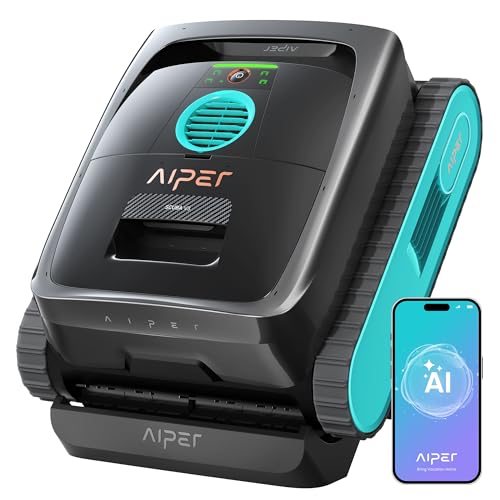
The Scuba V3 puts a front-facing AI camera on the nose and uses it to recognise more than 20 kinds of debris. The idea is a patrol routine that heads straight for leaves and dirt instead of covering every square foot, and the maker claims it cleans far faster than a standard sweep. In eco mode the robot runs up to 240 minutes, and it surfaces at the waterline when finished.

The wireless charging dock is the real quality-of-life feature. You skip the plug-and-wait step, and the robot parks where you can reach it. Against the Scuba S1, the V3 swaps raw runtime for smarter targeting, so it suits pools that get messy in patches rather than evenly dirty ones.

Smart features add complexity. Keep the camera lens clean, update the app when prompted, and rinse the filter after each run. If the pool is cloudy or the sun glares badly, expect the vision system to work less well, and fall back on a simpler robot if reliability matters more than novelty.

What works

  • AI camera spots 20 plus debris types
  • Eco mode runs up to 240 minutes
  • Parks at the waterline after cleaning
  • Wireless charging dock

Watch out for

  • Camera and software add failure points
  • Vision may struggle in cloudy water
  • Higher cost for features many pools never need

Spec sheet

Navigation
Front-facing AI camera
Debris detection
More than 20 types
Eco runtime
Up to 240 minutes
Return
Automatic to waterline
Charging
Wireless dock
03
Aiper Scuba S3, auto parking, lateral waterline scrub
Auto parkingDual filtrationLateral waterline scrubPath planning
Check price on Amazon
Best for: Pools with a persistent waterline ring from sunscreen, oils and pollen.

The Scuba S3 focuses on the part of the pool most robots skip: the waterline band where oils and scum collect. Instead of climbing up and down the wall, it travels sideways along the line, reaching about 2 inches higher than a conventional pass, which is where a stubborn ring usually forms.

It also parks itself. After a cycle the robot ascends and waits at the surface, and the app sends notifications, so you do not have to fish it out from the deep end. Smart route planning follows a logical path through the pool, and dual filtration collects fine debris. Compared with the Scuba S1, it has fewer headline runtime claims in the data we have, so it is better judged on waterline performance than endurance.

Upkeep follows the usual pattern. Empty and rinse the filters after every run, check the brushes for wear and hair, and wipe the waterline of the robot's tracks. If your pool has a visible scum line, this is the model to look at first.

What works

  • Lateral waterline scrub reaches 2 inches higher
  • Auto parking at the surface
  • App notifications when finished
  • Dual filtration for fine debris

Watch out for

  • Runtime not as clearly stated as the S1
  • Waterline work uses extra battery
  • Similar price tier to better-rounded models

Spec sheet

Navigation
Smart sensors with route planning
Waterline
Lateral scrub, 2 inches higher
Docking
Auto parking and smart alerts
Filtration
Dual filtration
Surfaces
Floor, wall and waterline
04
Aiper Scuba X1 (2026), 6600 GPH suction, 3 micron MicroMesh
6600 GPHDual jets3 micron meshWaveLine 2.0
Check price on Amazon
Best for: Inground pools with fine sand, silt or heavy seasonal debris.

This model leans on suction. A 6600 gallons per hour rating with dual jets is aimed at fine sand, silt and heavier debris that smaller robots leave behind. Multi-layer filtration with a 3 micron MicroMesh catches particles that would otherwise stay in the water.

Its WaveLine 2.0 feature lifts the robot about 2 inches above the waterline and holds it there for a sustained scrub, aimed at the same scum band the Scuba S3 targets. The difference is power: the X1 trades a tidier lateral pass for brute force on dirt. If your pool collects dust, pollen and storm debris, that suction rating is the point.

Higher suction also means a heavier robot and a filter that fills sooner, so clean it after every run and expect to handle more weight. Pair it with a pool that has a plain floor shape, and avoid very rough plaster where brushes will wear faster.

What works

  • 6600 GPH suction with dual jets
  • 3 micron MicroMesh filtration
  • WaveLine 2.0 waterline scrub
  • Cordless design

Watch out for

  • Filter fills quickly on dirty pools
  • Heavier than smaller Aiper robots
  • Not meant for above-ground pools

Spec sheet

Suction
6600 GPH with dual jets
Filtration
Multi-layer, 3 micron MicroMesh
Waterline
WaveLine 2.0, 2 inches above
Pool type
Inground
Power
Cordless
05
Aiper Seagull SE, above-ground robot, 1320 GPH, 100 minute runtime
1320 GPH100 min runtimeChemical dispenserAbove ground
Check price on Amazon
Best for: Above-ground pools with flat floors where a low-cost cordless robot is enough.

The Seagull SE is the one Aiper built for above-ground pools. Its suction is rated at 1320 GPH, far below the Scuba X1, and its runtime is up to 100 minutes on a flat pool, which is plenty for a smaller, simpler pool shape. A built-in chemical dispenser helps keep water balanced, a feature the larger inground models do not list in the data.

What it gives up is climbing power and fine filtration claims. It is meant for flat floors, so it does not suit steep or coved walls, and it will not compete with the Scuba S1 on large pools. For a plain round or oval above-ground pool, the lower cost and lighter body make it the sensible choice.

Keep the liner in mind. Check that debris and sharp objects are not in the pool before a run, rinse the filter after every cycle, and lift the robot out carefully so the liner is not scraped. Store it dry through winter.

What works

  • Designed for above-ground liners
  • 1320 GPH suction for flat floors
  • Built-in chemical dispenser
  • Cordless and light

Watch out for

  • Only about 100 minutes of runtime
  • Not for steep or coved inground walls
  • Lower suction than inground models

Spec sheet

Suction
1320 GPH
Runtime
Up to 100 minutes on flat pools
Pool type
Above-ground
Extra
Built-in chemical dispenser
Power
Cordless
06
Aiper EcoSurfer S2 solar skimmer, 150 micron filtration, chlorine dispenser
Solar skimmer150 micron filterChlorine dispenserApp control
Check price on Amazon
Best for: Pools that are mostly dirty on the surface, such as those under trees.

The EcoSurfer S2 does not vacuum the floor at all. It skims the surface, collecting leaves, pollen and insects before they sink, and it charges from the sun so it can work on a schedule through the day. Dual charging means a wall adapter backs up the panel on gloomy weeks, and a 150 micron filter catches fine floating debris.

An adjustable chlorine dispenser helps spread sanitiser as the unit moves, and the app handles scheduling, remote steering and progress tracking. Compared with the Scuba robots, it is a complement rather than a replacement, since it never touches the floor or walls.

It fits pools under trees and in windy yards where surface debris builds up faster than a floor robot can handle. Empty the filter basket regularly, wipe the solar panel to keep it working, and keep it away from pool jets when possible.

What works

  • Solar charging plus plug backup
  • 150 micron surface filtration
  • Adjustable chlorine dispenser
  • App scheduling and remote steering

Watch out for

  • Does not clean floor or walls
  • Needs sunlight for full solar performance
  • Skims only, so pair with a floor robot

Spec sheet

Type
Solar surface skimmer
Charging
Dual, solar plus plug
Filtration
150 micron
Extra
Adjustable chlorine dispenser
Control
App with schedules

Spec sheet decoder

What the numbers on the box really mean

The specs manufacturers lead with, translated into what they tell you about real-world performance.

GPH suction

The volume of water the pump moves per hour. Higher numbers pull more debris, and also load the filter faster.

Watch forThe Seagull SE lists 1320 GPH while the Scuba X1 lists 6600 GPH, a very different class.

Micron rating

The size of the smallest particle a filter can trap. Smaller microns catch finer silt but clog sooner.

Watch forThe Scuba S1 and X1 list 3 micron filtration, while the EcoSurfer S2 lists 150 microns.

Runtime

How long the battery lasts per charge, usually quoted for the lightest cleaning mode.

Watch forThe Scuba S1 claims up to 270 minutes, and the Seagull SE only up to 100.

Waterline cleaning

The ability to climb or scrub the surface band where oils collect, instead of stopping at the wall.

Watch forThe Scuba S3 uses a lateral scrub and the Scuba X1 uses WaveLine 2.0, each reaching about 2 inches higher.

AI vision

A camera and software that identify debris and steer toward it, rather than following a fixed grid.

Watch forThe Scuba V3 recognises more than 20 debris types, but vision can struggle in murky water.

Methodology

How We Evaluated These Aiper Robotic Pool Cleaners

Pool type fit

Each robot was sorted by the pool it targets. We separated inground floor and wall models, an above-ground unit and a surface skimmer, so that comparisons stayed fair.

Runtime claims

We compared listed runtimes, such as 270 minutes for the Scuba S1, 240 in eco for the V3 and about 100 for the Seagull SE, and weighed them against typical pool sizes.

Filtration

Micron ratings and layers of filtration were noted. The 3 micron media on the S1 and X1 ranked above the coarser skimmer filter for fine silt removal.

Waterline performance

We looked at the maker's waterline features, the S3 lateral scrub and the X1 WaveLine 2.0. Models with no stated waterline reach scored lower for scum rings.

Convenience and risk

Docking, app control and AI features counted as conveniences, balanced against added complexity. Simpler robots scored higher on predictable operation.

Decision guide

How to Choose the Right Aiper Robotic Pool Cleaners

By Pool Type

SituationPickWhy
Inground pool, general useScuba S1270 minute runtime and full coverage
Above-ground poolSeagull SEBuilt for flat liners
Surface leaves and pollenEcoSurfer S2Solar surface skimmer
Fine sand and heavy debrisScuba X16600 GPH suction

By Budget

TierPickWhy
Lowest cost tierSeagull SEBasic above-ground robot
Middle tierScuba S1Best balance of runtime and coverage
Higher cost tierScuba V3AI camera and wireless dock

Floor robot vs Skimmer

Floor and wall robot

The Scuba S1, S3, V3 and X1 clean the pool bottom and walls, and some reach the waterline. They suit pools with dirt and algae on surfaces.

Surface skimmer

The EcoSurfer S2 collects leaves, pollen and insects before they sink, powered by the sun. It never touches the floor.

Choose a floor robot for general dirt, and add a skimmer if you have trees and constant surface debris.

Convenience Preference

PreferencePickWhy
Wireless dock and AIScuba V3Camera and dock reduce handling
Auto parkingScuba S3Surfaces on its own after cleaning
Simple, long runtimeScuba S1Fewer features, 270 minute runtime
Set and forget schedulingEcoSurfer S2App schedules plus solar charging

For Waterline Scum Specifically

Look for

A robot with a stated waterline scrub that reaches above the surface, and a filter fine enough to catch oils and pollen.

In this comparison

The Scuba S3 with its lateral scrub and the Scuba X1 with WaveLine 2.0 both target this problem. The S3 is more efficient, while the X1 brings more suction.

When to Spend More

Spend more if

Your pool is large or dirty. The Scuba V3 and X1 add AI and suction that bigger pools can use.

Save if

Your pool is small and simple. The Seagull SE or Scuba S1 cover the basics.

Ownership

Maintenance schedule

The upkeep that decides whether this machine lasts two seasons or ten.

TaskIntervalWhy it matters
Rinse the filterAfter every runFine filters clog fast and a clogged basket cuts suction. A quick rinse restores performance.
Check brushes and tracksMonthlyHair and debris wrap around moving parts. Wear shows up as poor wall climbing.
Charge before storageAfter each cycleBatteries age when left empty. Plug in or dock after use.
Rinse with fresh waterAfter chemical treatmentChlorine residue dries and stiffens seals. A rinse extends the life of the plastic.
Clean the solar panelWeekly in seasonPollen and dust cut solar charging on the EcoSurfer S2. A damp cloth restores output.

FAQ

Frequently Asked Questions

Which Aiper is best for inground pools?

The Scuba S1 suits most inground pools thanks to its 270 minute runtime and full coverage. The Scuba X1 is better for sandy or heavily dirty pools.

Is the Seagull SE for inground pools?

No. It is designed for flat above-ground pools with up to about 100 minutes of runtime. Inground pools need a model with wall climbing.

What does a solar skimmer do?

It cleans the surface, collecting leaves, pollen and insects before they sink. It does not clean the floor or walls, so many owners pair it with a floor robot.

Do the AI features matter?

They help in pools with patchy debris, as with the Scuba V3. In clean pools a simple robot like the S1 does the same job with fewer things to fail.

How often should I clean the filter?

After every run, especially on models with fine 3 micron filters. A clogged filter cuts suction and shortens runtime.

What is waterline cleaning?

It is scrubbing the band where the pool surface meets the wall, which collects oils and scum. The Scuba S3 and Scuba X1 both include features aimed at this band.

Bottom line

The short version

Browse more aiper robotic pool cleanerson Amazon →
James Miller, Lead Machine Editor

About the author

James Miller

Lead Machine Editor, MachineFanatic

James Miller leads MachineFanatic's buying guides, turning spec sheets, manuals and owner feedback into clear verdicts on power tools, outdoor power equipment, shop machines and kitchen machines.

More from James →

Keep reading

Related guides