
Amazon affiliate links - we earn a commission.Affiliate disclosure

Buying guide · 12 min read · Updated 2026-11-13

Best Air Purifiers for Home Offices (2026)

Five air purifiers for a home office, judged on fan noise during calls, desk placement, sensor behavior and how often the filters need replacing.

James MillerBy James MillerLead Machine Editor5 machines comparedSpec-sheet verified
Best Air Purifiers for Home Offices

At a glance

Our top picks

A home office is a room you occupy for eight hours at a stretch, usually with the door shut, a laptop heat source and a printer or two. That is a long exposure in a small volume, and the fan that cleans it is going to share an acoustic space with every call you take.

So the criteria shift from raw output toward behaviour: how the machine sounds in the background of a meeting, where its sensor decides to ramp up, and whether it can sit beside a desk without blowing papers around. Those are the points this ranking is built on.

Before you buy

6 Criteria to Look For Before Buying an Air Purifier for Home Offices

  1. 01

    Noise on video calls

    A purifier near your microphone is an acoustic problem before it is an air-quality one. The FULMINARE at about 20 dB and the Membrane Solutions MSA3 at about 22 dB stay below the level most laptop mics resolve, while anything above 35 dB will be picked up by a headset. Run the unit on its lowest speed during calls and let a larger reserve of coverage do the work. If the fan changes pitch in auto mode mid-sentence, treat that as a flaw.

  2. 02

    Desk-side versus corner placement

    Air moves best when the intake is clear on all sides, so a corner or a bookshelf cuts effective airflow. A floor tower like the MSA3 wants two feet of clearance, while the Blueair Mini Max Auto sits at desk height and cleans your breathing zone directly. In a small office a floor unit across the room often does more good than one jammed beside the desk. Point the outlet away from loose papers.

  3. 03

    Sensor behavior and auto mode

    Auto mode is only as good as its sensor. The Levoit Vital 200S-P and ECOSELF both read particles and adjust, but a laser sensor reads high near a warm laptop and drifts as dust coats it. A sensor that hunts between speeds is louder than a fixed low setting. If you value silence, pick a unit with a sleep mode you can lock.

  4. 04

    Reserve capacity for long hours

    A home office is occupied for eight hours, so a purifier that works steadily at low speed beats one that bursts. The ECOSELF 2400 and Vital 200S-P claims are far above what a 150 square foot room needs, which is how they stay quiet. Divide the claimed area by four or five to estimate allergy-grade capacity, and check that your room fits under that figure.

  5. 05

    Printer and electronics emissions

    Laser printers can emit ultrafine particles and some odor, and new electronics outgas for a few weeks. A particle filter handles the particles, but gases need carbon. The MSA3 and FULMINARE both include a carbon layer, but it is thin, so ventilate and place the printer away from the intake. Do not expect a compact purifier to remove chemical smells fully.

  6. 06

    Filter cost and availability

    Work-from-home use means the filter loads year-round. Genuine MSA3 filters are explicitly named on the listing, and the Levoit Vital uses its own maker's cartridges. Compare the cost of two replacements against the purchase price. Washable pre-filters are cheap insurance against early clogging.

Detailed reviews

The 5 best air purifiers for home offices, explained

01
Membrane Solutions MSA3 H13 purifier, 1590 sq ft
H13 True HEPA22 dB low speed1590 sq ft claim3-stage filter
Check price on Amazon
Best for: Remote workers who take calls all day and want the lowest audible fan.

The MSA3 is built as a three-stage design: a pre-filter for hair and large dust, an H13 true HEPA layer for the fine fraction, and an activated carbon layer for the lighter odors that drift in from a kitchen or a printer. The low setting is quoted at about 22 dB, which in a quiet room sits below the keyboard and below the fan on most laptops. That makes it a rare purifier that will not leak into a conference call.

A 1590 square foot claim reads like overkill for a 120 square foot office, and in a sense it is, but that reserve is what lets you leave it on its lowest setting. The tradeoff is size, since a tower with that much capacity is a bulky object beside a desk. Against the FULMINARE below, the MSA3 gives you more reserve and a more established filter supply.

The listing specifically asks owners to buy genuine MSA3 filters and warns about non-official replacements, which tells you the sealing and carbon load of third-party parts varies. Plan on a filter swap every six months with a vacuum of the pre-filter between, and put the unit a couple of feet from the desk so its intake pulls room air rather than your paperwork.

What works

  • About 22 dB on low sits under typical laptop fan noise
  • H13 stage plus carbon in one three-stage stack
  • 1590 sq ft claim leaves huge reserve for a spare room
  • Genuine filters are clearly identified on the listing

Watch out for

  • Tower footprint is bulky next to a small desk
  • Non-official filters are a poor substitute, so refills cost more

Spec sheet

Claimed coverage
Up to 1590 sq ft
Filter grade
H13 True HEPA
Low-speed noise
About 22 dB
Stages
Pre-filter, H13, carbon
Particle claim
99.97 percent of fine particles
02
Levoit Vital 200S-P smart purifier, 1875 sq ft
27 dB quiet mode1875 sq ft claimAHAM VerifideSmart app
Check price on Amazon
Best for: Offices that already run on smart-home schedules and want a verified number.

Levoit's Vital 200S-P is a connected tower for a large room that works as an office pick because its quiet mode is quoted at 27 dB, and because the app lets you schedule it for working hours. An air quality sensor adjusts the fan automatically, so when you open the door to the hall and a gust of dust comes in it will respond within a minute or so.

The cost is the headline: it is the priciest tower of the five and the reserve is far beyond what a home office needs. A 1875 square foot figure in a 150 square foot room means the unit will rarely work hard, which is good for noise. Compared with the MSA3, the Vital adds verification and smart scheduling, and gives up a little of the low-end silence.

Ownership is routine: vacuum the pre-filter, swap the main filter on the maker's schedule, and wipe the sensor window since auto mode depends on it. Place it away from the laptop exhaust vent, because warm air on the sensor can confuse a reading. A schedule from the app means it can clear the room before you start work.

What works

  • AHAM Verifide listing backs the coverage claim
  • App scheduling can clear the room before work starts
  • Air quality sensor drives auto fan speed
  • 27 dB quiet mode suits a working room

Watch out for

  • Highest cost of the five and far more capacity than a small office needs
  • Sensor near a laptop heat source can misread

Spec sheet

Claimed coverage
Up to 1875 sq ft
Quiet mode
About 27 dB
Verification
AHAM Verifide
Control
App and voice
Sensor
Air quality monitoring
03
ECOSELF large-room True HEPA, 2400 sq ft with PM2.5 display
PM2.5 display22 dB sleep2400 sq ft claimTrue HEPA
Check price on Amazon
Best for: Home workers who like to see air quality numbers change in real time.

ECOSELF puts a PM2.5 number on the front of the unit, along with an infrared sensor that moves the fan with the dust level. For a home office that is a practical feature: you can see the number fall after you vacuum or after the printer finishes a job, which turns the purifier from a black box into an instrument. The 2X power filtration claim describes a twice-per-hour air change in a space up to 2400 square feet.

The weakness of any display is that it reads particles only. It will not register toner fumes or a scented candle, and a sensor that responds in a minute can hunt up and down while you work. In sleep mode it drops to about 22 dB, which is fine for a call, but the auto speed is where you will hear changes.

Compared with the MSA3, the ECOSELF is cheaper per claimed square foot, while the MSA3 is better documented on its filter grade. An aromatherapy tray is included, and I would leave it empty in a work space: fragrance on a diffuser pad adds particles. Wash or vacuum the pre-filter monthly and replace the main filter at about six to nine months.

What works

  • Front display shows live PM2.5 readings
  • Infrared sensor drives automatic fan speed
  • Sleep mode around 22 dB for calls
  • True HEPA filter grade is stated on the listing

Watch out for

  • Auto mode can change fan pitch during meetings
  • Display and sensor read particles only, not fumes

Spec sheet

Claimed coverage
Up to 2400 sq ft
Display
PM2.5 readout
Sleep noise
About 22 dB
Filter
True HEPA
Extra
Aromatherapy tray
04
Blueair Mini Max Auto desktop purifier
Desk placementAuto sensorHEPASilentCompact
Check price on Amazon
Best for: A shared workspace or a desk in a larger room where you want clean air at head height.

The Mini Max Auto is the only unit here you can put beside the monitor, and that is its whole advantage. Placing the intake at desk height pulls air from your breathing zone instead of cleaning the air near the floor, which is a smarter way to spend limited airflow in a work area. A built-in particle sensor adjusts the fan so that you do not need to tap buttons.

It is also the least powerful pick. Think of it as personal-space air, not whole-room air, and pair it with a larger unit if the room is over about 150 square feet. Because the fan sits near your ears, the sound at higher speed will be more audible than a tower three metres away.

Upkeep is brief: replace the filter on the maker's timeline and wipe the intake. Keep it away from the printer exhaust and from the monitor's heat, and remember that the sensor sees dust, not fumes. At the price of a mid-range tower it is a sound add-on rather than the single solution for a large home office.

What works

  • Sits on the desk and cleans the breathing zone
  • Auto sensor needs no button presses
  • HEPASilent filtration from a trusted filter family
  • Small body leaves desk space free

Watch out for

  • Limited airflow for a whole room
  • Fan is close to your ears at higher speeds

Spec sheet

Placement
Desk or shelf
Filtration
HEPASilent
Control
Auto particle sensor
Target
Small spaces and offices
Particle claim
At least 99.97 percent
05
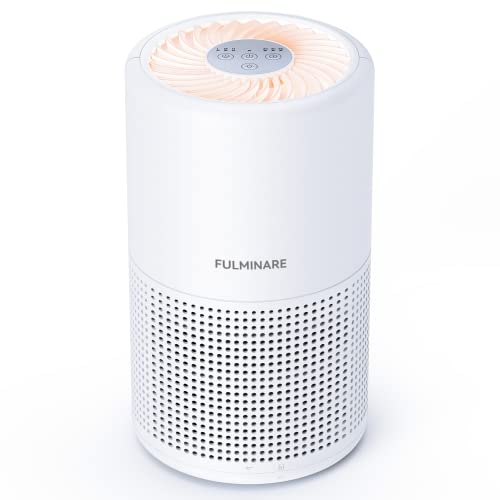
FULMINARE H13 tower, 1086 sq ft with carbon layer
H13 HEPA20 dB quiet1086 sq ft claimCarbon layer
Check price on Amazon
Best for: A budget-conscious remote worker with a small spare-room office.

FULMINARE offers the same three-stage layout as the more expensive towers, with a pre-filter, an H13 HEPA layer and an activated carbon stage, plus a dual-channel intake and 360 degree outlet. It is quoted at about 20 dB at its quietest, and it is the cheapest unit in this list by a clear margin.

That saving comes with limits. The carbon layer is thin, so do not expect it to handle strong smells, and the unit has no sensor, so you will set the speed yourself. A coverage figure of 1086 square feet is more than enough for a small office, so the fan can sit near its lowest speed most of the day.

Against the MSA3, this is the compromise pick: lower cost, similar layout, less documentation and a smaller reserve. Replacement filters should be bought as a pair so the cost over two years is clear. Vacuum the pre-filter regularly, and rinse nothing that the instructions do not say is washable.

What works

  • Cheapest tower in this lineup
  • H13 HEPA stage with a carbon layer
  • About 20 dB at its quietest
  • Dual inlet and 360 outlet spread airflow

Watch out for

  • No sensor, so speed is manual
  • Carbon layer is thin for strong odors

Spec sheet

Claimed coverage
Up to 1086 sq ft
Filter
Pre-filter, H13, carbon
Quiet mode
About 20 dB
Airflow
Dual channel, 360 outlet
Cost tier
Lowest in this list

Spec sheet decoder

What the numbers on the box really mean

The specs manufacturers lead with, translated into what they tell you about real-world performance.

H13 grade

H13 is a European standard for high-efficiency particulate filters, around 99.95 percent at the hardest-to-catch size. It is comparable to true HEPA for practical purposes.

Watch forThe MSA3 and FULMINARE both quote H13, so compare their carbon content instead.

Sleep mode dB

The decibel figure is for the lowest setting, so a call-friendly unit is one that cleans enough at that level.

Watch forThe ECOSELF at about 22 dB and the MSA3 at about 22 dB are the ones to compare.

PM2.5 display

A readout of fine particle concentration. It lets you see the effect of a run but says nothing about gases.

Watch forThe ECOSELF display will not respond to toner or glue fumes.

Claimed coverage

The area a unit can turn over once an hour. Divide by four or five for an allergy-grade room size.

Watch forThe Vital 200S-P claim of 1875 sq ft is well beyond a spare room's needs.

AHAM Verifide

An independent check of CADR and room-size claims. It adds trust to a published number.

Watch forThe Levoit Vital carries it, while the other four rely on manufacturer statements.

Methodology

How We Evaluated These Air Purifiers for Home Offices

Acoustic fit

Because the unit shares a room with a microphone, we weighted the quietest quoted setting above everything else. The FULMINARE at about 20 dB and the MSA3 and ECOSELF at about 22 dB led. A unit whose quiet mode still moved too little air for the room was marked down.

Placement practicality

We compared tower footprints against a typical desk setting and the Mini Max Auto's desktop design. A pick that could only work in a corner scored lower than one that cleans near the worker.

Sensor and control design

We examined auto mode, display and scheduling features, and how likely each is to change fan pitch mid-call. The Vital 200S-P and ECOSELF both have sensors that need regular cleaning to stay accurate.

Filter content

Filter stacks were read as listed: H13 plus carbon on the MSA3 and FULMINARE, True HEPA on the ECOSELF. Carbon thickness is rarely published, so we treated it as light on all of them.

Owner feedback patterns

Based on owner feedback patterns rather than our own bench work, we weighted recurring comments about sensor misreads, fan whine at higher speed and the cost of genuine filters. These moved close-ranked picks up or down.

Decision guide

How to Choose the Right Air Purifiers for Home Offices

By Office Setup

SituationPickWhy
Dedicated spare room, 120 to 200 sq ftMembrane Solutions MSA3Reserve lets it idle at 22 dB.
Corner of a living roomBlueair Mini Max AutoDesk-height intake cleans your breathing zone.
Smart-home office with schedulesLevoit Vital 200S-PApp scheduling and verified claim.
Wants to watch air quality changeECOSELF True HEPAPM2.5 display on the front.
Tight budget, small roomFULMINARE H13 towerLowest cost with an H13 layer.

By Budget

TierPickWhy
LowestFULMINARE H13 towerBasic but complete three-stage design.
Lower midBlueair Mini Max AutoA desk unit with sensor control.
MidECOSELF True HEPADisplay and big reserve for the price.
Upper midMembrane Solutions MSA3Better documented filters and quieter low speed.
TopLevoit Vital 200S-PVerification and smart features.

Tower vs Desktop Unit

Floor tower (MSA3, ECOSELF, FULMINARE)

A tower has the fan power to turn over a whole room and can idle at low noise. It needs floor space and clearance. It is the right answer for a closed office.

Desktop unit (Mini Max Auto)

A desktop unit puts the intake at your breathing height but has limited airflow and a fan close to your ears. It is a supplement or a solution for a shared workspace.

Choose a tower for a dedicated room and a desktop unit for a nook or a shared space.

Auto Sensor vs Fixed Speed

PreferencePickWhy
Wants hands-off cleaningLevoit Vital 200S-PSensor and app manage the fan.
Wants a display and auto modeECOSELF True HEPAShows PM2.5 and adjusts.
Wants a locked quiet speedFULMINARE H13 towerNo sensor, so no pitch changes.
Wants a locked quiet speed with more reserveMembrane Solutions MSA3Larger unit idles lower.

For Printer and Electronics Fumes Specifically

Look for

A carbon stage and a pre-filter that catches particles from the printer. A particle sensor will not respond to fumes, so run the unit continuously and keep the printer away from the intake. Ventilate new equipment for a couple of weeks.

In this comparison

The Membrane Solutions MSA3 and FULMINARE tower both include carbon. Neither is a serious chemical filter, but both help with light odor. For heavy printer use, read the printer odor guide.

When to Spend More

Spend more if

You work long hours in a closed room or take calls all day. The MSA3 and the Levoit Vital 200S-P give the quietest operation and a verified or well-documented filter system.

Save if

You have a small room and a light-use schedule. The FULMINARE H13 tower or a Mini Max Auto covers the job.

Ownership

Maintenance schedule

The upkeep that decides whether this machine lasts two seasons or ten.

TaskIntervalWhy it matters
Vacuum the pre-filterEvery 2 to 4 weeksOffice dust and paper fibres load the first stage. A clean pre-filter keeps the fan quieter.
Replace the main filterEvery 6 to 9 monthsContinuous daytime running ages the filter faster than occasional use. Follow the maker's schedule for genuine parts.
Wipe the sensor windowEvery 3 monthsA dusty sensor reads high and speeds up the fan, which you will hear on calls. Use a dry swab.
Check the carbon layerWith each filter swapThin carbon saturates quietly. If smells return before the filter is due, swap early.
Reposition away from heatWhen moving equipmentA laptop or printer exhaust near the intake distorts sensor readings. Keep a foot or two of clearance.

FAQ

Frequently Asked Questions

Which purifier is quietest for a home office?

The FULMINARE at about 20 dB and the Membrane Solutions MSA3 at about 22 dB are the quietest quoted settings here. Both need to idle on their lowest speed to stay that quiet.

Is an auto-mode sensor worth paying for?

It is useful if you leave the office and return. Be aware that sensors can drift and change fan pitch during calls, so a fixed speed is better for silence.

Where should I put it?

A tower wants two feet of clearance on each side and should sit a few feet from the desk. A desktop unit like the Mini Max Auto works best beside the monitor but not near warm exhaust vents.

Will it clear printer smell?

It will reduce light odor through the carbon layer, but laser printer fumes and toner are mostly a ventilation issue. Place the printer away from the intake.

How long do filters last in an office?

Six to nine months is typical for continuous daytime use. Vacuuming the pre-filter monthly extends that.

Do I need the biggest claimed coverage?

No. Reserve helps the unit run quietly, but a claim several times your room size is enough. Beyond that you pay for size you will not use.

Bottom line

The short version

Browse more air purifiers for home officeson Amazon →
James Miller, Lead Machine Editor

About the author

James Miller

Lead Machine Editor, MachineFanatic

James Miller leads MachineFanatic's buying guides, turning spec sheets, manuals and owner feedback into clear verdicts on power tools, outdoor power equipment, shop machines and kitchen machines.

More from James →

Keep reading

Related guides