
Amazon affiliate links - we earn a commission.Affiliate disclosure

Buying guide · 13 min read · Updated 2026-11-07

Best Air Purifiers for Workshops (2026)

Workshop air cleaners compared by CFM, filter grade and fume handling, with the sizing math for wood dust, laser smoke and garage shop air.

James MillerBy James MillerLead Machine Editor6 machines comparedSpec-sheet verified
Best Air Purifiers for Workshops

At a glance

Our top picks

Side by side

Spec comparison

A workshop purifier is a different machine from a home one. The air carries larger volumes of dust, sparks of fine wood dust that stay airborne for hours, and sometimes fumes, so these units are sized in hundreds or thousands of cubic feet per minute and use coarser, cheaper filters that you replace often.

This guide ranks the units by airflow against a real shop volume, by the filter grade they use and by how they handle fumes. It also says what an air cleaner cannot do: it does not replace dust collection at the tool, and it does not replace a respirator while you cut.

Before you buy

6 Criteria to Look For Before Buying an Air Purifier for Workshops

  1. 01

    Size by CFM and shop volume

    Multiply floor area by ceiling height for cubic feet, then divide CFM times 60 by that volume for air changes per hour. A 20 by 20 foot shop with an eight-foot ceiling is 3,200 cubic feet, and the ALORAIR at 1,350 CFM turns it over about 25 times per hour. Aim for at least six to ten.

  2. 02

    Filter grade matches the dust

    Shop units use MERV-rated media, such as the Abestorm's MERV-11, because true HEPA would clog in hours with wood dust. They hold most fine dust and let the finest fraction pass, so a respirator is still needed. A home HEPA unit like the FreAire suits only light dust.

  3. 03

    Source capture comes first

    An air cleaner removes what escaped from the tool. Dust collection at the saw and sander removes most of it, and the hanging unit mops up the rest. Skipping source capture asks the air cleaner to do a job it cannot. A shop vacuum with a cyclone at the sander often does more for the air than a second hanging unit.

  4. 04

    Fume versus dust

    Laser and finishing fumes need carbon and point-source extraction, as on the ATOMSTACK D5. Hanging dust filters do not remove gases. Match the machine to the contaminant.

  5. 05

    Ionizers and ozone

    The ALORAIR and Abestorm units list built-in ionizers, and the listings say they do not meet California requirements. Ionizers can emit ozone, so ventilate and keep them off if you are sensitive. The filtration works without the ionizer.

  6. 06

    Filter life and cost

    A shop filter loads fast. The Abestorm lists a two to four month replacement for its MERV-11 set, which is a realistic figure for regular use. Budget for filters as a running cost, and check that they are easy to buy.

Detailed reviews

The 6 best air purifiers for workshops, explained

01
ALORAIR hanging air filter, 1,050 and 1,350 CFM
1,050 / 1,350 CFMVortex fanRemote and timer
Check price on Amazon
Best for: Two-car garage shops and woodworking spaces up to about 3,200 cubic feet.

This hanging unit gives a shop real air changes. At 1,350 CFM on high, it moves 81,000 cubic feet per hour, which turns over a 20 by 20 foot shop with an eight-foot ceiling, about 3,200 cubic feet, more than 25 times per hour. Even the 1,050 CFM speed is about 20 changes, which is more than a home purifier would manage in a living room.

A 360 degree intake and a strong vortex fan pull air from around the cabinet, and the timer lets you set it to run for one to nine hours after you finish cutting, so it clears the fine dust that stays aloft. An IR remote makes this easy to use from the bench. A built-in ionizer is listed, and the listing says the unit does not meet California regulations, so it cannot ship there.

The filter is a coarse media, not true HEPA, which is the normal trade for the airflow. Plan on swapping or cleaning the filters every few months, depending on how much you cut. Compared with the ALORAIR 580/780, it moves almost double the air. Hang it near the middle of the shop, a few feet below the ceiling, on rated chains and hooks into joists, and keep the intake clear of lumber racks. Run it on high while you cut and on low after.

What works

  • 1,350 CFM turns over a 3,200 cubic foot shop over 25 times per hour
  • 360 degree intake with a strong vortex fan
  • Timer and IR remote for run-after-cutting
  • Hangs overhead, off the floor

Watch out for

  • Not sold for shipping to California
  • Coarse filters, not true HEPA

Spec sheet

Airflow
1,050 and 1,350 CFM
Intake
360 degree
Fan
Strong vortex fan
Control
IR remote, 1 to 9 hour timer
Extra
Built-in ionizer
02
ALORAIR hanging air filter, 580 and 780 CFM
580 / 780 CFM270 degree intakeRemote control
Check price on Amazon
Best for: One-car garage and hobby shops near 1,500 cubic feet.

The smaller ALORAIR pairs a two-stage filter with 580 and 780 CFM speeds, which suits a one-car garage or a hobby shop of about 1,500 cubic feet. On high, 780 CFM is 46,800 cubic feet per hour, about 30 changes in a shop that size, and even the low speed gives plenty of turnover.

A 270 degree intake and a vortex fan pull air from three sides, and a remote control lets you set the speed from the bench. Like the larger unit, it does not meet California's requirements and cannot be shipped there.

Ownership is a filter change every few months and a wipe of the intake. It is a good fit for a hobbyist who cuts a few hours a week. Because its two stages are simple, expect to clean the first stage often during a project. Hang it where the airflow crosses the main work area.

What works

  • 780 CFM on high gives about 30 changes in a small shop
  • Two-stage filtration
  • Remote control
  • Lower price tier than the larger unit

Watch out for

  • Not sold for shipping to California
  • Too small for a large shop

Spec sheet

Airflow
580 and 780 CFM
Intake
270 degree
Fan
Strong vortex fan
Control
Remote control
Stages
2 stage
03
Abestorm hanging air filter, 1,350 CFM with 4 MERV-11 filters
1,350 CFMMERV-11 filtersTouch and remote
Check price on Amazon
Best for: Shops that want a clear filter replacement schedule at 1,350 CFM.

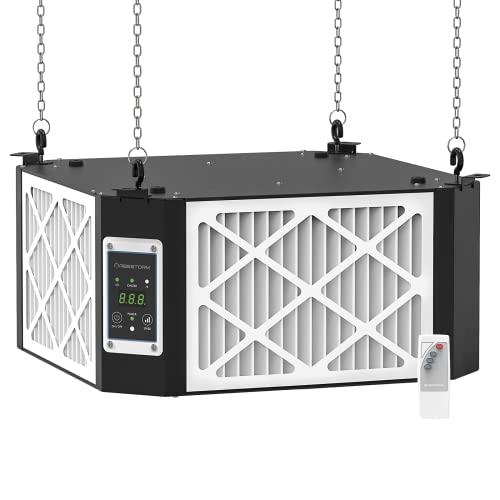
The Abestorm is the best documented of the hanging units on filter detail. The listing says it includes four MERV-11 filters that need replacing every two to four months, which is the honest running cost you should plan for with a shop unit. MERV-11 is a pleated media rated for fine dust, but it is not HEPA, so it holds the dust that matters most in a shop while letting the very fine fraction pass.

It moves 1,350 CFM on high and has two speeds, with touch and remote controls. A built-in ionizer is listed, and a vortex fan draws air from 360 degrees. It is compact for its airflow, and the listing mentions three installation methods.

Compared with the ALORAIR 1,050 and 1,350 CFM unit, it has the same top airflow and a clearer statement of filter life. The ionizer should be treated with the ozone caution below. Buy the replacement set before you need it, so a loaded set does not sit in the unit through a busy month. Because it has two speeds, use the low one for idle running and the high one while you cut.

What works

  • States 4 MERV-11 filters with a 2 to 4 month interval
  • 1,350 CFM on high
  • Touch and remote controls
  • Several installation options

Watch out for

  • Filter interval means a recurring cost
  • Ionizer needs an ozone check

Spec sheet

Airflow
1,350 CFM
Filters
4 MERV-11, replace every 2 to 4 months
Speeds
2 speed
Control
Touch and remote
Extra
Built-in ionizer
04
DEWALT DXF1612 drum fan air purifier, 4,000 CFM
4,000 CFMPM2.5 sensor95% dust capture
Check price on Amazon
Best for: Large garages and job sites that need a movable unit with a dust reading.

The DEWALT is a high-velocity floor fan with a filter, and its 4,000 CFM figure is a fan rating that applies without the filter loading the airflow. The listing says the premium filtration traps 95 percent of airborne dust and debris, which is a general capture claim and not a HEPA grade.

A real-time PM2.5 sensor and an LED display show particle level, and a flared drum structure gives strong airflow for a garage or job site. It runs on AC power. The sensor tells you when the shop air is worse than expected.

It is a mobile machine that you can move to where the work is, which helps in a large shop. With the filter in the airstream the delivered airflow will be well below 4,000 CFM, so treat the figure as a fan rating. Replace the filter as the sensor suggests. Place it so the intake faces the work and the exhaust blows away from you, and watch the sensor drop as it cleans. Its size makes it awkward in a small shop, so measure the corner you plan to use.

What works

  • Movable floor unit with a drum fan
  • PM2.5 sensor and LED display
  • Very high fan rating
  • AC powered

Watch out for

  • The 4,000 CFM figure is a fan rating, not a filtered rate
  • Takes floor space

Spec sheet

Airflow
4,000 CFM
Capture claim
95 percent of airborne dust and debris
Sensor
PM2.5 with LED display
Power
AC
Form
Flared drum floor fan
05
ATOMSTACK D5 smoke purifier, 1,400 Pa, HEPA and carbon
1,400 Pa suction3-layer HEPA and carbonLaser fume extractor
Check price on Amazon
Best for: Laser engraver and cutter workspaces that need fume extraction.

The D5 is a different tool from the hanging air filters. It is a fume extractor made for laser cutting and engraving, with a 1,400 Pa suction fan that pulls smoke from the cutting area and passes it through a three-layer filter of HEPA and carbon. The listing claims 99.5 percent purification.

Laser smoke is fine particulate plus gases, so a HEPA layer with a carbon bed is the right combination. Suction is measured in pascals, not CFM, because it has to pull a smoke plume through a hose, and 1,400 Pa is a reasonable figure for that job.

This is a point-source tool and not a room cleaner. Ownership is replacing the filter cartridge, which loads quickly with resin and wood smoke. Position the hose inlet within a few inches of the cut, since suction falls sharply with distance. Check that your engraver's exhaust port fits the hose, and replace the filter when you notice more odor at the bench.

What works

  • Point-source extraction for laser smoke
  • HEPA and carbon layers
  • 1,400 Pa suction
  • Tabletop size

Watch out for

  • Not a room-scale air cleaner
  • Filter cartridge loads fast with smoke

Spec sheet

Suction
1,400 Pa
Filtration
3-layer HEPA and carbon
Claim
99.5 percent purification
Use
Laser cutting and engraving
Format
Tabletop extractor
06
FreAire HAP605 HEPA, washable layer, up to 2,600 sq ft
Up to 2,600 sq ftTriple intakeWashable layer
Check price on Amazon
Best for: Finished hobby rooms with light, fine dust.

The HAP605 is a home purifier, and it earns a place here for finished hobby rooms, a conditioned shop with a small bench or a sewing and crafting space. A HEPA layer catches the finest dust that a MERV-rated shop filter lets through, and a washable layer lowers running cost.

Its airflow is far below the hanging units, so it is not for a woodworking garage. A PM2.5 sensor drives the auto mode and the triple intake helps spread the draw.

Use it where the dust is light and fine, such as a sanding bench with good collection or a finishing room. Ownership is a layer rinse and a filter swap. Keep it out of the sanding area itself and place it at the edge of the room, so heavy chips do not clog the washable layer. A hobby room with good tool collection and this unit makes a pleasant combination.

What works

  • HEPA layer for fine dust
  • Washable layer lowers running cost
  • PM2.5 sensor with auto mode
  • Triple intake

Watch out for

  • Far less airflow than shop units
  • Not meant for heavy wood dust

Spec sheet

Listed coverage
2,600 sq ft
Intake
Front plus two side inlets
Filter
HEPA with washable layer
Sensor
PM2.5 with auto mode
Class
Finished room

Spec sheet decoder

What the numbers on the box really mean

The specs manufacturers lead with, translated into what they tell you about real-world performance.

CFM

Cubic feet per minute of airflow. For shop units it is a fan rating at the fan.

Watch forThe DEWALT's 4,000 CFM is a fan figure, the ALORAIR's 1,350 is for the filtered unit.

Air changes per hour

CFM times 60 divided by shop volume. Six to ten is a minimum for dust.

Watch forThe ALORAIR gives about 25 in a 3,200 cubic foot shop.

MERV-11

A pleated filter grade for fine dust, below HEPA. It lets the finest particles pass.

Watch forThe Abestorm uses four of them.

Pa (suction)

Pressure a fume extractor can pull through a hose. It matters for point-source capture.

Watch forThe ATOMSTACK D5 lists 1,400 Pa.

Ionizer

A stage that charges particles. It can emit ozone.

Watch forThe ALORAIR and Abestorm list ionizers.

Methodology

How We Evaluated These Air Purifiers for Workshops

Airflow versus shop volume

We converted CFM to air changes per hour for a 3,200 cubic foot shop and a 1,500 cubic foot shop. The ALORAIR 1,350 gives about 25 and the 780 gives about 30 in the smaller space. This is a spec-sheet evaluation.

Filter grade and cost

We compared MERV media with HEPA and the replacement intervals, with the Abestorm's two to four months as the clearest figure.

Fume handling

We separated dust units from fume extractors. The ATOMSTACK D5 is the one unit built for laser smoke.

Safety notes

We flagged ionizers and the California shipping notes on the hanging units. Any unit that can emit ozone should be run with ventilation.

Mounting and use

We considered how each unit is installed or moved, from hanging overhead to a floor drum fan.

Decision guide

How to Choose the Right Air Purifiers for Workshops

By Shop Size

SituationPickWhy
Two-car garage shop near 3,200 cubic feetALORAIR 1,050 and 1,350 CFMAbout 25 changes per hour on high
One-car garage near 1,500 cubic feetALORAIR 580 and 780 CFMAbout 30 changes per hour on high
Shop that wants a clear filter scheduleAbestorm 1,350 CFMMERV-11 set with a 2 to 4 month interval
Large garage or job siteDEWALT DXF1612Movable, with a dust sensor
Laser workspaceATOMSTACK D5Point-source extraction

By Budget

TierPickWhy
LowestFreAire HAP605Home unit for light dust
LowerALORAIR 580 and 780 CFMSmall shop value
MidATOMSTACK D5Laser extractor
Upper midAbestorm 1,350 CFMLarger airflow
HighestALORAIR 1,050 and 1,350 / DEWALTLarge shop, or movable unit

Hanging Unit vs Floor Unit

Hanging unit

The ALORAIR and Abestorm hang overhead, out of the way, and circulate the whole shop air. They suit a permanent shop.

Floor unit

The DEWALT sits on the floor and can be moved to the work. It suits a job site or a shared garage.

Choose a hanging unit for a dedicated shop, and a floor unit if the space is shared or temporary.

Dust vs Fumes

ContaminantPickWhy
Wood dustALORAIR 1,050 and 1,350High air changes
Laser smokeATOMSTACK D5HEPA and carbon at the source
Light fine dust in a finished roomFreAire HAP605HEPA layer
Mixed garage dustDEWALT DXF1612Dust sensor and movable

For Woodworking Specifically

Look for

Enough CFM for six to ten changes, a MERV-rated filter you can replace cheaply, a timer to run after cutting and dust collection at the tools.

In this comparison

The ALORAIR 1,050 and 1,350 CFM unit gives the airflow, and the Abestorm gives a clear filter schedule.

When to Spend More

Spend more if

The shop is large, you cut wood daily or you want a timer and remote, as on the ALORAIR 1,050 and 1,350 CFM.

Save if

The shop is small or the dust is light, where the ALORAIR 580 and 780 or the FreAire is enough.

Ownership

Maintenance schedule

The upkeep that decides whether this machine lasts two seasons or ten.

TaskIntervalWhy it matters
Replace the main filtersEvery 2 to 4 monthsWood dust loads shop filters quickly. A loaded filter cuts airflow, which cuts the air changes you are counting on.
Clean the pre-filterEvery 2 weeksCoarse chips and lint block the first stage. Tap it out or vacuum it.
Run it after workAfter every cutting sessionFine dust stays aloft for hours. A timer run of one to nine hours clears it.
Inspect the hanging hardwareEvery 6 monthsCheck the chains, hooks and mounts. A unit falling from a ceiling is a real hazard.
Empty and replace the laser filterPer useThe ATOMSTACK cartridge loads with resin and smoke. Replace it when suction drops.

FAQ

Frequently Asked Questions

How many CFM does a workshop need?

Multiply floor area by ceiling height for volume, then aim for six to ten air changes per hour. For a 3,200 cubic foot shop that is about 320 to 530 CFM, which the ALORAIR units exceed. Add margin for heavy cutting.

Can an air cleaner replace dust collection?

No. It cleans what the tool collection missed. Source capture comes first, and a respirator is still needed.

Is HEPA better for a workshop?

For heavy wood dust it clogs fast. MERV-rated media with a replaceable interval is the practical choice, and a home HEPA unit suits only light dust.

Are ionizers safe in a shop?

They can emit ozone. Ventilate and keep them off if you are sensitive. The filtering does not depend on them.

Where should I hang the unit?

Overhead, near the center of the shop, with clear space around the intake and secure mounts. Mounting hardware should be rated well above the unit's weight.

Do I need a different tool for laser fumes?

Yes. A point-source extractor with HEPA and carbon, like the ATOMSTACK D5, handles fumes that dust filters do not.

Bottom line

The short version

Browse more air purifiers for workshopson Amazon →
James Miller, Lead Machine Editor

About the author

James Miller

Lead Machine Editor, MachineFanatic

James Miller leads MachineFanatic's buying guides, turning spec sheets, manuals and owner feedback into clear verdicts on power tools, outdoor power equipment, shop machines and kitchen machines.

More from James →

Keep reading

Related guides