
Amazon affiliate links - we earn a commission.Affiliate disclosure

Buying guide · 14 min read · Updated 2026-11-07

Best Bladeless Tower Fans (2026)

Six bladeless tower fans compared on sweep angle, speed steps, noise ratings, heating options and smart sensors, with honest notes on how they work.

James MillerBy James MillerLead Machine Editor6 machines comparedSpec-sheet verified
Best Bladeless Tower Fans

At a glance

Our top picks

Side by side

Spec comparison

A bladeless fan hides its moving parts. Inside the housing a motor still spins an impeller, but the airflow is pushed through a slot or ring, so there are no exposed blades to touch, collect dust or catch a curious finger.

The appeal is part safety and part appearance, and the trade is usually price and raw air speed. These six machines show the range, from a simple quiet tower to a heater combination and a sensor-driven design that sweeps farther than any conventional fan.

Before you buy

6 Criteria to Look For Before Buying a Bladeless Tower Fan

  1. 01

    How bladeless really works

    A bladeless fan still has a motor and an impeller inside the base or body. The air is pushed through a slot or ring, which is why the outside has no blades. That design avoids exposed parts and gives a smooth airflow, and it generally moves less air per unit of power than a bladed fan. Treat claims of multiplied airflow as marketing unless a figure is stated. The honest way to compare machines is by quoted air speed at the outlet and by how the breeze feels at the bed or sofa, because a fan can multiply air by entrainment and still deliver a weak stream at the person. Entrainment is real physics, since fast air pulls slower surrounding air along, but the amount depends on the geometry and does not change how much energy the motor uses.

  2. 02

    Noise and DC motors

    The Pelonis quotes about 22 dB and the Levoit about 28 dB, both with DC motors, while the Eduzita is rated about 35 dB. The lower the rating, the more it matters at night. A closed shell also muffles some motor noise, but airflow whoosh remains, so judge noise at the speed you will use. The sound of a bladeless fan is also different in character: with no blade chop, the noise is a broad rush of air through the slot, and it tends to be less irritating than a bladed tower of the same loudness. Even so, a fan at its top speed is a fan at its top speed, and the lowest quoted decibel figure never describes the setting you use on a stuffy night.

  3. 03

    Sweep and coverage

    The Shark sweeps 180 degrees and the dreame covers 270 degrees of spatial airflow, while the Pelonis, Levoit and MOMOKOVA sweep 90 and the Eduzita 80. A wider sweep suits a living room, and a narrow one suits a single bed. Remember that wide coverage thins the breeze at any one spot.

  4. 04

    Heat and extra functions

    The Shark adds a heater with three modes, including Thermo IQ, which makes it a year-round machine. That brings a heavy electrical draw and a need for a clear space. Features like the MOMOKOVA negative ion mode add little, so do not pay for them. The heater is a different story, because it replaces a second appliance and a space heater that is stored half the year. Weigh the saved floor space against the extra weight, the high power draw and the need to treat the machine with a heater's respect, with clearance on all sides and no extension cord. If you already own a safe heater, a plain fan will cost less and run more quietly.

  5. 05

    Automatic control

    The dreame TempSync sensor and the Levoit style auto modes adjust speed to temperature. Automatic control helps if you forget to turn the fan down at night. A simple timer, such as the Eduzita 9 hour setting, does a similar job at a lower price. Sensor-driven machines depend on where the sensor sits, so a fan placed in a corner or behind a curtain may read the wrong temperature and run slower than you want. Give it a clear spot, and treat the first night as a calibration period before trusting the automation.

  6. 06

    Height and placement

    Fans stand from 36 to 47 inches, and the Levoit adjusts through that range. A tower that is too short blows at the mattress rather than your body. Check the height against your bed or sofa, and note that tall, narrow bases tip easily if a child leans on them.

Detailed reviews

The 6 best bladeless tower fans, explained

01
PELONIS 40-Inch Bladeless Tower Fan, 22 dB DC Motor, 6 Speeds
40 in. height22 dB6 speeds4 modes
Check price on Amazon
Best for: A bedroom or nursery where noise and safety matter more than raw airflow.

The Pelonis 40 inch tower puts a DC motor behind a smooth, grille-free shell, and the maker quotes about 22 dB on its quietest setting. That figure is lower than the 28 dB typical of ordinary bedroom towers, and it is the main reason this machine ranks first.

Six speeds and four modes cover the usual range, and a remote handles them from bed. The airflow is smooth and gentle rather than punchy, which suits sleeping more than cooling a hot afternoon. The maker emphasises safety for children and pets because the housing has no exposed blades.

Because the outlet is a narrow slot, dust gathers around its edge and in the inlet at the base, so vacuum both monthly. Place it on a flat surface and keep the intake clear. It is the machine to buy when you want a fan that looks like furniture and sounds like nothing.

What works

  • About 22 dB at its quietest setting
  • Smooth shell with no exposed blades
  • Six speeds and four modes
  • Remote control from bed

Watch out for

  • Gentle airflow is weaker on hot afternoons
  • Costs more than a plain bladed tower

Spec sheet

Height
40 inch
Noise
About 22 dB
Speeds
Six
Modes
Four
Control
Remote and panel
02
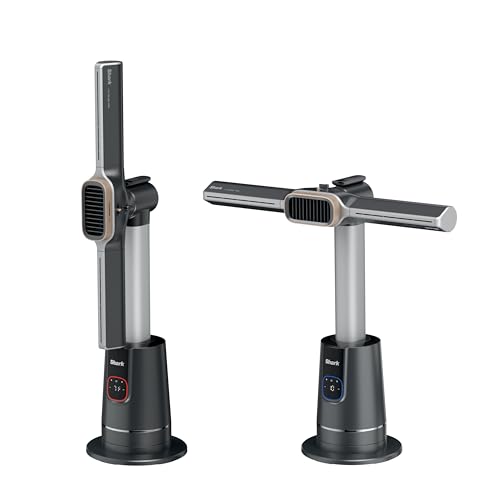
Shark TurboBlade TH202 Bladeless Tower Fan and Heater
Fan plus heater180 degree sweep10 fan speeds3 heat modes
Check price on Amazon
Best for: A room that needs cooling in summer and a space heater in winter.

The Shark TurboBlade is two appliances in one: a bladeless tower fan in summer and a heater in winter. It sweeps 180 degrees, wider than the 90 degree standard, offers 10 fan speeds, and has three heating modes, including Thermo IQ, which adjusts heat output toward a target temperature.

The combination is the attraction, since a single tower can stand in the corner all year instead of being packed away. The compromise is that a heater is a high-draw device that needs its own outlet, and heater parts add complexity and weight. Against the Pelonis it is a more flexible machine and a less purely quiet one.

Keep the intake clear, and vacuum dust from the heating vents before the winter season. Never cover the housing while heating, and place it away from curtains and bedding. It earns its space in a room where you need both functions.

What works

  • Fan and heater in one machine
  • 180 degree oscillation sweeps wide
  • 10 fan speeds for fine control
  • Thermo IQ automatic temperature control

Watch out for

  • Heater draws substantial current and needs its own outlet
  • More complex and heavier than a fan-only tower

Spec sheet

Functions
Cooling fan and heater
Oscillation
180 degrees
Fan speeds
10
Heat modes
Three, including Thermo IQ
Model
TH202
03
dreame MF10 Bladeless Tower Fan, 270 Degree Spatial Airflow
270 degree airflowTwo GyroWing outletsTemp sensorSmart control
Check price on Amazon
Best for: A living space where whole-room circulation and automatic control are wanted.

The dreame is the most unusual machine here. Two GyroWing outlets rotate independently up to 90 degrees vertically, and together with horizontal sweeping they produce a 270 degree spatial pattern that no ordinary tower can reach. The maker says its AirBoost design draws in surrounding air to multiply the airflow, a claim that depends on how it is measured.

A built-in temperature sensor and TempSync algorithm adjust the fan automatically as room temperature changes, so you do not have to touch the speed. That is closer to a thermostat than a fan, and it suits people who dislike fiddling.

The moving outlet mechanisms are the part that deserves care, so keep them free of obstructions and dust. It is a newer product from a brand better known for other appliances, so check support terms. It is the pick for a person who wants the room circulated as a whole.

What works

  • 270 degree spatial airflow pattern
  • Two independent GyroWing outlets
  • TempSync sensor adjusts speed automatically
  • Smart control and sleek shell

Watch out for

  • Moving outlets add mechanical complexity
  • Newer product with less long-term history

Spec sheet

Airflow pattern
270 degrees spatial
Outlet design
Two GyroWing, each to 90 degrees vertically
Amplification
AirBoost, up to 16 times claimed
Sensor
TempSync temperature sensor
Type
Smart standing fan
04
Levoit Bladeless-Style Tower Fan, 36 to 47 Inch Adjustable, 28 dB
36 to 47 in. height28 dB23 ft/sConvertible
Check price on Amazon
Best for: A tall bed or a room where the fan height must change with the furniture.

The Levoit offers the widest height range in the group, from 36 to 47 inches, and a lower section that can be removed to convert it into a shorter fan. That flexibility suits a raised bed or a high sofa as well as a low chair.

Its VORTEXAir technology delivers up to 23 ft/s while the motor stays near 28 dB, which puts it in the quiet class but below the 26 to 28 ft/s of the best bladed towers. A 90 degree sweep covers a standard room. The maker markets it as bladeless in style, with a closed shell.

Checking the height joint when you assemble it is worthwhile, since an adjustable section is a place where a wobble can appear. Dust the intake every few weeks and wipe the shell with a damp cloth.

What works

  • 36 to 47 inch adjustable height
  • About 28 dB with 23 ft/s airflow
  • Lower section removes for a shorter fan
  • 90 degree sweep

Watch out for

  • Adjustment joint is a place to check for wobble
  • Air speed trails the best bladed towers

Spec sheet

Height
36 to 47 inch adjustable
Noise
About 28 dB
Air speed
23 ft/s
Technology
VORTEXAir
Conversion
Lower section removes for a shorter fan
05
MOMOKOVA 36-Inch Bladeless Tower Fan, 24 Speeds, 26 ft/s
36 in. height24 speeds26 ft/s12H timer
Check price on Amazon
Best for: A user who wants very fine speed control from a mid-height tower.

The MOMOKOVA gives 24 speed steps, more than any other fan here, with a quoted 26 ft/s of airflow and a 12 hour timer. Fine steps let you sit exactly at the quietest speed that keeps you comfortable.

It offers touch and remote control and a negative ion mode, a feature of questionable benefit that you can safely ignore. A 90 degree sweep and a 36 inch height make it a good bedroom fan. The maker describes a silent turbine design, which is how it explains its closed shell.

The brand is newer, so check the warranty terms. Dust the intake monthly, keep the base level and do not rely on the ion mode as an air cleaner.

What works

  • 24 speed steps for precise control
  • 26 ft/s quoted airflow
  • 12 hour timer
  • Touch panel and remote

Watch out for

  • Negative ion mode adds little real benefit
  • Newer brand with less track record

Spec sheet

Height
36 inch
Speeds
24
Air speed
26 ft/s
Oscillation
90 degrees
Extras
12 hour timer, negative ion mode
06
Eduzita H601 Bladeless Tower Fan, 10 Speeds, 80 Degree Sweep, 35 dB
10 speeds80 degree sweep35 dB9H timer
Check price on Amazon
Best for: A first bladeless fan for a desk or a small bedroom.

The Eduzita is the plain, lower-priced bladeless tower: 10 speeds, an 80 degree sweep and a noise rating of about 35 dB. A remote and touch panel control the speed, oscillation and a 9 hour timer.

It sits behind the Pelonis on noise, at 35 dB against 22, and a little behind the 90 degree standard on sweep. What it offers is the bladeless shell at a lower cost, with a soft, gentle airflow that suits a desk or a bedroom corner.

Wipe the shell and vacuum the base intake monthly. Anyone curious whether the bladeless design suits them can treat it as a first try.

What works

  • 10 speeds with a soft airflow
  • 9 hour timer
  • Remote and touch panel
  • Closed shell with no exposed blades

Watch out for

  • 35 dB is louder than the quietest models
  • 80 degree sweep is narrower than most

Spec sheet

Speeds
10
Oscillation
80 degrees
Noise
About 35 dB
Timer
9 hours
Control
Remote and touch panel

Spec sheet decoder

What the numbers on the box really mean

The specs manufacturers lead with, translated into what they tell you about real-world performance.

Oscillation angle

The arc the airflow sweeps. Wider arcs cover more of a room.

Watch forThe Shark sweeps 180 degrees and the Eduzita 80.

Noise (dB)

Sound level at the lowest speed. Lower numbers are quieter.

Watch forThe Pelonis is rated about 22 dB, the Eduzita about 35.

Speed steps

The number of fan speeds. More steps allow finer low-speed tuning.

Watch forThe MOMOKOVA has 24, the Pelonis six.

Air speed

How fast air leaves the fan, in feet per second.

Watch forThe MOMOKOVA quotes 26 ft/s and the Levoit 23 ft/s.

Thermo IQ

A heater mode that adjusts output toward a target temperature.

Watch forThe Shark TurboBlade is the only heater model here.

Methodology

How We Evaluated These Bladeless Tower Fans

Quietness

We compared decibel figures and motor types. The 22 dB Pelonis leads, and the 35 dB Eduzita trails.

Coverage

We weighed sweep angles. The dreame 270 degree and Shark 180 degree patterns lead, and the Eduzita 80 degree sweep trails.

Control and sensors

We considered speed steps, timers and sensors. The MOMOKOVA 24 speeds and dreame TempSync stand out.

Versatility

We counted heating, adjustable height and conversion features. The Shark and Levoit lead.

Maturity and support

We noted brand history. The Pelonis, Levoit and Shark have more history than the newer dreame, MOMOKOVA and Eduzita entries.

Decision guide

How to Choose the Right Bladeless Tower Fans

By Priority

SituationPickWhy
Quietest bedroom fanPELONIS 40-inchAbout 22 dB
Cool in summer, heat in winterShark TurboBlade TH202Fan and heater, 180 degree sweep
Whole-room circulationdreame MF10270 degree spatial airflow
High bed or flexible heightLevoit adjustable36 to 47 inch height
Fine speed controlMOMOKOVA 24-speed24 steps and a 12H timer

By Budget

TierPickWhy
LowestEduzita H601Simple bladeless shell
Low to midMOMOKOVA 24-speedMany speed steps
MidPELONIS 40-inchQuietest in the group
Upper midLevoit adjustableHeight range and quiet
TopShark TurboBlade or dreame MF10Heater or sensor-driven airflow

Bladeless vs Bladed Tower

Bladeless

The six here have closed shells that resist dust and keep fingers out. They are usually quieter and gentler, and they cost more per unit of airflow.

Bladed

A conventional tower moves more air for the money and is easy to clean at the grille. It has a slot or grille that collects dust and, in some models, a louder motor.

Bladeless for safety and gentle quiet, bladed for value and airflow. The price gap is real, and in a hot spell a bladed tower at the same price will move noticeably more air, so decide whether the shell design, the low noise or the child-friendly shape is what you are really paying for. If the answer is one of those, the closed shell is worth it, and if it is only the look, it is a luxury.

By Household

HouseholdPickWhy
Young children and petsPELONIS 40-inchClosed shell and low noise
Single room all yearShark TurboBladeReplaces a space heater
Open-plan livingdreame MF10Wide spatial pattern
Tight budgetEduzita H601Cheapest closed-shell tower

For a Child's Room Specifically

Look for

Look for a closed shell with no exposed blades, a low noise rating and a stable base. A timer helps turn the fan off after a child is asleep.

In this comparison

The Pelonis 40 inch at about 22 dB is the best fit, with the Eduzita as the budget choice.

When to Spend More

Spend more if

Spend more if you need heat as well as cooling, with the Shark, or sensor-driven airflow, with the dreame. The extra money buys a second function or a new airflow pattern.

Save if

Save if you want the closed shell for a desk or a bedroom corner. The Eduzita or MOMOKOVA covers that need.

Ownership

Maintenance schedule

The upkeep that decides whether this machine lasts two seasons or ten.

TaskIntervalWhy it matters
Vacuum the base intakeMonthlyDust blocks the inlet and cuts airflow. A soft brush attachment is enough.
Wipe the shell and outlet slotEvery few weeksDust gathers around the slot edge and shows on a dark shell. A damp cloth clears it. A closed shell keeps dust out of the impeller far better than an open grille does, but the intake still pulls dust in over a season, so the base filter or mesh needs attention too. Unplug the fan before wiping, never spray liquid onto the shell, and let the cloth dry on the slot edge before turning it on.
Clear heater vents (Shark)Before winterDust burns off on first use and smells. Clean the vents before turning the heater on.
Check the height jointEach seasonAdjustable models can develop a wobble at the joint. Tighten before the hot season.
Replace remote batteriesYearlyA dead remote forces you out of bed. Keep spare cells nearby.

FAQ

Frequently Asked Questions

Are bladeless fans really bladeless?

No. A motor and impeller sit inside the base or body. The airflow leaves through a slot or ring, so the outside has no exposed blades.

Are they quieter than bladed towers?

Often, but not always. The closed shell muffles some motor noise, and good models run near 22 to 28 dB. Cheaper models can be as loud as a bladed fan.

Do bladeless fans move less air?

Usually less per unit of power, so they feel gentler. Treat claims of multiplied airflow carefully unless a figure is stated.

Are they safer around children?

The closed shell keeps fingers away from moving parts, which is the main safety advantage. They still need a stable base and a clear cord.

Does the heater model replace a space heater?

For a small room, yes. A heater draws substantial current, so give it its own outlet and keep it away from fabric.

Is the ion mode useful?

Claims about negative ions improving air are weak. Treat it as a bonus, not a reason to buy, and use a proper air purifier if air quality matters.

Bottom line

The short version

Browse more bladeless tower fanson Amazon →
James Miller, Lead Machine Editor

About the author

James Miller

Lead Machine Editor, MachineFanatic

James Miller leads MachineFanatic's buying guides, turning spec sheets, manuals and owner feedback into clear verdicts on power tools, outdoor power equipment, shop machines and kitchen machines.

More from James →

Keep reading

Related guides