
Amazon affiliate links - we earn a commission.Affiliate disclosure

Buying guide · 12 min read · Updated 2026-11-12

Best Brinly Lawn Aerators (2026)

Brinly sells push, tow-behind spike and tow-behind plug aerators. We compare the lineup by tine design, width and weight tray so you can pick the right one.

James MillerBy James MillerLead Machine Editor5 machines comparedSpec-sheet verified
Best Brinly Lawn Aerators

At a glance

Our top picks

Side by side

Spec comparison

MachineTypeWidthSpoonsTrayHitch
Brinly PA-482BH-A2 tow-behind plug aerator, 48 inBest OverallBrinly PA-482BH-A2 tow-behind plug aerator, 48 inTow-behind plug48 in32, heat-treated 16 gaugeFully enclosed weight trayUniversal
Brinly 20-inch push spike aerator with weight trayBest Push OptionBrinly 20-inch push spike aerator with weight trayPush roller, spiken/an/an/an/a
Brinly SAT2-40BH-P tow-behind spike aerator, 40 in carbonBest Spike Tow UnitBrinly SAT2-40BH-P tow-behind spike aerator, 40 in carbonTow-behind spike40 inn/an/an/a
Brinly 40-inch tow-behind plug aerator, universal hitchBest Mid-Size PlugBrinly 40-inch tow-behind plug aerator, universal hitchTow-behind plug40 in24, heat-treated 16 gaugeEnclosed weight trayUniversal
Brinly PA-42BH-A tow-behind plug aerator, folding tow barBest for StorageBrinly PA-42BH-A tow-behind plug aerator, folding tow barTow-behind plug42 inHeat-treated 16 gauge steelEnclosed weight trayFolding easy-store tow bar

Aeration sounds like one job, but the tools split into pushed spikes, towed spikes and towed plugs, and the differences show up in clay, in thatch and in the time you spend on a Saturday. Choosing inside one brand narrows the variables so the real trade-offs stay visible.

This guide stays within a single maker's range and sorts it by how each machine opens the soil, how wide a strip it covers and what you need to pull or push it. Ownership details, such as storage and rust, get as much attention as the headline specs.

Before you buy

6 Criteria to Look For Before Buying a Brinly Lawn Aerator

  1. 01

    Weight, depth and ballast

    Wheeled and towed units only dig as deep as their weight pushes them, so the weight tray or fillable drum is the depth control. The Brinly PA-482BH is one of these ground-driven designs, which means a tray, drum or roller you must load with sand, bricks or water. Add ballast in small steps, stay within the maker's stated limit and watch the tow vehicle or your own back before adding more. A loaded unit that spins a mower tire or stalls a push is already past the sweet spot.

  2. 02

    Working width and passes

    Working width converts directly to passes. The Brinly PA-482BH covers 48 inches per pass while the Brinly 20-inch push covers 20, which on an open lawn is the difference between a short afternoon and a long weekend. Wider is only better if your tow vehicle, your gates and your storage space can handle it. Measure the narrowest gate you will pass through, plus a few inches of margin for the frame.

  3. 03

    Hole count and spacing

    Hole count per step or per revolution is a rough measure of density. The Brinly SAT2 carbon lists 132 tines or knives, against 24 on the Brinly 40-inch plug, so it perforates a strip more thoroughly each time. Density matters less than depth, but a sparse pattern forces extra passes at right angles. Plan on two or three crossing passes for a thorough job.

  4. 04

    Tine steel and finish

    Tines are the wear item, so material and finish decide how the tool looks in year three. The Brinly PA-482BH advertises a steel treatment such as galvanizing, stainless or heat treatment, which resists rust and bending better than bare iron. Look for welded or bolted joints at the foot bar and handle, since cheap tools fail there long before the tines. Rinse and dry after every use, whatever the metal.

  5. 05

    Matching the tow vehicle

    Match the unit to what pulls it. The Brinly PA-482BH spans 48 inches, which suits a lawn tractor, while the Brinly SAT2 carbon at 40 inches is easier for a smaller mower or ATV. Look for a universal hitch, and treat the stated weight capacity as a ceiling rather than a target. Keep towing speed under about 4 mph so the tines bite instead of bouncing.

  6. 06

    Core versus spike action

    Aeration works two ways, and the difference decides results. A core or plug tine removes a cylinder of soil and leaves an open channel, while a spike pushes a hole and squeezes the surrounding soil tighter. In this lineup the Brinly PA-482BH cores and the Brinly 20-inch push spikes, so they solve different problems. Use cores for clay and heavy traffic; spikes are acceptable on loose loam and sandy soil.

Detailed reviews

The 5 best brinly lawn aerators, explained

01
Brinly PA-482BH-A2 tow-behind plug aerator, 48 in
48 in plug32 plug spoonsWeight tray
Check price on Amazon
Best for: Larger lawns where fewer, wider passes matter most.

The PA-482BH is the big Brinly plug unit: a 48 inch path and 32 heat-treated spoons that cut cores over a wider strip than the 40 or 42 inch models. All-steel construction with a fully enclosed tray suits it to repeated seasons behind a lawn tractor. The wider path cuts the time on a one acre lawn by several passes, but weight and turning radius grow with it. A mower with a short wheelbase can feel the load on a downhill turn. Brinly PA-482BH-A2 tow-behind plug reads type tow-behind plug, width 48 in, spoons 32, heat-treated 16 gauge and tray fully enclosed weight tray on paper.

Heavier to maneuver, store and tow vehicle needs enough drawbar pull are what you give up. Larger lawns where fewer, wider passes matter most is the use it was built around. Its 48 inches covers more ground per pass when set against the Brinly 20-inch push, which sits at 20 inches.

Brinly PA-482BH-A2 tow-behind plug aerator needs weight and soil moisture working together, so core after a soaking rain or a deep watering the day before. For the Brinly PA-482BH-A2 tow-behind plug aerator, run this Brinly in two directions across the lawn for compaction, but keep the second pass at a right angle to the first so passes overlap evenly.

What works

  • Widest Brinly plug path at 48 inches
  • 32 heat-treated plugging spoons
  • All-steel build with enclosed tray
  • Universal hitch for mowers and ATVs

Watch out for

  • Heavier to maneuver and store
  • Tow vehicle needs enough drawbar pull

Spec sheet

Type
Tow-behind plug
Width
48 in
Spoons
32, heat-treated 16 gauge
Tray
Fully enclosed weight tray
Hitch
Universal
02
Brinly 20-inch push spike aerator with weight tray
20 in pathFive tine wheelsWeight tray
Check price on Amazon
Best for: Owners who want a push unit from a brand that also makes tow-behind gear.

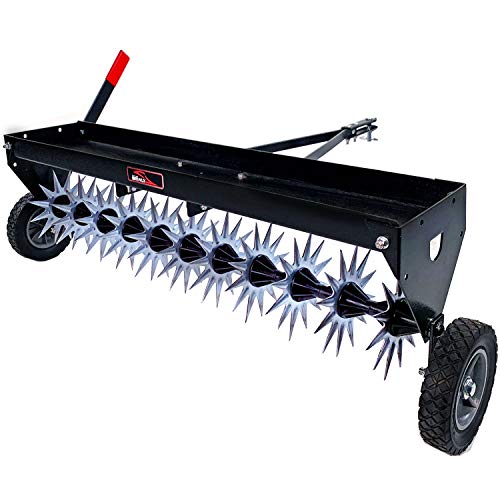
This is a push roller with five 8 inch tine wheels, each carrying 12 spike tips, so every revolution punches a staggered row of holes. The tines are a galvanized steel design the maker calls 3D, meant to double the strength of flat stock and shrug off rust. A weight tray sits over the axle so you can load bricks or sand bags when the soil resists, which is the difference between a spike that skates and one that sinks. As with any spike design it displaces soil sideways, so it suits light compaction and routine maintenance better than rock-hard clay. Brinly 20-inch push spike reads type push roller, spike, path 20 in, tines five 8 in wheels, 12 tips each and steel galvanized 3D tines on paper.

Spikes compress soil walls instead of removing plugs and narrow path means many passes on a big lawn are the main cautions. Owners who want a push unit from a brand that also makes tow-behind gear is the buyer it has in mind. Next to the Brinly SAT2 carbon (40 inches), its 20 inches means more passes to finish the same lawn.

On the Brinly 20-inch push spike aerator with weight tray, clean soil off the tine wheels of this Brinly with a hose and let them dry before you store it upright. For the Brinly 20-inch push spike aerator with weight tray, keep this Brinly off wet clay; mud builds in the spacing between tines and stops them from turning.

What works

  • Galvanized 3D tines resist rust between seasons
  • Weight tray lets you add ballast for hard soil
  • Five wheels of 12 tips each give a dense hole pattern
  • Push format needs no tractor or mower

Watch out for

  • Spikes compress soil walls instead of removing plugs
  • Narrow path means many passes on a big lawn

Spec sheet

Type
Push roller, spike
Path
20 in
Tines
Five 8 in wheels, 12 tips each
Steel
Galvanized 3D tines
Ballast
Weight tray
03
Brinly SAT2-40BH-P tow-behind spike aerator, 40 in carbon
40 in tow-behind11 tine wheelsTransport wheels
Check price on Amazon
Best for: Riding mower owners with lawns past a quarter acre who accept spikes over plugs.

The SAT2 pulls eleven 8 inch tine wheels, each with 12 spike tips, across a 40 inch swath behind a lawn tractor. It is a ground-driven machine: the wheels turn as you move, so there is no engine and the only wear points are the axle and the tines. Because it uses spikes, each pass leaves narrow holes with compacted walls instead of pulled cores. That is fine for loam and sandy ground, but heavy clay rewards the plug units covered below with deeper channels, and the weight tray matters more here than on any hand tool. Brinly SAT2-40BH-P tow-behind spike breaks down as type tow-behind spike, width 40 in, tines 11 wheels, 12 tips each and steel galvanized 3D tines.

Spike holes do not remove soil, so deep clay stays tight and needs a mower or tractor with a drawbar hitch are the price of admission. Riding mower owners with lawns past a quarter acre who accept spikes over plugs is the job it is aimed at. With the Brinly 40-inch plug also at 40 inches on working width, capacity does not separate the two and build quality has to.

On the Brinly SAT2-40BH-P tow-behind spike aerator, with a 40 in path, this Brinly is only as good as the tractor pulling it, so match drawbar pull before you buy rather than after. For the Brinly SAT2-40BH-P tow-behind spike aerator, turn wide at the end of each lane with this Brinly, because tight turns drag tines through finished turf.

What works

  • Eleven 8 inch tine wheels cover 40 inches per pass
  • Transport wheels make moving it to the lawn easier
  • Galvanized 3D tines are built for rust resistance
  • Weight tray accepts ballast for deeper penetration

Watch out for

  • Spike holes do not remove soil, so deep clay stays tight
  • Needs a mower or tractor with a drawbar hitch

Spec sheet

Type
Tow-behind spike
Width
40 in
Tines
11 wheels, 12 tips each
Steel
Galvanized 3D tines
Transport
Wheels included
04
Brinly 40-inch tow-behind plug aerator, universal hitch
40 in plug24 plug spoonsWeight tray
Check price on Amazon
Best for: Lawns up to about half an acre that need real core removal behind a mower.

Where spike units punch, this one scoops. Twenty-four 16 gauge, heat-treated steel spoons rotate on the drum and lift small plugs from the turf, leaving channels that air and water can enter without compacted walls. The enclosed weight tray is how you set the depth, because the spoons only dig as deep as the load pushes them. It sits in the middle of the Brinly plug family, narrower than the 48 inch unit and cheaper to tow behind a small tractor. Brinly 40-inch tow-behind plug comes to type tow-behind plug, width 40 in, spoons 24, heat-treated 16 gauge and tray enclosed weight tray, spec for spec.

Lawns up to about half an acre that need real core removal behind a mower is the buyer it has in mind. Needs ballast to bite hard soil and cores must be left to break down on the lawn are the main cautions. At 42 inches, the Brinly PA-42BH is the yardstick, and its 40 inches means more passes to finish the same lawn.

Given the Brinly 40-inch tow-behind plug aerator, run this Brinly in two directions across the lawn for compaction, but keep the second pass at a right angle to the first so passes overlap evenly. Around the Brinly 40-inch tow-behind plug aerator, turn wide at the end of each lane with this Brinly, because tight turns drag tines through finished turf.

What works

  • 24 heat-treated spoons pull actual soil plugs
  • All-steel frame with enclosed weight tray
  • Universal hitch fits common mowers
  • 40 inch path cuts the passes needed

Watch out for

  • Needs ballast to bite hard soil
  • Cores must be left to break down on the lawn

Spec sheet

Type
Tow-behind plug
Width
40 in
Spoons
24, heat-treated 16 gauge
Tray
Enclosed weight tray
Hitch
Universal
05
Brinly PA-42BH-A tow-behind plug aerator, folding tow bar
42 in plugFolding tow barWeight tray
Check price on Amazon
Best for: People with tight garage space who still want a plug design.

The PA-42BH uses 16 gauge heat-treated plugging spoons across a 42 inch path, with an enclosed tray above that you fill with weight to push the spoons deeper. The headline feature is a folding tow bar, which lets the frame stand compact in a corner of the shed. That makes it a smart match for owners who store implements vertically. The trade is another pivot to grease and an extra place where a pin can wear loose over a few seasons. Brinly PA-42BH-A tow-behind plug reads type tow-behind plug, width 42 in, spoons heat-treated 16 gauge steel and hitch folding easy-store tow bar on paper.

People with tight garage space who still want a plug design is the buyer it has in mind. Needs a tractor or ATV to pull it and folding hinge is one more joint to maintain are the main cautions. At 48 inches, the Brinly PA-482BH is the yardstick, and its 42 inches means more passes to finish the same lawn.

Owning the Brinly PA-42BH-A tow-behind plug aerator means this: with a 42 in path, this Brinly is only as good as the tractor pulling it, so match drawbar pull before you buy rather than after. Given the Brinly PA-42BH-A tow-behind plug aerator, turn wide at the end of each lane with this Brinly, because tight turns drag tines through finished turf.

What works

  • Folding tow bar shortens the stored footprint
  • Heat-treated plugging spoons remove cores
  • 42 inch path trims passes
  • Enclosed weight tray accepts ballast

Watch out for

  • Needs a tractor or ATV to pull it
  • Folding hinge is one more joint to maintain

Spec sheet

Type
Tow-behind plug
Width
42 in
Spoons
Heat-treated 16 gauge steel
Hitch
Folding easy-store tow bar
Tray
Enclosed weight tray

Spec sheet decoder

What the numbers on the box really mean

The specs manufacturers lead with, translated into what they tell you about real-world performance.

Penetration depth

Aeration depth is usually listed as a maximum; real depth depends on soil moisture and weight. Two to three inches is the practical target for most lawns.

Watch forTreat listed depth as a ceiling and use a ruler on the Brinly 20-inch push the first time.

Tine or spike count

More tines mean more holes per pass, but each tine also needs force. On a hand tool, more spikes can make the step harder; on a tow unit it raises the pull.

Watch forThe Brinly SAT2 carbon lists 132, the Brinly 40-inch plug lists 24.

Steel and finish

Galvanized, stainless, heat-treated or bare iron describes how long the tines resist rust and bending. Welds and bolt joints matter as much as the tine metal.

Watch forLook closely at the foot bar and joints on the Brinly SAT2 carbon.

Tine geometry

Hollow or spoon tines remove soil cores, while solid spikes and star wheels only punch holes. Core removal does more for compaction; spikes are quicker to use.

Watch forCompare the Brinly PA-482BH with the Brinly 20-inch push before assuming holes are equal.

Operating format

Step-on, push roller, tow-behind, three-point and gas-driven designs all sell as lawn aerators, but they suit different lawn sizes. Format decides effort, speed and storage.

Watch forThis lineup mixes tow plug, push spike and tow spike.

Methodology

How We Evaluated These Brinly Lawn Aerators

Leverage and effort

For hand and push tools we read the spec sheet for handle length, foot platform and weight. The Brinly 20-inch push and the Brinly SAT2 carbon differ in how much body weight each can use. We favored designs that let an owner stay upright.

Build and corrosion resistance

Steel type, finish and joints were read from each listing. The Brinly PA-482BH and the Brinly 40-inch plug were compared on galvanizing, stainless, heat treatment and joint design. Welded or reinforced foot bars scored higher than bolted thin tubes.

Value for the format

Value was judged within each format rather than across them, since a hand tool and a tractor attachment are different purchases. We used relative price tier among the retrieved listings. Longer service history on established names counted in their favor.

Storage and transport

We considered folded height, folding bars and transport wheels. The Brinly SAT2 carbon was judged against the rest for how easily it moves and stores. Heavy ground-driven frames lost points for awkward storage.

Clog resistance

Hollow tines clog and spikes pack with soil. We looked for side discharge, spring ejection and open frames on the Brinly 20-inch push and its rivals. Owner feedback patterns on clogging in wet clay also informed the scores.

Decision guide

How to Choose the Right Brinly Lawn Aerators

By Lawn Size and Format

SituationPickWhy
Larger lawns where fewer, wider passes matter mostBrinly PA-482BHWidest Brinly plug path at 48 inches.
Owners who want a push unit from a brand that also makes tow-behind gearBrinly 20-inch pushGalvanized 3D tines resist rust between seasons.
Riding mower owners with lawns past a quarter acre who accept spikes over plugsBrinly SAT2 carbonEleven 8 inch tine wheels cover 40 inches per pass.
Lawns up to about half an acre that need real core removal behind a mowerBrinly 40-inch plug24 heat-treated spoons pull actual soil plugs.
People with tight garage space who still want a plug designBrinly PA-42BHFolding tow bar shortens the stored footprint.

By Budget

Tiers are relative to the other picks in this guide, based on the listing price tier when we checked.

Price positionPickWhat you get
Lowest cost in this groupBrinly 20-inch pushWeight tray lets you add ballast for hard soil; spikes compress soil walls instead of removing plugs.
Lower middleBrinly SAT2 carbonTransport wheels make moving it to the lawn easier; spike holes do not remove soil, so deep clay stays tight.
Upper middleBrinly 40-inch plugAll-steel frame with enclosed weight tray; needs ballast to bite hard soil.
Higher in this groupBrinly PA-42BHHeat-treated plugging spoons remove cores; needs a tractor or ATV to pull it.
Highest in this groupBrinly PA-482BH32 heat-treated plugging spoons; heavier to maneuver and store.

Core vs Spike

Core and plug aerators

These remove soil plugs and leave open channels for air, water and roots, which is why they are the answer for compacted clay and heavily used lawns. The cost is more effort and a core mess on the surface that breaks down in a couple of weeks. In this guide: Brinly PA-482BH, Brinly 40-inch plug and Brinly PA-42BH.

Spike aerators

These punch holes without removing soil, which is faster and tidier but compacts the walls of each hole. They suit light compaction, sandy soil and routine upkeep rather than hardpan. In this guide: Brinly 20-inch push and Brinly SAT2 carbon.

Pick cores if water pools or a shovel struggles to sink; pick spikes if the lawn is loose and you want quick seasonal maintenance.

By Soil Type

ConditionPickWhy
Heavy clay, compacted or high-traffic soilBrinly PA-482BH48 in plug, 32 plug spoons.
Light compaction, loam or sandy soilBrinly 20-inch push20 in path, five tine wheels.
Light compaction, loam or sandy soilBrinly SAT2 carbon40 in tow-behind, 11 tine wheels.
Heavy clay, compacted or high-traffic soilBrinly 40-inch plug40 in plug, 24 plug spoons.
Heavy clay, compacted or high-traffic soilBrinly PA-42BH42 in plug, folding tow bar.

For Lawn Tractor Owners Specifically

Look for

Check that the hitch, weight tray and width match your mower, and decide between spikes for light soil and plugs for compacted clay.

In this comparison

The Brinly PA-482BH fits best because widest Brinly plug path at 48 inches. The Brinly SAT2 carbon is the alternative when riding mower owners with lawns past a quarter acre who accept spikes over plugs.

When to Spend More

Spend more if

You want what the Brinly PA-482BH offers: widest Brinly plug path at 48 inches and 32 heat-treated plugging spoons. That matters when you will use it every season or on a larger area.

Save if

The lawn is modest or the job is occasional. The Brinly 20-inch push gives you galvanized 3D tines resist rust between seasons, with the tradeoff that spikes compress soil walls instead of removing plugs.

Ownership

Maintenance schedule

The upkeep that decides whether this machine lasts two seasons or ten.

TaskIntervalWhy it matters
Check fasteners and jointsEach seasonVibration loosens bolts and thin foot bars bend on rocks. Tighten and look for hairline cracks at the welds.
Store dry and uprightOff seasonPark the aerator off the floor with tines clear of the ground. A dry corner prevents rust pitting.
Drain fill weightsBefore winterWater left in a drum or tray can freeze and split the shell. Drain, dry and store with the cap open.
Rinse and dry tinesAfter every sessionDried soil traps moisture against the steel and starts rust. A hose rinse and a rag dry-down takes two minutes.
Inspect tine conditionBefore each useBent or dull tines tear turf and make poor holes. Replace or straighten them as soon as you see damage.

FAQ

Frequently Asked Questions

When is the best time to aerate?

Aerate when the grass is actively growing and the soil is moist. Cool-season lawns do best in early fall, and warm-season lawns in late spring or early summer. Avoid frozen, saturated or drought-stressed ground, even with a capable machine like the Brinly PA-482BH.

Do aerator shoes work?

Aerator shoes push spikes in as you walk, but they are awkward, tend to compact soil, and cover little ground. A step tool or roller such as the Brinly 20-inch push gives you far better leverage. That is why shoes are not featured here.

How much weight should I add to a tow-behind or roller aerator?

Add ballast in steps until the tines reach about two to three inches, and stay within the stated capacity. If the tow vehicle loses traction or the unit stalls, you have gone too far. Hard dry soil needs less weight once it has been watered.

Should I aerate before overseeding?

Yes. Aerating first opens channels where seed can contact soil and settle, which improves germination. Make your passes with the Brinly PA-482BH, spread seed, then water lightly for a few weeks.

Should I leave the soil plugs on the lawn?

Yes. Cores break down in a couple of weeks and return nutrients to the soil, and raking them up undoes part of the benefit. Only rake away large clumps that smother the grass. This applies to any coring pick here, such as the Brinly PA-482BH.

How often should I aerate my lawn?

Most lawns benefit from one pass a year, and heavily used or clay lawns may want two. Light, sandy lawns can go every second year. A shovel test helps you decide whether the Brinly 20-inch push is worth bringing out.

Bottom line

The short version

Browse more brinly lawn aeratorson Amazon →
James Miller, Lead Machine Editor

About the author

James Miller

Lead Machine Editor, MachineFanatic

James Miller leads MachineFanatic's buying guides, turning spec sheets, manuals and owner feedback into clear verdicts on power tools, outdoor power equipment, shop machines and kitchen machines.

More from James →

Keep reading

Related guides