Amazon affiliate links - we earn a commission.Affiliate disclosure

Buying guide · 12 min read · Updated 2026-11-16

Best Camping Coffee Makers for Large Groups (2026)

Five camp coffee makers for big groups compared by capacity, heat source, materials and cleanup, from percolators to propane and plug-in urns.

James MillerBy James MillerLead Machine Editor5 machines comparedSpec-sheet verified
Best Camping Coffee Makers for Large Groups

At a glance

Our top picks

Side by side

Spec comparison

MachineCapacityMaterialHeat sourcePower
Coletti Scoutmaster 24-cup stainless camping percolatorBest OverallColetti Scoutmaster 24-cup stainless camping percolator24 cups18/8 stainless steelStove, grate or campfireNone needed
BLACK+DECKER 40-cup programmable coffee urn with spigotBest Plug-In UrnBLACK+DECKER 40-cup programmable coffee urn with spigot40 cupsn/an/aElectric, needs an outlet
Coleman 10-cup portable propane drip coffeemakerBest Propane BrewerColeman 10-cup portable propane drip coffeemaker10 cupsn/an/aNo electricity
GSI Outdoors Glacier stainless steel camping percolatorBest Viewing DomeGSI Outdoors Glacier stainless steel camping percolatorn/aGlacier stainless steelStovetop or campfireNone needed
Coletti Bozeman 9-cup stainless percolator, no aluminum or plasticBest for Mid-Size GroupsColetti Bozeman 9-cup stainless percolator, no aluminum or plastic9 cups, about 4 mugsStainless steelStove or fireNone needed

Feeding caffeine to a crowd at camp is a logistics problem before it is a taste problem. You need volume, a heat source you will actually have, and something that survives being tossed in a bin with the lanterns.

Percolators, propane brewers and electric urns each solve that problem differently. The right choice depends on whether you cook over fire, carry gas, or camp where a campsite outlet is guaranteed.

Before you buy

6 Criteria to Look For Before Buying a Camping Coffee Maker for Large Groups

  1. 01

    Capacity in real mugs

    Camp coffee makers count five-ounce cups, so a 24-cup Scoutmaster holds about 120 ounces, roughly twelve 10 oz mugs. The Bozeman's nine cups equals about four mugs, which the listing states directly. Divide your group size by the mug count to work out how many pots you will need. Most groups underestimate, because people refill, so plan for two mugs per person on a cold morning and add a pot if you also serve visitors from neighboring sites.

  2. 02

    Heat source and power

    Percolators like the Scoutmaster and GSI Glacier work on a stove or campfire and need no power. The Coleman propane brewer carries its own fuel, while the BLACK+DECKER 40-cup urn needs an outlet. Pick the machine that matches what your campsite actually provides.

  3. 03

    Brewing method and taste

    Percolators recirculate water through the grounds, which gives a bold cup but can turn bitter if boiled too long. A drip brewer like the Coleman passes water through once, giving a smoother result. Decide whether your crowd wants strong camp coffee or a gentler pot.

  4. 04

    Material and flavor safety

    Stainless steel without aluminum or plastic, as on the Scoutmaster and Bozeman, resists rust and does not leach flavor. Thin enamelware chips, and aluminum can pit over time. Thicker 18/8 stainless is heavier but holds up for years of campfire use.

  5. 05

    Fragile parts

    Glass domes and carafes, such as the GSI PercView lid and the Coleman carafe, are the first parts to break. Pack them in padding, and carry a spare if you are far from a store. Metal-only parts are safer for rough use.

  6. 06

    Cleanup in the field

    A percolator needs hot water and a brush to clear fine grounds from the basket. An urn needs spigot rinsing and a lot of water. Plan for water and a drying spot so nothing goes back into the bin damp. Camp sinks are often a bucket, so a pot with a wide mouth, like the percolators here, is far easier to scrub than a tall urn with a narrow tap assembly.

Detailed reviews

The 5 best camping coffee makers for large groups, explained

01
Coletti Scoutmaster 24-cup stainless camping percolator
24-cup18/8 stainlessNo aluminumStove or fire
Check price on Amazon
Best for: Scout troops, family reunions and groups of ten or more.

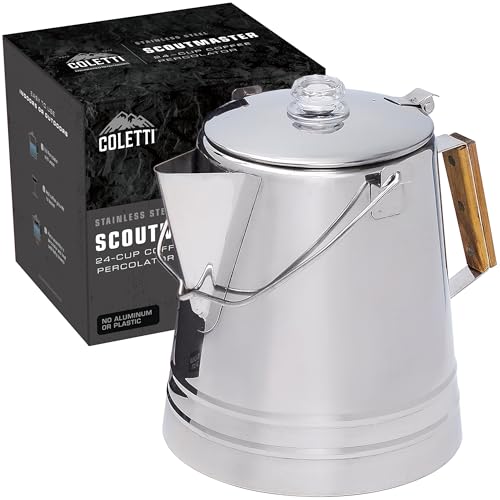
The Scoutmaster is the heavyweight of the percolator world. A 24-cup capacity, counted in five-ounce coffee cups, means roughly 120 ounces of water, which covers a big family or a scout troop. It is built from thick 18/8 stainless steel and avoids aluminum and plastic in the brew path, so flavors stay clean.

A percolator works by cycling hot water up a center tube and letting it drip back through the basket repeatedly. That recirculation gives a strong, bold cup, but it can over-extract if you let it boil too long, so you need to watch the time. Next to the GSI Glacier, it holds far more, and next to the Bozeman it is the version meant for a crowd rather than a handful of people.

Plan on carrying it by the handle with a heat-proof glove. Clean it with hot water and a soft brush after each trip, since oils lock into the basket. Dry it fully before packing so no stale smell forms.

What works

  • 24-cup capacity serves a large crowd
  • Thick stainless steel resists dents and rust
  • No power needed, works on stove or fire
  • Brew path is free of aluminum and plastic

Watch out for

  • Heavy and bulky to pack
  • Percolation can over-extract if left boiling
  • Needs a sturdy grate or large burner

Spec sheet

Capacity
24 cups
Material
18/8 stainless steel
Heat source
Stove, grate or campfire
Coating
No aluminum, no plastic
Power
None needed
02
BLACK+DECKER 40-cup programmable coffee urn with spigot
40-cupElectric urnProgrammableDrip-free spigot
Check price on Amazon
Best for: Powered campsites, retreats and group events.

This urn is the answer when the group is truly large and the site has electricity. It holds 40 cups, which is about 200 ounces, and brews at roughly one cup per minute, so a full batch takes well over half an hour. A ready light and a drip-free spigot let people fill their own mugs without opening the lid.

It is not a backcountry tool, because it needs an outlet and a stable table. Compared with the Scoutmaster, it brews cleaner coffee without percolator over-extraction, but only if you have power and plan the long cycle in advance. The programmable feature lets you start a batch before the group wakes, which is useful at a retreat.

Expect to rinse the urn and spigot after each use, since milk and sugar residue clog the tap. Descale the heater if you use hard campground water. Check the outlet capacity before plugging it in, because large urns draw substantial current, and avoid sharing the circuit with a space heater or a hot plate.

What works

  • 40-cup capacity for very large groups
  • Drip-free spigot for self-serve pouring
  • Programmable start fits morning schedules
  • Ready light shows when coffee is finished

Watch out for

  • Needs a reliable electric outlet
  • Long brew cycle for a full batch
  • Bulky to carry and store

Spec sheet

Capacity
40 cups
Brew speed
About 1 cup per minute
Power
Electric, needs an outlet
Dispensing
Drip-free spigot, ready light
Use
Events, offices, powered campsites
03
Coleman 10-cup portable propane drip coffeemaker
10-cupPropaneDrip stylePortable
Check price on Amazon
Best for: Campers who prefer drip-style coffee without electricity.

Coleman's propane coffeemaker brings a real drip brew to a campsite without plugging in. It holds 10 cups, so it handles a medium group rather than a crowd, and runs on a propane fuel source you already carry for the stove. The listing family quotes roughly 18 minutes for a pot, which is slower than a plug-in but acceptable at camp.

The benefit is cleaner, smoother coffee than a percolator because the water passes through the grounds once instead of recirculating. The drawback is that it needs fuel and a flame-safe setup, so it is not for tents or enclosed spaces. Beside the Scoutmaster, it brews a gentler cup but at less than half the volume.

Keep the burner clear of spills, and store the glass carafe in padding so it does not crack in transit. Check hoses and fittings before each trip. Rinse the basket and carafe after use to avoid stale oils.

What works

  • Brews drip-style coffee without a power outlet
  • Runs on common propane fuel
  • Smoother cup than a percolator
  • Useful at tailgates and during outages

Watch out for

  • Only 10 cups for a large group
  • Glass carafe can break in transit
  • Requires safe use outdoors only

Spec sheet

Capacity
10 cups
Fuel
Propane
Style
Drip with glass carafe
Power
No electricity
Use
Camp, tailgate, power outage
04
GSI Outdoors Glacier stainless steel camping percolator
StainlessPercView domeStove or fireUltra-rugged
Check price on Amazon
Best for: Campers who want to watch the percolation and avoid bitter pots.

The GSI Glacier percolator is notable for its PercView glass dome in the lid, which lets you watch the coffee bubble. That visual cue is more useful than it sounds, because percolation timing is what separates a good pot from a bitter one. Glacier stainless steel resists corrosion, and the body is described as ultra-rugged for use over a stove or fire.

The handle is designed to be comfortable when you pour, and a standard percolator basket and stem sit inside. Because capacity varies by size, check the specific listing before counting on it for a crowd. Compared with the Scoutmaster, it trades some volume for a lighter feel and a helpful dome.

The glass dome is the weak point. Keep it away from sharp impacts and never drop it onto a hot surface. Rinse the basket promptly after use, and wipe the exterior before the next trip to avoid smoke stains.

What works

  • Glass dome shows percolation timing
  • Corrosion-resistant stainless steel body
  • Works over a stove or campfire
  • Handle is comfortable for pouring

Watch out for

  • Glass dome can chip if dropped
  • Capacity varies by size
  • Percolation still over-extracts if forgotten

Spec sheet

Material
Glacier stainless steel
Viewing
PercView glass dome
Heat source
Stovetop or campfire
Handle
Ergonomic design
Power
None needed
05
Coletti Bozeman 9-cup stainless percolator, no aluminum or plastic
9-cupStainlessNo plasticNo electricity
Check price on Amazon
Best for: Small and mid-size camps, or a backup pot beside a big percolator.

The Bozeman is the smaller sibling of the Scoutmaster. The listing is clear that nine cups equals about four mugs, because a cup here is five ounces, which makes it a fit for a group of three to five rather than a crowd. It is built of stainless steel without aluminum or plastic, so there is nothing to leach flavor.

Its size is its virtue: it fits on a small camp stove and cools faster after use, so it is more manageable than the 24-cup. For a large group, you would need several Bozemans or a single Scoutmaster. This works as a good second pot when the main one is empty.

Carry it inside a cook pot to save space. Clean the basket and stem after every pot, since fine grounds lodge in the perforations. Dry it with the lid off to prevent a damp, metallic smell.

What works

  • Compact enough for a small stove
  • Stainless build with no aluminum or plastic
  • Nine cups serves about four mugs
  • Easy to pack in a cook set

Watch out for

  • Too small for a crowd on its own
  • Percolation can over-extract
  • Needs constant timing attention at the stove

Spec sheet

Capacity
9 cups, about 4 mugs
Material
Stainless steel
Coating
No aluminum or plastic
Heat source
Stove or fire
Power
None needed

Spec sheet decoder

What the numbers on the box really mean

The specs manufacturers lead with, translated into what they tell you about real-world performance.

24 cups

A cup in coffee maker terms is five ounces, so 24 cups is about 120 ounces. It translates to roughly twelve 10 oz mugs.

Watch forThe Scoutmaster states 24 cups, while the Bozeman states nine cups equals about four mugs.

18/8 stainless

A steel grade with chromium and nickel that resists corrosion. It is common in food-grade cookware.

Watch forThe Scoutmaster uses it, and thick walls matter more than the label.

PercView dome

A glass lid insert that shows the coffee as it percolates. It helps you time the brew.

Watch forThe GSI Glacier has it, but glass can crack if dropped.

Brew speed per cup

How many minutes it takes to heat and brew each cup. Urns state this as a rate.

Watch forThe BLACK+DECKER urn brews about one cup per minute, so 40 cups takes a long time.

Propane fuel

A fuel source that powers a burner without an outlet. It requires safe outdoor use.

Watch forThe Coleman needs a flame-safe area and never belongs in a tent.

Methodology

How We Evaluated These Camping Coffee Makers for Large Groups

Capacity honesty

We converted cup counts into real mug volumes. The Scoutmaster's 24 cups and the urn's 40 cups were treated as large-group options, while the Bozeman's nine cups was treated as a small-group pot. This keeps buyers from underestimating how many mugs they need.

Heat source fit

We matched each machine to the fuel or power it needs. The percolators need only a fire or stove, the Coleman needs propane, and the urn needs an outlet. Machines that fit more campsites scored higher.

Materials

We favored stainless steel without aluminum or plastic in the brew path. The Scoutmaster and Bozeman stood out on this point. Glass components were noted as a fragility risk. We also read the listings for how each pot handles direct flame, since a base that warps on a grate shortens the life of any camp pot.

Brew quality risk

We considered percolation over-extraction versus single-pass drip. The Coleman is gentler on the grounds, while the percolators reward careful timing. The GSI dome helps users judge time.

Field cleanup

We looked at how easily each machine can be rinsed and dried at camp. Simple metal pots won out over urns with spigots. Water needs were weighed for each.

Decision guide

How to Choose the Right Camping Coffee Makers for Large Groups

By Group Size

SituationPickWhy
Three to five campersColetti Bozeman 9-cupAbout four mugs per pot
Ten to fifteen campersColetti Scoutmaster 24-cupRoughly twelve 10 oz mugs per pot
Forty-person event with powerBLACK+DECKER 40-cup urnSelf-serve spigot and a long batch
Medium group wanting dripColeman propane 10-cupSingle-pass drip brewing
Campers who want to time the perkGSI Glacier percolatorPercView dome

By Budget

Budget tierPickWhy
Lowest spendColetti BozemanSmall stainless pot
Low-mid spendGSI GlacierDome and rugged build
Mid spendColetti ScoutmasterLarge capacity in stainless
Higher spendBLACK+DECKER 40-cup urnLargest capacity and spigot

Percolator vs Drip

Percolator

The Scoutmaster, Bozeman and GSI Glacier recirculate water, which gives bold coffee and needs no power. You must watch the time or the pot turns bitter.

Drip

The Coleman and the urn pass water through once. The cup is smoother but you need propane or an outlet.

Pick a percolator if you cook over fire; pick drip if you want a gentle cup and have fuel or power. Mixed groups often do best with one of each, a percolator for the strong-coffee crowd and a drip brewer for people who find percolated coffee harsh.

Heat Source Axis

PreferencePickWhy
Campfire or stoveColetti ScoutmasterNo power needed
Propane at campColeman 10-cupMatchless fuel setup
Outlet at the siteBLACK+DECKER 40-cup urnPlug-in convenience

For Large Gatherings Specifically

Look for

Look for 100 or more ounces of capacity, a sturdy base, a spigot or easy pour, and a heat source you can count on. Plan the timing so the last pot finishes as people wake. A practical routine is to start the first pot before the group stirs, keep the second pot ready to go on the stove, and give early risers a self-serve mug station so one person is not stuck pouring for everyone. Cold mornings stretch heat-up times, so allow extra minutes whenever the air is near freezing or the wind is up.

In this comparison

The Scoutmaster handles groups at fire sites, and the 40-cup urn handles them at powered sites. The Bozeman is the useful second pot.

When to Spend More

Spend more if

Spend more if you run big trips regularly and want the Scoutmaster's thick stainless or the urn's capacity. Heavy-gauge steel survives years of fire contact and bin travel, and an urn saves a volunteer from standing at the stove for an hour.

Save if

Save if your group is small. A Bozeman or GSI Glacier handles most weekend trips, and the money you keep is better spent on good beans, a sturdy grate and a spare basket than on capacity you will rarely fill.

Ownership

Maintenance schedule

The upkeep that decides whether this machine lasts two seasons or ten.

TaskIntervalWhy it matters
Brush the percolator basketAfter every potCoffee silt packs into the perforations and sours. A bottle brush under hot water clears them quickly.
Dry the pot fullyBefore packingA damp percolator in a bin grows a metallic smell. Air it with the lid off for a few hours.
Inspect glass dome or carafeBefore each tripHairline cracks in glass grow in the cold, and a cracked dome or carafe can shatter when it meets sudden heat. Replace a damaged piece before it fails over a flame, and keep a spare lid or pot in the gear bin for long trips.
Check propane hose and fittingsBefore each useLeaks are a safety hazard. Spray soapy water on fittings and look for bubbles.
Descale the urn heaterEvery few uses in hard waterScale slows large heaters and raises power draw. A vinegar pass keeps the cycle near one cup per minute.

FAQ

Frequently Asked Questions

How much coffee do I need for a big group?

Plan for about two mugs per person, with each mug at roughly 10 ounces. A 24-cup percolator yields about twelve such mugs, so a group of twelve usually needs two pots.

Is a percolator or an urn better for camping?

A percolator wins if you have no power because it only needs a flame. An urn is better at a powered site with a huge crowd. Choose based on power, not preference.

Why does my percolator coffee taste bitter?

Percolators recirculate water, so a pot boiled too long over-extracts. Watch the dome or the sound, and pull the pot off the heat a few minutes after the first perks.

Can I use a propane brewer in a tent?

No. Propane brewers are for open, ventilated areas only, because open flames and carbon monoxide are real hazards. Use it outside, away from tent walls, dry brush and low branches. Set it on level ground, keep children and pets clear of the flame, and shut off the fuel at the source before you move the unit.

How long do camping percolators last?

Thick stainless models can last for decades if you dry them after use. Glass domes and silicone gaskets are the parts that fail first.

What grind should I use?

Coarse grounds, because a fine grind slips through the basket and over-extracts. Use roughly one to two tablespoons per five ounce cup and adjust to taste. Pre-measure each pot into a zip bag at home so you are not scooping in the dark, and bring a few extra paper filters if the basket has fine holes that let silt through.

Bottom line

The short version

Browse more camping coffee makers for large groupson Amazon →
James Miller, Lead Machine Editor

About the author

James Miller

Lead Machine Editor, MachineFanatic

James Miller leads MachineFanatic's buying guides, turning spec sheets, manuals and owner feedback into clear verdicts on power tools, outdoor power equipment, shop machines and kitchen machines.

More from James →

Keep reading

Related guides