
Amazon affiliate links - we earn a commission.Affiliate disclosure

Buying guide · 13 min read · Updated 2026-11-18

Best Citrus Juicers (2026)

Seven citrus juicers compared: motorized presses, pulp-control reamers and heavy manual levers, with notes on yield, cone size, noise and cleanup for each.

James MillerBy James MillerLead Machine Editor7 machines comparedSpec-sheet verified
Best Citrus Juicers

At a glance

Our top picks

Citrus juicers fall into three families, and the family matters more than the brand. Electric reamers spin a ribbed cone as you press a half fruit onto it. Motorized presses squeeze the half with a lever or an arm that does the work for you. Manual presses and squeezers use a lever or hinged bowl and your own strength.

The best choice depends on volume, fruit size and how much you care about cleanup. A breakfast habit of several oranges wants a motor, while a squeeze of lime for a drink wants a small hand tool. This guide compares seven machines using the listing specs and general juicing knowledge, with attention to cone size, pulp control, power assist and how easy each is to wash.

Before you buy

6 Criteria to Look For Before Buying a Citrus Juicer

  1. 01

    Electric reamer, press or manual

    Electric reamers like the Cuisinart and CJ625 spin a cone as you press fruit down. Motorized presses like the Breville 800CPXL and BCP600 and the Vinci do the squeeze for you. Manual presses like the Zulay and Chef'n use your strength with a lever. If you juice more than a few fruits at a time, choose a motor. If you juice a lemon now and then, choose a manual tool. A useful measure is how many halves you squeeze per session: under four, manual is fine, and over eight, a motor saves real time.

  2. 02

    Cone size and fruit range

    A small cone fails on grapefruit and large navel oranges, while a very large cone fits limes poorly. The Breville BCP600 and the Vinci list a one-size cone from small limes to large grapefruit. Match the cone to the fruit you juice most, and check reviews of fit for the fruit you actually buy. Very small limes are the hardest fruit for a large cone, so test with your usual fruit when you first use it.

  3. 03

    Pulp and seed control

    The Cuisinart offers three pulp settings and the CJ625 an adjustable control with a pulp basket. Pulp control matters for cocktails and smooth juice, while pulpy juice suits breakfast. Presses like the Zulay hold seeds back from the glass, whereas reamers can let seeds through unless strained. If you strain juice for cocktails, a fine mesh sieve over a jug solves almost any pulp problem on any machine.

  4. 04

    Power assist and effort

    The Breville presses use an assisted arm so you need little hand strength, and the Vinci presses automatically. The Zulay uses a long lever for mechanical advantage, and the Chef'n uses dual gears. If you have weak hands or juice often, power assist is worth the premium. Chilled fruit gives less juice than room-temperature fruit, so leave citrus on the counter before juicing.

  5. 05

    Material and corrosion

    Citrus juice is acidic, and it attacks uncoated aluminum and can stain nylon over time. Stainless steel, as on the Breville 800CPXL, resists it. Cast iron on the Zulay needs rinsing and drying. Plastic reamers can crack, so favor models with durable cones. Never leave acidic juice sitting in a metal or nylon part for hours.

  6. 06

    Cleanup

    Dried pulp is far harder to remove than fresh, so rinse parts right after juicing. The CJ625 has dishwasher-safe parts and the Cuisinart has removable pieces. Enclosed machines like the Vinci need extra attention to seals. A juicer that is easy to clean is the one you will use. A small brush clears pulp from cone grooves in seconds.

Detailed reviews

The 7 best citrus juicers, explained

01
Breville 800CPXL Citrus Press Pro Orange Juicer
Power armQuadra-Fin coneStainlessAll citrus
Check price on Amazon
Best for: Daily juicers who want a power-assisted press with high yield.

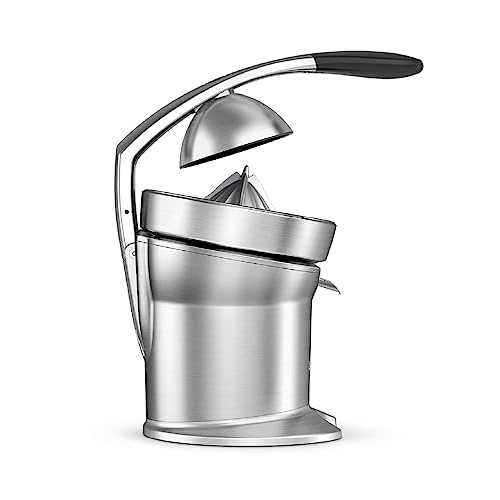
The 800CPXL is the juicer for people who actually drink fresh juice every day. An active-arm press with a power-assisted lever does the pressing, so you guide the arm rather than muscle it, and the triple hinged arm is designed to create downward pressure with little effort. A finned, undulated Quadra-Fin cone is designed to extract maximum juice from citrus.

The tradeoff is price and counter space. It is the most expensive juicer in the lineup, and a large brushed stainless unit is a permanent resident on a counter. It also has a single-size cone, so very small limes can be fiddly. Compared with the BCP600 it is a more traditional press arm design, and compared with the Cuisinart it offers no pulp control selector.

Ownership centers on rinsing parts promptly and wiping the stainless base, never immersing the motor. Pulp and seeds collect in a basket that needs emptying. For a household that juices a dozen oranges on a weekend, it is the machine that makes the habit effortless. The base also doubles as a stable platform so the machine does not walk across the counter.

What works

  • Power-assisted lever makes pressing effortless
  • Quadra-Fin cone extracts well from citrus
  • Triple hinged arm adds downward pressure
  • Brushed stainless build

Watch out for

  • Costs the most in the lineup
  • Large permanent counter footprint
  • Single cone size is fiddly for tiny limes

Spec sheet

Type
Active-arm power-assisted press
Cone
Quadra-Fin finned and undulated
Arm
Triple hinged
Body
Brushed stainless steel
Fruit
Oranges, lemons, limes, grapefruit
02
Breville BCP600 Citrus Press Motorized Orange Juicer
MotorizedOne-size coneAssisted armOne-handed
Check price on Amazon
Best for: Mixed-fruit juicers who want one cone for limes and grapefruit.

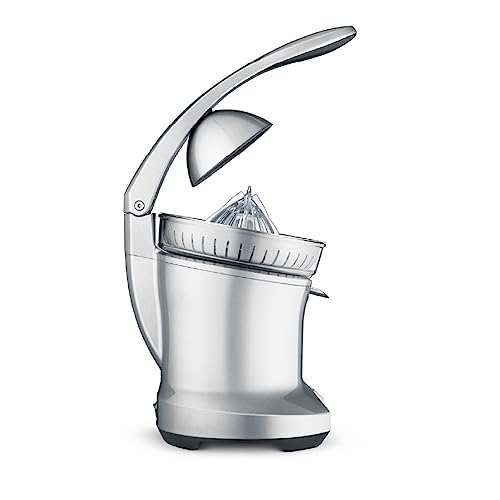
The BCP600 is the motorized relative of the 800CPXL. The listing says its one-size-fits-all finned cone and fruit dome grip and extract juice from the smallest lime to the largest grapefruit, and that its assisted arm needs only one free hand. That makes it easy to juice a bowl of mixed citrus without changing a cone.

Build quality is plastic-heavy next to the stainless 800CPXL, and the assisted arm needs a steady hand to position fruit. Compared with the 800CPXL it is simpler in operation but less premium, and compared with the Vinci it is more manual in the pressing step.

Rinse the cone and juice jug right after use, since dried pulp is hard to remove. Empty the pulp basket regularly. It suits households that juice mixed fruit and want one cone for everything.

What works

  • One cone handles limes to large grapefruit
  • Assisted arm needs only one hand
  • Finned cone and dome grip fruit
  • Easy to use

Watch out for

  • Less premium build than the 800CPXL
  • Counter appliance with a big footprint
  • Needs prompt rinsing

Spec sheet

Type
Motorized press with assisted arm
Cone
One-size-fits-all finned cone and dome
Operation
Effortless, one-handed
Range
Smallest lime to largest grapefruit
Arm
Powerful assisted arm
03
Cuisinart Pulp Control Citrus Juicer with 3 Pulp Settings
3 pulp levelsFinal spinReamerAuto reverse
Check price on Amazon
Best for: People who want adjustable pulp for breakfast and cocktails.

The Cuisinart is the juicer for people who care how much pulp ends up in the glass. An adjustable reamer offers three pulp control settings, low, medium and high, and a final-spin feature extracts more juice from the pulp at the end of a squeeze. That combination lets you serve smooth juice for cocktails or pulpy juice for breakfast from the same machine.

A reamer juicer is less effortless than a power-assisted press, since you still lean the fruit onto the cone. The cone also needs to match fruit size, and large grapefruit are a stretch. Compared with the Breville presses it asks more of your hands, but it is a much simpler machine with fewer parts.

Wash the cone, strainer and juice spout after each use. The removable parts make cleanup quick if you do it promptly. Anyone who wants control over pulp at a moderate price will find it a fair match. The strainer can be set low for lemonade and high for pulpy orange juice.

What works

  • Three pulp control settings
  • Final-spin feature extracts more juice
  • Simple reamer design
  • Removable parts for cleanup

Watch out for

  • Needs hand pressure from the user
  • Large grapefruit are a stretch
  • Pulp control adds a part to clean

Spec sheet

Type
Electric reamer juicer
Pulp control
3 settings: low, medium, high
Feature
Final-spin extracts more juice
Reamer
Adjustable
Fruit
Oranges, lemons, limes
04
BLACK+DECKER CJ625 32 Ounce Electric Citrus Juicer
32 ozPressure activatedPulp basketDishwasher safe
Check price on Amazon
Best for: Cooks who want a simple, low-cost electric reamer with measurement marks.

The CJ625 is the straightforward electric juicer. Pressure-activated operation means it spins when you press fruit onto the cone and stops when you lift. Auto-reversing cones help extract more juice, and the adjustable pulp control collects pulp in a removable basket. A 32 ounce container with clear measurement markings makes juicing for recipes easy.

The tradeoff is power and finish. It is a lighter-duty reamer, so large batches are slower than with a power-assisted press, and the plastic body is less durable than stainless. Compared with the Cuisinart it has similar controls and a dishwasher-safe set, and compared with the Breville presses it is far cheaper.

Rinse the cone and basket right away or run them through the dishwasher. The measurement markings are a real convenience when a recipe asks for a specific amount of lime or lemon juice. Choose it for a no-nonsense electric reamer at a low outlay. The 32 ounce jug also works for storing a batch of juice in the fridge.

What works

  • Pressure-activated start and stop
  • Auto-reversing cones
  • Dishwasher-safe parts
  • Clear measurement markings on the container

Watch out for

  • Lighter-duty than a press
  • Plastic body is less durable
  • Large batches are slower

Spec sheet

Type
Pressure-activated electric reamer
Capacity
32 ounce juice container
Cone
Auto-reversing
Pulp
Adjustable control with removable basket
Cleanup
Dishwasher-safe parts
05
Vinci Hands-Free Electric Citrus Press Machine
Hands freeEnclosedAuto pressLimes to grapefruit
Check price on Amazon
Best for: People who want hands-free, splash-free juicing from limes to grapefruit.

The Vinci is the closest thing to a fire-and-forget juicer. You cut the citrus in half, place it on the reamer, close the lid and press the Auto button, and the machine presses without you holding anything. The listing says patented automatic technology adjusts pressure based on the thickness of the fruit, and that the enclosed design is splash free.

Because it is a closed system you cannot watch the juice, and it works through one half at a time. Basic reamers cost less. Compared with the Breville 800CPXL it needs no hand on the arm, but it is a different mechanism with fewer manual cues. Compared with the CJ625 it is far more automatic.

Wipe the lid seals and rinse the cone promptly, since sticky juice builds up in the enclosed chamber. It suits people with limited hand strength or a love of clean counters.

What works

  • Fully enclosed, splash-free design
  • Automatic pressure adjusts to fruit
  • No hand pressure needed
  • Handles key limes to grapefruit

Watch out for

  • Processes one half at a time
  • Closed chamber needs careful cleaning
  • Costs more than basic reamers

Spec sheet

Type
Automatic enclosed press
Operation
Place fruit, close lid, press Auto
Pressure
Adjusts to fruit thickness
Range
Key limes to large grapefruit
Splash
Fully enclosed
06
Zulay Kitchen Cast Iron Citrus Press Juicer
Cast ironLever armKeeps seeds outHeavy duty
Check price on Amazon
Best for: Heavy manual juicing without a motor, such as for a bar or large household.

The Zulay is a manual press built from heavy cast iron. A long cast iron lever gives serious mechanical advantage, so you press down and the juice comes out with little hand strength, and the design holds seeds back from the glass. For a bar or a household that squeezes a lot of limes and oranges without electricity, it is a durable tool.

The tradeoff is weight and care. It is a heavy item to store, and cast iron needs rinsing and drying to avoid rust, and acid can damage uncoated metal. It is slower than an electric press for large batches. Compared with the Chef'n it is much larger and more robust, and compared with the electrics it needs no outlet.

Rinse right after use and dry thoroughly. If the finish is coated, avoid abrasive scrubbers. A long-lasting manual tool is the draw here, provided the weight does not bother you. Because it holds seeds back, it is also popular with people who juice limes for drinks.

What works

  • Cast iron lever gives mechanical advantage
  • Keeps seeds out of the glass
  • Built for continuous use
  • No electricity needed

Watch out for

  • Heavy to store
  • Needs drying to prevent rust
  • Slower for large batches

Spec sheet

Type
Manual lever press
Body
Heavy-duty cast iron
Lever
Cast iron lever arm
Seeds
Held out of the glass
Use
Continuous, high-volume juicing
07
Chef'n FreshForce Manual Lemon Squeezer
HandheldDual gearNylon and steelNon-slip handles
Check price on Amazon
Best for: Cooks who squeeze a lemon or lime at a time.

The FreshForce is the small hand tool for a lemon or lime. A dual-gear mechanism multiplies the force of your grip, and the listing says the nylon and stainless steel build is durable with non-slip handles that reduce pressure on your hands. It fits in a drawer and is easy to wash.

The tradeoff is scope. A handheld press suits lemons and limes and struggles with oranges and grapefruit, and it processes a half at a time. Compared with the Zulay press it is far smaller and less powerful, and compared with the electrics it is slower for big jobs but much cheaper and quieter.

Rinse after use and avoid leaving it in acidic juice, which can stain nylon. Squeezing a lemon or lime for a recipe or a drink is where it earns its place. A small drawer-friendly tool is also easy to pack for a picnic.

What works

  • Dual-gear mechanism multiplies grip force
  • Nylon and stainless steel build
  • Non-slip handles reduce hand strain
  • Small and easy to store

Watch out for

  • Only suited to small citrus
  • Slower for large jobs
  • Nylon can stain over time

Spec sheet

Type
Handheld hinged press
Mechanism
Dual-gear power
Build
Nylon and stainless steel
Handles
Non-slip ergonomic
Fruit
Lemons and limes

Spec sheet decoder

What the numbers on the box really mean

The specs manufacturers lead with, translated into what they tell you about real-world performance.

Pulp control

An adjustable strainer that sets how much pulp reaches the glass. Higher pulp settings suit orange juice for breakfast.

Watch forThe Cuisinart lists three settings and the CJ625 an adjustable control.

Pressure-activated

The cone spins when you press fruit onto it and stops when you lift. It prevents the cone from spinning empty.

Watch forThe CJ625 uses it.

Active-arm or assisted arm

A motorized lever that applies pressing force for you. It matters most for large fruit that needs steady force.

Watch forThe Breville 800CPXL and BCP600 list it.

Quadra-Fin cone

A cone with fins and undulations designed to grip fruit and release more juice. It is a design feature, not a different motor.

Watch forThe Breville 800CPXL lists it.

Dual-gear mechanism

Gears that multiply grip force in a handheld press. It helps people with weaker hands.

Watch forThe Chef'n lists it.

Methodology

How We Evaluated These Citrus Juicers

Yield design

We compared cones, reamers and presses for how they are designed to extract juice, such as the Breville Quadra-Fin cone. We also noted that no listing guarantees a yield figure, so design is the best guide.

Effort required

We weighed power assist, automatic pressing and lever design against hand effort. A machine that presses for you scored best for effort.

Pulp and seed control

We credited adjustable pulp control and seed retention. A seed filter counts as a plus for cocktails.

Build and acidity

We favored stainless and coated materials that resist citrus acid. Plastic cones scored lower for longevity.

Cleanup

We looked at dishwasher-safe parts, removable baskets and enclosed chambers. Dried pulp is the main reason juicers go unused.

Decision guide

How to Choose the Right Citrus Juicers

By How Much You Juice

SituationPickWhy
Daily, several orangesBreville 800CPXL Citrus Press ProPower-assisted press
Mixed fruit sizesBreville BCP600 Citrus PressOne-size cone
Weekend batchesBLACK+DECKER CJ625Electric reamer
A lemon or lime now and thenChef'n FreshForce SqueezerHandheld

By Budget

TierPickWhy
Lowest outlayChef'n FreshForce SqueezerHandheld
Low outlayBLACK+DECKER CJ625Simple electric
Mid rangeCuisinart Pulp ControlAdjustable pulp
Highest outlayBreville 800CPXL Citrus Press ProPower-assisted and stainless

Electric vs Manual

Electric (Breville, Cuisinart, CJ625, Vinci)

Fast for many fruits and easy on hands, but they cost more, need an outlet and take counter space.

Manual (Zulay, Chef'n)

Cheap or durable, quiet and outlet-free, but they need hand strength and are slower for big batches.

Choose electric if you juice often and manual if you juice occasionally. Many cooks keep one of each.

By Pulp Preference

PreferencePickWhy
Adjustable pulpCuisinart Pulp ControlThree settings
Basket for pulpBLACK+DECKER CJ625Removable pulp basket
Seed-free glassZulay Cast Iron PressSeeds held back
Hands-freeVinci Hands-Free PressEnclosed and automatic

For Mixed Citrus Specifically

Look for

A cone that fits limes and large grapefruit, a strong press and easy cleanup. Roll fruit first to break membranes.

In this comparison

The Breville BCP600 and the Vinci list a one-size cone for limes to grapefruit.

When to Spend More

Spend more if

You juice daily or have limited hand strength. The Breville 800CPXL or the Vinci is worth the step up.

Save if

You juice occasionally. The CJ625 or a handheld press does the job. A handheld press is a cheap second tool.

Ownership

Maintenance schedule

The upkeep that decides whether this machine lasts two seasons or ten.

TaskIntervalWhy it matters
Rinse the cone and strainerRight after every useDried pulp is hard to remove and breeds odor. A soft brush clears the grooves.
Empty the pulp basketAfter each batchA full basket blocks juice flow.
Wipe the baseAfter each useSticky juice attracts dust and insects. Never immerse the motor base. A damp cloth is enough.
Dry cast iron pressesAfter each useAcid and moisture cause rust on uncoated iron.
Check seals on enclosed modelsMonthlySticky buildup can stop a lid from sealing.

FAQ

Frequently Asked Questions

Which citrus juicer is best for oranges?

A power-assisted press like the Breville 800CPXL or a one-size cone like the BCP600 handles oranges well. Manual handhelds struggle with oranges. For single oranges, a basic reamer also works.

Do I need a motorized juicer?

If you juice several fruits regularly, yes. For a lemon or lime now and then, a manual press is enough.

How do I get more juice?

Roll the fruit on the counter, use room-temperature fruit and press firmly. A few seconds in the microwave also helps. Fresh fruit also juices better than old fruit.

How do I keep seeds out?

A press holds seeds in the cup, and reamers need a strainer. The Zulay press is built to keep seeds out of the glass.

Are the parts dishwasher safe?

The CJ625 lists dishwasher-safe parts. Check the manual for the others, and never put motor bases in water. Always unplug before cleaning.

How long does fresh juice last?

Fresh citrus juice is best within a day and should be kept cold. It loses brightness as it oxidizes.

Bottom line

The short version

Browse more citrus juicerson Amazon →
James Miller, Lead Machine Editor

About the author

James Miller

Lead Machine Editor, MachineFanatic

James Miller leads MachineFanatic's buying guides, turning spec sheets, manuals and owner feedback into clear verdicts on power tools, outdoor power equipment, shop machines and kitchen machines.

More from James →

Keep reading

Related guides