

Amazon affiliate links - we earn a commission.Affiliate disclosure

Buying guide · 13 min read · Updated 2026-11-25

Best Coffee Grinders Under $100 (2026)

Five coffee grinders that list for under $100, led by 40 mm conical burr machines, with notes on gear-reduction motors, settings, retention and value.

James MillerBy James MillerLead Machine Editor5 machines comparedSpec-sheet verified
Best Coffee Grinders Under $100

At a glance

Our top picks

Side by side

Spec comparison

The jump into this price band brings larger burrs, slower motors and finer adjustment. Bigger burrs cut beans faster at lower speed, and slower motors run cooler and quieter, which protects flavor and makes the machine pleasant to use early in the morning.

What the budget does not buy is true espresso capability or very low retention. We ranked the grinders by burr size, adjustment range, motor design and how easy each is to live with every day. Prices move, and the $100 cap reflects listing prices when this guide was updated.

Before you buy

6 Criteria to Look For Before Buying a Coffee Grinder Under $100

  1. 01

    Burr size

    A 40 millimeter conical burr, as on the OXO and Ollygrin, has more cutting surface than the small burrs in cheaper grinders. That lets it grind quickly at a lower speed, so beans run cooler and the machine is quieter. Burr size is not everything, since alignment and quality matter, but at this price a bigger burr is a reliable sign of a better build. If you grind daily, it is worth stepping up to a 40 millimeter size. If you grind occasionally, a smaller burr is fine. Burr size also affects how long you wait: a large burr clears a double dose in seconds, while a small one takes noticeably longer. Over a year of daily mornings that difference is small, but it shows in how the machine feels to use.

  2. 02

    Motor speed and heat

    The Ollygrin's gear reduction motor turns the burrs slowly, which the listing says cuts noise and heat. A slow grinder keeps aromatic compounds in the bean, which matters for light roasts. A fast direct-drive motor grinds quickly but warms the beans and throws more static. If quiet mornings matter, choose a slow motor and accept a few extra seconds. Slow grinding also leaves less fine dust clinging to the burr chamber, so you waste fewer grams of coffee. If you share a wall with a sleeper, the quieter motor can decide the purchase more than any other spec.

  3. 03

    Settings and micro-adjustment

    The OXO offers 15 steps with 43 micro-adjustments, and the CEVING hand mill offers 40 external steps. More steps help only if they sit where you need them. For espresso, you want very fine steps near the fine end, which none of these machines are built for. For pour-over and drip, a dozen well-spaced steps are enough. A micro-adjustment layer is a luxury at this price, but it is the feature that lets you correct a recipe by a hair without jumping a whole step. If you use a scale and a timer, those small changes show up in the cup as a bit more sweetness or a bit less bitterness.

  4. 04

    Retention and cleaning

    Every burr grinder keeps some grounds in the chute and the burr chamber. That stale coffee gets pushed out with the next dose. A weekly brush and a small purge when you change beans keep it under control. Look for a design where the burr and chute are accessible without tools. Some owners tap the machine or use a small rubber bulb to blow out the chute, which clears more than a brush alone. Retention is worst when beans are oily, so dark roasts need cleaning more often than light ones.

  5. 05

    Dosing method

    A timer dial, as on the SHARDOR and Ollygrin, sets grinding time for a cup count. It saves effort but varies with bean density and roast. Weighing beans with a scale is more precise. A one-touch machine that remembers its last setting, like the OXO, trades dosing control for convenience. Neither approach is wrong, so decide whether you want the precision of a scale or the ease of a button. People who brew one cup in a hurry usually prefer the button, and people who chase a particular flavor prefer the scale.

  6. 06

    Flat versus conical burr

    Flat burrs, like the SHARDOR's, sit face to face and give a narrow range of particle sizes, which many people taste as brighter and cleaner. Conical burrs, like the OXO's, run cooler and give a rounder cup. Neither is better; match the flavor to your taste. If you are unsure, a conical burr is the safer first choice, because it is forgiving across brew methods and runs quieter. A flat burr rewards a careful brewer who wants to taste the differences between beans.

Detailed reviews

The 5 best coffee grinders under $100, explained

01
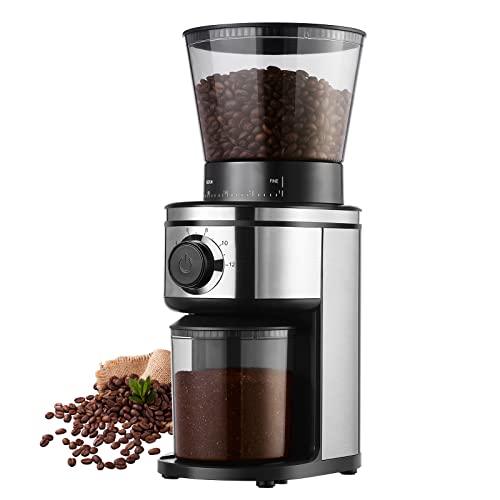
OXO Brew conical burr grinder, 40 mm steel burrs, 15 settings
40 mm conical15 settings + 43 micro12 oz hopperOne-touch memory
Check price on Amazon
Best for: Daily drip, pour-over and French press drinkers who want fine adjustment.

The OXO Brew uses 40 millimeter stainless steel conical burrs, a substantial size for a home grinder. A bigger conical burr has more cutting edge, so it can turn at a lower speed and still grind quickly, which reduces heat and noise. The result is more uniform grounds than a blade or a small burr set can deliver.

It lists 15 grind settings plus 43 micro-adjustments, which means you can move between steps and fine-tune within each one. That structure gives finer control than a plain 30- or 38-click dial, and it covers espresso-fine to French press-coarse in the listing. One-touch start remembers your last setting, so you press once and walk away.

Set beside the Ollygrin in this list, the OXO offers a larger hopper at 12 ounces and a micro-adjust system, while the Ollygrin offers more simple steps. Burr grinders retain some grounds in the chute, so brush it out weekly and purge a few beans when you change coffee. Keep the hopper lid on and store beans in an airtight container. The one-touch memory is handy but easy to forget about, so check the setting when you change from a French press to a pour-over. Many owners fill the hopper with only a few days of beans to keep them fresh.

What works

  • Large 40 mm steel conical burrs
  • Fifteen steps plus 43 micro-adjustments
  • One-touch start remembers the setting
  • Twelve ounce hopper for a full week

Watch out for

  • Chute retains some grounds
  • Steps are not fine enough for demanding espresso

Spec sheet

Burrs
40 mm stainless steel conical
Settings
15, plus 43 micro-adjustments
Hopper
12 ounce
Operation
One-touch, remembers last setting
Range
Fine for espresso to coarse for French press
02
Ollygrin conical burr grinder, 40 mm burrs, 30 settings, gear reduction
40 mm conical30 settingsGear reduction2 to 12 cups
Check price on Amazon
Best for: Quiet kitchens that brew several methods and want a slow grinder.

Ollygrin also uses 40 millimeter stainless steel conical burrs, driven by a gear reduction motor. Gear reduction turns the burrs slowly, which the listing says reduces noise and heat. Slow grinding also reduces static and keeps volatile aromatics, which matters most with lightly roasted beans.

Thirty steps run from an ultra-fine to a coarse grind, and a cup selector covers from 2 to 12 cups. A selector sets the time for the cup count, so it behaves like a timer and not a scale. Measured against the OXO, it offers more simple steps but no micro-adjustment layer, so fine tuning between steps is limited.

It suits a household that brews a variety of methods and wants a quiet machine. Ownership is routine: brush the burr and chute weekly, wipe the hopper with a dry cloth and avoid washing burrs with water. Because it runs slowly, a large dose takes longer than on a fast machine, so allow a little extra time on busy mornings. The slower speed also means the grounds arrive less warm, which is a quiet advantage for light roasts. A small brush that clips to the side of the unit keeps the chute clean.

What works

  • Gear reduction motor runs slow and cool
  • Forty millimeter conical steel burrs
  • Thirty steps from fine to coarse
  • Cup selector for 2 to 12 cups

Watch out for

  • Slow grinding for large doses
  • No micro-adjustment layer

Spec sheet

Burrs
40 mm stainless steel conical
Settings
30
Motor
Gear reduction, slow grinding
Capacity
2 to 12 cups
Range
Ultra-fine to coarse
03
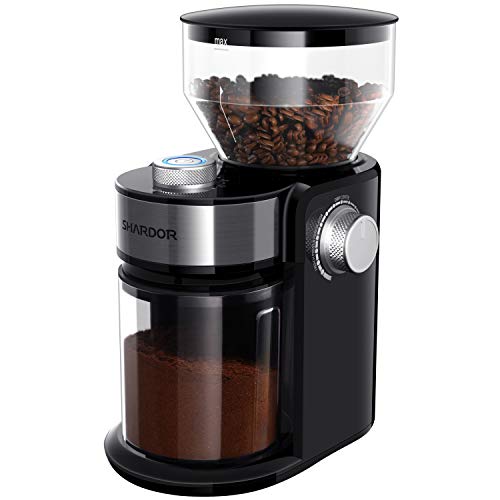
SHARDOR electric burr grinder 2.0, flat burr, 16 settings, timer
Flat burr16 settings2 to 14 cupsAuto shut-off
Check price on Amazon
Best for: Pour-over drinkers who like a bright, clean cup and a timer.

SHARDOR's 2.0 grinder uses a metallic flat burr set and 16 micro-adjusted settings. A flat burr pair crushes beans between two parallel plates, and a good set gives a narrow range of particle sizes. Per the listing, it grinds without burning the beans, which points to a controlled speed.

The timer dial selects 2 to 14 cups, runs one-touch and shuts off automatically. As with every timer, it measures time and not weight. Against the OXO and Ollygrin, the flat burr gives a different flavor profile, often described as brighter, while the cheaper machines here use conical burrs that produce a rounder cup.

At this tier it is the budget-friendly flat burr choice. Brush the chute weekly, run a few beans through when switching coffees and keep the hopper covered. If grounds cling, a small spritz of water on the beans reduces static. Because flat burrs are sensitive to alignment, avoid dropping or knocking the unit, and listen for a change in the sound that could signal a shifted burr. Rinse the grounds bin with warm water and dry it fully to avoid stale smells.

What works

  • Flat burrs give sharp uniformity
  • Timer dial for 2 to 14 cups
  • One-touch with automatic shut-off
  • Sixteen micro-adjusted steps

Watch out for

  • Smaller burr than the 40 mm units
  • Timer does not measure weight

Spec sheet

Burr
Metallic flat burr
Settings
16 micro-adjusted
Timer
2 to 14 cups
Operation
One-touch, auto shut-off
Range
Fine to coarse
04
CEVING mini manual coffee grinder, ceramic burr, 40 external settings
Ceramic conical burr40 settings325 gHand crank
Check price on Amazon
Best for: Travelers and campers who want an even grind without a plug.

CEVING's mini mill puts its 40 grind settings on the outside of the body, so you change the grind without opening the grinder. Many hand mills hide the adjustment under the burr, which makes dialing in a new coffee a chore. The conical ceramic burr runs cool and gives a more uniform grind than a blade, and the whole unit weighs only 325 grams.

The listing pitches it for camping, travel, RVs and patios, which tells you the design priorities: light, compact and independent of a power outlet. The cost is effort, since a mug takes about a minute of cranking. Next to the electric burr grinders here, it has no motor, no timer and no hopper to speak of, but it also has no noise and nothing to break.

In a household with a main electric grinder it is a sensible second unit for the cabin or the desk. Brush the burr weekly, avoid water on the ceramic and steel parts, and tighten the center nut gently if the grind drifts.

What works

  • Conical ceramic burr gives even grounds
  • External dial with 40 settings
  • Only 325 grams and 7.4 inches tall
  • Silent and cordless

Watch out for

  • Cranking takes about a minute per cup
  • Holds only enough for a couple of mugs

Spec sheet

Burr
Conical ceramic
Adjustment
40 external settings
Weight
325 grams
Size
6.7 by 2.3 by 7.4 inches
Use
Camping, travel, RV, patio
05
Rsoilch manual grinder, ceramic burr, 40 clicks, glass jar
Ceramic burr40 clicks25 gGlass jar
Check price on Amazon
Best for: Travelers and desk brewers who want a quiet second grinder.

The Rsoilch is a hand mill with a ceramic burr, 40 adjustment clicks and a transparent glass jar that lets you watch the grinding. The glass jar also stops grounds from spilling. It holds up to 25 grams of beans, enough for a mug or two, and weighs 11.3 ounces, so it is easy to carry.

A hand mill at this budget is a quiet, portable alternative to an electric unit. It takes a minute or two of cranking per mug, but it makes a grind that rivals the electric burr machines in this list for evenness. The ceramic burr runs cool and avoids rust.

Measured against the electric grinders, it saves counter space and electricity but costs effort. It is the one to buy for travel or a second grinder at work, and it costs nothing to run. Brush the burr, keep it dry and tighten the nut gently. The glass jar looks good on a desk but is breakable, so pack it in a pouch when you travel. Rubber bands or a silicone sleeve around the jar give a better grip.

What works

  • Ceramic burr gives even grounds
  • Transparent glass jar
  • Forty adjustment clicks
  • Silent and cordless

Watch out for

  • Only 25 grams per batch
  • Cranking takes a minute or two

Spec sheet

Burr
Ceramic
Adjustment
40 clicks
Capacity
Up to 25 grams
Weight
11.3 ounces
Jar
Transparent glass

Spec sheet decoder

What the numbers on the box really mean

The specs manufacturers lead with, translated into what they tell you about real-world performance.

Burr diameter

The size of the cutting burr. Bigger burrs grind faster at lower speed.

Watch forThe OXO and Ollygrin use 40 mm conical burrs.

Gear reduction

A gearbox that slows the burrs. It cuts noise, heat and static.

Watch forOnly the Ollygrin lists it.

Micro-adjustment

Fine steps within each main setting. It helps fine-tune a recipe.

Watch forThe OXO lists 43 micro-adjustments on top of 15 steps.

Timer cups

A dial that grinds for a time matched to a cup count.

Watch forThe SHARDOR offers 2 to 14 cups, the Ollygrin 2 to 12.

Hopper size

How many ounces of beans the hopper holds.

Watch forThe OXO lists 12 ounces.

Methodology

How We Evaluated These Coffee Grinders Under $100

Burr and motor design

We compared burr size, type and motor speed. The 40 mm conical burrs on the OXO and Ollygrin scored highest, with the Ollygrin's gear reduction earning extra credit. Smaller burrs scored on compactness.

Adjustment depth

Settings and micro-adjustment were reviewed. The OXO's layered system led. The CEVING's 40 external steps were noted, with the caveat that espresso is out of reach.

Daily convenience

One-touch memory, timers and hopper size were considered. The OXO's memory and large hopper earned credit. Hand mills scored on silence and portability.

Upkeep

Access to the burr and chute and ease of cleaning were rated. All the electric burr grinders need weekly brushing. Glass and ceramic parts on the hand mill made it easy to clean.

Cap compliance

Every grinder was verified under the $100 cap at the time of writing. Notes rely on the spec sheet and owner feedback patterns. This guide shares at most two grinders with its lower-cap sibling.

Decision guide

How to Choose the Right Coffee Grinders Under $100

By Brew Method

SituationPickWhy
Daily pour-over and dripOXO Brew conical40 mm burrs and micro-adjust
Quiet household, many methodsOllygrinGear reduction and 30 steps
Bright, clean pour-overSHARDOR 2.0Flat burr
Small counter or backpackCEVING mini manualLight ceramic hand mill
Travel or deskRsoilch hand millCeramic burr and glass jar

By Budget

TierPickWhy
Lowest in this listRsoilch hand millSimple ceramic mill
Lower middleCEVING mini manualExternal 40-step dial
MiddleSHARDOR 2.0Flat burr and timer
Upper middleOllygrin40 mm burrs, gear reduction
Top of the capOXO Brew conicalMicro-adjust and memory

Flat vs Conical

Flat burr (SHARDOR)

Narrow particle range and a bright, clean cup. It needs careful alignment.

Conical burr (OXO, Ollygrin, CEVING)

Cooler, quieter and a rounder cup. Common in home grinders.

Choose flat for clarity and conical for body and quiet.

Motor Preference

PreferencePickWhy
Quietest electricOllygrinGear reduction
Fastest dosingOXO Brew conicalLarge burrs
No motor at allRsoilch hand millHand crank
Timer simplicitySHARDOR 2.02 to 14 cups

For Light Roast Coffee Specifically

Look for

A slow, cool grinder with fine, repeatable adjustment. Light roasts are dense and punish heat and uneven grounds.

In this comparison

The Ollygrin's slow motor and the OXO's micro-adjustments fit best. Pair either with a scale for dosing.

When to Spend More

Spend more if

You brew espresso or want stepless adjustment and low retention. Those start at a higher cap.

Save if

You brew one cup of drip a day. A smaller grinder covers it.

Ownership

Maintenance schedule

The upkeep that decides whether this machine lasts two seasons or ten.

TaskIntervalWhy it matters
Brush the burr and chuteWeeklyStale grounds taint new doses. A brush clears them.
Wipe the hopperWeeklyCoffee oils turn rancid. A dry cloth removes them.
Purge when changing beansEach changeOld grounds mix with the next dose. A few beans clear the chute.
Check burr tightnessMonthlyA loose burr gives an uneven grind. Tighten as the manual advises.
Keep burrs dryAlwaysWater can rust steel burrs. Dry cleaning is enough.

FAQ

Frequently Asked Questions

Is a 40 mm burr worth it?

For daily use, yes. A larger burr grinds faster at lower speed, which keeps the beans cooler and the machine quieter.

Can I make espresso with these?

Not properly. Espresso needs very fine, repeatable adjustment that these machines do not provide.

What does gear reduction do?

It slows the burrs. That cuts noise, heat and static, which helps preserve aroma.

Why does a timer dose vary?

A timer measures time, not weight. Bean density and roast change the output, so weigh a few doses.

How often should I clean it?

Brush the chute after each use and do a deeper clean weekly. Purge when you change beans.

Does the $100 cap change?

Listing prices move. The cap reflects prices when this guide was updated, so check the live listing. If one of the picks has moved above the cap, the others here do a very similar job, and the Rsoilch and CEVING hand mills are the lowest-cost way to get a burr grind, though they ask for more effort on every cup.

Bottom line

The short version

Browse more coffee grinders under $100on Amazon →
James Miller, Lead Machine Editor

About the author

James Miller

Lead Machine Editor, MachineFanatic

James Miller leads MachineFanatic's buying guides, turning spec sheets, manuals and owner feedback into clear verdicts on power tools, outdoor power equipment, shop machines and kitchen machines.

More from James →

Keep reading

Related guides