
Amazon affiliate links - we earn a commission.Affiliate disclosure

Buying guide · 13 min read · Updated 2026-11-25

Best Coffee Grinders Under $50 (2026)

Six coffee grinders that list for under $50, with two electric burr models, two blade grinders and a ceramic hand mill, ranked on grind quality and upkeep.

James MillerBy James MillerLead Machine Editor5 machines comparedSpec-sheet verified
Best Coffee Grinders Under $50

At a glance

Our top picks

Side by side

Spec comparison

The jump from the cheapest grinders to this tier is the arrival of electric burr grinders. A burr machine crushes beans between two surfaces at a set gap, so the particles come out close in size, and that evenness is the single biggest improvement you can make to home coffee.

These machines still have limits. Settings are coarser than on pricier grinders, and fine espresso grinding is out of reach. We ranked them on burr design, adjustment range, timer control and how much grounds they retain. Prices move, and the $50 cap reflects listing prices when this guide was updated.

Before you buy

6 Criteria to Look For Before Buying a Coffee Grinder Under $50

  1. 01

    Burr type

    Flat burrs, like the SHARDOR's, sit face to face and crush beans in a narrow zone, producing sharp, uniform particles. Conical burrs, like the HAUSCAFE's, run cooler and quieter and are common in cheaper machines. Either beats a blade for evenness. At this budget, burr material matters less than whether the burr is aligned and the machine does not wobble. Pick by the other features and by how easy it is to keep clean. Both types give a clear step up from a blade grinder. The real risk is a grinder that is out of alignment, which shows up as a grind that varies from batch to batch or a squeal as the burrs touch. If you can, run a handful of beans through it on the day it arrives and look at the grounds on a white plate. A good grind looks like even sand, not a mix of powder and boulders.

  2. 02

    Range, not step count

    The HAUSCAFE lists 38 settings and the SHARDOR 16, but the range determines usefulness. Check whether the finest step reaches the grind you need and whether the coarsest suits a French press. For espresso, neither machine is fine enough, and a cheap burr grinder that claims espresso capability is usually overstating. For pour-over and drip, a dozen well-spaced steps are enough. The way to find your own setting is to brew the same recipe and change one step at a time: sour and thin means go finer, bitter and harsh means go coarser. Keep a note of the number that suits each brew method, because it will take you three or four brews to find it.

  3. 03

    Timer and dosing

    A timer dial, as on the SHARDOR, grinds for a set time, which repeats a dose without a scale. Time is not weight, and a different bean will give a different dose. Weigh the first few doses on a kitchen scale and adjust the dial. For the best results, weigh the beans before grinding. A cheap kitchen scale that reads to the gram is the most useful accessory you can buy for coffee. With a scale, a timer becomes a guide, and you can reproduce a good cup from one day to the next.

  4. 04

    Retention and static

    Burr grinders hold some grounds in the burr chamber and chute. That stale coffee mixes with the next dose, so a quick brush after each use matters. Static makes grounds cling to the bin. A tiny spritz of water on the beans, applied before grinding, cuts the static. Retention matters most when you switch beans, because the last few grams of the old coffee come out with the first dose of the new. Purging with a few beans before the real dose clears it, and the beans you purge can go in the compost.

  5. 05

    Noise and heat

    Blade grinders run fast and loud. Burr grinders run slower, and a conical burr tends to be quieter. Less heat helps preserve aroma, which matters most for light roasts. If you grind early in the morning in a shared space, noise is a practical concern, not just a spec. Heat also changes with batch size, since a long grind of a big dose warms the burrs. For a single cup the difference is small, but for a full pot a slower grinder keeps the beans cooler.

  6. 06

    Batch size and bin

    The Hamilton Beach handles up to 14 cups' worth, while the Amazon Basics bowl holds about 30 grams. A burr grinder's bin usually holds enough for a pot. Match the size to how many cups you brew, and remember that a hand mill like the CEVING holds only enough for a couple of cups. Also consider the hopper: a big hopper full of beans exposes them to air and light, so fill it only with what you will use in a few days. Beans stay freshest in an airtight container.

Detailed reviews

The 5 best coffee grinders under $50, explained

01
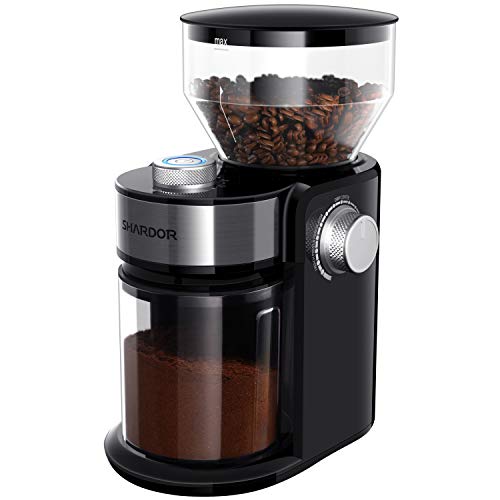
SHARDOR electric burr coffee grinder 2.0, flat burr, 16 settings
Flat burr16 settings2 to 14 cup timerAuto shut-off
Check price on Amazon
Best for: Daily drip and pour-over drinkers who want a repeatable timer dose.

SHARDOR's 2.0 grinder uses a metallic flat burr set, which the listing says grinds consistently without burning the beans. A flat burr pair sits face to face and crushes beans as they pass between the plates, and a well-made set produces a narrow range of particle sizes. The grinder offers 16 micro-adjusted settings that run from fine to coarse.

The timer dial is the practical feature. You select a cup count from 2 to 14, press once and the machine grinds for the matching time and stops. That makes a repeatable dose without a scale, though a timer measures time and not weight, so it drifts as the bean oil content and roast change. Weigh the first few doses to learn what a dial setting gives you.

The setting range reaches fine but not true espresso fine, so it suits pour-over, drip, AeroPress and French press. Measured against the HAUSCAFE in this list, it has fewer settings but a flat burr and a timer. Burr grinders retain some grounds in the chute, so brush it out weekly, and run a small amount of beans through before you brew after a deep clean. Keep the hopper lid on to keep beans fresh.

What works

  • Metal flat burrs give uniform grounds
  • Timer dial for 2 to 14 cups
  • Sixteen settings from fine to coarse
  • One-touch operation with auto shut-off

Watch out for

  • Timer measures time, not weight
  • Not fine enough for true espresso

Spec sheet

Burr
Metallic flat burr
Settings
16 micro-adjusted
Timer
Dial for 2 to 14 cups
Operation
One-touch, auto shut-off
Use
Fine for espresso to coarse for French press
02
HAUSCAFE electric conical burr grinder, 38 grind settings
Conical burr38 settingsCompactLess heat
Check price on Amazon
Best for: Small kitchens that want conical burrs and plenty of settings.

HAUSCAFE puts a conical burr and 38 grind settings in a compact countertop body. A conical burr sits one cone inside another, which grinds with less heat and noise than a high-speed blade or a flat burr of the same size. The spec sheet says it reduces heat build-up and produces uniform grounds, a fair expectation compared with a blade.

Thirty-eight settings sounds like a lot, but the range is what counts. At this price the finest setting reaches roughly the fine drip end, and espresso needs steps that these small burrs rarely provide. The wide step count does make it easier to nudge between pour-over and French press, with finer control than the 16-step SHARDOR.

It is lightweight and designed to fit on any counter, which is good for a small kitchen but means it can wander on a slick surface when the motor starts. Hold it down for the first second, or place it on a mat. Brush the chute after each use, and wipe the hopper with a dry cloth since coffee oils go stale. If grounds cling, a light spritz of water on the beans before grinding cuts static. Because a conical burr is aligned by one central shaft, keep an eye out for a change in sound, since a new rattle can mean a loose burr.

What works

  • Conical burr runs cooler and quieter
  • Thirty-eight settings for fine tuning
  • Compact body fits tight counters
  • Covers pour-over to French press

Watch out for

  • Light body can shift on a slick counter
  • Fine settings fall short of espresso

Spec sheet

Burr
Conical
Settings
38
Range
Espresso to French press
Design
Compact countertop
Claim
Reduced heat build-up
03
Hamilton Beach Custom Grind electric grinder, 14 cups, grind presets
Blade grinderUp to 14 cupsGrind selectorHands-free
Check price on Amazon
Best for: Large households that brew full pots of drip coffee.

Hamilton Beach's Custom Grind is still a blade grinder, but it adds a grind size and cup count selection and a hands-free mode that runs a timed cycle. Pressing down also works as a manual push for people who prefer control. The bowl removes, which makes filling, pouring and cleaning easier than with a fixed chamber.

The selector changes the grind time, not the gap between burrs, so the result is still a blend of fine dust and coarse chunks. That is acceptable in a drip machine with a paper filter and a poor match for pour-over or espresso. It handles a big batch, up to 14 cups, which suits a household that brews a full pot.

Against the SHARDOR, it has no burr and a weaker grind but a bigger batch size. It also grinds spices and herbs, though odors transfer to coffee. Wash the bowl after a few uses, wipe the lid and keep spice and coffee grinding apart where you can. Use short pulses if you want a coarser result. Because the presets set a time, a larger cup count means a finer, more powdery result, so treat the dial as a guide and test it.

What works

  • Holds up to 14 cups' worth
  • Presets by size and cup count
  • Hands-free mode saves effort
  • Removable bowl for easy cleaning

Watch out for

  • Blade chops unevenly
  • Presets control time, not particle size

Spec sheet

Type
Electric blade grinder
Capacity
Up to 14 cups
Selection
Grind size and cup count
Operation
Hands-free or manual push
Bowl
Removable
04
Amazon Basics fast electric coffee grinder, 30 g capacity
Blade grinder30 g capacityHeavy-duty bladeSimple
Check price on Amazon
Best for: Small households that want the simplest, fastest grinder for drip coffee.

This is a plain electric blade grinder with a heavy-duty blade and a lid that you press to run. The listing says it grinds about 30 grams, one ounce, of beans for drip coffee in a short time. That is a small batch, enough for two or three cups, and it keeps the machine compact and cheap.

It is the most basic option here and it behaves like every blade grinder. The grind depends on how long you hold the lid and how you swirl the beans, and the result is uneven. The ease of use and the speed are the point: it grinds a dose in seconds and cleans with a quick wipe.

Next to the Hamilton Beach Custom Grind, it has no presets and a smaller bowl, but it costs less and takes less counter space. Use short pulses, shake the unit between pulses, and keep the lid dry. Unplug it before you wipe near the blade. A blade grinder is also the right tool for a quick spoonful of spices, so many kitchens keep a second one for that. At this size it stores easily in a drawer.

What works

  • Grinds a dose in seconds
  • Simple press-to-grind design
  • Compact and light
  • Handles coffee and spices

Watch out for

  • Small 30 gram batch size
  • Uneven grind from the blade

Spec sheet

Type
Electric blade grinder
Capacity
About 30 grams (1 ounce)
Blade
Heavy-duty stainless
Use
Coffee beans and spices
Operation
Press lid to grind
05
CEVING mini manual coffee grinder, ceramic burr, 40 settings
Ceramic burr40 settings325 gHand crank
Check price on Amazon
Best for: One-cup brewers who value silence and portability over speed.

At this tier the CEVING hand mill still earns a place because its conical ceramic burr beats any blade for grind evenness and its 40 external settings are easy to change. The ceramic burrs generate little heat and are not prone to rust. The mill weighs 325 grams, so it also doubles as a travel grinder.

The tradeoff against the electric burr grinders is effort, since a hand mill takes about a minute to grind a mug's worth. The advantage is silence and no cord. The external dial lets you move between brew methods in seconds, which is rare on a hand mill.

Set beside the HAUSCAFE, it offers a comparable burr type, less capacity and no electricity. It suits one or two cups. Brush out the burr weekly and keep it dry. At this price tier it is the only grinder that costs nothing to run, which suits an office or a camper. Crank at an even pace and hold the body steady.

What works

  • Ceramic conical burr, even grounds
  • External 40-step dial
  • Silent and cordless
  • Light enough for travel

Watch out for

  • Cranking takes about a minute per cup
  • Small capacity suits one or two mugs

Spec sheet

Burr
Conical ceramic
Adjustment
40 external settings
Weight
325 grams
Power
Hand crank
Use
Home, travel, camping

Spec sheet decoder

What the numbers on the box really mean

The specs manufacturers lead with, translated into what they tell you about real-world performance.

Flat versus conical burr

Two burr shapes. Flat gives sharp uniformity, conical gives lower heat and noise.

Watch forThe SHARDOR is flat, the HAUSCAFE is conical.

Grind settings

Steps between fine and coarse. The usable range matters more than the count.

Watch forHAUSCAFE lists 38, SHARDOR 16, CEVING 40.

Timer cups

A dial that grinds for the time suited to a cup count.

Watch forThe SHARDOR offers 2 to 14 cups.

Blade versus burr

A blade chops, a burr crushes. Burr gives more even grounds.

Watch forThe Hamilton Beach and Amazon Basics are blades.

Ceramic versus steel

Burr materials. Ceramic runs cool, steel cuts quickly.

Watch forThe CEVING uses ceramic and the SHARDOR uses metal.

Methodology

How We Evaluated These Coffee Grinders Under $50

Grind uniformity

We prioritised burr grinders over blades because the grind is more even. The SHARDOR's flat burr and the HAUSCAFE's conical burr led. Blade grinders were rated on speed and convenience.

Adjustment and dosing

Settings and timers were reviewed together. The SHARDOR's timer and the HAUSCAFE's 38 steps earned credit. Presets on a blade grinder were noted as time controls, not grind controls.

Noise and heat

Motor speed and burr design were weighed. Conical burrs scored for low heat and noise. Fast blades scored lower on both.

Upkeep

Removable bowls, accessible burrs and brushes were considered. The Hamilton Beach's removable bowl helped it. Burr grinders were credited when the chute is easy to clean.

Cap compliance

Every grinder was verified under the $50 cap at the time of writing. Notes rely on the spec sheet and owner feedback patterns. This guide shares at most one grinder with the lower-cap sibling.

Decision guide

How to Choose the Right Coffee Grinders Under $50

By Brew Method

SituationPickWhy
Pour-over and drip, dailySHARDOR 2.0Flat burr and timer
Wide range of methodsHAUSCAFE 38 settingsFine step control
Full pot of drip for a familyHamilton Beach Custom GrindUp to 14 cups
Quick small batchesAmazon Basics grinderSimple and fast
One mug, silentCEVING mini manualCeramic burr and no motor

By Budget

TierPickWhy
Lowest in this listAmazon Basics grinderBasic blade
Lower middleCEVING mini manualHand mill with burr
MiddleHamilton Beach Custom GrindPresets and big batch
Upper middleHAUSCAFE 38 settingsConical burr
Top of the capSHARDOR 2.0Flat burr and timer

Burr vs Blade

Burr (SHARDOR, HAUSCAFE, CEVING)

More even grounds and cleaner flavor. Slower and more expensive.

Blade (Hamilton Beach, Amazon Basics)

Fast and cheap. The grind is a mix of dust and chunks.

Choose burr for flavor and blade for speed and price.

Counter Space

PreferencePickWhy
Small kitchenHAUSCAFE 38 settingsCompact body
Cupboard storageAmazon Basics grinderSmall and light
No electric outletCEVING mini manualHand crank
Permanent counter spotSHARDOR 2.0Larger timer unit

For Pour-Over Specifically

Look for

A burr grinder with a narrow particle spread and fine control around the medium range. Pour-over is sensitive to uneven grounds.

In this comparison

The HAUSCAFE's 38 settings and the SHARDOR's flat burr suit it best. The CEVING works for a single cup.

When to Spend More

Spend more if

You brew espresso, want stepless adjustment or low retention. That starts at a higher cap.

Save if

You brew drip in a paper filter. A blade covers it.

Ownership

Maintenance schedule

The upkeep that decides whether this machine lasts two seasons or ten.

TaskIntervalWhy it matters
Brush the burr and chuteWeeklyStale grounds taint new doses. A brush clears them.
Wipe the hopper and binWeeklyCoffee oils turn rancid. A dry cloth removes them.
Check for loose burrsMonthlyA loose burr gives an uneven grind. Tighten as the manual advises.
Empty and clean the binAfter useFine powder attracts moisture. A dry bin keeps coffee fresh.
Unplug before cleaningAlwaysBurrs and blades can start unexpectedly. Safety first.

FAQ

Frequently Asked Questions

Is a $50 burr grinder much better than a blade?

For flavor, yes. A burr gives even grounds, which means more even extraction and a cleaner cup. The step up is clear in pour-over.

Can I make espresso with these?

Not properly. Espresso needs a very fine and very uniform grind with precise adjustment, which these machines do not offer.

Why does the timer dose vary?

A timer measures grinding time, not weight. Bean density and roast change the output, so weigh a few doses to calibrate.

How do I reduce static?

Spritz a drop of water on the beans before grinding. A metal bin also helps.

How often should I clean a burr grinder?

Brush the chute after each use and do a deeper clean weekly. Stale grounds affect flavor.

Does the $50 cap change?

Listing prices move. The cap reflects prices when this guide was updated, so check the live listing.

Bottom line

The short version

Browse more coffee grinders under $50on Amazon →
James Miller, Lead Machine Editor

About the author

James Miller

Lead Machine Editor, MachineFanatic

James Miller leads MachineFanatic's buying guides, turning spec sheets, manuals and owner feedback into clear verdicts on power tools, outdoor power equipment, shop machines and kitchen machines.

More from James →

Keep reading

Related guides