
Amazon affiliate links - we earn a commission.Affiliate disclosure

Buying guide · 13 min read · Updated 2026-11-16

Best Coffee Makers for Offices (2026)

Six office coffee makers compared on team size, batch versus single-cup service, warming method and cleaning load, from pods to dual-station brewers.

James MillerBy James MillerLead Machine Editor6 machines comparedSpec-sheet verified
Best Coffee Makers for Offices

At a glance

Our top picks

Side by side

Spec comparison

An office coffee maker has a harder job than a home one. It serves many people with different tastes, gets filled by whoever is nearest, and is cleaned only when someone gets annoyed enough to do it.

The real decision is service style. A batch brewer fills a pot for the morning rush, while a single-cup machine serves anyone at any hour but pays for that flexibility in refills and pod waste.

Before you buy

6 Criteria to Look For Before Buying a Coffee Maker for Offices

  1. 01

    Team size and peak demand

    A rule of thumb is two cups per person across a morning. The Keurig K-1500 is rated for up to fifteen employees, while the K-2550 targets medium to large offices with a 110 oz tank. If everyone arrives at 9 a.m., a batch brewer like the TQS Cafe's 24 cups per cycle handles the rush better than any pod machine.

  2. 02

    Single serve versus batch

    Single serve gives each worker choice and avoids a stale pot, but it costs more per cup and creates pod waste. Batch brewers, such as the SYBO and VEVOR, are cheaper per cup and faster at peak, but a pot left on a plate goes bad. Mixed offices often run one of each, with the batch brewer covering the first hour of the day and the pod machine handling the afternoon trickle of single cups, so neither one sits idle or goes stale.

  3. 03

    Holding method

    Hot plates keep coffee warm but cook it, so a pot that sits for an hour tastes bitter. The VEVOR's thermal carafe is claimed to hold heat for four hours, which suits offices where coffee is poured unevenly through the day. If no one empties the pot, a thermal carafe is a major upgrade.

  4. 04

    Safety certification

    Appliances used at work should carry a recognized listing. The SYBO states ETL certification, which is worth confirming on any commercial unit, since lesser-known brands sometimes skip it. Check the plug rating against the circuit so you do not trip a breaker.

  5. 05

    Cleaning ownership

    Shared machines rot when no one owns them. Post a rota, and favor models with a removable reservoir and basket, such as the Keurig K-1500's handled tank. A dual-station unit like the TQS needs twice the rinsing.

  6. 06

    Water access and refill burden

    Pour-over commercial brewers need a person to fill the reservoir each time, while plumbed units connect to a line. The Keurig K-2550's 110 oz tank is the biggest single-serve option here, reducing refill trips to once or twice daily.

Detailed reviews

The 6 best coffee makers for offices, explained

01
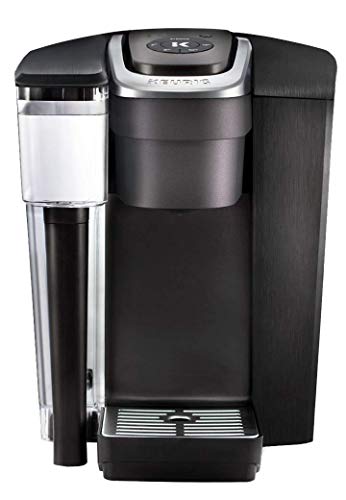
Keurig K-2550 medium business single serve brewer, 110 oz reservoir
Single serve110 oz tankPod rangeFast cups
Check price on Amazon
Best for: Offices of fifteen or more that want fast single cups all day.

The K-2550 is aimed at offices with many people drifting in and out all day. A 110 oz reservoir means fewer trips to the sink than a small pod machine, and a cup takes about a minute, so a short queue clears quickly. The pod format lets each worker pick coffee, tea or cocoa without making a full pot.

Single-cup service is the right answer when the office has mixed schedules and some decaf drinkers. It avoids the stale pot that forms in a batch brewer by midmorning. Next to the K-1500, the K-2550 trades a smaller footprint for a bigger tank and more demand headroom.

The cost of that convenience is pod waste and a higher cost per cup. Plan a regular descaling job, since heavy use scales the heater quickly. Assign someone to refill the tank each morning, and keep a spare pod bin so the area stays tidy.

What works

  • 110 oz reservoir cuts refills
  • About one minute per cup keeps a line moving
  • Coffee, tea and cocoa pods in one machine
  • Designed for medium to large business use

Watch out for

  • Pods raise cost per cup and waste
  • Needs scheduled descaling under heavy use
  • Larger than a home pod brewer

Spec sheet

Style
Single serve K-Cup pods
Reservoir
110 oz
Target
Medium to large businesses
Speed
A cup in about a minute
Variety
Coffee, tea and hot cocoa pods
02
Keurig K-1500 commercial brewer, 96 oz reservoir
Single serve96 oz tank4 cup sizesUp to 15 people
Check price on Amazon
Best for: Teams of six to fifteen that want pod convenience with a business-grade tank.

The K-1500 is the commercial-grade step up from a home Keurig. It brews four cup sizes, from 6 to 12 oz, and carries a 96 oz reservoir with a handle for easy filling and cleaning. The listing positions it for small businesses of up to fifteen employees, which is where it works best.

That target is honest, because above fifteen users the tank empties quickly and the queue grows. For a team of six to twelve, it is a sensible pick with less bulk than the K-2550. Against a standard home K-Mini, the larger tank and sturdier build matter more than any feature.

Expect to refill once or twice a day and to descale every few months. Use the reusable filter if you want to supply your own grounds. Keep a cleaning rota posted beside the machine, because shared appliances only stay clean when ownership is explicit.

What works

  • 96 oz reservoir with a carry handle
  • Four brew sizes from 6 to 12 oz
  • Reusable filter option for own grounds
  • Sized for up to fifteen employees

Watch out for

  • Tank empties fast above fifteen users
  • Pod cost adds up across a team
  • Needs a posted cleaning rota

Spec sheet

Style
Single serve K-Cup pods
Reservoir
96 oz with handle
Sizes
6, 8, 10 and 12 oz
Target
Small business, up to 15 employees
Filter
Reusable
03
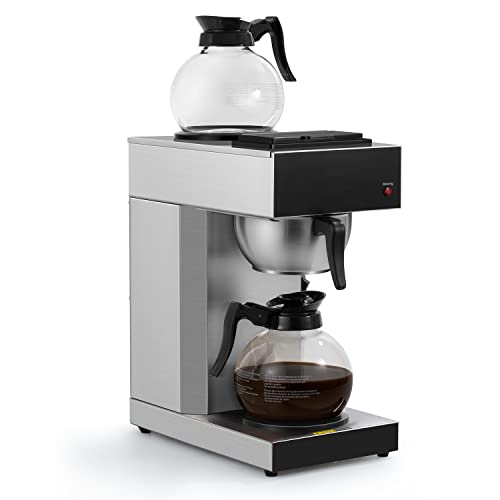
TQS Cafe commercial dual 12-cup stainless brewer
Dual 12-cupUp to 24 cupsStainlessBreakroom
Check price on Amazon
Best for: Break rooms that need regular and decaf available at once.

The TQS Cafe machine puts two brewing stations in one stainless body, which lets you run regular and decaf at once or double up for a meeting. Up to 24 cups per cycle is plenty for a morning rush, and the metal housing looks and wears better than plastic in a shared space.

Batch brewing is the cheapest way to serve many people and the quickest at peak times. The risk is stale coffee, so plan your cycles around actual demand and remove the pot if it sits. Compared with the SYBO, it gives more capacity, but the brand is less established and you should confirm the warranty.

Two stations also mean two sprayheads and two baskets to keep clean. Rinse them every evening and wipe the housing weekly. Check the rated amperage before you plug it into an office circuit shared with other appliances, because a heavy brewer running beside a microwave can trip a breaker at the worst moment of the morning.

What works

  • Two 12-cup stations serve different tastes
  • Up to 24 cups per brewing cycle
  • Stainless housing suits a busy space
  • Low cost per cup compared with pods

Watch out for

  • Newer brand with limited support history
  • Two stations double the cleaning
  • Coffee goes stale if cycles outpace demand

Spec sheet

Style
Commercial batch brewer
Capacity
Two 12-cup stations, up to 24 cups per cycle
Housing
Stainless steel
Use
Breakrooms, conference rooms
Format
Stainless, two heating stations
04
SYBO SF-CB-2GA 12-cup commercial pour-over brewer
12-cupETL certifiedDual warmersUnder 10 minutes
Check price on Amazon
Best for: Small and medium break rooms that want inexpensive batch coffee.

SYBO's commercial pour-over brewer is a stainless 12-cup unit with a reusable basket and two warming plates. The listing stresses ETL certification, which is a safety listing worth checking on any appliance used in a workplace. A pour-over design means you fill the reservoir by hand, so no water line is needed.

A full batch finishes in under ten minutes, and two warmers let you hold a second pot while the first brews. This is a straightforward answer for an office that wants real batch coffee without a plumbing project. Against the TQS, you get half the capacity but a lower entry cost and a stronger safety story.

Because the plates stay hot, remove pots that have sat for more than an hour. Clean the basket daily and descale the heater monthly. Keep it on a heat-safe surface, not a plastic-top table.

What works

  • ETL certification for workplace use
  • Two warming plates hold a second pot
  • Finishes 12 cups in under ten minutes
  • No plumbing required

Watch out for

  • Hot plates cook coffee that sits
  • Fill by hand each time
  • Smaller capacity than a dual-station unit

Spec sheet

Style
Commercial pour-over batch
Capacity
12 cups
Brew time
Under 10 minutes
Warmers
Two warming plates
Safety
ETL certified
05
VEVOR commercial drip brewer, 2.5 L thermal carafe, hot water tap
16-17 cups2.5 L thermal4 hr warmHot water tap
Check price on Amazon
Best for: Offices that hold meetings and want hot coffee plus a tea tap.

VEVOR pairs a full 2.5 L batch with a thermal carafe that the listing says keeps coffee hot for four hours. That removes the warming plate and its scorched-coffee problem, which matters for offices where a pot sits through a long meeting. A dedicated hot water tap also doubles as tea service.

A hot water tap is a quiet office benefit, because it takes pressure off the kettle in the kitchenette. The drawback is a heavier, more complex machine and a carafe that is harder to scrub. Compared with the SYBO, it holds more and keeps coffee hot without a plate, but it is a larger purchase.

Rinse the carafe daily and wipe the tap, since drips attract bacteria. Descale the unit monthly and keep a spare lid on hand. Treat the four-hour figure as a manufacturer claim and expect a gradual temperature drop.

What works

  • Thermal carafe holds heat without a plate
  • Dedicated hot water tap for tea
  • 2.5 L batch serves a full meeting
  • Four-hour retention claim reduces waste

Watch out for

  • Large and heavy for a small counter
  • Carafe and tap take extra cleaning
  • Heat retention depends on lid seal

Spec sheet

Style
Commercial drip with thermal carafe
Capacity
2.5 L, 16 to 17 cups
Heat retention
4 hours
Extras
Dedicated hot water tap
Use
Offices, meetings, cafes
06
Bunn GRB Velocity Brew 10-cup brewer for small offices
10-cupHot water tankSingle switchGlass carafe
Check price on Amazon
Best for: Teams of three to five with a shared pot and a simple routine.

A small office does not always need commercial equipment. The GRB makes a ten-cup pot quickly from a stainless steel tank that holds hot water, so a second pot starts with no delay. With one switch and no menus, a new hire can use it without a tutorial.

What you give up is capacity and serving flexibility. It cannot run two pots at once, and a ten-cup pot is gone fast in a team of eight. For three to five people, it is the sweet spot. Against the single-cup Keurigs, you save on pod costs and gain a fresher pot, but only if people finish the carafe.

Hot plates on glass carafes are the usual office gripe, because no one turns them off. Empty the carafe before leaving, and wipe the faceplate weekly. Unplug it over holidays.

What works

  • Quick brewing from a steel hot water tank
  • One switch, easy for anyone to use
  • Low cost per cup compared with pods
  • Simple parts that are easy to replace

Watch out for

  • Cannot serve a large team
  • Glass pot on a plate stews old coffee
  • No timer for pre-opening brewing

Spec sheet

Style
Home-style batch brewer
Capacity
10 cups
Heating
Internal stainless steel tank
Controls
Single switch
Origin
Designed and assembled in the USA

Spec sheet decoder

What the numbers on the box really mean

The specs manufacturers lead with, translated into what they tell you about real-world performance.

Reservoir size

How much water the machine holds before refilling. Bigger tanks mean fewer interruptions.

Watch forThe K-2550 carries 110 oz and the K-1500 carries 96 oz.

Cups per cycle

How much coffee one batch produces, counted in five-ounce cups. It sets how many people one cycle can serve.

Watch forThe TQS Cafe states up to 24 cups per cycle across two stations.

ETL certified

A safety mark showing a product met a recognized electrical standard. It matters for workplace appliances.

Watch forThe SYBO lists it, while some commercial import brands do not.

Heat retention

How long a carafe keeps coffee hot without a heater. Longer retention reduces bitter, over-warmed coffee.

Watch forThe VEVOR lists four hours, which is a manufacturer claim.

Brew time

How long a full batch takes from start to finish. It determines whether a second batch is ready for a rush.

Watch forThe SYBO finishes 12 cups in under ten minutes.

Methodology

How We Evaluated These Coffee Makers for Offices

Team fit

We matched each machine's stated target to a team size. The K-1500 is rated for up to fifteen employees, while the K-2550 aims higher. Machines used outside their rating lost points.

Serving style

We compared single serve with batch brewing in a workplace. The Keurigs suit mixed schedules, and the TQS, SYBO and VEVOR suit peaks. We weighed pod costs against stale-pot risk.

Holding quality

We looked at plates versus thermal carafes. The VEVOR's four-hour carafe claim and the SYBO's dual warmers were treated as different answers to the same problem.

Safety and compliance

We noted listed certifications such as ETL on the SYBO and flagged brands that did not state one. Offices carry liability, so this counted for more than a feature.

Cleaning workload

We estimated the upkeep each machine demands from a shared team. Handled tanks and removable baskets scored well, and two-station units scored lower.

Decision guide

How to Choose the Right Coffee Makers for Offices

By Team Size

SituationPickWhy
Three to five peopleBunn GRBOne switch and a fast ten-cup pot
Six to fifteen peopleKeurig K-150096 oz tank and four brew sizes
Fifteen or more, mixed hoursKeurig K-2550110 oz tank and quick cups
Peak-hour rushTQS Cafe dual 12-cupUp to 24 cups per cycle
Long meetingsVEVOR thermal dripThermal carafe with four hour claim

By Budget

Budget tierPickWhy
Lowest spendBunn GRBSimple batch brewer
Low-mid spendSYBO 12-cupCommercial pour-over with certification
Mid spendKeurig K-1500Pod service for small teams
Higher spendVEVOR or K-2550Thermal batch or large pod tank

Pods vs Batch

Pods

The Keurig K-1500 and K-2550 give each worker a fresh cup of their choice in about a minute. You pay more per cup and manage waste.

Batch

The TQS, SYBO, VEVOR and Bunn make full pots for less per cup. They are quicker at peak, but a neglected pot goes stale.

Choose pods for mixed schedules and decaf drinkers; choose batch for a rush and a lower cost per cup.

Warming Axis

PreferencePickWhy
No hot plateVEVOR thermal dripThermal carafe
Two pots at onceSYBO 12-cupTwo warmers
Regular and decafTQS Cafe dualTwo brew stations

For Shared Break Rooms Specifically

Look for

Look for sturdy housing, a certification mark, a reservoir that is easy to fill and a pot that tolerates neglect. Add a posted cleaning rota, a small trash bin for filters or pods, and a drip tray mat so spills do not reach the counter laminate or nearby paperwork.

In this comparison

The SYBO covers most break rooms with a safety mark and two warmers, and the VEVOR is the pick for a conference-heavy office.

When to Spend More

Spend more if

Spend more if the team is above fifteen, or if coffee must stay hot all day. The K-2550 and VEVOR address those needs.

Save if

Save if the team is small. A Bunn GRB serves three to five people at a fraction of the cost.

Ownership

Maintenance schedule

The upkeep that decides whether this machine lasts two seasons or ten.

TaskIntervalWhy it matters
Descale the heaterMonthly in heavy useShared machines run all day, so scale builds faster than at home. Use a descaling solution and run two plain-water cycles.
Rinse baskets and carafesEvery eveningCoffee oils go rancid overnight, and the next morning's pot tastes off. Hot soapy water solves it.
Empty and dry the reservoirWeekly on pod machinesStanding water in a large tank grows film. Dry it before refilling.
Clean the hot water tapWeeklyDrips at the tap harbor bacteria and mineral spots. A damp cloth and a quick rinse prevent buildup.
Check the plug and cordQuarterlyHeavy commercial units draw significant current and can warm a loose plug. Replace damaged cords right away.

FAQ

Frequently Asked Questions

How many cups should an office brewer make?

Plan for about two cups per person across a morning. A team of ten needs roughly twenty cups, which a 24-cup dual-station unit or two batches from a 12-cup brewer would cover.

Are pod machines a good idea for offices?

They work for mixed schedules because each person chooses a cup in about a minute. They cost more per cup than batch coffee and create pod waste, so many offices pair one with a batch brewer.

Do I need a commercial machine?

Only above about eight to ten people or for heavy use. A home brewer like the Bunn GRB handles a small team and costs less. Commercial units add capacity and durability.

Why does office coffee taste burnt by midmorning?

A pot left on a hot plate cooks. Use a thermal carafe like the VEVOR's, or brew smaller batches more often and discard what has sat for an hour.

What safety mark should I look for?

A recognized electrical listing such as ETL, which the SYBO states. Confirm it on any commercial brewer, especially from lesser-known brands.

Who should clean the machine?

Assign a person or a weekly rota. Shared appliances decline fast when cleaning is nobody's job, so name an owner and post the schedule beside the machine. Rotating the duty monthly spreads the chore fairly, and a short checklist taped to the cabinet covers descaling, basket rinsing and tank refilling without anyone needing to read a manual.

Bottom line

The short version

Browse more coffee makers for officeson Amazon →
James Miller, Lead Machine Editor

About the author

James Miller

Lead Machine Editor, MachineFanatic

James Miller leads MachineFanatic's buying guides, turning spec sheets, manuals and owner feedback into clear verdicts on power tools, outdoor power equipment, shop machines and kitchen machines.

More from James →

Keep reading

Related guides