
Amazon affiliate links - we earn a commission.Affiliate disclosure

Buying guide · 13 min read · Updated 2026-11-16

Best Cold Brew Coffee Makers (2026)

Six cold brew makers compared on steep method, filter mesh, capacity and cleanup, from fridge pitchers to a ten-minute electric brewer.

James MillerBy James MillerLead Machine Editor6 machines comparedSpec-sheet verified
Best Cold Brew Coffee Makers

At a glance

Our top picks

Side by side

Spec comparison

Cold brew is coffee extracted with time instead of heat. Coarse grounds sit in cold or room-temperature water for many hours, which pulls out sugars and oils while leaving much of the sharp acidity behind.

The hardware is simple, but small design choices decide how pleasant it is to live with: how fine the filter is, how well the lid seals, how easily you can pour, and how much of a mess you make when you clean the grounds out.

Before you buy

6 Criteria to Look For Before Buying a Cold Brew Coffee Maker

  1. 01

    Steeping versus speed

    Classic cold brew steeps for 12 to 24 hours, which suits planning ahead. The VINCI Express brews in about ten minutes with electric circulation, which suits spontaneous drinkers. A slow steep gives a smoother result, while the fast machine trades a little character for convenience.

  2. 02

    Filter fineness

    A fine mesh keeps sediment out but drains slowly. The Maestri House uses a 350-mesh filter, while the County Line and Takeya rely on coarser stainless mesh. If you dislike grit in the cup, favor the finer filter and grind coarsely so it does not clog.

  3. 03

    Material and flavor retention

    Glass pitchers like the County Line and OVALWARE do not hold flavors, while Tritan models such as the Takeya and Maestri House are shatter-proof but can pick up odors. Pick glass for flavor purity and plastic for safety around kids or in an office.

  4. 04

    Capacity versus fridge space

    A 64 oz pitcher is bulky, and a full one is hard to fit on a crowded shelf. The 2 quart Takeya is designed for a fridge door, the OXO makes 32 oz of concentrate that you dilute, and the OVALWARE makes about 34 oz. Measure your shelf before buying, including the height with the lid on, since many jars are taller than the gap between two fridge shelves and end up exiled to the door or the floor of the crisper drawer.

  5. 05

    Ratio guidance

    Most bad cold brew comes from a poor coffee to water ratio. The Maestri House prints guide marks, and a common starting point is about one part coffee to four or five parts water by weight for a concentrate. Adjust after the first batch. Keep a short note of the dose, the water volume and the steep time on the lid or in your phone, because changing two things at once makes it impossible to tell which one improved the result.

  6. 06

    Cleanup and drain design

    Lifting a wet basket drips on the counter, while the OXO's release switch drains cleanly. Wide mouths and removable filters are easier to scrub. If you will brew weekly, convenience matters more than a slightly better filter. A set of parts you can rinse in under two minutes gets used every week, while a fiddly one gets pushed to the back of the cupboard by the third batch.

Detailed reviews

The 6 best cold brew coffee makers, explained

01
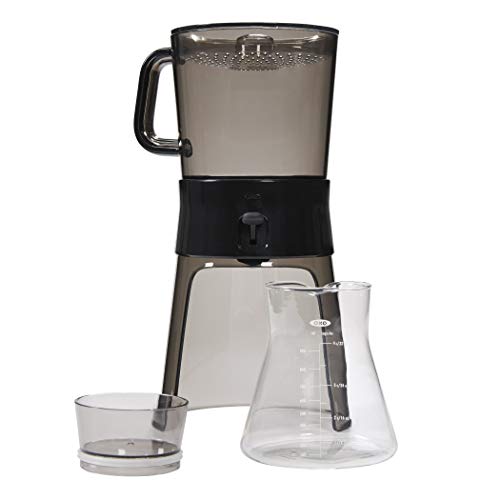
OXO Good Grips Cold Brew Coffee Maker, 32 oz with Rainmaker top
32 ozRainmaker topBrew-release switchConcentrate
Check price on Amazon
Best for: People who want a tidy workflow and a concentrate to dilute.

The OXO takes a different route from most pitchers. You pour water over the grounds through a Rainmaker top that sprays it evenly, so every particle gets wet instead of leaving dry pockets. After the long steep, you flip a release switch and the concentrate drains into a carafe, so you never lift a dripping filter.

That design addresses two common failures of simple pitchers: channeling and mess. The outcome is a concentrate you dilute with water or milk, which stretches a 32 oz brew into a surprising amount of drinks. Compared with the County Line, you pay for the engineered top and drain, and you give up a one-piece jar you can toss in the dishwasher.

Plan the first brew with a coarse grind, because a fine grind clogs the drain. Rinse the parts the same day, and let them dry fully before stacking. The pieces are plastic and silicone, so replacement gaskets are easy to find and worth keeping.

What works

  • Rainmaker top wets the grounds evenly
  • Release switch drains without lifting a filter
  • Concentrate stretches across many drinks
  • Easy-access design cuts the mess

Watch out for

  • More parts to clean than a simple pitcher
  • Fine grinds can clog the drain
  • Plastic pieces are less rugged than glass

Spec sheet

Capacity
32 oz brew
Water delivery
Rainmaker top spreads water over grounds
Drain
Brew-release switch
Output
Low-acid concentrate
Method
Immersion with slow drip filtration
02
VINCI Express electric cold brew maker, 47 oz, 3 strengths
47 oz10 minute brew3 strengthsElectric
Check price on Amazon
Best for: Impatient drinkers who want cold brew the same afternoon.

VINCI skips the overnight wait entirely. An electric brewer circulates cold water through the grounds with what the maker calls Circle Flow, finishing in about ten minutes instead of the usual 18 to 24 hours. Three strength settings let you steer concentration, and a 47 oz capacity makes a decent batch.

Speed is the selling point, but there is a tradeoff in character. Fast mechanical agitation does not replicate a slow steep exactly, so the cup can taste different from a classic overnight batch. Picture it as a good fit for someone who decides at lunchtime that they want iced coffee at three. Next to the OXO, it costs more and needs an outlet, but it removes waiting.

Because it has a motor and a pump, it needs more care than a jar. Rinse the brew chamber and the filter after each batch, and descale the lines on a regular basis. Keep it dry when stored.

What works

  • Brews in about ten minutes
  • Three strength settings
  • 47 oz capacity per batch
  • No planning ahead needed

Watch out for

  • Costs more than any pitcher
  • Motor and pump add wear points
  • Flavor differs from a long overnight steep

Spec sheet

Capacity
47 oz
Brew time
About 10 minutes
Strength
3 selectable strengths
Technology
Circle Flow circulation
Power
Electric
03
County Line Kitchen 64 oz glass cold brew pitcher with mesh filter
64 ozGlassMesh filterLeak-proof lid
Check price on Amazon
Best for: Large-batch households who like a simple glass jar.

This is the plain jar-and-filter design done sensibly. A stainless steel mesh basket holds the grounds inside a 64 oz glass pitcher, and the lid is built to pour without leaking. You add coarse coffee and cold water, wait overnight, then lift out the basket.

The mesh does a decent job of keeping grit out of the cup, though no mesh is as fine as paper. At 64 oz, it makes a large batch that stays good for about a week or two in the fridge, depending on the lid seal. Compared with the OXO, there is no clever top or drain, so you lift a wet basket and let it drip.

Glass is easy to inspect for staining and does not hold flavors the way plastic can. Wash the basket with a brush, and check the lid gasket for wear. A heavy full jar needs a steady hand when pouring.

What works

  • 64 oz glass pitcher makes a big batch
  • Stainless mesh filter keeps grit down
  • Leak-proof lid for fridge storage
  • Glass does not hold stale flavors

Watch out for

  • Mesh is coarser than paper filtration
  • Lifting a wet basket is messy
  • Full glass jar is heavy

Spec sheet

Capacity
64 oz
Material
Glass
Filter
Stainless steel mesh
Lid
Leak-proof, easy pour
Method
Immersion steep in the fridge
04
Takeya Premium cold brew maker, 2 quart Tritan pitcher
2 quartTritanAirtight lidFits fridge door
Check price on Amazon
Best for: Offices, dorms and families who worry about glass breaking.

Takeya's pitcher is built from shatter-proof Tritan, which matters if the jar lives in a busy fridge or travels to an office. An airtight twist lid keeps the brew fresh and resists leaks, and the 2 quart size fits in most refrigerator doors.

At 64 oz of water the batch is the same as the County Line, but the body weighs less and does not break. The price of this is that plastic can pick up odors over time and may stain from dark coffee, so use fresh water and clean it thoroughly. Against the OXO, it is simpler and cheaper but less tidy at draining.

Wash it by hand and avoid abrasive pads. Keep the lid gasket clean, and replace it if it hardens. The stainless infuser stays in place while you pour.

What works

  • Shatter-proof Tritan body
  • Airtight twist lid keeps brew fresh
  • Compact size fits most fridge doors
  • Lighter than glass when full

Watch out for

  • Plastic can pick up odors and stains
  • No drain or release switch
  • Filter basket must be lifted by hand

Spec sheet

Capacity
2 quarts
Material
BPA-free Tritan
Lid
Airtight, leak-resistant twist lid
Fit
Compact for most refrigerators
Method
Immersion steep
05
Maestri House 40 oz Tritan cold brew pitcher with ratio scale
40 oz350-mesh filterRatio markingsTritan
Check price on Amazon
Best for: First-time cold brewers who want ratio guidance printed on the jar.

Maestri House targets beginners who do not know how much coffee to use. Scale markings on the pitcher and filter show the coffee and water amounts, which removes the guessing that ruins first batches. A 350-mesh ultra-fine filter holds back more sediment than a typical coarse basket.

Ratio is the biggest lever in cold brew, because too little coffee gives weak tea and too much gives bitter sludge. Having it printed on the jar makes the first week easier. The filter's fineness may also slow the drain, so grind coarsely. Against the Takeya, it is smaller but smarter.

Wash the fine filter with a soft brush and rinse it from the back to clear trapped grounds. Dry it fully, since fine mesh holds moisture and can pick up odors.

What works

  • Printed ratio guide takes the guesswork out
  • 350-mesh filter holds back sediment
  • Tritan body resists breakage
  • Zero-leak sealing design

Watch out for

  • Fine mesh can slow draining
  • 40 oz is smaller than other pitchers
  • Plastic can retain odors

Spec sheet

Capacity
40 oz
Filter
350-mesh ultra-fine
Guide
Scale marks for coffee and water ratios
Material
BPA-free Tritan
Sealing
Zero-leak design
06
OVALWARE airtight cold brew maker, 34 oz borosilicate with tea infuser
34 ozBorosilicateAirtightTea infuser
Check price on Amazon
Best for: Singles and couples who also want cold-steeped tea.

OVALWARE uses borosilicate glass, which tolerates temperature swings better than ordinary glass. That makes it a good choice if you also want to steep hot tea or move the pitcher from a warm counter to a cold fridge. The filter is a laser-cut 18/8 stainless basket, and an airtight lid keeps the brew fresh.

A one-liter size suits a single person or a couple. The included tea infuser turns it into a cold-steeped tea pitcher as well, which doubles its use. Compared with the County Line, it is smaller but better built for temperature changes.

Handle borosilicate with care, since it can still chip at the rim. Clean the basket with a brush and let the parts dry before reassembling. Replace the lid gasket if you see cracks.

What works

  • Borosilicate glass handles temperature changes
  • Laser-cut stainless filter
  • Tea infuser doubles the use
  • Airtight lid with handle

Watch out for

  • Smaller capacity at about 34 oz
  • Glass can chip at the rim
  • Needs hand washing

Spec sheet

Capacity
1.0 L, about 34 oz
Material
Borosilicate glass
Filter
18/8 stainless laser cut
Extras
Tea infuser and spout
Sealing
Airtight lid with handle

Spec sheet decoder

What the numbers on the box really mean

The specs manufacturers lead with, translated into what they tell you about real-world performance.

Immersion steep

Coffee grounds sit in water for hours, extracting slowly. It is the classic cold brew method.

Watch forMost pitchers here use it, while the VINCI circulates water instead.

Mesh count

How fine the filter openings are. A higher number holds back finer particles.

Watch forThe Maestri House lists 350 mesh; some mason pitchers list 100 micron filters.

Concentrate

A strong cold brew you dilute with water or milk. It stretches a small batch across many drinks.

Watch forThe OXO is designed to make concentrate.

Borosilicate glass

A glass that handles temperature changes better than standard soda-lime glass. It is less likely to crack.

Watch forThe OVALWARE uses it, while the County Line uses standard glass.

Brew time

How long a batch takes from start to drinkable. Pitchers take overnight; electric brewers take minutes.

Watch forThe VINCI brews in about ten minutes.

Methodology

How We Evaluated These Cold Brew Coffee Makers

Extraction method

We compared slow immersion pitchers with the VINCI's electric method. The OXO's evenly wetted bed and the VINCI's circulation were treated as the most engineered options. We did not claim that faster is better.

Filtration quality

We looked at mesh fineness and basket design. The Maestri House's 350-mesh filter and the OVALWARE's laser-cut basket stood out for sediment control. Coarser mesh scored lower for grit.

Material choice

We weighed glass against Tritan. Glass wins on flavor purity, and Tritan wins on resilience. We noted that the OVALWARE's borosilicate adds temperature tolerance.

Workflow and mess

We asked how easily a batch goes from steeping to the glass. The OXO's release switch was the cleanest, and a lift-out basket was the messiest. Cleanup mattered for weekly use.

Size and storage

We compared capacities from the 32 oz OXO to the 64 oz County Line. Fridge fit and household size decide the right choice, so we noted both.

Decision guide

How to Choose the Right Cold Brew Coffee Makers

By How You Drink It

SituationPickWhy
Want it same-dayVINCI ExpressAbout ten minutes per batch
Dilute concentrate dailyOXO Cold Brew32 oz of concentrate with a release switch
Big weekly batchCounty Line 64 ozLarge glass pitcher
Crowded fridge doorTakeya 2 quartCompact Tritan pitcher
First-time brewerMaestri House 40 ozPrinted ratio guide
Also steep teaOVALWARE 34 ozBorosilicate with tea infuser

By Budget

Budget tierPickWhy
Lowest spendCounty Line 64 ozSimple glass pitcher
Low-midTakeya 2 quartShatter-proof body
MidMaestri House 40 ozFine filter and ratio marks
HigherOXO Cold BrewRainmaker top and drain
TopVINCI ExpressElectric fast brewing

Steep in the Fridge vs Electric Brewing

Fridge steep

The County Line, Takeya, Maestri House, OVALWARE and OXO all rely on time. They cost less and produce a smooth, low-acid cup, but you must plan ahead.

Electric brewing

The VINCI circulates water to finish in about ten minutes. It costs more and needs an outlet, but nothing waits overnight.

Choose a pitcher if you plan your week; choose the VINCI if you decide on a whim. Many owners end up with both, a jar steeping in the fridge for the weekly supply and an electric brewer on hand for the days the jar runs dry.

Material Axis

PreferencePickWhy
Pure glass flavorCounty Line 64 ozStandard glass pitcher
Temperature toleranceOVALWARE 34 ozBorosilicate
Break resistanceTakeya 2 quartTritan body

For Smooth, Low-Acid Coffee Specifically

Look for

Look for even wetting, a fine filter and a ratio you can repeat. Coarse grounds and a full 12 to 18 hour steep help extract sweetness without harshness. Medium or dark roasts give a chocolate-forward cup that stands up to milk, while a light roast steeped cold tastes fruity and tea-like, so choose the bean to match the glass you plan to pour.

In this comparison

The OXO's Rainmaker top is the best at even wetting, and the Maestri House makes the ratio easy to repeat.

When to Spend More

Spend more if

Spend more if you brew several times a week and want less mess, which points to the OXO, or if you want same-day batches, which points to the VINCI.

Save if

Save if you brew once a week. The County Line glass jar does the job for little money, and putting the savings toward fresh, coarsely ground beans improves the cup more than any hardware upgrade.

Ownership

Maintenance schedule

The upkeep that decides whether this machine lasts two seasons or ten.

TaskIntervalWhy it matters
Wash the filter and basketAfter every batchWet grounds spoil within a day and leave a sour smell. Rinse from the back to push trapped grounds out of the mesh.
Replace the lid gasketWhen it hardens or cracksA worn seal lets air in and shortens how long the brew keeps. Spare gaskets are cheap.
Discard old concentrateWithin about a week or twoCold brew keeps longer than hot coffee but still tastes stale. Label the jar with the date.
Descale the electric brewerEvery few weeks of useThe VINCI circulates water through narrow lines, so scale builds up. Use a descaling solution according to the manual.
Dry parts fullyBefore storingA damp basket grows mildew in a closed cupboard. Air-dry everything open.

FAQ

Frequently Asked Questions

How long should I steep cold brew?

Most pitchers work best at 12 to 18 hours in the fridge, with a coarse grind. Shorter steeps taste thin and longer ones can turn bitter. Taste a sample at 12 hours and decide.

What grind should I use?

Coarse, similar to coarse sea salt. Fine grounds slip through mesh and clog drains, and they over-extract during a long steep.

Is cold brew really less acidic?

It tastes smoother because cold water extracts fewer of the sharp compounds. Acidity numbers vary, so think of it as tasting mellow rather than being medically gentle.

How long does cold brew keep?

A sealed pitcher often keeps about a week to two in the fridge. Concentrate lasts a bit longer than diluted coffee, so dilute per glass.

Is the electric brewer worth it?

If you want cold brew without planning ahead, yes. The VINCI finishes in about ten minutes and offers three strengths, but it costs more and tastes slightly different from a long steep.

Can I make hot coffee in these pitchers?

Only if the maker says so. Standard glass can crack from boiling water, and some listings warn against it, so use a borosilicate pitcher like the OVALWARE for hot tea.

Bottom line

The short version

Browse more cold brew coffee makerson Amazon →
James Miller, Lead Machine Editor

About the author

James Miller

Lead Machine Editor, MachineFanatic

James Miller leads MachineFanatic's buying guides, turning spec sheets, manuals and owner feedback into clear verdicts on power tools, outdoor power equipment, shop machines and kitchen machines.

More from James →

Keep reading

Related guides