
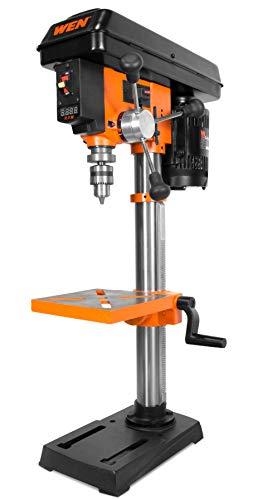
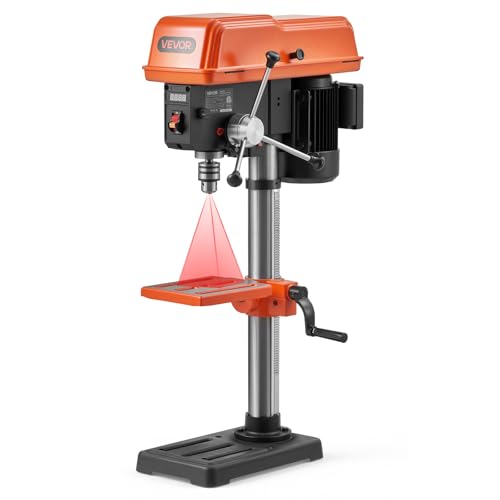


An induction motor has no brushes to wear and runs far quieter than the universal motors found in handheld drills, which is why the quoted 6.2 amps here translates to smooth torque at low speed. A mechanical variable-speed system lets you dial RPM anywhere between 530 and 3,100 without moving a belt, so switching from a 1 inch Forstner bit in hardwood to a small twist bit in steel takes seconds. The digital readout shows the actual spindle speed, which removes the guessing that makes belt-and-pulley machines slow to set up.
The tradeoff is complexity. A variable-speed pulley system has more parts than a five-step belt, so over years it needs more attention than the SKIL DP9505 with its simple stepped belt. Compared with the JET JWDP-10, the WEN gives you the digital readout and continuous speed adjustment, while the JET offers a more established name and a table that tilts to 45 degrees in either direction. The 2 inch spindle travel is the standard for this class and is enough for most holes.
Ownership: check table squareness with a machinist's square when you assemble it, and shim the table if it is off. Keep the quill return spring tension set so the quill rises without slamming. Wipe the column and apply paste wax so the table glides, and clean the variable-speed pulleys with a dry brush a few times a year to keep the speed control from sticking.
What works
- Induction motor runs quietly with strong low-speed torque
- Variable speed from 530 to 3,100 RPM without belt changes
- Digital readout shows the actual spindle speed
- 10 inch swing with a cast iron build resists vibration
Watch out for
- Variable-speed pulley system has more wear parts than a belt
- Table squareness may need shimming after assembly
- Laser guides lose accuracy if the head is knocked
Spec sheet
- Motor
- 6.2 amp induction
- Swing
- 10 inches
- Spindle travel
- 2 inches
- Speed
- 530 to 3100 RPM, variable
- Extras
- Digital RPM readout and laser