


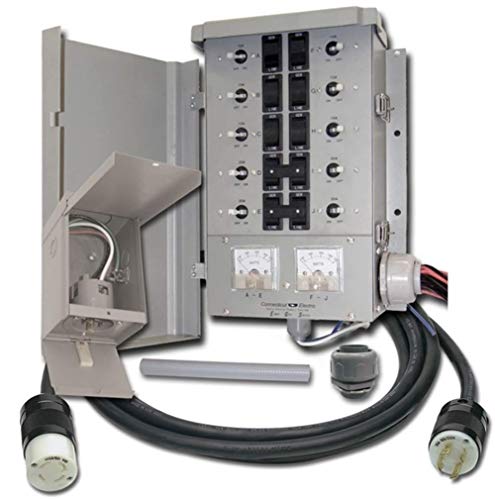
Forty amps at 240 volts works out to 9,600 watts, and that ceiling is the reason this variant tops the guide. It slides in behind the meter, so the generator plugs into an outside cable and the house is separated from the grid by the device itself. The listing calls it automatic, which spares you from walking to the panel in the dark, and it names a surge-protected version.
Homes with up to 200 amp service are supported per the listing, so a large house is not locked out; the generator supplies only what its own rating and this 40A limit allow. Compared with the 30A sibling, you gain roughly 2,400 additional watts of headroom, which can be the difference between running a well pump and a dryer at once. Against a panel kit like the Reliance A306C, you give up choosing circuits and gain whole-house reach.
The real homework is administrative. Ask the utility whether it allows meter-socket adapters, whether a lineman must reseal the meter, and whether a permit applies. Keep the generator cable coiled and dry between outages, and look at the weather-resistant housing for cracks each spring because it sits in the sun and rain for years.
What works
- 40A at 240V allows about 9,600W of supply
- Meter-socket design leaves the panel untouched
- Surge version adds protection for electronics
- Automatic transfer needs no trip to the panel
Watch out for
- Needs utility approval and usually a pro install
- Does not select individual circuits
Spec sheet
- Rating
- 40A at 240V
- Mounting
- Behind the utility meter
- Operation
- Automatic transfer
- Surge
- Surge-protection version
- Service size
- Listing says up to 200A service