
Amazon affiliate links - we earn a commission.Affiliate disclosure

Buying guide · 15 min read · Updated 2026-11-25

Best Espresso Machines Under $100 (2026)

Six espresso machines at or under $100, from De'Longhi Classic and Chefman to OLIXIS, Spacekey and AMZCHEF thermoblock models, with honest bar-rating advice.

James MillerBy James MillerLead Machine Editor6 machines comparedSpec-sheet verified
Best Espresso Machines Under $100

At a glance

Our top picks

Side by side

Spec comparison

An entry-level espresso machine pushes hot water through a packed puck of coffee under pressure. At this price you are buying a small pump, a fast-heating element and a steam wand, and the quality of the shot depends as much on your grinder, your dose and your tamp as on the box.

Prices move, and the $100 cap used here reflects live listing prices when this guide was updated. Pressure ratings on the box are marketing numbers, so the guide decodes them and compares what actually differs: heater type, steam wand, baskets and how forgiving the machine is for a beginner.

Before you buy

6 Criteria to Look For Before Buying an Espresso Machine Under $100

  1. 01

    What the bar number means

    Espresso is brewed at about 9 bar at the coffee puck. A 15 or 20 bar figure on the box is the vibratory pump's maximum against a blocked system, not the brew pressure. A machine with a good pressure limiter brings the puck to around 9 bar regardless of the headline, and a cheap one may not. Treat the De'Longhi's 9 bar claim as the honest one, and 20 bar as marketing. A quick sanity check is to read the maker's own description of what the pressure limiter does, because a machine that never mentions a limiter or an extraction pressure is likely leaving puck pressure to chance. Shots that gush in ten seconds usually point to a pressure or grind problem, not a defective machine.

  2. 02

    Thermoblock and temperature stability

    Every machine here heats water on demand with a thermoblock, which warms up quickly and switches between brew and steam but swings in temperature more than a boiler. A PID, as on the AMZCHEF, tightens the control but cannot fix the small thermal mass. Run a blank shot to warm the group before pulling the real one. If shots taste sour, the water is too cool, and if bitter, too hot. On a thermoblock you can nudge temperature by flushing a little water before the shot, which cools the block, or by running a quick blank shot to heat it. Treat those tricks as tuning aids, not fixes, and accept that a machine this size will never match a boiler for consistency.

  3. 03

    Pressurized baskets and grinders

    Most machines in this band ship with pressurized baskets that add a restrictor hole so pressure builds regardless of grind. They are forgiving, but the crema is artificial and extraction is capped. A non-pressurized basket demands a fine, consistent grind and a decent burr grinder. Budget more for the grinder than you think, since grind quality drives shot quality. A hand grinder with a steel burr set costs less than most machines here and outperforms a blade grinder by a wide margin. If you only have pre-ground coffee, the pressurized basket is the right choice and you should buy small bags to keep it fresh.

  4. 04

    Steam wand and milk

    A manual steam wand makes real microfoam with practice, while an automatic frother is easier but less flexible. The AMZCHEF's wand swivels 360 degrees and the AERCANA's makes dry steam. Purge the wand before use and wipe it after, since milk protein bakes on quickly. A thermoblock recovers steam power slowly, so work in short batches.

  5. 05

    Heat-up time and wattage

    The AMZCHEF and OLIXIS list a 30 second preheat on 1350W, the Spacekey 45 seconds and the AERCANA a 1450W heater. Fast heat-up is a convenience for mornings. It is not a measure of shot quality. Check that the group head and portafilter also warm, because a cold portafilter steals heat from the first shot.

  6. 06

    Support, parts and descaling

    At this price a machine is a wear item, and parts support decides how long it lasts. De'Longhi sells baskets, gaskets and descaler widely, while smaller brands often do not. Descale every month or two, since scale clogs a thermoblock. Use filtered water to extend the interval.

Detailed reviews

The 6 best espresso machines under $100, explained

01
De'Longhi Classic Espresso Machine with Manual Milk Frother, 9 Bar
9 bar extractionThermoblockManual steam wandCompact
Check price on Amazon
Best for: Beginners who want a recognized brand, honest pressure and easy parts support.

The De'Longhi Classic cites a 9 bar extraction, which is the pressure that espresso is actually brewed at, rather than the inflated pump maximums on cheaper boxes. A thermoblock heater reaches brewing temperature quickly, and an easy-to-use milk frother handles lattes and cappuccinos. The matte black finish and compact body suit a small counter.

The honest point about this machine is the restraint: it does not chase a 20 bar headline, because the brewing target is nine. Against the OLIXIS and Spacekey, it has a lower bar number and less raw heating wattage, but it comes from a company with filter baskets, gaskets and descaler easy to find. For a beginner, that support is worth more than a bigger number on the front.

Expect to use the supplied pressurized baskets at first, which forgive grind and tamp errors. Descale every month or two, wipe the steam wand after each use and keep the drip tray empty. Pair it with a burr grinder when you can, since a good grinder improves shots more than any machine upgrade. A simple routine for a first week is 18 grams in, 36 grams of liquid out in about 28 seconds, then adjusting the grind finer or coarser by one step until the shot tastes balanced rather than sour or bitter. Keep notes on the grind setting and bag, because every new batch of beans shifts the sweet spot.

What works

  • 9 bar extraction target
  • Thermoblock heats quickly
  • Established parts and filters
  • Compact body

Watch out for

  • Pressurized baskets cap flavor
  • Steam wand takes practice
  • Thermoblock swings in temperature

Spec sheet

Extraction
9 bar high-pressure extraction
Heater
Thermoblock
Milk
Easy-to-use frother
Finish
Matte black
Support
Established parts and filters
02
OLIXIS 20 Bar Compact Espresso Machine, 1350W Boiler, Four Modes
20 bar pump1350W30s preheat4 modes
Check price on Amazon
Best for: Buyers who want fast heat-up and four pre-set modes.

The OLIXIS pairs a 20 bar rated pump with a 1350W heating system that preheats in about 30 seconds and NTC temperature control. Four modes, single shot, double shot, hot water and steam, cover the common drinks. A stainless steel body and a steam wand finish the package.

The 20 bar number is a pump maximum, so the real brew pressure at the puck depends on the machine's pressure limiter and your grind. Next to the De'Longhi, it offers more heating power and more modes, but less documentation about what the machine actually does at 9 bar. For a buyer who wants fast warm-up and a full set of buttons, it is the stronger spec sheet.

Use a fine grind and tamp firmly if the machine accepts a non-pressurized basket, and keep a thermometer on the steam wand in mind. Descale monthly, since a 1350W boiler scales fast in hard water. Purge the steam wand before and after use. The four-mode layout also makes hot water for an Americano a single press, so you can pull a double shot and top it up without carrying a kettle across the kitchen. Let the machine cool before moving it, because hot water left in the thermoblock can leak onto the counter.

What works

  • 1350W heater preheats in about 30 seconds
  • NTC temperature control
  • Four brew and steam modes
  • Stainless steel body

Watch out for

  • 20 bar is a pump rating, not brew pressure
  • Limited documentation on baskets
  • Scales quickly in hard water

Spec sheet

Pump
20 bar rated
Heater
1350W, preheats in 30 seconds
Control
NTC temperature control
Modes
Single, double, hot water, steam
Body
Stainless steel
03
Spacekey CM5080 20 Bar Espresso Machine with Milk Frother, 1350W
20 bar pump1350W45s heat-upPre-infusion
Check price on Amazon
Best for: Beginners who want pre-infusion and a one-touch Americano mode.

The Spacekey CM5080 uses a 20 bar rated pump and a 1350W boiler that reaches the set temperature in about 45 seconds. Before extraction it applies low pressure to saturate the coffee puck gradually, a pre-infusion step that reduces channeling. An Americano mode and customizable volumes round out the controls.

Pre-infusion is the feature to watch, since it helps even extraction, particularly with a pressurized basket. Set beside the OLIXIS, it adds pre-infusion but a slightly slower heat-up. Measured against the De'Longhi, it has more features but less brand support.

Fill the water tank with filtered water and run a rinse shot before first use. Wipe the portafilter and basket after every shot, and descale on schedule. If extraction runs too fast, grind finer and tamp level. Pre-infusion is gentle enough that it can make stale or coarse coffee taste a bit better than it deserves, so judge the machine with fresh beans before deciding. When pulling several shots in a row, wait a minute between them so the heater can recover and the group head does not overheat.

What works

  • Low-pressure pre-infusion
  • 1350W boiler
  • Americano mode
  • Customizable volumes

Watch out for

  • 45 second heat-up is slower than rivals
  • 20 bar is a pump rating
  • Less brand support

Spec sheet

Pump
20 bar rated
Heater
1350W, ready in about 45 seconds
Pre-infusion
Low-pressure saturation of the puck
Modes
Americano mode and custom volume
Body
Stainless steel
04
AMZCHEF Compact 20 Bar Espresso Machine with PID and One-Touch Brewing
20 bar pumpPID control30s heat-up1350W
Check price on Amazon
Best for: Buyers who care about brew temperature stability and a flexible steam wand.

The AMZCHEF Compact lists a 20 bar pump, a 1350W heater that preheats in about 30 seconds, PID temperature control and a steam wand that swivels 360 degrees. One-touch brewing handles shots, and the machine warms cups as it heats. The PID is the notable feature in this price band, since temperature stability is one of the main weaknesses of a thermoblock.

Against the OLIXIS, it adds PID and a rotating wand but not much else. Against the Chefman, it has a higher pump rating and a faster heater. A PID on a thermoblock still shows more swing than on a boiler, so do not expect prosumer behavior.

Run a purge cycle before pulling a shot, and keep the grounds level in the basket. Descale regularly, and empty the drip tray before it overflows. For milk drinks, start the milk first with the steam wand, then pull the shot, because thermoblock steam is strongest right after the heater switches modes. Give the steam wand a ten second purge, wipe it with a damp cloth and flush it again so the next shot has no milk residue in its water path.

What works

  • PID temperature control
  • 1350W with 30 second preheat
  • 360 degree steam wand
  • One-touch brewing

Watch out for

  • PID on a thermoblock still swings
  • 20 bar is a pump rating
  • Plastic parts in the water path

Spec sheet

Pump
20 bar rated
Heater
1350W, preheats in 30 seconds
Control
Stable PID temperature
Steam
360 degree rotating wand
Drinks
Americano, latte, cappuccino
05
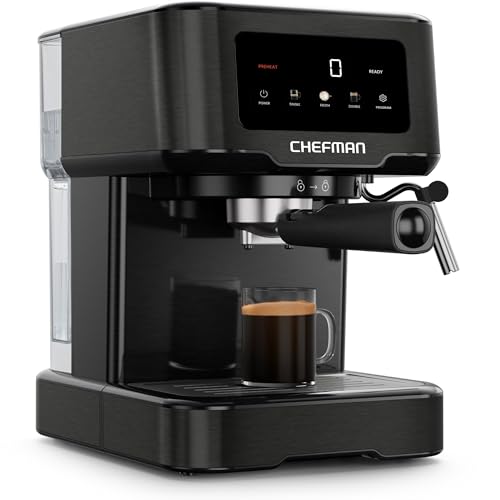
Chefman CraftBrew 15 Bar Digital Espresso Machine with Steam Wand
15 bar pumpDigital touch2 shot optionsSteam wand
Check price on Amazon
Best for: Beginners who want a simple touch panel and a compact body.

The Chefman CraftBrew has a 15 bar pump, a digital touch panel, single and double shot options and a steam wand for lattes and cappuccinos. The 15 bar rating is closer to the realistic range than the 20 bar numbers elsewhere, and the touch panel makes the machine easy to operate. A compact body fits tight counters.

Next to the AMZCHEF, it has a lower pump rating and no PID claim, but a simple digital interface. Next to the De'Longhi, it has a touch panel instead of knobs, which is a convenience but also an electronic part that can fail. It suits beginners who want a clean, simple look.

Wipe the touch panel with a dry cloth and avoid steam near it. Descale on schedule and keep the water tank filled with filtered water. Use fresh beans ground just before brewing. The two shot options are pre-programmed volumes, so tune them to your own dose by running the programming mode once and saving a volume that tastes right. If the panel reports an error after a long idle, unplug the machine for a minute and re-prime the pump by running water through the group.

What works

  • 15 bar rating is more realistic
  • Digital touch panel
  • Single and double shot options
  • Compact body

Watch out for

  • Touch panel is a failure point
  • No stated temperature control
  • Plastic body

Spec sheet

Pump
15 bar rated
Control
Digital touch panel
Shots
Single and double
Milk
Steam wand
Body
Compact
06
AERCANA 20 Bar Espresso Machine with Pressure Gauge and 1450W Heater
20 bar pump1450WPressure gaugeSteam wand
Check price on Amazon
Best for: Learners who want a gauge to watch while they dial in grind and tamp.

The AERCANA is a semi-automatic machine with a 20 bar pump, a 1450W fast-heating system, a visible pressure gauge and a steam wand that makes dry, consistent steam. The gauge is the draw: you can see the pressure while a shot runs and learn how grind and tamp change it. A 1450W heater is the highest wattage in this guide.

The gauge reading is not the same as pressure at the puck, since tubing and the pump add loss, but it is still a useful training tool. Set beside the Spacekey, it has a gauge and a stronger heater, but no pre-infusion claim. Measured against the De'Longhi, it offers more spec at less brand support.

Pull a few test shots with a throwaway dose to learn how the gauge moves. Descale monthly, and clean the steam wand tip with a pin if it clogs. Keep the drip tray empty. A good habit is to log the gauge reading on a fresh-ground shot and on a deliberately coarse shot, because the difference teaches you how grind controls resistance and pressure. The gauge also catches a clogged basket early, since the needle jumps above the green zone when the holes are blocked.

What works

  • Visible pressure gauge
  • 1450W fast heating
  • Powerful dry steam
  • Semi-automatic control

Watch out for

  • Gauge differs from puck pressure
  • 20 bar is a pump rating
  • Less brand support

Spec sheet

Pump
20 bar rated
Heater
1450W fast heating
Gauge
Visible pressure gauge
Steam
Powerful dry steam
Type
Semi-automatic 2-in-1

Spec sheet decoder

What the numbers on the box really mean

The specs manufacturers lead with, translated into what they tell you about real-world performance.

20 bar

The maximum pressure of the pump, measured against a blocked system. It is not the pressure at the coffee puck.

Watch forOLIXIS, Spacekey, AMZCHEF and AERCANA all list it, but real brew pressure should be near 9 bar.

9 bar

The target extraction pressure at the puck. Most espresso recipes assume it.

Watch forThe De'Longhi Classic cites it directly.

PID

A controller that holds temperature near a setpoint. It works best with a boiler.

Watch forThe AMZCHEF lists PID, but a thermoblock still shows swing.

Pre-infusion

A low-pressure soak before full pressure. It reduces channeling and evens extraction.

Watch forThe Spacekey and AMZCHEF mention pre-infusion or low-pressure saturation.

1350W and 1450W

Heater power in watts. Higher wattage reaches temperature sooner.

Watch forThe AERCANA lists 1450W and the OLIXIS, Spacekey and AMZCHEF list 1350W.

Methodology

How We Evaluated These Espresso Machines Under $100

Pressure honesty

We compared pump ratings with realistic extraction targets. The De'Longhi's 9 bar claim and the Chefman's 15 bar rating scored for honesty, while 20 bar claims were treated as pump maximums.

Heating and temperature

Stated heater wattage, preheat time and PID or NTC control were compared. The AMZCHEF and OLIXIS lead on a 30 second preheat, and the AERCANA on 1450W.

Steam and milk

Steam wand design, from the AMZCHEF's 360 degree swivel to the manual De'Longhi wand, was weighed. Wand reach and steam power matter for lattes.

Support and parts

Brand support and parts availability were considered. The De'Longhi's baskets and descaler are easy to find.

Fit at the cap

Every item is at or under the cap on its live listing. We favored honest specifications over the largest bar number.

Decision guide

How to Choose the Right Espresso Machines Under $100

By Experience Level

SituationPickWhy
First espresso machineDe'Longhi Classic Espresso Machine9 bar target and parts support
Learning to dial in shotsAERCANA 20 Bar with GaugeVisible pressure gauge
Temperature-sensitive beansAMZCHEF Compact 20 Bar with PIDPID temperature control
Even extractionSpacekey CM5080 20 BarPre-infusion
Fast and many modesOLIXIS 20 Bar Espresso Machine30 second preheat and four modes

By Budget

TierPickWhy
Lowest in the lineupOLIXIS 20 Bar Espresso MachineCheapest and well specified
Lower middleSpacekey CM5080 20 BarAdds pre-infusion
MiddleChefman CraftBrew 15 BarTouch panel
Upper middleAMZCHEF Compact 20 Bar with PIDPID control
Top of the capDe'Longhi Classic Espresso MachineBrand and support

Pump Rating vs Real Pressure

20 bar rated (OLIXIS, Spacekey, AMZCHEF, AERCANA)

A big number that is a pump maximum. Real brew pressure depends on the limiter and the basket.

9 or 15 bar (De'Longhi, Chefman)

A lower, more realistic number that matches espresso recipes.

Pick for features and support, since the number alone does not decide shot quality.

Heater and Steam

PreferencePickWhy
Fastest preheatOLIXIS 20 Bar Espresso Machine30 seconds at 1350W
Strongest heaterAERCANA 20 Bar with Gauge1450W
Flexible steam wandAMZCHEF Compact 20 Bar with PID360 degree swivel

For Milk Drinks Specifically

Look for

A steam wand that you can angle, a pre-warmed machine and a thermoblock that recovers quickly. A manual wand rewards practice.

In this comparison

The AMZCHEF's rotating wand and the AERCANA's dry steam lead, and the De'Longhi's easy frother is the beginner choice.

When to Spend More

Spend more if

You want a 54 mm portafilter, a built-in grinder or a heat exchanger. Higher tiers give better temperature stability and shot repeatability.

Save if

You make milk drinks occasionally, in which case a compact machine with a good grinder is enough.

Ownership

Maintenance schedule

The upkeep that decides whether this machine lasts two seasons or ten.

TaskIntervalWhy it matters
Descale the machineEvery 4 to 8 weeksScale clogs thermoblock channels. Use the maker's descaler or citric acid.
Purge the steam wandAfter every useMilk protein bakes into the tip. A quick purge and wipe keeps it clear.
Empty the drip trayDailyA full tray overflows onto the counter. Rinse it and dry it.
Rinse the portafilter and basketAfter every shotOld grounds go rancid. Rinse with hot water and dry.
Replace the group gasketYearlyA hardened gasket leaks and weakens pressure. Replacements are cheap.

FAQ

Frequently Asked Questions

Is 20 bar better than 9 bar?

No. 20 bar is a pump maximum, while espresso is brewed at about 9 bar at the puck. A machine with a good limiter delivers 9 bar regardless.

What does the $100 cap buy?

It buys a compact thermoblock machine with a steam wand and pressurized baskets. The cap reflects listing prices when this guide was updated.

Do I need a grinder?

Yes, for the best shots. A burr grinder improves flavor more than a machine upgrade, and pre-ground coffee goes stale fast.

How long do these machines last?

Two to four years with regular descaling. Pumps and gaskets are the usual wear points.

Can I make real latte art?

With practice, a good steam wand can make microfoam. Thermoblock steam recovers slowly, so work in short batches.

What are pressurized baskets?

They add a restrictor so pressure builds regardless of grind. They are forgiving but cap flavor and create artificial crema.

Bottom line

The short version

Browse more espresso machines under $100on Amazon →
James Miller, Lead Machine Editor

About the author

James Miller

Lead Machine Editor, MachineFanatic

James Miller leads MachineFanatic's buying guides, turning spec sheets, manuals and owner feedback into clear verdicts on power tools, outdoor power equipment, shop machines and kitchen machines.

More from James →

Keep reading

Related guides