
Amazon affiliate links - we earn a commission.Affiliate disclosure

Buying guide · 12 min read · Updated 2026-11-07

Best Food Processors for Grinding Meat (2026)

Seven food choppers and processors that mince boneless meat, compared by motor, bowl material, blade design and cleanup, with tips for chilled-meat batches.

James MillerBy James MillerLead Machine Editor7 machines comparedSpec-sheet verified
Best Food Processors for Grinding Meat

At a glance

Our top picks

Side by side

Spec comparison

MachineMotorUseBowlsSpeeds
LINKChef 10-Cup 600W Stainless Meat ChopperBest OverallLINKChef 10-Cup 600W Stainless Meat Chopper600 WMeat, vegetables, saucesn/an/a
Ganiza Dual-Bowl Chopper 8-Cup Stainless and GlassBest Value Dual BowlGaniza Dual-Bowl Chopper 8-Cup Stainless and Glassn/aChopper and meat grinder8-cup stainless plus 8-cup glassTwo
800W 3-Liter 18/10 Stainless Meat ChopperBest Large Capacity800W 3-Liter 18/10 Stainless Meat Chopper800 Wn/an/an/a
KOIOS 500W Dual-Bowl Food Chopper 8-CupBest Copper MotorKOIOS 500W Dual-Bowl Food Chopper 8-Cup500 W copperChop, grind, minceTwo 8-cup (2 L)n/a
Savorfuze 2-Bowl Food Chopper and Meat GrinderBest Budget Dual BowlSavorfuze 2-Bowl Food Chopper and Meat Grindern/an/a8-cup glass plus a second 8-cup bowlLow and high
SPZTJK 300W 3-Speed Chopper and Meat GrinderBest Baby Food CrossoverSPZTJK 300W 3-Speed Chopper and Meat Grinder300 Wn/a8-cup 304 stainless and 8-cup glassThree
Kitchen in the Box 3-Cup 400W Mini ChopperBest Mini GrinderKitchen in the Box 3-Cup 400W Mini Chopper400 W all-copperSmall-batch mincen/aTwo

Grinding meat in a food chopper is a different job from chopping vegetables. Fat smears, gristle wraps blades, and warm meat turns to paste, so the machine and the technique both have to cooperate.

This guide looks at bowl-and-blade machines that can mince small batches of boneless meat. We compare motor strength, bowl material, blade design and how easily fat rinses off, because those details decide whether the texture is coarse and juicy or gummy.

Before you buy

6 Criteria to Look For Before Buying a Food Processor for Grinding Meat

  1. 01

    Motor watts and meat density

    Meat is far denser than vegetables, so wattage matters more here. The 800-watt 3-liter unit and the 600-watt LINKChef have headroom, the 500-watt KOIOS is middling, and the 300-watt SPZTJK needs small, partly chilled cuts. Under about 300 watts, treat any chopper as a soft-food tool.

  2. 02

    Bowl material and fat

    Stainless bowls such as the LINKChef and the 3-liter unit stay cold and rinse fat cleanly, while glass bowls like the Savorfuze's resist odors. Plastic bowls hold on to grease smell. Choose metal for raw meat and glass for vegetables when you can.

  3. 03

    Bowl size and batch

    A pound of cubed meat needs room to circulate, so the 10-cup LINKChef and the 3-liter unit grind better than 3-cup bowls. Overfilling is the main cause of paste instead of grind. Plan batches at half the bowl's brim volume.

  4. 04

    Blade design

    Bi-level S-shaped blades, as on the KOIOS, cut at two heights and keep meat from climbing the walls. A single flat blade tends to smear fat. Keep blades sharp and remove silver skin first.

  5. 05

    Overheat protection

    The Ganiza lists built-in overheat protection, which matters when grinding cold, dense loads. A cutoff saves the motor if you push too hard. It is not a substitute for resting the machine between batches.

  6. 06

    Chopper versus true grinder

    These machines chop with spinning blades and do not push meat through a plate. They give a coarse, mince-like texture. For sausage, bones or large volumes, a dedicated meat grinder is the right tool.

Detailed reviews

The 7 best food processors for grinding meat, explained

01
LINKChef 10-Cup 600W Stainless Meat Chopper
10-cup bowl600 W motorStainless parts
Check price on Amazon
Best for: People who grind a pound or two of boneless meat regularly and want a metal bowl and a strong motor.

A 600-watt motor is the number that stands out in this lineup, and the stainless steel construction is why it earns the top spot for meat. A metal bowl takes chilled meat well, stays cold longer than plastic and does not hold on to fat odors. The listing describes the parts as BPA free, which matters when raw protein sits in the bowl.

The 10-cup bowl gives room for a pound of cubed meat to move around the blades, which is the real constraint on texture. Smaller bowls crowd the meat, so the blade smears rather than cuts. Against the 300-watt SPZTJK, it offers twice the motor, and against the 800-watt 3-liter model it trades headroom for a more conventional shape.

Upkeep is straightforward but strict. Hot soapy water on the bowl and blades straight after use matters because fat hardens quickly, and dry the blade hub fully since trapped water causes spotting. Do not fill past the marked line, and pause between batches so the motor can cool.

What works

  • 600 W motor beats most chopper-style rivals
  • All-stainless bowl cleans fat well
  • 10 cups gives meat room to move
  • Handles vegetables and sauces too

Watch out for

  • Metal bowl hides the texture while you work
  • Heavier than glass or plastic options

Spec sheet

Bowl capacity
10 cups
Motor
600 W
Bowl material
Stainless steel
Blades
Sharp stainless
Use
Meat, vegetables, sauces
02
Ganiza Dual-Bowl Chopper 8-Cup Stainless and Glass
Two 8-cup bowls2-speedOverheat protection
Check price on Amazon
Best for: Cooks who want separate meat and vegetable bowls without buying two machines.

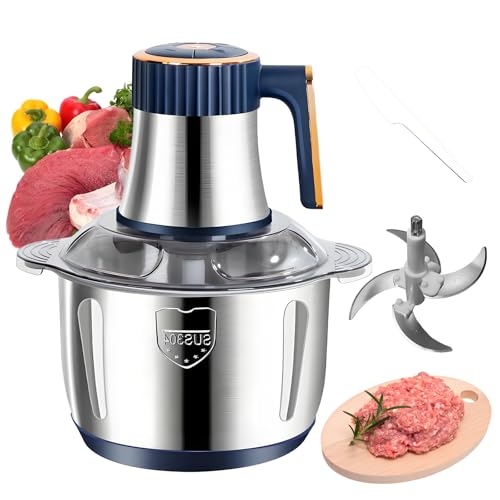
Two bowls is the idea that sets this one apart. The stainless steel bowl suits raw meat, and the glass bowl suits vegetables and sauces, so you can grind meat and then chop herbs without a full wash in between. Two sets of blades come with it, which prevents the raw-meat blade from touching food that will not be cooked.

The built-in overheat protection is a useful guard for this kind of work. Meat is dense, and a small motor grinding a cold load can heat quickly, so the cutoff protects the motor instead of letting it burn out. Compared with the LINKChef 10-cup, it offers smaller bowls but better versatility for the price.

Treat the two bowls as roles. Keep the metal one for raw proteins, wash it immediately after use, and let the glass bowl cool before rinsing to avoid thermal shock. Store blades in the bowl they belong to so you do not mix up the raw-meat set.

What works

  • Stainless and glass bowls for different jobs
  • Two blade sets keep raw and cooked prep apart
  • Overheat protection guards the motor
  • Two speeds for coarse or fine texture

Watch out for

  • Eight-cup bowls are smaller than the 10-cup LINKChef
  • Two bowls take more cabinet space

Spec sheet

Bowls
8-cup stainless plus 8-cup glass
Blades
Two sets
Speeds
Two
Safety
Built-in overheat protection
Use
Chopper and meat grinder
03
800W 3-Liter 18/10 Stainless Meat Chopper
3 L bowl800 W motor5-key control
Check price on Amazon
Best for: Big-batch cooks who make meatballs, burgers or fillings in volume.

This unit has the highest motor rating in the guide at 800 watts and the largest bowl at three liters, roughly twelve cups. That combination suits bigger batches, such as a few pounds of cubed pork for meatballs, without splitting the load. Its bowl is 18/10 stainless steel, a grade known for resisting corrosion and staining.

A five-key panel and a built-in carry handle make it more of an appliance than a gadget, and the kneading function means it can double for dough in small amounts. Beside the LINKChef, it adds capacity and wattage but offers a less familiar brand and a heavier build.

Because the bowl is big, treat weight carefully. Lift the bowl out by its handle, wash it with a long-handled brush and dry it upside down. If the motor sounds strained on a cold load, stop, remove half the meat and run it in two rounds rather than forcing the machine.

What works

  • 800 W is the strongest motor here
  • Three-liter bowl takes large batches
  • 18/10 stainless resists staining
  • Kneading mode adds dough capability

Watch out for

  • Heavy when full
  • Less established brand than the others

Spec sheet

Bowl capacity
3 liters
Motor
800 W
Material
18/10 stainless steel
Control
5-key operation
Extras
Portable handle, kneading mode
04
KOIOS 500W Dual-Bowl Food Chopper 8-Cup
500 W copper motorTwo 8-cup bowlsBi-level blades
Check price on Amazon
Best for: Cooks who want a mid-power dual-bowl chopper with a heat-conscious motor.

The KOIOS pairs a 500-watt copper-wound motor with two eight-cup bowls and two S-shaped bi-level blades. Copper windings are a sign of a motor designed to handle heat, which is what grinding repeatedly demands. The bi-level blade cuts at two heights, so meat is less likely to ride up the walls.

It sits between the 300-watt SPZTJK and the 600-watt LINKChef in power. That makes it a reasonable middle choice if you grind half-pound to one-pound batches and want separate bowls for different foods. It does not have the capacity or the wattage of the 800-watt unit, but it keeps the dual-bowl convenience.

Press-and-hold operation gives you texture control, since you can stop the instant the meat looks right. Keep the cuts cubed to roughly one inch, chill them first, and rinse the bowl in cold water before hot water so fat does not smear on the surface.

What works

  • 500 W copper motor handles repeated batches
  • Two bowls keep flavors separate
  • Bi-level blades cut at two heights
  • Two speed modes for texture control

Watch out for

  • Not as strong as the 600 W or 800 W models
  • Eight cups is modest for large batches

Spec sheet

Motor
500 W copper
Bowls
Two 8-cup (2 L)
Blades
Two S-shaped bi-level
Modes
Two speed modes
Use
Chop, grind, mince
05
Savorfuze 2-Bowl Food Chopper and Meat Grinder
Two 8-cup bowls2-speedPress-to-chop
Check price on Amazon
Best for: Occasional meat mincing of small batches on a low budget.

The Savorfuze is described by its maker as mincing small batches of boneless meat, and that honest scope is the right way to buy it. It uses two eight-cup bowls and a press-and-hold two-speed control, and the low speed is meant for gentle work. For burger patties of a half pound it will do the job.

The glass bowl is the odor-proof choice for onions and garlic, so you can pair meat and aromatics. Its trade-off is power, since the listing does not emphasise a wattage figure the way the KOIOS and LINKChef do, and tougher cuts should be cut small before they go in.

Keep batches modest, run in short bursts and let it rest. Always chill meat first and remove silver skin because it wraps blades. Wash the glass bowl after it cools to avoid cracking from sudden temperature changes.

What works

  • Low-cost entry to dual-bowl chopping
  • Glass bowl resists odors
  • Press-and-hold gives texture control
  • Handles small boneless meat batches

Watch out for

  • Wattage is not highlighted by the listing
  • Best kept to half-pound batches

Spec sheet

Bowls
8-cup glass plus a second 8-cup bowl
Speeds
Low and high
Control
Press and hold
Meat use
Small boneless batches
Tier
Low in this guide
06
SPZTJK 300W 3-Speed Chopper and Meat Grinder
300 W motor3-speedTwo 8-cup bowls
Check price on Amazon
Best for: Small batches of tender meat, baby food and soft vegetables.

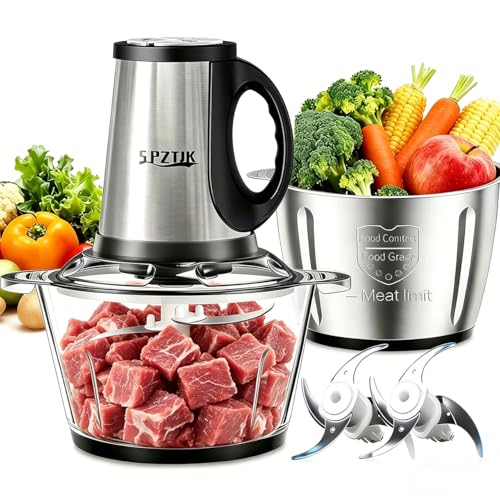
At 300 watts the SPZTJK is the lowest-powered full-size chopper in the guide, and that sets its role. It has three speeds, a 304 stainless bowl and a glass bowl, and the maker pitches it for meat, vegetables and baby food. For small, soft jobs it is quiet and handy, and the third speed gives finer control than the two-speed models.

The low wattage limits tougher loads. Cold, dense chunks of meat will stall a 300-watt motor faster than they stall the 500-watt KOIOS or 600-watt LINKChef, so cut small, chill only partly and work in short bursts. It suits poultry and tender cuts better than gristly beef.

Its dual bowls make cleanup easy, because the stainless one handles raw meat and the glass handles the rest. Wash promptly, dry the blade hub and keep the lid seated each time you run it so the safety lock engages.

What works

  • Three speeds for finer control
  • Stainless and glass bowls included
  • Quiet on soft loads
  • Useful for baby food purees

Watch out for

  • 300 W stalls on dense cold meat
  • Limited to small batches

Spec sheet

Motor
300 W
Speeds
Three
Bowls
8-cup 304 stainless and 8-cup glass
Uses
Meat, vegetables, baby food
Tier
Mid in this guide
07
Kitchen in the Box 3-Cup 400W Mini Chopper
3-cup bowl400 W motor2-speed
Check price on Amazon
Best for: Cooks for one or two who mince small portions of meat and aromatics.

A 3-cup glass bowl with a 400-watt all-copper motor is a lot of motor for a small bowl. That ratio helps with garlic, onions and small portions of meat because the blade has torque in a tight space. The two-speed buttons let you pulse coarse or hold for fine.

Its capacity is the limit. A quarter pound of cubed meat is about all it will move properly, and a full burger batch needs several rounds. If you grind meat for two, it is perfectly sized, and it stores in a drawer.

Clean the bowl and blade promptly, hold the base when pulsing so it does not creep, and never run it empty. Avoid dropping frozen meat in; partly thawed is the safe state for any small motor.

What works

  • 400 W motor in a 3-cup bowl
  • All-copper motor winding
  • Drawer-size footprint
  • Two-speed control

Watch out for

  • Only a quarter pound at a time
  • Many rounds for a family batch

Spec sheet

Bowl capacity
3 cups
Motor
400 W all-copper
Speeds
Two
Bowl
Glass
Use
Small-batch mince

Spec sheet decoder

What the numbers on the box really mean

The specs manufacturers lead with, translated into what they tell you about real-world performance.

800 W vs 300 W

The wattage spread in this guide runs from 300 to 800. Higher figures give more headroom for dense cold loads.

Watch forThe 3-liter 800 W unit is the strongest, while the SPZTJK at 300 W is the weakest.

304 and 18/10 stainless

Both are corrosion-resistant stainless grades used for food contact. 18/10 contains more nickel and resists staining slightly better.

Watch forThe SPZTJK uses 304 and the 3-liter unit lists 18/10.

Bi-level blade

A blade with two sets of edges at different heights. It cuts the whole depth of the bowl at once.

Watch forThe KOIOS and Ganiza use bi-level or two-blade designs.

Press-and-hold control

The blades spin only while the button is pressed. It lets you stop at exactly the right texture.

Watch forThe Savorfuze and Kitchen in the Box rely on this style.

Copper motor winding

Copper conducts heat and current better than aluminum. It suits a motor that runs in short, heavy bursts.

Watch forThe KOIOS and the 3-cup Kitchen in the Box both highlight copper.

Methodology

How We Evaluated These Food Processors for Grinding Meat

Motor strength

We lined up the stated wattages from 300 to 800 and treated meat as a dense load. Higher continuous ratings ranked higher for grinding. We also noted copper windings and overheat protection.

Bowl material

We compared stainless, glass and mixed bowls for fat handling and odor. Metal bowls scored well for raw proteins, and glass scored well for aromatics. Mixed sets earned points for flexibility.

Batch size

We matched bowl volume, from the 3-cup mini to the 3-liter unit, against typical meat batches. A bowl that fits a pound with room to move ranked higher. Small bowls were treated as small-batch tools.

Cleanup and hygiene

We checked whether bowls are metal or glass, whether blades are separate for raw meat, and how easily fat rinses off. Separate blade sets and smooth stainless earned credit.

Value across the range

We ordered the seven by price tier, from the Savorfuze up to the LINKChef, and asked what each step adds. Stronger motors and metal bowls arrive as you move up.

Decision guide

How to Choose the Right Food Processors for Grinding Meat

By Batch Size

SituationPickWhy
Quarter pound for one or twoKitchen in the Box 3-Cup400 W in a small bowl
Half-pound burgersSavorfuze 2-BowlDual bowls, press-and-hold
One pound weeklyLINKChef 10-Cup600 W, stainless bowl
Two to three pounds800 W 3-Liter ChopperBiggest bowl and motor
Mixed meat and vegGaniza Dual-BowlStainless and glass bowls

By Budget

TierPickWhy
LowestSavorfuze 2-BowlDual bowls at a low tier
LowSPZTJK 300WStainless and glass, three speeds
Lower midKOIOS 500WCopper motor, dual bowls
MidGaniza Dual-BowlOverheat protection
UpperLINKChef 10-Cup600 W, metal bowl

Metal Bowl vs Glass Bowl

Metal bowl

The LINKChef, the 3-liter unit and the stainless halves of the Ganiza and SPZTJK stay cold and rinse fat well. They suit raw meat.

Glass bowl

The Savorfuze, the Kitchen in the Box and the glass halves of the dual-bowl sets resist odors and let you see the texture.

Pick metal for raw meat, glass for aromatics and cooked food, or buy a dual-bowl set for both.

By Meat Type

PreferencePickWhy
Tender poultrySPZTJK 300WEnough for soft loads
Beef for burgersLINKChef 10-Cup600 W for denser cuts
Pork for meatballs in bulk800W 3-Liter ChopperLarge bowl, strong motor
Mixed batchesKOIOS 500WTwo bowls, copper motor

For Safe Meat Grinding Specifically

Look for

Separate blades or a bowl you can sanitize, metal parts that wash well and an overheat guard. Chill meat to partly frozen and cube it to about one inch. Cook ground beef to 160 F as a rule.

In this comparison

The Ganiza Dual-Bowl offers two blade sets and overheat protection, and the LINKChef offers an all-stainless bowl. Both suit careful meat handling.

When to Spend More

Spend more if

You grind a pound or more each week or work with dense cuts. Step up to the LINKChef 600 W or the 800 W 3-liter unit.

Save if

You mince small batches or poultry. The Savorfuze or SPZTJK handles that.

Ownership

Maintenance schedule

The upkeep that decides whether this machine lasts two seasons or ten.

TaskIntervalWhy it matters
Wash right after useEvery timeFat hardens as it cools and clings to blades. Hot soapy water clears it quickly.
Sanitize raw-meat partsAfter each meat batchRaw meat can leave bacteria on blades and bowls. Use hot water and soap and dry fully.
Dry the blade hubAfter washingTrapped water under the blade causes spotting and odor. Stand the blade upright to dry.
Check overheat behaviorWhen it stallsIf the motor cuts out, stop and let it cool. Repeated cutoffs mean the load is too big.
Sharpen or replace bladesWhen texture turns to pasteA dull blade smears fat instead of cutting. Replace worn blades promptly.

FAQ

Frequently Asked Questions

Can a food processor grind meat?

A bowl-and-blade chopper can mince small batches of boneless meat to a coarse texture. It does not push meat through a plate like a true grinder. Chill the cubes first for the best result.

Which motor wattage do I need for meat?

Aim for 500 watts or more for regular beef and pork. The 600-watt LINKChef and 800-watt 3-liter unit have headroom. A 300-watt unit is fine for poultry and small batches.

Is stainless or glass better for meat?

Stainless stays cold and rinses fat well. Glass resists odors and shows texture. Dual-bowl sets give you both.

How do I keep meat from turning to paste?

Chill it until firm but not frozen, cut it into one-inch cubes and pulse in short bursts. Do not overfill the bowl. Stop as soon as the texture is even.

Is it safe to grind meat at home?

It is safe when you keep the meat cold, clean the machine well and cook ground beef to a safe internal temperature of 160 F. Use separate blades or wash thoroughly between raw meat and other foods.

Can these grind bones?

No. Chopper-style machines are for boneless meat and soft food. Bones will damage blades and motors.

Bottom line

The short version

Browse more food processors for grinding meaton Amazon →
James Miller, Lead Machine Editor

About the author

James Miller

Lead Machine Editor, MachineFanatic

James Miller leads MachineFanatic's buying guides, turning spec sheets, manuals and owner feedback into clear verdicts on power tools, outdoor power equipment, shop machines and kitchen machines.

More from James →

Keep reading

Related guides