
Amazon affiliate links - we earn a commission.Affiliate disclosure

Buying guide · 12 min read · Updated 2026-11-07

Best Food Processors for Shredding Cheese (2026)

Six food processors that shred cheese cleanly, compared on feed chute size, shredding disc design, motor and bowl capacity, with tips for firm and soft cheese.

James MillerBy James MillerLead Machine Editor6 machines comparedSpec-sheet verified
Best Food Processors for Shredding Cheese

At a glance

Our top picks

Side by side

Spec comparison

Pre-shredded cheese is coated to keep it from clumping, and many cooks notice it melts less smoothly than a block shredded at home. A food processor turns a block into a fluffy pile in seconds, which is the reason cheese is one of its most popular jobs.

Cheese is a demanding load in its own way: cold, firm and sticky. What matters is a sharp disc, a feed chute wide enough for a block and a base that does not stall, so we compare machines on those three points.

Before you buy

6 Criteria to Look For Before Buying a Food Processor for Shredding Cheese

  1. 01

    Feed tube size

    A wide feed tube saves more time than a stronger motor when you shred a block. The Cuisinart 14-cup has an extra-large tube and the KitchenAid 7-cup has a 2-in-1 design. Small tubes on the Ganiza and the 4-cup Hamilton Beach force you to cut the cheese first.

  2. 02

    Cheese temperature

    Cold cheese shreds into clean strands while warm cheese smears and clogs the disc. Chill a block for about fifteen minutes before shredding, and chill soft cheese like mozzarella in the freezer for a short spell. A powerful motor does not make up for warm cheese.

  3. 03

    Motor and block hardness

    A 720-watt base like the Cuisinart 14-cup will push through a cold block of cheddar without slowing. The 250-watt Hamilton Beach mini needs small pieces. Hard cheeses like parmesan need the most power, and soft ones need sharper discs. If you mostly buy mozzarella for pizza, a gentler base with a sharp disc is better than raw wattage, while a cook who grates a wedge of aged cheese weekly should pay for the steadier motor.

  4. 04

    Bowl size and batch

    Loose shreds take up much more space than a block, so a 5-cup bowl holds about half a pound. The 12-cup Ninja and 14-cup Cuisinart hold a pound or more. Match the bowl to how much cheese you actually shred at once. Stopping to empty a small bowl is not a failure, but if you do it three times for one recipe, the machine is too small for you.

  5. 05

    Disc design and storage

    A reversible disc, as on the FP-5, gives you slice and shred on one part. The KitchenAid keeps the discs in the bowl. A sharp disc stored loose is a hazard, so choose a machine that keeps it covered.

  6. 06

    Cleanup of melted residue

    Cheese dries hard on discs, so rinse right away and use a brush. Cool water first stops it going gummy. Dishwasher-safe bowls help, but hand-wash the disc. Pushing a scrap of bread through the chute after a cheese run is an old trick that clears stuck shreds before washing.

Detailed reviews

The 6 best food processors for shredding cheese, explained

01
Cuisinart 14-Cup Food Processor 720-Watt
14-cup bowl720 W motorXL feed tube
Check price on Amazon
Best for: Households that shred pounds of cheese for lasagna, casseroles and holiday cooking.

Shredding cheese is mostly a feed-tube problem. If the opening is narrow you spend your time cutting a block into sticks, and the extra-large tube on this model takes a sizable piece so you cut much less. Its 720-watt motor then pushes the disc through cold cheddar or mozzarella without slowing.

The bowl is a big 14 cups, which suits a pound of cheese in one pass. That is where it pulls ahead of the 7-cup KitchenAid and the 5-cup FP-5, which fill quickly and need emptying midway. The cost is size: it is tall and heavy, and it wants a spot on a counter rather than a cabinet.

Chill the cheese for fifteen minutes first, since a firm block shreds into distinct strands and a warm one smears. Wash the shredding disc by hand with a brush and let it dry upright so the stainless stays clean. Top-rack the bowl and lid. The pusher has a hollow inner tube, so for a thin wedge of cheese use the small pusher and keep the wide one for full blocks. Feed the cheese at a steady, light pressure, because leaning on the pusher is what stalls a motor and tears shreds into crumbs.

What works

  • Extra-large feed tube takes a block
  • 720 W motor never bogs on cold cheese
  • 14 cups holds a pound of shreds
  • Simple two-button operation

Watch out for

  • Tall and heavy for cabinet storage
  • Too much machine for tacos-for-two

Spec sheet

Bowl capacity
14 cups
Motor
720 W
Feed tube
Extra large
Shredding disc
Medium, stainless
Controls
On and off/pulse
02
Cuisinart FP-5 5-Cup Chop and Shred
5-cup bowlReversible discNesting storage
Check price on Amazon
Best for: Small kitchens that shred cheese weekly and want compact storage.

This machine does two jobs, chopping and shredding, and shredding cheese is the job it was designed to do well. A reversible disc handles the shred, and everything nests inside the five-cup bowl, so the whole machine is the size of a mixing bowl. That makes it the clear choice for a small kitchen.

The bowl is the limit. Five cups of loosely shredded cheese is roughly a half pound, so a lasagna means emptying and running a second pass. Against the 14-cup Cuisinart it gives up volume and a feed tube of block size, and in return it is cheaper and easier to store.

Cut a block into chunks that fit the chute and chill them first. Rinse the disc right away since melted cheese hardens on it, and use a brush rather than a sponge. The reversible disc should be stored in the bowl so the sharp face is never exposed in a drawer. If you shred cheese most weeks, buy block cheese in the size that fits the chute, since a ten-ounce piece needs no cutting at all and saves a minute each time. A twice-yearly check of the lid tabs is enough upkeep for a machine this simple.

What works

  • Compact bowl nests the disc and blade
  • Cheapest dedicated chop-and-shred here
  • Reversible disc covers shredding
  • Cord stores in the base

Watch out for

  • Five cups needs second passes
  • Smaller chute means pre-cutting

Spec sheet

Bowl capacity
5 cups
Shredding
Reversible disc
Chopping
Universal blade
Storage
Parts nest in the bowl
Cord
Stores in base
03
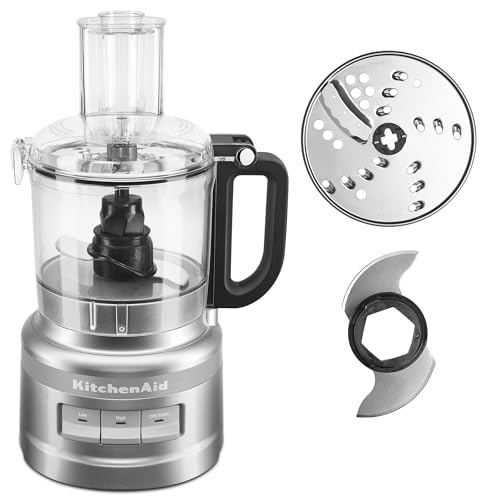
KitchenAid 7-Cup Food Processor KFP0718
7-cup bowl3 speedsIn-bowl storage
Check price on Amazon
Best for: Cooks who want a mid-size machine with tidy storage and speed control.

The KitchenAid stores every blade and disc inside its bowl, which makes the shredding disc easy to find and safe to store. The 2-in-1 feed tube gives you a wide opening for large pieces and an inner pusher for narrow items, and that suits cheese in blocks as well as cheese in chunks.

Three speeds plus pulse give more control than the FP-5's single setting, and that matters when you shred soft cheeses like mozzarella that tend to stick. Seven cups sits between the compact FP-5 and the 14-cup unit in bowl size.

Its cleanup is easy: the bowl assembles with a click and washes quickly. After shredding soft cheese, rinse with cool water first because hot water makes cheese gummy, then wash normally. Store the disc in the bowl. Owners who shred and then slice vegetables in the same session should shred the cheese last, because a cheesy disc is harder to rinse than a vegetable-stained one and the bowl stays cleaner.

What works

  • In-bowl storage for discs
  • 2-in-1 feed tube
  • Three speeds plus pulse
  • One-click bowl assembly

Watch out for

  • Seven cups is mid-size, not large
  • Pricier than the FP-5

Spec sheet

Bowl capacity
7 cups
Speeds
Three plus pulse
Storage
Blades and discs in the bowl
Feed tube
2-in-1
Tasks
Chop, shred, slice, puree
04
Ninja Professional XL 12-Cup 1200 Peak Watts
12-cup bowl1200 peak WAuto-iQ programs
Check price on Amazon
Best for: Cooks who want preset programs and a large bowl for regular cheese shredding.

The Ninja shreds through a preset program, so you press a button and let it run a timed pattern. That takes the pulse counting out of cheese shredding, which suits people who find it hard to judge. The 12-cup bowl is large enough for a pound of cheese.

The 1200-watt figure is a peak number, so do not assume it is stronger than the 720-watt Cuisinart. In practice it handles cheese well, but the claim is about burst power. The presets are tuned for general food, so check the shredding result on your first block and adjust the chill time.

Storage is the question: it is a big base with a big bowl. Rinse the disc promptly, since cheese dries stiff, and hand-wash the sharp parts. A program that stops early on a very firm block is a signal to cut it smaller. Because the base is wide, it sits steadily on a counter and does not walk during a long run, which is a quiet advantage over lighter machines when you push a block through the chute.

What works

  • Auto-iQ programs remove pulse timing
  • 12-cup bowl holds a pound of shreds
  • Covers chop, slice, shred and dough
  • Strong peak rating for cold cheese

Watch out for

  • 1200 W is a peak figure
  • Large base needs shelf space

Spec sheet

Bowl capacity
12 cups
Motor
1200 peak watts
Programs
Four Auto-iQ presets
Tasks
Chop, slice, shred, puree, dough
Blade
Ninja blade technology
05
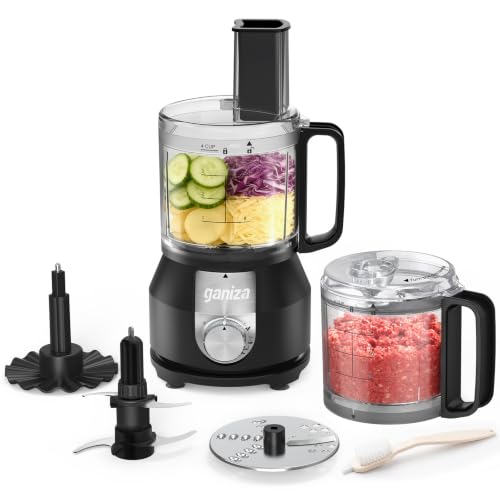
Ganiza 4-in-1 Processor with Two 4-Cup Bowls
Two 4-cup bowlsDial controlSlice, shred, mince
Check price on Amazon
Best for: Cooks who shred small amounts of cheese and want hands-free running.

This machine lists slicing and shredding among its four functions, and the dial control means it keeps running without a held button. For shredding a block that is useful, because you can feed the chute with both hands. The two small bowls keep portions manageable.

The limit is volume. Four cups holds only a few ounces of shredded cheese before it needs emptying, so a lasagna needs several rounds. The 600 peak-watt rating is also a burst figure, which suggests short runs on firm cheese.

Its small size is its strength for tacos and pizza toppings. Rinse the shredding parts right away, wipe the sealed lid and let the bowls dry fully. Do not force dry, hard cheese through the chute; cut it smaller instead. Because the lid is sealed, avoid running it with a wet disc, which can send a spray of water along the groove. A cheese that has been out for an hour is better grated than shredded in a small machine.

What works

  • Dial runs without holding a button
  • Two small bowls suit small portions
  • Covers slice, shred and mince
  • Sealed lid reduces splatter

Watch out for

  • Four-cup bowls fill fast
  • Peak-watt rating needs short runs

Spec sheet

Bowls
Two 4-cup
Motor
600 peak watts
Control
Dial for Low or High
Tasks
Slice, shred, mince, whisk
Lid
Sealed with pour groove
06
Hamilton Beach Stack and Snap 4-Cup Mini Processor
4-cup bowl250 W motorQuad blade
Check price on Amazon
Best for: Small portions of shredded cheese for tacos, salads and toppings.

The listing names cheese among the things its slice and shred function can handle, and the 4-cup bowl suits an ounce or two of cheese for a salad or a taco night. It has a 250-watt motor and a quad blade, and its Stack and Snap assembly makes the parts click together.

It is the smallest and gentlest option here. A 250-watt motor does not have the headroom for a firm block of cheddar in volume, so cut the cheese into small pieces and chill it. A leak-proof bowl with a pour spout makes the shredded cheese easy to dispense.

Use it for light daily jobs and keep it away from large blocks. Clean the bowl and attachments after each use, and store the shredding disc where it will not rub other parts. It is a sensible second machine for a household that already owns a big processor, because it saves hauling the large bowl out for a handful of cheese and takes seconds to rinse.

What works

  • Small bowl suits daily portions
  • Stack and Snap assembly
  • Leak-proof bowl with pour spout
  • Compact and easy to store

Watch out for

  • 250 W is limited with firm blocks
  • Four cups means frequent emptying

Spec sheet

Bowl capacity
4 cups
Motor
250 W
Blade
Stainless quad blade
Bowl
Leak-proof with pour spout
Tasks
Chop, puree, slice, shred

Spec sheet decoder

What the numbers on the box really mean

The specs manufacturers lead with, translated into what they tell you about real-world performance.

Extra-large feed tube

A wide opening that takes big pieces or a block of cheese with an inner pusher for smaller items. It cuts prep.

Watch forThe Cuisinart 14-cup and KitchenAid 7-cup have this feature.

Reversible disc

One disc with a shredding face on one side and a slicing face on the other. It saves storage space.

Watch forThe Cuisinart FP-5 uses one.

Peak watts

A burst rating at start-up rather than a sustained figure. It does not predict how long the motor can push a block.

Watch forThe Ninja XL lists 1200 peak and the Ganiza 600 peak.

Quad blade

A blade with four cutting edges that chops and purees in a small bowl. It does not shred.

Watch forThe Hamilton Beach mini uses a quad blade for chopping and a disc for shredding.

Auto-iQ programs

Timed run patterns that pulse and pause for you. They reduce guesswork.

Watch forThe Ninja XL lists four of them.

Methodology

How We Evaluated These Food Processors for Shredding Cheese

Chute and disc design

We compared feed tube size and the shredding disc setup on each machine. A wide chute and a sharp reversible disc ranked highest. Small chutes were noted as extra prep.

Motor against cold cheese

We lined up the 720-watt Cuisinart, the 250-watt Hamilton Beach mini and the peak-rated Ninja and Ganiza. Steady wattage counted more than a peak claim for firm blocks.

Bowl size for shreds

We matched bowl volume from 4 cups to 14 cups to typical cheese amounts, remembering that shreds fill space. Larger bowls ranked well for volume, and small bowls were credited for light daily use.

Storage and safety

We looked at how discs are stored, from the KitchenAid's in-bowl storage to the FP-5's nesting. Covered storage earned credit.

Value across the tier

We ordered the six by price tier, from the Hamilton Beach mini up to the Cuisinart 14-cup, and asked what each step adds in capacity.

Decision guide

How to Choose the Right Food Processors for Shredding Cheese

By How Much Cheese You Shred

SituationPickWhy
A few ounces for tacosHamilton Beach 4-Cup MiniSmall bowl, easy cleanup
Half a pound weeklyCuisinart FP-5Reversible disc, compact
A pound for lasagnaKitchenAid 7-Cup2-in-1 tube, in-bowl storage
Holiday and bulk shreddingCuisinart 14-Cup 720-WattXL tube and strong motor
Presets for beginnersNinja Professional XLAuto-iQ shred program

By Budget

TierPickWhy
LowestHamilton Beach 4-Cup MiniCheapest in the guide
LowGaniza 4-in-1Dial control, two bowls
Lower midCuisinart FP-5Dedicated chop and shred
Upper midNinja Professional XLPrograms and 12 cups
TopCuisinart 14-Cup 720-WattLargest bowl and tube

Compact vs Full-Size

Compact

The Hamilton Beach 4-cup, Ganiza and FP-5 take little space and suit small batches. They need pre-cut cheese.

Full-size

The Cuisinart 14-cup, Ninja XL and KitchenAid 7-cup handle blocks and pounds of cheese. They need shelf room.

Pick compact for tacos and toppings, and full-size for lasagna and bulk shredding.

By Cheese Type

PreferencePickWhy
Hard cheddar and parmesanCuisinart 14-Cup 720-WattSteady motor
Soft mozzarellaKitchenAid 7-CupSpeed control
Mixed cheeses in small amountsGaniza 4-in-1Small bowls for each
Everyday cheddarCuisinart FP-5Simple and compact

For Block Cheese Specifically

Look for

An extra-large chute, a steady motor and a sharp stainless disc. Chill the block first. Avoid forcing the pusher.

In this comparison

The Cuisinart 14-cup is the best match, and the KitchenAid 7-cup is the mid-size alternative.

When to Spend More

Spend more if

You shred pounds of cheese regularly. The Cuisinart 14-cup repays the cost with a block-size tube.

Save if

You shred a little. The FP-5 or the Hamilton Beach mini is enough.

Ownership

Maintenance schedule

The upkeep that decides whether this machine lasts two seasons or ten.

TaskIntervalWhy it matters
Rinse the disc in cool waterAfter each useHot water melts residue into a gummy film. Cool water lifts it first.
Brush the shredding holesAfter each useCheese lodges in the openings. A brush clears them without risking fingers.
Dry the disc uprightAfter washingStanding dry avoids water spots on stainless.
Wipe the baseWeeklyGrease and dust collect near the controls. Keep the base dry.
Check disc sharpnessEvery few monthsA dull disc tears cheese into crumbs. Replace it when shreds look ragged.

FAQ

Frequently Asked Questions

Why shred cheese at home?

Block cheese shreds into fluffier strands and many cooks find it melts more smoothly than bagged cheese, which is coated to prevent clumping. A processor makes it fast.

How cold should the cheese be?

Chill a block for about fifteen minutes so it is firm. Soft cheese like mozzarella benefits from a short stay in the freezer. Warm cheese smears and clogs, and a block left on the counter during prep is the most common reason a shred turns out gummy instead of fluffy.

Can I shred parmesan?

A strong motor helps with hard cheese, so the 720-watt Cuisinart is the best fit. Cut it into small chunks and use a fine disc if available. Smaller machines can struggle.

Which bowl size do I need?

Shreds are bulky, so a 5-cup bowl holds about half a pound. For a pound or more, pick 12 or 14 cups. Small bowls are fine for tacos.

Why does the cheese clump on the disc?

It is probably too warm or too soft. Chill it and use light pressure on the pusher. Clean the disc between batches, and if the disc itself is dull, no amount of chilling will fix it, so replace it when strands look torn rather than cut.

Are these dishwasher safe?

Bowls and lids usually are on the top rack. Hand-wash the shredding disc so the edge stays sharp.

Bottom line

The short version

Browse more food processors for shredding cheeseon Amazon →
James Miller, Lead Machine Editor

About the author

James Miller

Lead Machine Editor, MachineFanatic

James Miller leads MachineFanatic's buying guides, turning spec sheets, manuals and owner feedback into clear verdicts on power tools, outdoor power equipment, shop machines and kitchen machines.

More from James →

Keep reading

Related guides