
Amazon affiliate links - we earn a commission.Affiliate disclosure

Buying guide · 13 min read · Updated 2026-11-07

Best Gas Leaf Blowers (2026)

Gas leaf blowers compared: 2-cycle versus 4-cycle, handheld versus backpack, CFM and MPH decoded, with picks from light yard tools to pro machines.

James MillerBy James MillerLead Machine Editor7 machines comparedSpec-sheet verified
Best Gas Leaf Blowers

At a glance

Our top picks

Side by side

Spec comparison

MachineEngineAirflowAir speed
Husqvarna 125B 28cc 2-Cycle HandheldBest OverallHusqvarna 125B 28cc 2-Cycle Handheld28cc 2-cycle, 1.1 HP470 CFMAbout 170 MPH
SENIX 4QL 26.5cc 4-Cycle HandheldBest 4-CycleSENIX 4QL 26.5cc 4-Cycle Handheld26.5cc 4-cycle full crankUp to 410 CFMUp to 125 MPH
HTK 63cc 2-Stroke Backpack 665 CFMBest Value BackpackHTK 63cc 2-Stroke Backpack 665 CFM63cc 2-stroke665 CFMUp to 205 MPH
Echo PB-9010T 79.9cc X Series BackpackBest Pro PowerEcho PB-9010T 79.9cc X Series Backpack79.9cc 2-stroke X Series1110 CFM220 MPH
DOWILIN 28cc Handheld 495 CFM 200 MPHBest Variable SpeedDOWILIN 28cc Handheld 495 CFM 200 MPH28cc two-stroke495 CFMUp to 200 MPH
Relxxon 26cc 2-Cycle HandheldBest Easy StartRelxxon 26cc 2-Cycle Handheld26cc 2-cycle380 CFM180 MPH
Getell 26cc Handheld 380 CFMBest Quiet HandheldGetell 26cc Handheld 380 CFM26cc 2-cycle, 50:1 fuel mix380 CFM180 MPH

A gas leaf blower is a small engine driving a fan, and the machine is judged by how much air it moves and how fast it moves it. Volume shifts piles of leaves; speed breaks the grip of wet, matted debris. Both come from the same engine, so displacement and fan design matter more than any badge.

The real decisions are about format and fuel. Handheld units are light and quick for small jobs, backpack units carry the weight on your hips for long sessions, and the engine type decides whether you mix fuel and oil or pour straight gasoline. This guide compares those choices and decodes the airflow numbers.

Before you buy

6 Criteria to Look For Before Buying a Gas Leaf Blower

  1. 01

    CFM and MPH together

    CFM is air volume and decides how fast you move a pile, while MPH is speed and loosens wet, matted debris. Both are maker-measured at the nozzle and are not comparable across brands. The Husqvarna 125B's 470 CFM and 170 MPH, for example, is balanced, while the SENIX 4QL's 125 MPH struggles with wet leaves. Think of CFM as how much it moves and MPH as how hard it hits; most yards need both in moderation.

  2. 02

    2-cycle versus 4-cycle

    Two-cycle engines like the Husqvarna 125B are lighter and more powerful but need a fuel and oil mix. Four-cycle engines like the SENIX 4QL run on straight gasoline but weigh more for the same output. If mixing fuel annoys you, the 4-cycle is worth the lower air speed.

  3. 03

    Handheld or backpack

    Handhelds suit small yards and quick jobs. Backpacks like the HTK 63cc and Echo PB-9010T carry weight on the hips and suit sessions beyond 20 or 30 minutes. If your yard takes more than half an hour, pick a backpack. Try holding a handheld at arm's length for ten minutes to feel how a session will go.

  4. 04

    Engine size and fan design

    A 63cc backpack moves about 665 CFM, while a 26cc handheld moves around 380. Displacement sets the ceiling, but nozzle and fan shape decide how much of it reaches the leaves. Do not assume cc alone predicts performance. Fan and nozzle shape often matter as much as cc, so compare owner feedback where you can.

  5. 05

    Start system and control

    Reduced-pull recoil, as on the Relxxon, and air-purge primers, as on the HTK, make starting easier. Variable speed on the DOWILIN lets you reduce force near beds. Check that the throttle works with gloves.

  6. 06

    Fuel handling and storage

    Ethanol gasoline left in a small carburetor leaves gum that blocks jets. Use fresh fuel, add stabilizer and run the carb dry before long storage. Mix the correct ratio per the manual, usually 50:1 for modern blowers. Never store a gas blower with a full tank of untreated fuel over winter.

Detailed reviews

The 7 best gas leaf blowers, explained

01
Husqvarna 125B 28cc 2-Cycle Handheld
28cc 2-cycle1.1 HP470 CFMHandheld
Check price on Amazon
Best for: Homeowners with a half-acre or less who want a reliable, balanced handheld.

Husqvarna's 125B is a conventional two-cycle handheld: a 28cc engine making about 1.1 horsepower, tuned to produce 470 CFM at the nozzle. The tube is balanced against the engine so the machine does not pull your wrist, and the adjustable soft-grip handle reduces strain on long sessions.

It sits near the top of the homeowner class for airflow, ahead of the 26cc units that quote 380 CFM, and it is a known quantity with dealers, parts and an established service network. The cost is a higher price tier than the generic 26cc blowers.

Ownership means mixing fuel and oil in the correct ratio, using fresh fuel and keeping the air filter clean. Drain or run the carburetor dry before winter, since ethanol fuel left in a small carb is the usual cause of spring no-starts. Store it level with the fuel tank empty or stabilized, and keep spare plugs in the garage.

What works

  • 470 CFM is high for a handheld
  • Balanced tube and soft-grip handle
  • Established service and parts network
  • Proven 28cc 2-cycle engine

Watch out for

  • Higher price tier than generic handhelds
  • Requires fuel and oil mixing
  • Not enough for large properties

Spec sheet

Engine
28cc 2-cycle, 1.1 HP
Airflow
470 CFM
Air speed
About 170 MPH
Format
Handheld with adjustable grip
Class
Homeowner
02
SENIX 4QL 26.5cc 4-Cycle Handheld
26.5cc 4-cycle410 CFM125 MPHNo fuel mixing
Check price on Amazon
Best for: Owners who refuse to mix fuel and mostly move dry leaves.

A four-cycle engine runs on straight gasoline with a separate oil reservoir, so there is no premix to measure and no gummy oil residue in the carburetor. The SENIX 4QL uses a 26.5cc four-cycle, full-crank engine with automatic compression release to ease pull starts.

The tradeoff is output and weight. It quotes up to 410 CFM and only 125 MPH, well below the 170 to 205 MPH of two-cycle rivals, so it moves volume but struggles with matted, wet leaves. Four-cycle engines also weigh more for a given power.

It is the sensible pick for someone who dislikes mixing fuel and wants lower emissions. Check the oil level, as you would with any four-cycle, and use fresh gasoline. Check the oil level before each session, because a four-cycle engine can seize if the sump runs low.

What works

  • No fuel and oil premix
  • Lower emissions than a two-cycle
  • Automatic compression release eases starting
  • Up to 410 CFM of volume

Watch out for

  • Only 125 MPH air speed
  • Heavier for its power
  • Weak on wet, matted leaves

Spec sheet

Engine
26.5cc 4-cycle full crank
Airflow
Up to 410 CFM
Air speed
Up to 125 MPH
Start
Automatic compression release
Fuel
Straight gasoline, no mixing
03
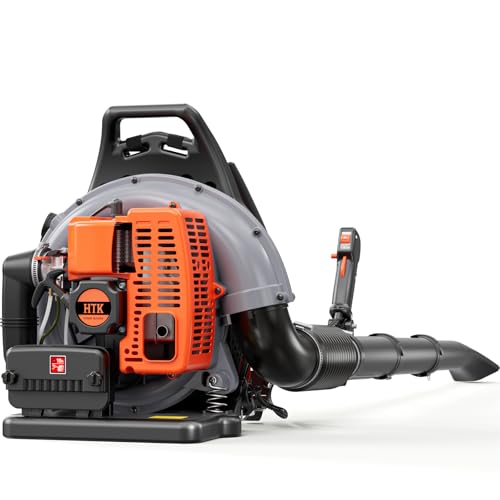
HTK 63cc 2-Stroke Backpack 665 CFM
63cc 2-stroke665 CFM205 MPHAir purge
Check price on Amazon
Best for: Large yards and long sessions on a budget.

HTK puts a 63cc two-stroke engine on a padded backpack harness, with 665 CFM and up to 205 MPH. That is roughly a 40 percent airflow increase over the 470 CFM Husqvarna handheld and a clear step up in speed, which is why backpacks dominate large-yard work.

Carrying the weight on your hips and back makes 30-minute sessions realistic where a handheld would tire your arm. An air-purge primer clears vapor from the carburetor to simplify starts, and the oversized controls are easy to use with gloves.

The tradeoff is the brand: parts and service are less established than Husqvarna or Echo. It is a good value for a big yard if you can handle your own upkeep. Wear hearing protection and eye protection every time, since this class of machine is loud at the operator.

What works

  • 665 CFM and 205 MPH for large cleanups
  • Padded backpack harness reduces fatigue
  • Air-purge primer simplifies starting
  • Lower price tier than established brands

Watch out for

  • Thinner dealer and parts network
  • Heavier than handheld units
  • Two-stroke mixing and noise

Spec sheet

Engine
63cc 2-stroke
Airflow
665 CFM
Air speed
Up to 205 MPH
Start aid
Air-purge primer system
Format
Backpack with padded harness
04
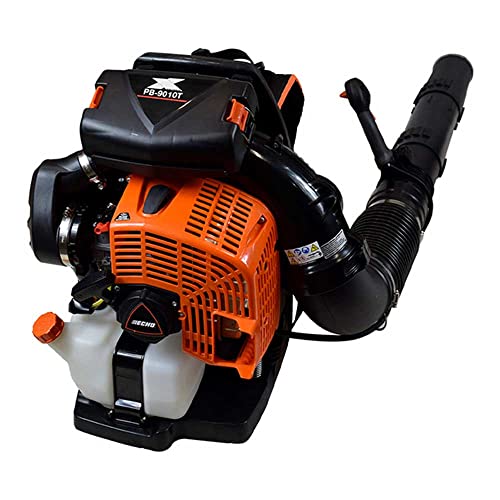
Echo PB-9010T 79.9cc X Series Backpack
79.9cc 2-stroke1110 CFM220 MPHTube throttle
Check price on Amazon
Best for: Contractors and large properties where all-day power matters.

Echo's X Series PB-9010T is a professional backpack: a 79.9cc two-stroke making 1110 CFM and 220 MPH, the highest figures in this guide. A tube-mounted throttle puts control at your hand rather than at the engine, which is the standard setup on professional machines.

This is a machine for acreage, parking lots and contractors who blow all day. Compared with the HTK 63cc, it moves about two thirds more air, and the engine is built for continuous use. The price tier reflects that.

The listing carries little detail, so confirm the exact kit before buying. Expect to mix fuel carefully, clean the air filter often in dusty work and wear hearing protection. Budget for a good harness fit session at the dealer, since all-day comfort depends on adjustment.

What works

  • 1110 CFM and 220 MPH for heavy debris
  • Tube-mounted throttle for control
  • Professional-grade engine
  • Established brand and service network

Watch out for

  • Highest price tier here
  • Heavy and loud
  • Overkill for a typical yard

Spec sheet

Engine
79.9cc 2-stroke X Series
Airflow
1110 CFM
Air speed
220 MPH
Controls
Tube-mounted throttle
Class
Professional
05
DOWILIN 28cc Handheld 495 CFM 200 MPH
28cc 2-stroke495 CFM200 MPHUnder 10 lb
Check price on Amazon
Best for: Budget buyers who want variable speed and strong paper specs.

DOWILIN quotes 495 CFM and 200 MPH from a 28cc two-stroke, with variable speed and a weight under 10 pounds. Variable speed matters near flower beds, where full throttle blows mulch onto the lawn.

Those figures are higher than the Husqvarna 125B's on paper, but remember they are maker-measured, usually at the nozzle, and not comparable across brands. The Husqvarna's balance and service network remain advantages.

It is a value handheld for owners who want strong specs at a lower price tier. Keep the fuel fresh and clean the air filter. Test the variable speed on a patch of mulch before relying on it near beds.

What works

  • Variable speed for delicate areas
  • 495 CFM and 200 MPH quoted
  • Under 10 pounds
  • Low price tier

Watch out for

  • Maker-measured numbers are not comparable
  • Thin service network
  • Two-stroke mixing

Spec sheet

Engine
28cc two-stroke
Airflow
495 CFM
Air speed
Up to 200 MPH
Controls
Variable speed
Weight
Under 10 pounds
06
Relxxon 26cc 2-Cycle Handheld
26cc 2-cycle380 CFM180 MPH7.7 lb
Check price on Amazon
Best for: Small yards and users who want a light, easy-start handheld.

Relxxon aims at weekend clearing: a 26cc two-cycle engine, 380 CFM, 180 MPH and a dry weight of 7.7 pounds, one of the lightest handhelds here. The advanced recoil is said to cut pull resistance by 50 percent, which helps users with weaker arms.

At 380 CFM it moves less air than the Husqvarna 125B's 470, so large piles take longer. But for steps, vehicles, flower beds and damp leaves in a small yard, it is a manageable tool.

Expect the usual small two-stroke upkeep. It is not a machine for acreage. Keep spare plugs and a small funnel with it, since light units are often used by occasional owners.

What works

  • 7.7 pounds is very light
  • Reduced-pull recoil
  • 180 MPH moves damp leaves
  • Low price tier

Watch out for

  • 380 CFM is modest
  • Not for large properties
  • Thin brand support

Spec sheet

Engine
26cc 2-cycle
Airflow
380 CFM
Air speed
180 MPH
Weight
7.7 pounds dry
Start
Reduced-pull recoil
07
Getell 26cc Handheld 380 CFM
26cc 2-cycle380 CFM180 MPH50:1 mix
Check price on Amazon
Best for: Small to medium yards where vibration comfort matters.

Getell offers a 26cc two-cycle with 380 CFM and 180 MPH, a 9.4-pound body with anti-vibration handles and a half-pull recoil. The listing quotes about 60 decibels, which is a maker measurement at a distance and should not be read as quiet in the ear.

A 50:1 fuel-oil ratio is the common modern mix and is easy to measure per gallon. Compared with the Relxxon it is slightly heavier but offers anti-vibration handles.

Gas blowers are loud at the operator, so wear hearing protection regardless. It suits small to medium yards. Make a habit of mixing only enough fuel for a month, because old mixed fuel is the biggest cause of failure.

What works

  • Anti-vibration handles
  • Half-pull recoil
  • 50:1 mix is easy to measure
  • Light enough for one hand

Watch out for

  • 380 CFM is modest
  • Noise claim is a distance measurement
  • Thin service network

Spec sheet

Engine
26cc 2-cycle, 50:1 fuel mix
Airflow
380 CFM
Air speed
180 MPH
Weight
9.4 pounds
Noise claim
About 60 dB

Spec sheet decoder

What the numbers on the box really mean

The specs manufacturers lead with, translated into what they tell you about real-world performance.

CFM

Cubic feet per minute of air volume at the nozzle. More volume shifts more leaves per pass. Maker figures are measured at different points, so compare within a class.

Watch forHusqvarna 125B 470, Echo PB-9010T 1110.

MPH

Air speed at the nozzle tip. Higher speed breaks the grip of wet, matted debris.

Watch forSENIX 125 MPH versus HTK 205 MPH.

Displacement (cc)

Engine size. It sets the ceiling on airflow but not the efficiency of the fan. Fan efficiency and nozzle shape make the larger difference.

Watch for26 to 28cc handhelds versus 63 to 80cc backpacks.

Fuel mix ratio

The ratio of gasoline to two-stroke oil, such as 50:1 or 25:1. Wrong ratios cause smoke or engine damage.

Watch forFollow the manual for each unit.

Air purge

A bulb that pushes air and fuel vapor out of the carburetor to ease starting.

Watch forHTK includes one.

Methodology

How We Evaluated These Gas Leaf Blowers

Airflow and speed

We compared CFM and MPH across handhelds and backpacks, noting that figures are maker-measured. The Echo PB-9010T led on both, and the SENIX 4QL trailed on speed. We read airflow numbers as ceilings, not as head-to-head measurements.

Format and ergonomics

We weighed weight, balance and harness design. The Relxxon at 7.7 pounds and the HTK backpack harness earned credit.

Engine type and fuel handling

We separated two-cycle from four-cycle designs and considered start aids such as reduced-pull recoil and air purge.

Service and parts

We favored established networks on the Husqvarna and Echo, and scored generic brands cautiously. Owner feedback patterns on small-engine starting shaped the scores. Brand service networks mattered for engines because small-engine repair is where cost accumulates.

Value fit

We separated the HTK as the value backpack from the Echo as the professional pick.

Decision guide

How to Choose the Right Gas Leaf Blowers

By Yard Size

SituationPickWhy
Small yard, steps and patioRelxxon 26cc7.7 pounds
Quarter to half acreHusqvarna 125B470 CFM balanced handheld
Half to two acresHTK 63cc Backpack665 CFM on a harness
Acreage or contractor workEcho PB-9010T1110 CFM

By Budget

TierPickWhy
LowestRelxxon 26ccLight handheld
Low-midGetell 26ccAnti-vibration handles
MidDOWILIN 28cc or HTK 63ccVariable speed or backpack
PremiumHusqvarna 125B or Echo PB-9010TBrand and service network

2-Cycle vs 4-Cycle

2-cycle

The Husqvarna 125B, Relxxon, Getell and DOWILIN are lighter and faster but need fuel mixing and produce more smoke.

4-cycle

The SENIX 4QL runs on straight gasoline with lower emissions, but weighs more and blows slower at 125 MPH.

Pick 2-cycle for power and low weight, 4-cycle to avoid mixing fuel.

By Format

PreferencePickWhy
Quick jobs, one handGetell 26cc9.4 pounds
Control near bedsDOWILIN 28ccVariable speed
Long sessionsHTK 63cc BackpackHarness carries weight
All-day professionalEcho PB-9010TTube throttle

For Wet Leaves Specifically

Look for

Look for air speed above 180 MPH and a flat or concentrator nozzle. Wet leaves weigh far more than dry and need speed to peel off the ground.

In this comparison

The Echo PB-9010T at 220 MPH and the HTK at 205 MPH lead, and the SENIX 4QL at 125 MPH is the weakest.

When to Spend More

Spend more if

Spend more if you blow for more than 30 minutes at a time or work professionally, which points to the Echo PB-9010T.

Save if

Save if the yard is small. The Relxxon or Getell handhelds clear it at a lower price.

Ownership

Maintenance schedule

The upkeep that decides whether this machine lasts two seasons or ten.

TaskIntervalWhy it matters
Mix fuel correctly and use it freshEvery tankOld or wrongly mixed fuel is the leading cause of hard starts and engine wear.
Clean or replace the air filterEvery 10 to 20 hoursA clogged filter starves the engine and raises temperature.
Replace the spark plugAnnuallyA fouled plug is a common cold-start problem.
Inspect the fuel line and filterEach seasonEthanol hardens lines and clogs filters.
Drain or stabilize fuel for storageEnd of seasonPrevents gum in the carburetor.

FAQ

Frequently Asked Questions

Gas or battery leaf blower?

Gas has no runtime limit and the highest airflow. Battery blowers are quieter and easier to own, but run out of energy on big jobs.

Are CFM and MPH comparable between brands?

Not reliably. They are maker-measured, usually at the nozzle, so use them for rough ranking only.

Is a 4-cycle blower worth it?

If you hate mixing fuel, yes. Expect lower air speed and more weight.

Handheld or backpack?

Handheld for small yards and quick jobs, backpack for sessions over 20 to 30 minutes.

What fuel ratio should I use?

Follow the manual. Many modern units use 50:1, but some specify 25:1.

Do I need hearing protection?

Yes. Gas blowers are loud at the operator, regardless of the dB figure on the listing.

Bottom line

The short version

Browse more gas leaf blowerson Amazon →
James Miller, Lead Machine Editor

About the author

James Miller

Lead Machine Editor, MachineFanatic

James Miller leads MachineFanatic's buying guides, turning spec sheets, manuals and owner feedback into clear verdicts on power tools, outdoor power equipment, shop machines and kitchen machines.

More from James →

Keep reading

Related guides