
Amazon affiliate links - we earn a commission.Affiliate disclosure

Buying guide · 13 min read · Updated 2026-11-28

Best Gas Log Splitters (2026)

Six gas log splitters from 18 to 35 tons compared on tonnage, engine size, cycle time and towing so you match the machine to your firewood.

James MillerBy James MillerLead Machine Editor6 machines comparedSpec-sheet verified
Best Gas Log Splitters

At a glance

Our top picks

Side by side

Spec comparison

MachineSplitting forceEngineReturnLayoutPump
Full Boar 28 Ton Gas Log Splitter 212cc 49-StateBest OverallFull Boar 28 Ton Gas Log Splitter 212cc 49-State28 tons212cc OHVAuto-return valve with detentHorizontal/verticaln/a
BILT HARD 22 Ton Gas Log Splitter 209cc 2-Stage 14 GPMBest Fast CycleBILT HARD 22 Ton Gas Log Splitter 209cc 2-Stage 14 GPM22 tons209ccn/an/a14 GPM 2-stage gear
SuperHandy 25 Ton Portable Gas Log Splitter 7HP BucherBest Portable 25 TonSuperHandy 25 Ton Portable Gas Log Splitter 7HP Bucher25 tons7HPn/aHorizontal/vertical half beam2-stage Bucher gear pump
BILT HARD 35 Ton Horizontal Vertical Gas Log Splitter 301ccBest Heavy DutyBILT HARD 35 Ton Horizontal Vertical Gas Log Splitter 301cc35 tons301cc, 10HPn/aHorizontal/vertical full beamn/a
SuperHandy 20 Ton Portable Gas Log Splitter 7HP Auto ReturnBest ValueSuperHandy 20 Ton Portable Gas Log Splitter 7HP Auto Return20 tons7HPRapid auto returnHorizontal full beamBucher gear pump
BILT HARD 18 Ton 7HP 209cc Portable Gas Log SplitterBest Entry GasBILT HARD 18 Ton 7HP 209cc Portable Gas Log Splitter18 tons209cc, 7HPFast auto returnFull beam, steel wedgen/a

A gas log splitter is a hydraulic ram driven by a small engine. The engine turns a pump, the pump pushes a cylinder, and the cylinder shoves a round of wood into a steel wedge. Tonnage describes the force, but cycle time and log handling decide how much firewood you actually produce in an afternoon.

The market is crowded with near-identical machines with different stickers, so the differences that matter are pump design, engine size, beam layout and how the machine moves around a yard. This guide decodes those and ranks six splitters by who they suit.

Before you buy

6 Criteria to Look For Before Buying a Gas Log Splitter

  1. 01

    Tonnage and wood type

    Tonnage is pump pressure times cylinder area, and the number matters most when the wood is knotty or green. Straight seasoned oak and maple split fine at 18 to 22 tons, while knotty elm or sweetgum calls for 25 tons or more. The BILT HARD 18 and SuperHandy 20 fit the first group, the Full Boar 28 and BILT HARD 35 the second. A common mistake is buying 35 tons to split wood that a 22 ton would handle, which adds weight, fuel burn and a slower stroke for no benefit. The opposite mistake is just as costly: a machine that stalls on every third round turns a pleasant afternoon into a stop-start chore.

  2. 02

    Cycle time

    Cycle time is the time for the ram to go out and return, and it sets how many logs you split per hour. The BILT HARD 22 claims 7 seconds, the Full Boar 28 about 10.9 seconds, and heavier machines are slower. Faster is better until the pump loses force, so compare cycle time with tonnage and not alone. Remember too that the cycle is only part of the job: loading the round, positioning it and tossing split pieces aside usually takes longer than the stroke itself, so a log lift or a comfortable working height can save more time than shaving a second off the ram.

  3. 03

    Pump design

    Single-stage pumps hold full force but move slowly, while two-stage pumps run fast at low load and shift to high force when the wedge meets resistance. The BILT HARD 22 lists a 14 GPM two-stage pump and the SuperHandy models use Bucher two-stage gear pumps. A two-stage pump is the single most useful hydraulic feature for productivity. Single-stage designs are not wrong, but they commit you to a slow stroke on every log, easy or hard, so a seasoned-wood burner who splits several cords a year will feel the difference within the first afternoon.

  4. 04

    Engine size and displacement

    The engine turns the pump, so displacement sets how much load the pump can take before the engine bogs. A 301cc 10HP engine in the BILT HARD 35 carries the pump easily, while a 212cc engine in the Full Boar 28 is working harder. Look for OHV engines and an easily accessible choke and oil check. Also confirm that the engine has a low-oil shutoff, since a splitter pump that is run hard on a hot afternoon with a low crankcase is the quickest way to turn a good machine into a repair bill.

  5. 05

    Beam layout and log handling

    A horizontal splitter lets you roll rounds on the beam, and a vertical mode lets you stand heavy logs on end and split without lifting. The Full Boar and BILT HARD models offer both. Log lift accessories save your back on heavy rounds. Check maximum log length as well, since a 21 inch capacity is typical.

  6. 06

    Towing and portability

    A 35 ton machine with DOT tires such as the BILT HARD 35 is built to be towed, while lighter units are pulled by hand. Check tire pressure, hitch rating and local rules for highway towing. If you only split at home, a lighter unit that you can push by hand is more convenient than a heavy towable.

Detailed reviews

The 6 best gas log splitters, explained

01
Full Boar 28 Ton Gas Log Splitter 212cc 49-State
28 ton212cc OHV engine10.9 sec cycleAuto-return valve
Check price on Amazon
Best for: Homeowners processing several cords a year of mixed hardwood.

The Full Boar 28 ton couples a 212cc OHV engine to a hydraulic system that cycles in about 10.9 seconds, which is quick for a machine in this force class. An auto-return control valve with an adjustable detent saves effort because the ram retracts without you holding the lever. A 28 ton rating is enough for knotty hardwood rounds that stall smaller machines.

The tradeoff is that a 212cc engine is a modest motor for 28 tons, so heavy loads are slowed by the pump rather than the engine. Compared with the 35 ton BILT HARD, it gives up raw force but is lighter, easier to tow around a yard and cheaper to keep fueled. Against the SuperHandy 25 ton it adds three tons and a faster stated cycle.

Ownership is standard small-engine and hydraulic upkeep: check hydraulic fluid before the season, change engine oil, keep the wedge clean and grease the moving parts. Let the machine warm up in cold weather because thick fluid slows the ram.

What works

  • 28 tons handles knotty hardwood rounds
  • 10.9 second cycle keeps splitting moving
  • Auto-return valve with detent
  • Lighter than the 35 ton class

Watch out for

  • 212cc engine is modest for the tonnage
  • Cycle time still slower than a kinetic splitter
  • Needs towing or careful moving

Spec sheet

Splitting force
28 tons
Engine
212cc OHV
Cycle time
10.9 seconds
Return
Auto-return valve with detent
Layout
Horizontal/vertical
02
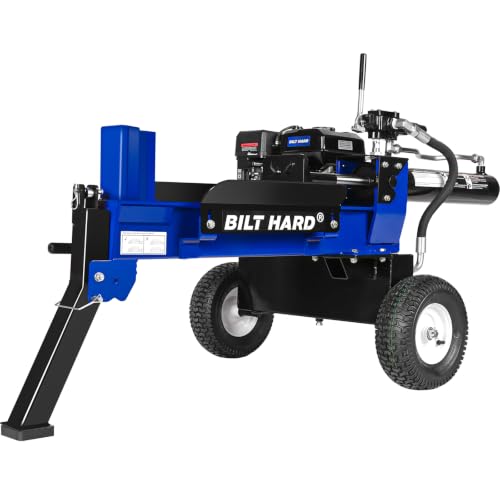
BILT HARD 22 Ton Gas Log Splitter 209cc 2-Stage 14 GPM
22 ton209cc engine14 GPM 2-stage7 sec cycle
Check price on Amazon
Best for: Owners who split large volumes of straight, seasoned wood and want speed.

This BILT HARD uses a 14 GPM two-stage gear pump to cut cycle time to about 7 seconds, the fastest in the lineup. A two-stage pump moves fast at low load and shifts to high force when the wedge meets resistance, so the ram does not crawl through easy wood. A 21 inch log capacity covers standard firewood lengths.

The tradeoff is force. At 22 tons it is below the Full Boar 28 ton, and knotty elm or sweetgum rounds can stall it where the bigger machine would push through. For straight seasoned oak and maple it is a speed machine.

Check the hydraulic fluid level before each season, keep the wedge clean and let the engine and fluid warm up in cold weather. A shorter cycle also means more cycles per hour, so watch for heat in a long session.

What works

  • 7 second cycle is the fastest here
  • Two-stage pump speeds easy cuts
  • 21 inch log capacity
  • 22 tons suits typical firewood

Watch out for

  • Less force than the 28 ton machines
  • Knotty rounds may stall it
  • Faster cycling heats fluid in long sessions

Spec sheet

Splitting force
22 tons
Engine
209cc
Pump
14 GPM 2-stage gear
Cycle time
7 seconds
Log length
21 inches
03
SuperHandy 25 Ton Portable Gas Log Splitter 7HP Bucher
25 ton7HP engineBucher 2-stage pumpHalf beam
Check price on Amazon
Best for: Owners who want 25 tons in a machine they can move by hand.

SuperHandy's 25 ton model uses a 7HP engine and a two-stage Bucher gear pump, a brand name known in hydraulics, on a half-beam frame designed to be light enough to roll around a yard. The horizontal and vertical layout lets you split on the ground for long rounds or stand logs for heavy lifting.

The tradeoff is beam length and cycle speed. A half-beam is lighter than a full beam but may have a shorter stroke, and a 7HP engine is the minimum for the tonnage. Compared with the Full Boar 28 ton it is lighter and easier to manage but offers three tons less.

Ownership is routine: fluid check, oil change, wedge cleaning and a quick grease. Keep the breather vented while running and plugged for transport as the manual says.

What works

  • Two-stage Bucher pump
  • Lighter half-beam frame
  • Horizontal and vertical splitting
  • 25 ton force

Watch out for

  • Half beam may limit log length
  • 7HP is a minimum engine for this force
  • Slower than the 22 ton BILT HARD

Spec sheet

Splitting force
25 tons
Engine
7HP
Pump
2-stage Bucher gear pump
Layout
Horizontal/vertical half beam
Moving
Wheels and handle
04
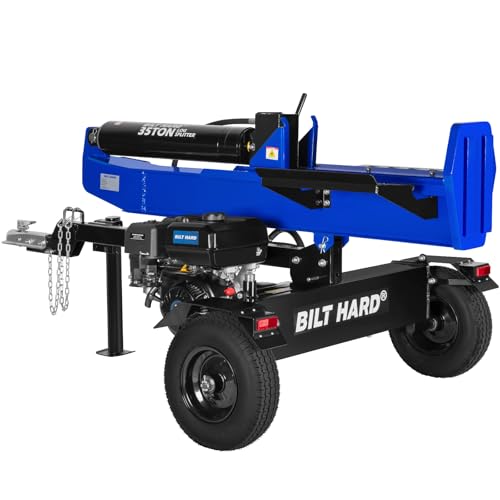
BILT HARD 35 Ton Horizontal Vertical Gas Log Splitter 301cc
35 ton301cc 10HPFull beam16 in DOT tires
Check price on Amazon
Best for: Landowners splitting large green or knotty rounds.

The BILT HARD 35 ton puts a 301cc 10HP engine behind the highest force in the group. Sixteen inch DOT-certified tires and a full beam frame mean it is built to be towed and to handle large, heavy rounds that smaller machines refuse. It splits horizontally or vertically.

The tradeoff is the machine itself. A 35 ton splitter is heavy and slow to move by hand, and the pump usually cycles slower than lighter units. Against the Full Boar 28 ton, it adds seven tons of force for a significant increase in weight and fuel use.

Expect more engine and hydraulic upkeep, and plan for a tow vehicle or ATV. Check the DOT tires and hitch before every trip and keep the beam and wedge cleaned of sap.

What works

  • 35 tons overpowers most rounds
  • 10HP 301cc engine
  • DOT tires for towing
  • Horizontal and vertical modes

Watch out for

  • Heavy and hard to move by hand
  • Slower cycle than lighter units
  • More upkeep and fuel

Spec sheet

Splitting force
35 tons
Engine
301cc, 10HP
Layout
Horizontal/vertical full beam
Tires
16 inch DOT
Use
Large rounds
05
SuperHandy 20 Ton Portable Gas Log Splitter 7HP Auto Return
20 ton7HP engineAuto returnBucher pump
Check price on Amazon
Best for: Firewood burners who split straight, seasoned logs.

The SuperHandy 20 ton is a horizontal full-beam splitter with a 7HP engine, a Bucher gear pump and a rapid auto return ram system. Twenty tons is the entry point for gas splitting and handles most straight seasoned logs. The full beam design is sturdy for its weight.

The tradeoff is that 20 tons is the minimum for hardwoods with knots, so heavy, green rounds will stall it. Compared with the SuperHandy 25 ton, it is lighter but less forceful, and compared with the 18 ton BILT HARD it is slightly stronger.

Upkeep is the usual fluid, oil and wedge checks. Run it on level ground with the wheels chocked and keep hands clear of the wedge. Because it is the most affordable way into hydraulic splitting here, owners tend to push it beyond its comfort zone, so cut oversized rounds down with a chainsaw first and the pump will thank you for it over many seasons.

What works

  • 20 ton force at a modest size
  • Auto return speeds repeated cuts
  • Bucher gear pump
  • Lighter than larger models

Watch out for

  • Struggles with knotty rounds
  • Horizontal only in this layout
  • 7HP engine is minimum class

Spec sheet

Splitting force
20 tons
Engine
7HP
Pump
Bucher gear pump
Return
Rapid auto return
Layout
Horizontal full beam
06
BILT HARD 18 Ton 7HP 209cc Portable Gas Log Splitter
18 ton209cc 7HPAuto returnFull beam
Check price on Amazon
Best for: Light firewood use where gas power is wanted at a small size.

The BILT HARD 18 ton is the smallest gas splitter in the group, with a 209cc 7HP engine, a steel wedge and a fast auto return. It is portable and easy to store, which makes it a sensible machine for a couple of cords a year.

The tradeoff is force. Eighteen tons splits softwoods and straight seasoned hardwood, but gnarled rounds will stop it cold. Against the 22 ton BILT HARD it saves weight but loses speed and force.

Keep fluid topped up, change the oil and keep the wedge clean. A small machine is easy to overwork, so cut very large rounds with a saw first.

What works

  • Light and portable
  • Fast auto return
  • 209cc engine is simple to maintain
  • Steel wedge

Watch out for

  • Lowest force in the group
  • Stalls on knotty rounds
  • Short on reserve for green hardwood

Spec sheet

Splitting force
18 tons
Engine
209cc, 7HP
Return
Fast auto return
Layout
Full beam, steel wedge
Use
Light firewood

Spec sheet decoder

What the numbers on the box really mean

The specs manufacturers lead with, translated into what they tell you about real-world performance.

Tonnage

The force the ram can apply, set by pump pressure and cylinder bore. Higher tonnage splits tougher wood.

Watch forThe lineup runs from 18 tons on the BILT HARD to 35 tons.

Cycle time

The total time for the ram to extend and retract. Shorter cycles split more logs per hour.

Watch forThe BILT HARD 22 lists 7 seconds and the Full Boar 28 about 10.9.

Two-stage pump

A pump that moves fast under light load and switches to high force under heavy load.

Watch forBoth SuperHandy models name a Bucher pump and the BILT HARD 22 names a 14 GPM two-stage pump.

Engine displacement

The size of the engine in cubic centimeters, a guide to real power.

Watch forThe BILT HARD 35 uses a 301cc engine while the 18 ton uses 209cc.

Auto return

A valve that retracts the ram without holding the lever, saving effort and time.

Watch forThe Full Boar 28 lists an adjustable detent.

Methodology

How We Evaluated These Gas Log Splitters

Splitting force

We compared stated tonnage with the pump and engine behind it. A machine that promised more force than its engine could drive was marked down. The 18 to 35 ton range in this lineup shaped the ranking.

Speed

We compared cycle times and pump type. The BILT HARD 22 at 7 seconds and the Full Boar 28 at about 10.9 seconds set the range. Claimed times are treated as claims.

Handling

We looked at beam layout, wheels, tires and log lift options. Machines with both horizontal and vertical modes scored higher. Heavy machines lost points for moving by hand.

Ownership

We considered fluid care, engine upkeep and parts access from listings and owner feedback patterns. Simpler machines scored better on upkeep. Brand history was a minor factor.

Match to use

We matched each machine to a likely firewood volume and wood type. The 18 ton BILT HARD suits a couple of cords while the 35 ton suits heavy rounds. Scores reflect the spec sheet.

Decision guide

How to Choose the Right Gas Log Splitters

By Wood Type

SituationPickWhy
Softwood and straight seasoned logsBILT HARD 18 TonEnough force at small size
Straight seasoned hardwoodSuperHandy 20 TonAuto return and Bucher pump
Fast splitting of seasoned oakBILT HARD 22 Ton7 second cycle
Mixed knotty hardwoodFull Boar 28 Ton28 tons with quick cycle
Large green roundsBILT HARD 35 TonHighest force and 10HP engine
Mixed hardwood on a light frameSuperHandy 25 Ton25 tons in a portable body

By Budget

TierPickWhy
Lowest tierBILT HARD 18 TonEntry gas machine
Low-mid tierSuperHandy 20 TonBucher pump and auto return
Mid tierBILT HARD 22 TonFast cycle
Upper mid tierSuperHandy 25 TonMore force, portable
High tierFull Boar 28 Ton28 tons and quick cycle
Highest tierBILT HARD 35 TonMaximum force

Fast Cycle vs High Tonnage

Fast cycle

The BILT HARD 22 at 7 seconds moves through straight wood quickly and saves time on large volumes. It is the best choice if your wood is seasoned and clean.

High tonnage

The Full Boar 28 and BILT HARD 35 push through knots and green wood at the cost of speed and weight. They are the best choice if your wood is difficult.

Pick fast cycle for easy wood and high tonnage for hard wood.

By Mobility

NeedPickWhy
Push by hand around the yardBILT HARD 18 TonLightest in the group
Portable with more forceSuperHandy 25 TonHalf-beam frame
Move occasionallySuperHandy 20 TonHorizontal full beam
Tow to a remote woodlotBILT HARD 35 TonDOT tires
Balance of size and forceFull Boar 28 TonMid-weight 28 ton

For Large Annual Firewood Needs Specifically

Look for

Look for a two-stage pump, a cycle time near or below 11 seconds, a vertical mode for heavy rounds and a log lift for large pieces. A bigger engine keeps the pump supplied through a long session.

In this comparison

The Full Boar 28 Ton and BILT HARD 22 Ton are the best match for several cords a year. The 35 ton model adds force for heavy rounds at a cost in weight.

When to Spend More

Spend more if

Spend more if your wood is green, knotty or oversized. The Full Boar 28 Ton and BILT HARD 35 Ton earn their cost by not stalling on tough rounds.

Save if

Save if you split a couple of cords of seasoned wood. The SuperHandy 20 Ton or BILT HARD 18 Ton is enough.

Ownership

Maintenance schedule

The upkeep that decides whether this machine lasts two seasons or ten.

TaskIntervalWhy it matters
Check hydraulic fluidBefore each seasonLow fluid starves the pump and makes the ram jerky. Use the oil the manual specifies.
Change engine oilPer manual, at least yearlySmall engines run hot under load. Fresh oil protects the engine.
Clean and file the wedgeEach seasonSap and rounded edges slow splitting. A clean wedge cuts with less force.
Grease the beam and wheelsEach seasonDry slide surfaces and bearings wear quickly. Grease keeps movement smooth.
Stabilize fuel for storageEnd of seasonOld fuel gums the carburetor and causes hard starts.

FAQ

Frequently Asked Questions

How many tons do I need?

For straight seasoned wood, 18 to 22 tons is enough. For knotty or green hardwood, 25 to 28 tons is a safer range. Thirty-five tons is for heavy rounds and landowners.

Is cycle time important?

Yes, it sets how many logs you split per hour. A 7 second cycle is nearly twice as fast as a 12 second cycle. Compare it against tonnage.

Horizontal or vertical splitting?

Horizontal is easier for smaller rounds. Vertical lets you stand heavy rounds and split without lifting. Machines with both modes are the most flexible.

How do I keep it running in cold weather?

Let the engine and fluid warm up before heavy use. Thick fluid slows the pump and causes jerky motion. Use the fluid grade the manual specifies.

Can I split wet wood?

Yes, but green wood is stringy and needs more force. Seasoned wood splits cleaner. A 4-way wedge halves the number of passes on straight rounds.

Is it safe?

Only with proper habits. Keep hands off the wedge path, use the control lever as designed and wear eye and foot protection. Shut off the engine before adjusting anything.

Bottom line

The short version

Browse more gas log splitterson Amazon →
James Miller, Lead Machine Editor

About the author

James Miller

Lead Machine Editor, MachineFanatic

James Miller leads MachineFanatic's buying guides, turning spec sheets, manuals and owner feedback into clear verdicts on power tools, outdoor power equipment, shop machines and kitchen machines.

More from James →

Keep reading

Related guides