
Amazon affiliate links - we earn a commission.Affiliate disclosure

Buying guide · 14 min read · Updated 2026-11-25

Best Gas Pressure Washers Under $300 (2026)

Four gas pressure washers that list for under $300, with engine size and cleaning units checked against PSI and GPM claims to spot overstated labels.

James MillerBy James MillerLead Machine Editor4 machines comparedSpec-sheet verified
Best Gas Pressure Washers Under $300

At a glance

Our top picks

Side by side

Spec comparison

MachinePressureFlowEngineHoseNozzles
Genkins GPW3200 gas foldable pressure washer, 3200 PSI, 2.5 GPM, soap tankBest OverallGenkins GPW3200 gas foldable pressure washer, 3200 PSI, 2.5 GPM, soap tank3,200 PSI2.5 GPM212cc OHVn/an/a
Ezasin gas pressure washer, 3500 PSI, 2.3 GPM, 212cc 7 HP, 25 ft hoseBest ValueEzasin gas pressure washer, 3500 PSI, 2.3 GPM, 212cc 7 HP, 25 ft hose3,500 PSI2.3 GPM212cc 4-stroke OHV, 7 HP25 footFour quick-connect: 0, 25, 40 degrees and soap
4200 PSI gas pressure washer, 4.0 GPM, 212cc 7 HP, 5 nozzlesBest Large Claim4200 PSI gas pressure washer, 4.0 GPM, 212cc 7 HP, 5 nozzlesn/an/a212cc, 7 HPn/aFive quick-connect, plus soap
Commercial-labelled 3500 PSI gas pressure washer, 2.4 GPM, 79.7cc 2.5 HPBest Compact EngineCommercial-labelled 3500 PSI gas pressure washer, 2.4 GPM, 79.7cc 2.5 HPn/a2.4 GPM79.7cc, 2.5 HP25 footFive: 0, 15, 25, 40 degrees and soap

A gas pressure washer is an engine driving a pump, and the numbers on the box describe what the pump could do if the engine could keep up. At the bottom of the price range those two halves do not always match, so the label may promise more than the machine delivers.

The check is simple physics. Cleaning power comes from pressure and flow together, and the engine has to supply the hydraulic power behind both. We worked through each listing's figures and ranked the machines by how believable they are. Prices move, and the $300 cap reflects listing prices when this guide was updated.

Before you buy

6 Criteria to Look For Before Buying a Gas Pressure Washer Under $300

  1. 01

    Cleaning units and engine power

    Cleaning power comes from pressure and flow together, and the engine must supply the hydraulic power for both. Hydraulic horsepower equals PSI times GPM divided by 1714, and real engines need about 40 percent more to cover pump losses. A 3,200 PSI, 2.5 GPM machine needs about 4.7 hydraulic horsepower, which a 212cc engine can supply. A 4,200 PSI, 4.0 GPM claim needs about 9.8, which a 7 horsepower engine cannot. Use this arithmetic on every listing. Run the numbers for a machine you are considering: multiply PSI by GPM, divide by 1714 and then multiply by about 1.4. If the answer is more than the engine's rated horsepower, the machine will not deliver its label, and the pump will either bog the engine or be throttled by an unloader valve. This one calculation separates the honest listings from the optimistic ones faster than any review.

  2. 02

    Flow versus pressure

    Pressure loosens dirt and flow carries it away, and flow often sets cleaning speed more than the PSI headline. Two machines at the same pressure but different flow will clean at different speeds, and a high-pressure, low-flow machine is slow on a big driveway. Consumer gas machines run up to roughly 2.8 GPM and professional units up to about 4 GPM. If the listing shows a flow near 4 GPM at this price, doubt it. A practical test is how long a driveway takes: a 2.5 GPM machine with a surface cleaner can clear a car-width strip in a few minutes, while a 1.5 GPM unit crawls. Flow also determines how well a surface cleaner spins, so a low-flow machine wastes the attachment.

  3. 03

    Pump type

    Axial cam pumps are common in consumer machines, economical for occasional use and usually not rebuildable. Triplex plunger pumps are commercial grade and serviceable, but they appear on much more expensive machines. At this budget you buy a disposable pump, so protect it: never run it dry, never run it with the trigger closed for long and drain it before winter. Use a pump-saver fluid at the end of each season as well, since it lubricates the seals and prevents freezing. Replacing a pump on a cheap machine often costs more than the machine is worth, so prevention is the whole strategy.

  4. 04

    Nozzles and surfaces

    A 0 degree nozzle is a cutting jet that can damage wood, siding and cars. The 15 degree tip suits hard surfaces, the 25 and 40 degree tips suit general rinsing and the soap nozzle applies detergent at low pressure. Wood, siding and vehicles need wider tips and lower pressure, while concrete tolerates more. Check that the set includes a 15 degree tip and a soap tip. Hold the nozzle at a consistent distance and sweep in overlapping passes to avoid stripes. Test on an inconspicuous spot first, particularly on soft wood, painted surfaces and older mortar, which can be gouged by a narrow jet.

  5. 05

    Soap tank and hose

    An onboard soap tank, like the Genkins's 0.5 gallon one, spares you a siphon tube. A 25 foot hose limits reach, and the hose and its quick connects are the most common failure points. Steel-braided hoses outlast cheap ones. Plan to replace the hose first when something leaks. A swivel at the gun end prevents the hose from kinking as you move. Store the hose coiled loosely, and check the O-rings in the quick connects each season.

  6. 06

    Engine and upkeep

    A 212cc OHV engine needs oil changes, fresh stabilized fuel, a clean air filter and a plug check. Gas left in the tank gums the carburetor over summer. A recoil start is simple but needs a firm pull. Look for a low-oil shutdown, which protects the engine if you forget to check. Run the engine outdoors only, in open air, because the exhaust contains carbon monoxide. Let the engine cool before you refuel, and never fill the tank while the machine is hot.

Detailed reviews

The 4 best gas pressure washers under $300, explained

01
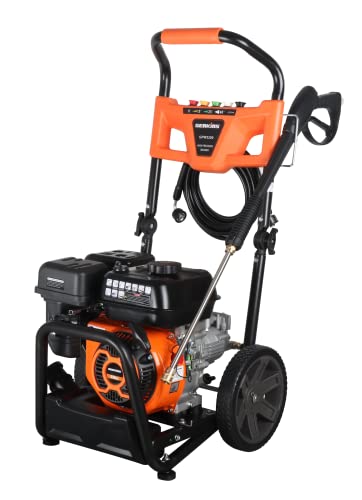
Genkins GPW3200 gas foldable pressure washer, 3200 PSI, 2.5 GPM, soap tank
3,200 PSI2.5 GPM212cc OHVFoldable
Check price on Amazon
Best for: Homeowners who want honest numbers, a soap tank and easy storage.

The Genkins GPW3200 is the most believable machine in this list. It pairs a 212cc OHV engine with an axial cam pump rated at 3,200 PSI and 2.5 GPM. Multiplying pressure by flow gives 8,000 cleaning units, and the hydraulic power behind that is roughly 4.7 horsepower at the pump, which a 212cc engine of about 6.5 to 7 horsepower can drive with some margin for pump losses.

An onboard 0.5 gallon detergent tank removes the need for a bucket and a siphon tube, and five quick-change nozzles at 0, 15, 25, 40 degrees and a soap tip cover most jobs. The 0 degree nozzle can cut wood and stain concrete, so keep it for stubborn spots on hard surfaces only. A foldable frame makes it easier to store than a fixed cart.

Against the 4200 PSI units, it claims less on the box and probably delivers more of what it claims. Axial cam pumps are economical and common on consumer machines, but they are usually not rebuildable, so treat the pump as a wear item. Use fresh stabilized fuel, change the oil as the manual says and never run the pump with the trigger closed for long. Drain the pump and run antifreeze through it before winter. Connect the garden hose and let water run through the pump before you start the engine, because a pump that runs dry for even a few seconds can be damaged.

What works

  • 3,200 PSI at 2.5 GPM matches the engine
  • Onboard soap tank
  • Five quick-change nozzles
  • Foldable frame stores compactly

Watch out for

  • Axial cam pump is usually not rebuildable
  • Low-end build with a simple recoil start

Spec sheet

Pressure
3,200 PSI
Flow
2.5 GPM
Engine
212cc OHV
Pump
Axial cam
Extras
0.5 gallon soap tank, five quick-change nozzles
02
Ezasin gas pressure washer, 3500 PSI, 2.3 GPM, 212cc 7 HP, 25 ft hose
3,500 PSI2.3 GPM212cc 7HP25 ft hose
Check price on Amazon
Best for: Cleaning decks and fences where extra pressure helps and flow is less critical.

The Ezasin lists 3,500 PSI at 2.3 GPM from a 212cc, 7 horsepower engine with a recoil start. Multiply and you get about 8,050 cleaning units. The hydraulic horsepower at the pump is roughly 4.7, so a 7 horsepower engine can plausibly drive it, though it will run near its limit, and pump losses make the numbers optimistic.

The 3,500 PSI headline comes at the price of flow, which is a trade-off: pressure strips paint and loosens grime, while flow rinses the debris away. At 2.3 GPM, a driveway takes longer to clean than with a 2.5 GPM machine, even though the pressure is higher. Four quick-connect nozzles, at 0, 25, 40 degrees and a soap tip, lack the 15 degree tip that is best for hard surfaces.

Next to the Genkins, it offers more pressure and less flow with no soap tank, so you need a siphon for detergent. Check the engine oil before every start, keep the air filter clean and store the machine with stabilized fuel or run the carburetor dry. A 25 foot hose limits your reach, so plan to move the machine as you work. If you add an extension hose, keep it of a similar diameter, because a thin hose loses pressure. A surface cleaner attachment is the single best upgrade for a driveway.

What works

  • 3,500 PSI headline pressure
  • 7 HP engine matches the rating
  • Four quick-connect nozzles
  • 25 foot hose included

Watch out for

  • No 15 degree nozzle or soap tank
  • 2.3 GPM slows large flat areas

Spec sheet

Pressure
3,500 PSI
Flow
2.3 GPM
Engine
212cc 4-stroke OHV, 7 HP
Hose
25 foot
Nozzles
Four quick-connect: 0, 25, 40 degrees and soap
03
4200 PSI gas pressure washer, 4.0 GPM, 212cc 7 HP, 5 nozzles
4,200 PSI label4.0 GPM label212cc 7HP5 nozzles
Check price on Amazon
Best for: Buyers who accept that the label is optimistic and want the nozzle set.

This washer claims 4,200 PSI and 4.0 GPM from a 212cc, 7 horsepower engine. The combination does not add up. A pump delivering 4,200 PSI at 4.0 GPM needs about 9.8 hydraulic horsepower, and with normal pump losses the engine would need to be roughly 13 to 14 horsepower, nearly double what a 7 horsepower engine provides. Consumer gas machines top out around 2.8 GPM, and professional machines reach about 4 GPM with engines of 11 horsepower or more.

What you can expect is a washer that behaves like a 3,000 PSI, 2.5 GPM machine at best, with the pump being driven past what the engine can hold. The listing offers five quick-connect nozzles and an easy-start system, which are convenient features, and the engine is the same size as the others in this list.

Set beside the honest Genkins, this label may overpromise, so the claim of commercial performance should be read as marketing. If you buy it, expect the engine to bog when you pull the trigger, and keep the pressure setting where the engine runs smoothly. Use the usual routine of fresh fuel, oil checks and winterizing, and consider it a light-duty machine. Because the pump may be oversized relative to the engine, keep a gentle hand on the trigger and release it if the engine labours. If the unloader valve chatters, shut down and check the inlet screen.

What works

  • Five quick-connect nozzles plus soap
  • 212cc 7 HP engine
  • Easy-start system
  • Large flow figure on paper

Watch out for

  • Label PSI and GPM exceed what a 7 HP engine can drive
  • Commercial claim is not credible at this size

Spec sheet

Pressure (label)
4,200 PSI
Flow (label)
4.0 GPM
Engine
212cc, 7 HP
Nozzles
Five quick-connect, plus soap
Start
Easy-start technology
04
Commercial-labelled 3500 PSI gas pressure washer, 2.4 GPM, 79.7cc 2.5 HP
3,500 PSI label2.4 GPM79.7cc 2.5HP25 ft hose
Check price on Amazon
Best for: Light chores like cars, bikes and furniture where a small engine is an advantage.

This machine pairs a 79.7cc, 2.5 horsepower engine with a label of 3,500 PSI and 2.4 GPM. The arithmetic fails by a wide margin: 3,500 PSI at 2.4 GPM requires about 4.9 hydraulic horsepower at the pump, roughly 7 horsepower from the engine, while the engine here makes 2.5 horsepower. The machine can only deliver a fraction of the label, probably closer to 1,500 to 1,800 PSI at a lower flow.

A machine of that real output can wash cars, patio furniture, bikes and light grime, but not a stained driveway or a mildewed deck. The listing offers five nozzles at 0, 15, 25, 40 degrees and soap, plus a 25 foot hose. A small engine is lighter and quieter than a 212cc unit, which counts for portability.

Measured against the others in this list, it is the one to avoid if you expect real pressure. If you buy it, set your expectations by the engine size and treat the PSI label as a ceiling no engine of this size can reach. Keep the fuel fresh, check the oil and protect the pump from running dry.

What works

  • Light and quiet compared with 212cc machines
  • Five nozzles and a 25 foot hose
  • Small engine is easy to start
  • Low fuel use

Watch out for

  • 3,500 PSI label cannot be delivered by a 2.5 HP engine
  • Too weak for driveways and decks

Spec sheet

Pressure (label)
3,500 PSI max
Flow
2.4 GPM
Engine
79.7cc, 2.5 HP
Nozzles
Five: 0, 15, 25, 40 degrees and soap
Hose
25 foot

Spec sheet decoder

What the numbers on the box really mean

The specs manufacturers lead with, translated into what they tell you about real-world performance.

PSI

Pressure at the nozzle. It loosens and cuts grime.

Watch forThe labels range from 3,200 to 4,200 PSI.

GPM

Flow in gallons per minute. It sets cleaning speed.

Watch forA 4.0 GPM label on a 7 HP engine is not credible.

Cleaning units

PSI multiplied by GPM. A simple comparison of cleaning power.

Watch forThe Genkins is 8,000 and the 4200 label is 16,800.

Engine displacement

A measure of engine size. Larger engines drive larger pumps.

Watch for212cc engines fit 3,000 PSI class machines, 79.7cc does not.

Axial cam pump

A consumer pump that is economical and usually not rebuildable.

Watch forThe Genkins lists one.

Methodology

How We Evaluated These Gas Pressure Washers Under $300

Label arithmetic

We multiplied PSI by GPM and compared the hydraulic horsepower with the engine size. The Genkins and Ezasin passed. The 4200 PSI and 79.7cc labels failed.

Realistic output

We estimated what each machine can deliver in practice. The Genkins at 3,200 PSI and 2.5 GPM was credited as believable. Overstated labels were scored lower.

Nozzles and extras

Nozzle sets, soap tanks and hose length were reviewed. The Genkins's soap tank and five tips earned credit. The Ezasin lacks a 15 degree tip.

Engine and upkeep

Engine size, start type and protections were compared. 212cc engines scored best for power. All machines need standard small-engine care.

Cap compliance

Every washer was verified under the $300 cap at the time of writing. We left out an electric model because the topic is gas. Notes rely on the spec sheet and owner feedback patterns.

Decision guide

How to Choose the Right Gas Pressure Washers Under $300

By Job

SituationPickWhy
General home cleaningGenkins GPW3200Honest 3,200 PSI at 2.5 GPM
Deck and fence strippingEzasin 3500 PSIHigher pressure
Light chores only79.7cc 2.5 HP unitLight and small
Driveway concreteGenkins GPW3200Higher flow for speed

By Budget

TierPickWhy
Lowest in this list79.7cc 2.5 HP unitLight-duty
Lower middle4200 PSI label unitLarge claim, modest reality
MiddleEzasin 3500 PSI7 HP engine
Top of the capGenkins GPW3200Soap tank and foldable frame

Pressure vs Flow

High pressure (Ezasin)

Strips paint and loosens deep grime. It is slower on big flat areas because the flow is lower.

Higher flow (Genkins)

Rinses faster and cleans driveways more quickly. It uses slightly less pressure.

Pick pressure for stubborn spots and flow for large surfaces. Many owners keep a 25 degree tip on the gun for most jobs and swap to the narrower tips only for particular stains, which protects surfaces and saves time. Soap and a short soak often beat a hot, narrow jet.

Label Reliability

PreferencePickWhy
Believable numbersGenkins GPW3200Engine and pump match
Plausible but near limitEzasin 3500 PSI7 HP at 8,050 units
Treat as light duty4200 PSI label unitNeeds about 13 HP for the claim
Treat as very light duty79.7cc 2.5 HP unitNeeds about 7 HP for the claim

For Driveways Specifically

Look for

High flow, a 15 degree tip and ideally a surface cleaner. Flow sets how fast a flat surface cleans.

In this comparison

The Genkins has the best believable flow. A surface cleaner attachment would help any of them.

When to Spend More

Spend more if

You want a proven engine brand, a triplex pump or real 4 GPM flow. Those cost much more.

Save if

You wash a car and a patio twice a year. An electric unit may be enough. Electric machines are quieter and need no fuel, though they top out around 2,000 PSI at under two gallons a minute, which is plenty for a car and a patio.

Ownership

Maintenance schedule

The upkeep that decides whether this machine lasts two seasons or ten.

TaskIntervalWhy it matters
Check engine oilBefore every startSmall engines hold little oil. Low oil damages the engine.
Stabilize fuel or run dryBefore storageOld fuel gums the carburetor. It is the top reason these machines will not start.
Inspect hose and quick connectsEach useCracked hoses and leaking fittings lose pressure. They are the first parts to fail.
Winterize the pumpBefore freezing weatherWater in the pump freezes and cracks it. Drain it and run pump antifreeze through.
Clean the inlet screen and air filterEach seasonA blocked screen starves the pump. A dirty filter chokes the engine.

FAQ

Frequently Asked Questions

How do I check a pressure washer's label?

Multiply PSI by GPM to get cleaning units, then divide by 1714 for hydraulic horsepower and add about 40 percent. Compare that with the engine's horsepower.

Is 4200 PSI at 4 GPM possible on a 7 HP engine?

No. That output needs roughly 13 to 14 horsepower. A 7 horsepower engine drives a pump in the 3,000 PSI, 2.5 GPM class.

Can I use the 0 degree nozzle on everything?

No. It can cut wood, strip paint and damage concrete. Use it only for stubborn spots on hard surfaces.

Why will my washer not start after winter?

Old gasoline gums the carburetor. Use stabilizer or run the carburetor dry before storage.

Does an axial cam pump last long?

It lasts well for occasional use if protected, but it is usually not rebuildable. Never run it dry.

Does the $300 cap change?

Listing prices move. The cap reflects prices when this guide was updated, so check the live listing. If a washer has moved above the cap, the arithmetic in this guide still applies to any replacement you consider.

Bottom line

The short version

Browse more gas pressure washers under $300on Amazon →
James Miller, Lead Machine Editor

About the author

James Miller

Lead Machine Editor, MachineFanatic

James Miller leads MachineFanatic's buying guides, turning spec sheets, manuals and owner feedback into clear verdicts on power tools, outdoor power equipment, shop machines and kitchen machines.

More from James →

Keep reading

Related guides