


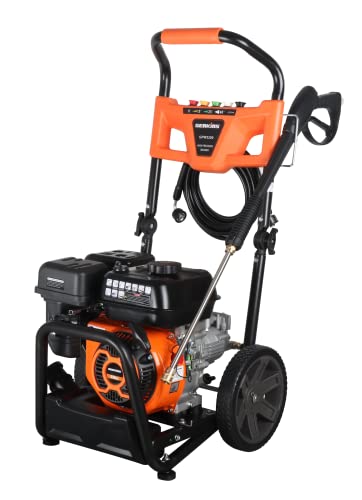
The Westinghouse WPX3400 lists 3,400 PSI and 2.6 GPM from a 212cc, four-stroke OHV engine with a recoil start. Multiplying gives about 8,840 cleaning units, and the hydraulic power behind that is roughly 5.2 horsepower at the pump, which comes to about 7.2 horsepower from the engine once pump losses are included. A 212cc engine rated near 7 horsepower is right at that line, so the label is believable but runs the machine near its limit.
Flow at 2.6 GPM is at the upper end for consumer machines, which are generally capped around 2.8 GPM, so it cleans flat surfaces faster than the 2.3 and 2.4 GPM units in this guide. A 25 foot abrasion-resistant hose, a lightweight spray gun and five quick-connect nozzles give a full set, and an onboard soap tank removes the siphon tube.
Against the Simpson, it offers slightly more pressure and flow with a less established pump brand. Check the oil before every start, keep the air filter clean and use fresh stabilized fuel. Drain the pump and run antifreeze through it before winter, and never run the pump dry. Wear eye and ear protection, closed shoes and long trousers, because a high-pressure jet can cut skin and the engine is loud. Keep children and pets well away during use.
What works
- 2.6 GPM flow cleans flat areas faster
- Believable 3,400 PSI for a 212cc engine
- Onboard soap tank
- Five quick-connect nozzles and a 25 foot hose
Watch out for
- Engine runs near its limit at full output
- Axial cam pump is not rebuildable
Spec sheet
- Pressure
- 3,400 PSI
- Flow
- 2.6 GPM
- Engine
- 212cc 4-stroke OHV, horizontal shaft
- Hose
- 25 foot abrasion-resistant
- Extras
- Onboard soap tank, five quick-connect nozzles