
Amazon affiliate links - we earn a commission.Affiliate disclosure

Buying guide · 14 min read · Updated 2026-11-18

Best Generator Transfer Switches for a House (2026)

Six home generator transfer switches compared, from 30 and 50 amp circuit panels to 200 amp whole-house disconnects, with a plain look at what each can power.

James MillerBy James MillerLead Machine Editor6 machines comparedSpec-sheet verified
Best Generator Transfer Switches for a House

At a glance

Our top picks

Side by side

Spec comparison

MachineRatingCircuitsEnclosureCapacity
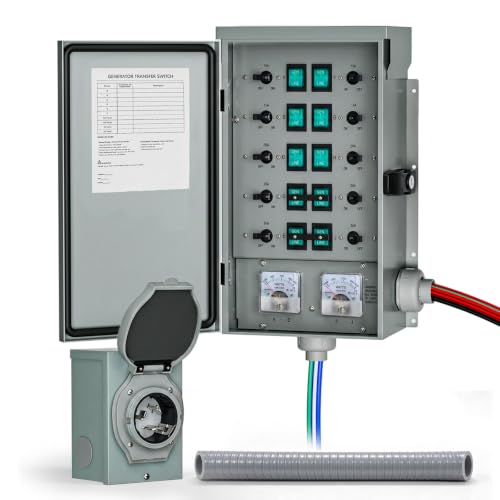
VEVOR 50A 10-Circuit Prewired Kit with CS6375 Inlet BoxBest Overall for Most HousesVEVOR 50A 10-Circuit Prewired Kit with CS6375 Inlet Box50 amp, 120/240V10, prewiredNEMA 3R weatherproofn/a
Nature's Generator 50A 12-Circuit Manual Transfer SwitchBest for Flexible 240V PairingNature's Generator 50A 12-Circuit Manual Transfer Switch50 amp, 120/240V12 at 120V or 6 at 240Vn/an/a
Nature's Generator 30A 12-Circuit Home Backup PanelBest Value for Mid-Size GeneratorsNature's Generator 30A 12-Circuit Home Backup Panel30 amp, 120/240V12Steeln/a
POOAMY 50A 10-Circuit Manual Transfer Switch, NEMA 3RBest Alternative 50A KitPOOAMY 50A 10-Circuit Manual Transfer Switch, NEMA 3R50 amp, 120/240V10Heavy-duty steel, NEMA 3R12,500W maximum
Tzechkii 200A Manual Double-Throw Transfer Switch, NEMA 3RBest 200A Whole-House DisconnectTzechkii 200A Manual Double-Throw Transfer Switch, NEMA 3R200 amp, 120/240Vn/aGalvanized steel, NEMA 3R48,000W as listed
LNEUIE 200A Manual Double-Throw Transfer Switch, 48,000WBest Alternative 200A DisconnectLNEUIE 200A Manual Double-Throw Transfer Switch, 48,000W200 amp, 120/240Vn/aGalvanized steel, protective coating48,000W as listed

Powering a house from a generator comes down to a choice between two philosophies. Either you feed a handful of chosen circuits through a panel, or you swing the whole service over to the generator with a large disconnect and manage the load by hand.

Neither is wrong, but they cost different amounts of money, wire and permission. The sections below explain which approach each product represents and how to match it to the house you actually have.

Before you buy

6 Criteria to Look For Before Buying a Generator Transfer Switch for a House

  1. 01

    Chosen circuits or the whole house

    A panel like the VEVOR or the Nature's Generator 50 amp moves ten or twelve chosen circuits, so you decide what stays powered. A 200 amp disconnect like the Tzechkii moves the whole service and leaves you to manage the load. Most houses on a portable generator are best served by the first kind, because no portable can carry central air, a range and a dryer together.

  2. 02

    Generator size versus panel size

    A 30 amp panel caps near 7,200 watts at 240 volts, a 50 amp panel near 12,000, and a 200 amp disconnect is far beyond any portable. The panel never makes the generator bigger. Start from the nameplate running watts of the generator you own, then pick the smallest switch that fits its outlet and your circuit plan. Remember that the numbers on a generator box often show peak watts, which only last seconds. Use the running figure when you add up the loads, and keep at least a fifth of it free so the engine does not run flat out through the night.

  3. 03

    240 volt loads in the house

    Wells, ranges, dryers and central air are 240 volt loads needing both legs. The Nature's Generator 50 amp panel can pair twelve positions into six 240 volt circuits. A 120 volt-only plan misses them. List which 240 volt loads you cannot live without, and buy for those first. A well pump is usually non-negotiable in the country, while an electric dryer is a luxury you can skip for three days. Matching the switch to that honest list is what separates a kit that earns its price from one that sits half used.

  4. 04

    Inlet, cord and feeder wire

    The weakest link sets the limit. A 50 amp panel with a 30 amp cord is a 30 amp system. The VEVOR includes a CS6375 inlet box, so you only need the matching cord. Heavy feeder wire for fifty amps is a real cost on a long run, so locate the panel near the inlet. A short run between inlet and panel also reduces voltage drop and keeps the conduit work cheap. If the main panel is on the far side of the house from where the generator can safely sit, price the run before choosing a model, since distance can cost more than the switch.

  5. 05

    Outdoor rating and placement

    The VEVOR, POOAMY and Tzechkii mention NEMA 3R enclosures. That covers rain on a wall, not flooding. Place any box above likely water lines, keep conduit entries pointing down and shade it from direct sun where possible, since heat shortens breaker life.

  6. 06

    Permits and inspection

    A house tie-in is regulated electrical work. Titles claiming UL or ETL are seller statements, and this guide does not confirm code compliance for any product. Ask the local authority which listing marks they accept before you buy, and keep the permit paperwork for insurance and resale.

Detailed reviews

The 6 best generator transfer switches for a house, explained

01
VEVOR 50A 10-Circuit Prewired Kit with CS6375 Inlet Box
50A 10-circuitPrewiredCS6375 inletNEMA 3R
Check price on Amazon
Best for: A typical house with a large portable generator and a list of essential circuits.

Most houses outgrow a handful of extension cords and a pair of lights, and a ten-circuit fifty amp panel is where a sensible house plan lands. This kit arrives prewired with a CS6375 inlet box, and the listing quotes use with generators up to 12,500 watts. That is enough for a refrigerator, a freezer, a furnace blower, a sump pump, lighting and a couple of outlet circuits at once.

It is not a whole-house solution, and the listing does not claim to be. The ten positions are chosen circuits, and big loads such as central air or an electric dryer must either be left off or traded in for something else. Against the Nature's Generator 30 amp panel below, the extra twenty amps buy you real headroom for a 240 volt pump.

Budget for the wiring day: ten conductors into the main panel, a permit in most places, and an inspector's sign-off. Ask the installer to confirm breaker sizes against the supplied wire, since this is a generic seller kit and the documentation is thinner than a big brand's.

What works

  • Ten prewired circuits at 120/240V
  • CS6375 inlet box in the carton
  • Weatherproof NEMA 3R enclosure
  • Fits generators up to 12,500W per listing

Watch out for

  • Generic brand, thin documentation
  • Cannot carry whole-house loads
  • Requires permit and wiring work

Spec sheet

Rating
50 amp, 120/240V
Circuits
10, prewired
Inlet
CS6375 included
Enclosure
NEMA 3R weatherproof
Generator class
Up to 12,500W
02
Nature's Generator 50A 12-Circuit Manual Transfer Switch
50A 120/240V12 circuitsManualPaired breakers
Check price on Amazon
Best for: Houses with several 240 volt loads and a large portable generator.

This panel is the house-sized answer when you want the most positions on a fifty amp feed. The listing describes interchangeable breakers, letting the twelve positions become six 240 volt circuits, so a well pump, a range hood or a dryer fan on its own pair is possible.

The trade is complexity. Twelve circuits mean twelve conductors and a longer wiring visit than the VEVOR's ten. It is also a bigger commitment to a generator with a fifty amp outlet, because the whole chain, inlet, cord and feeder, must match.

Where it pays off is flexibility in a house with a few 240 volt loads. If your plan includes more than one such load, this panel beats the 120-only options. Check the nameplate to see whether the UL claim in the title is true.

What works

  • Six 240V pairs possible on fifty amps
  • Twelve positions for load rotation
  • Non-automatic design with no electronics
  • Large generator compatibility

Watch out for

  • Heavy wiring day for twelve circuits
  • Needs a 50A generator outlet
  • UL claim needs a label check

Spec sheet

Rating
50 amp, 120/240V
Circuits
12 at 120V or 6 at 240V
Operation
Manual
Listing claim
Titled UL Listed; verify label
Generator match
Large portables, 50A outlet
03
Nature's Generator 30A 12-Circuit Home Backup Panel
30A 120/240V12 circuitsLit rockersSteel box
Check price on Amazon
Best for: Houses with a 7,500 watt generator and a habit of rotating loads.

At thirty amps this panel fits the common L14-30 outlet found on mid-size portables. Twelve illuminated rocker switches let a household rotate loads: a refrigerator and lights stay on, while the washing machine gets a turn in the afternoon.

The weakness is the ceiling. About 7,200 watts at 240 volts has to cover every circuit you flip on, so a house with an electric range or a large heat pump will run out of headroom. A gas furnace, gas water heater and gas range change that picture entirely, because the electrical load shrinks to blowers, igniters and lights. Compared with the VEVOR, you give up twenty amps and get lit switches in return.

It suits a house whose owner is willing to ration. Keep a written priority list, assign each rocker a label, and practise a switchover when the grid is up. The paperwork and electrician requirements are the same as for the larger panels.

What works

  • Matches common L14-30 generator outlets
  • Lit rockers show live circuits
  • Twelve positions for rotation
  • Pre-wired steel enclosure

Watch out for

  • About 7,200W total ceiling
  • Cannot carry a range plus much else
  • Wiring twelve circuits takes time

Spec sheet

Rating
30 amp, 120/240V
Circuits
12
Controls
Illuminated rockers
Enclosure
Steel
Wiring
Pre-wired
04
POOAMY 50A 10-Circuit Manual Transfer Switch, NEMA 3R
50A 120/240V10 circuits12,500W maxNEMA 3R
Check price on Amazon
Best for: Buyers comparing fifty amp kits who want a steel NEMA 3R body with simple mounting.

POOAMY offers the same fifty amp, ten-circuit idea as the VEVOR in a heavy-duty steel enclosure with pre-drilled holes. The listing states a 12,500 watt maximum and a NEMA 3R rating.

The two kits are close enough that the decision comes down to which carton arrives with the parts you need and which instruction sheet your electrician prefers. Against the Nature's Generator 50 amp panel, you drop two positions and the paired-breaker flexibility, but the ten-circuit layout is simpler to wire.

As with all generic sellers, inspect the box when it arrives, check for shipping damage, and confirm that the labels match what you ordered. Photograph the nameplate and keep it with the permit file. Seasonal upkeep is minimal because there are no electronics, but the pre-drilled mounting holes mean a gap behind the box can collect water, so seal the edges with exterior-grade caulk after mounting.

What works

  • Fifty amps with 12,500W stated maximum
  • Heavy-duty steel NEMA 3R enclosure
  • Pre-drilled holes ease mounting
  • Ten positions keep wiring manageable

Watch out for

  • Seller brand with limited support
  • Listing details are thin
  • Same permit and install burden

Spec sheet

Rating
50 amp, 120/240V
Circuits
10
Capacity
12,500W maximum
Enclosure
Heavy-duty steel, NEMA 3R
Install
Pre-drilled holes
05
Tzechkii 200A Manual Double-Throw Transfer Switch, NEMA 3R
200A 120/240VDouble throwNEMA 3R48,000W listed
Check price on Amazon
Best for: Whole-service switching with a standby generator or very large portable.

For a house whose entire service needs to swing to a generator, a 200 amp double-throw disconnect is the matching hardware. The listing describes a galvanized NEMA 3R enclosure and a manual lever that moves between utility and an auxiliary source such as a gas generator, with the action preventing both from connecting at once.

It differs fundamentally from the circuit panels: nothing is selected, the whole panel follows the lever. That means the generator must carry the house or the owner must switch big loads off by hand, which only a standby generator or a very large portable can support.

Against the LNEUIE 200 amp unit next to it, the specs read almost identically, so compare cost and the electrician's familiarity. This is service entrance work: a licensed installer, a permit and often utility notification are the norm.

What works

  • 200A rating matches typical service
  • Galvanized NEMA 3R enclosure
  • Double-throw lever blocks dual feed
  • No electronics to fail

Watch out for

  • Service entrance work, electrician only
  • Needs a generator far larger than a portable
  • Utility coordination may be needed

Spec sheet

Rating
200 amp, 120/240V
Capacity
48,000W as listed
Enclosure
Galvanized steel, NEMA 3R
Action
Manual lever
Purpose
Utility to auxiliary source
06
LNEUIE 200A Manual Double-Throw Transfer Switch, 48,000W
200A 120/240VDouble throw48,000W listedGalvanized
Check price on Amazon
Best for: Whole-house service switching where the installer prefers this model.

LNEUIE's 200 amp switch is the second whole-service disconnect in the group. The listing emphasises aluminum connections with no electronic components and a galvanized steel case with a protective coating.

The practical difference from the Tzechkii is small. Both give a manual double-throw action at the same rating and listed capacity, so use the electrician's preference as the tie-breaker. If your installer already works with one of the two, that familiarity is worth more than any spec line.

Aluminum lugs need the right torque and anti-oxidant compound, and a yearly check. A hard-wired service switch is not a place for improvisation, so treat the paperwork seriously. Whichever 200 amp model you choose, ask the installer how the neutral and ground are handled at the service, since this is where the switch design and the house wiring must agree, and where mistakes cause nuisance trips or shock hazards.

What works

  • Same 200A rating as the Tzechkii
  • No electronic components to fail
  • Galvanized case with coating
  • Manual lever is simple to understand

Watch out for

  • Aluminum lugs demand torque discipline
  • Service work needs a licensed installer
  • Little brand documentation

Spec sheet

Rating
200 amp, 120/240V
Capacity
48,000W as listed
Connections
Aluminum, no electronics
Enclosure
Galvanized steel, protective coating
Action
Manual double throw

Spec sheet decoder

What the numbers on the box really mean

The specs manufacturers lead with, translated into what they tell you about real-world performance.

Circuits

Individual branch circuits that can be moved to generator power. Ten or twelve is typical for a house panel.

Watch forThe VEVOR and POOAMY have ten, the Nature's Generator panels twelve.

Amperage

The current the switch and feeder can carry. 30, 50 and 200 amps are the three tiers here.

Watch forMatch the generator outlet; a mismatch sets the real limit.

Double throw

A lever with two live positions, utility or generator, and never both.

Watch forBoth 200A boxes use it.

NEMA 3R

Rain-tight outdoor enclosure rating. It does not mean flood-proof.

Watch forListed for the VEVOR, POOAMY and Tzechkii.

Maximum wattage

A ceiling for the switch, not a promise about your generator.

Watch for12,500W for the 50 amp kits, 48,000W for the 200 amp boxes.

Methodology

How We Evaluated These Generator Transfer Switches for a House

House-scale fit

We asked whether each product can reasonably serve a house, from chosen circuits to the whole service. Smaller single-circuit boxes were left to their own guides.

Rating tiers

Products fall into 30, 50 and 200 amp tiers. We ranked within tiers and then compared across them by who benefits.

Wiring burden

We weighed circuit count, prewiring and enclosure style against the electrician hours each is likely to need.

Brand and documentation

Generic seller kits carry less documentation than big brands. We noted that tradeoff openly, as an owner feedback pattern.

Claim caution

We repeated listing claims without endorsing them and reminded readers to check labels and permits.

Decision guide

How to Choose the Right Generator Transfer Switches for a House

By Generator Class

SituationPickWhy
7,500W portableNature's Generator 30A 12-Circuit PanelMatches an L14-30 outlet
9,000 to 12,000W portableVEVOR 50A 10-Circuit KitFifty amp with inlet included
Standby generatorTzechkii 200A Double-ThrowWhole-service switching

By Budget

SituationPickWhy
Lower tierNature's Generator 30A 12-Circuit PanelLighter wire and smaller feeder
Middle tierPOOAMY 50A 10-Circuit KitSteel NEMA 3R kit
Higher tierNature's Generator 50A 12-CircuitPaired 240V flexibility

Circuit Panel vs Whole-House Disconnect

Circuit panel

The VEVOR, POOAMY and Nature's Generator panels move selected circuits. You choose what runs, and a portable generator can carry it.

Whole-house disconnect

The Tzechkii and LNEUIE swing the whole service. Powerful, but the generator and the owner must manage the load.

Choose a panel for a portable generator; choose a disconnect only with a standby unit.

By Installation Complexity

SituationPickWhy
Fewest conductorsVEVOR 50A 10-Circuit KitTen prewired circuits
Most flexible layoutNature's Generator 50A 12-CircuitTwelve positions, six 240V
Service entrance workLNEUIE 200A Double-ThrowSingle lever for the service

For Well Pumps and Furnaces Specifically

Look for

A 240 volt position for the pump and a furnace blower circuit that stays powered. Check running amps against the generator.

In this comparison

The Nature's Generator 50 amp panel can pair circuits for a pump, while the VEVOR covers a furnace and pump within ten positions.

When to Spend More

Spend more if

You own a large generator and want 240 volt pairs from the Nature's Generator 50 amp panel, or a standby unit that needs a Tzechkii 200 amp switch.

Save if

A 7,500 watt portable and a short priority list is all you need. The Nature's Generator 30 amp panel suffices.

Ownership

Maintenance schedule

The upkeep that decides whether this machine lasts two seasons or ten.

TaskIntervalWhy it matters
Exercise the switchEvery 6 monthsContacts oxidise when idle. Move each position with the generator off to keep the action smooth.
Re-torque lugsYearlyHeat cycles loosen terminals, aluminum especially. An electrician should tighten to the label torque.
Inspect the inletBefore storm seasonA corroded inlet pin overheats. Clean and replace a damaged cover.
Keep the load list currentAfter appliance changesA new freezer shifts priorities. Update the labels and the written list.
Run a dry-run outageYearlySwitch over with the grid on and watch for a hard start or tripped breaker, so surprises happen on a calm day.

FAQ

Frequently Asked Questions

Can a transfer switch run my whole house?

Only a 200 amp disconnect moves the whole service, and your generator must be big enough to carry it. A portable usually cannot run central air, an electric range and a dryer together, so load management is essential.

How many circuits do I need?

Most houses survive on six to ten: refrigeration, heat, pump, lights and a few outlets. More positions help rotation but add wiring. Walk the house with a pencil, list each breaker in the main panel and mark the ones you would genuinely miss after day one, which usually settles the count.

Which switch lasts longest?

Manual switches last as long as their contacts and lugs stay tight. Annual torque checks and a dry enclosure matter more than the brand. The wear items are the inlet pins and the cord, which take the abuse of repeated plugging in outdoors, so budget for replacing them before you budget for replacing the switch.

Is a 50 amp panel better than a 30 amp panel?

Only with a generator that has a 50 amp outlet. Otherwise the thirty amp panel gives the same circuits at lower wiring cost.

Do I need a permit?

Almost always, and many jurisdictions require a licensed electrician. Ask before buying. Expect an inspection after the work, and do not energise the system until it passes, since a failed inspection after the wall is closed is expensive to fix. Some utilities also want to know when a switch is installed.

Does UL Listed in a title mean it passes inspection?

No. It is a seller statement. Read the label and ask the inspector what is accepted.

Bottom line

The short version

Browse more generator transfer switches for a houseon Amazon →
James Miller, Lead Machine Editor

About the author

James Miller

Lead Machine Editor, MachineFanatic

James Miller leads MachineFanatic's buying guides, turning spec sheets, manuals and owner feedback into clear verdicts on power tools, outdoor power equipment, shop machines and kitchen machines.

More from James →

Keep reading

Related guides