
Amazon affiliate links - we earn a commission.Affiliate disclosure

Buying guide · 12 min read · Updated 2026-11-07

Best Inverter Window Air Conditioners (2026)

Six inverter window air conditioners from 6,000 to 14,000 BTU compared on variable-speed compressors, efficiency claims, noise and window fit for 2026.

James MillerBy James MillerLead Machine Editor6 machines comparedSpec-sheet verified
Best Inverter Window Air Conditioners

At a glance

Our top picks

Side by side

Spec comparison

An inverter window air conditioner swaps the old on-off compressor for one whose speed changes with the load. At the hottest hour it runs fast, and once the room is cool it slows to a trickle that holds the temperature, which removes the start-up thump and the temperature swing.

The benefit is real but oversold. Savings depend on how many hours you run the unit, and the inverter board is the costliest part to replace. Know what you are paying for before you pay for it.

Before you buy

6 Criteria to Look For Before Buying an Inverter Window Air Conditioner

  1. 01

    Know what an inverter changes

    A fixed-speed compressor switches fully on, runs to the setpoint and then shuts off, so the room swings and every start thumps. An inverter lowers its speed as the room nears the setpoint, so the Midea 7,800 BTU or the LG 14,000 BTU hold temperature closely. The benefit is largest in rooms that run the unit for hundreds of hours a season.

  2. 02

    Verified versus claimed efficiency

    The Midea 7,800 BTU carries an Energy Star mark, while the Midea U-shaped units claim over 37 percent savings and the LG claims up to 35 percent above the Energy Star requirement. A certification is checkable, and a percentage is a manufacturer comparison against an unstated baseline. Weigh the mark more than the number.

  3. 03

    Stated power draw

    Hisense lists 700 watts for its 8,000 BTU unit, which lets you do the running-cost math. If your electricity costs a known amount per kilowatt-hour, 700 watts for 8 hours a day is about 5.6 kilowatt-hours. Units with no stated draw leave you guessing. Even a rough running-cost estimate tells you whether an inverter premium is likely to repay itself in your climate.

  4. 04

    Window and weight

    The U-shaped Midea units need a sash that closes on a narrow neck, the LG 14,000 BTU needs a sturdy window and bracket, and the slim TCL and Hisense units fit ordinary windows. Measure the opening and check the sill. A heavy unit on a weak sill tilts and leaks.

  5. 05

    Repair cost of the board

    An inverter drive board costs far more than a mechanical thermostat and is the typical failure point after year five. The LG's broad service network helps, and a unit with a long warranty reduces the risk. Treat the inverter premium as partly insurance against high running hours.

  6. 06

    Size to the room

    A 6,000 BTU Midea suits 250 square feet, the 7,800 BTU Midea suits 340, the TCL and Hisense 8,000 BTU suit about 350, and the 10,000 BTU Midea suits 450. Inverters are more forgiving of oversizing because they slow down, but an oversize unit still wastes money. Match the room.

Detailed reviews

The 6 best inverter window air conditioners, explained

01
Midea 7,800 BTU Inverter Window AC, Energy Star, 340 sq ft
7,800 BTUInverterEnergy Star340 sq ft
Check price on Amazon
Best for: A large bedroom or small living room where verified efficiency and quiet both matter.

This Midea pairs an inverter compressor with an Energy Star mark, which makes its efficiency claim checkable instead of a marketing percentage. It has four modes, an LED display, a 24-hour timer and an eco energy saver, and a swing function that moves the louvers.

Its 340 square feet of coverage fits a large bedroom or small living area, and it uses a standard chassis, so it does not need the narrow-neck window that the U-shaped units require. Against the TCL it adds the Energy Star certification, and against the U-shaped Midea models it gives up the outside compressor but costs less and fits more windows.

Ownership is routine: a washable filter and a spring coil clean. The inverter board is the pricey spare, so register the unit and keep the receipt in case the warranty is needed. Use the 24-hour timer to avoid running it in an empty house.

What works

  • Energy Star certified inverter
  • 24-hour timer and eco mode
  • Fits standard windows
  • Covers up to 340 square feet

Watch out for

  • Compressor is partly indoors
  • Costs more than fixed-speed units of similar size
  • Inverter board is costly to replace

Spec sheet

Cooling capacity
7,800 BTU
Coverage
340 sq ft
Compressor
Inverter
Certification
Energy Star
Features
LED display, 24-hour timer, eco mode
02
TCL 8,000 BTU Q-Series Smart Inverter Window AC
8,000 BTUInverterSmart control3-step install
Check price on Amazon
Best for: A bedroom of about 350 square feet where an inverter is wanted at the lowest entry cost.

The TCL Q-Series is an 8,000 BTU inverter with remote and smart control, aimed at a quick install: set it in the window, secure the side panels and plug it in. The listing also notes that you can still open the window, which suggests a slimmer cabinet profile than a traditional box.

Its role in this lineup is the inverter at the lowest price tier. It lacks the Energy Star claim of the Midea 7,800 BTU and the 35 percent claim of the LG, so the efficiency story is less verifiable. For a first inverter, that is acceptable, since the biggest day-to-day benefit is the absence of hard cycling.

Upkeep is the usual filter and coil routine. Because the brand is newer in window units, check the warranty length and keep the packaging for the first season. If you mostly cool one bedroom, it is worth setting the thermostat a degree or two higher than you would on a fixed-speed unit, because the inverter holds that temperature without the swing and still feels comfortable.

What works

  • Inverter compressor at the lowest price tier
  • Quick three-step installation
  • Remote plus smart control
  • Window can still open

Watch out for

  • No Energy Star claim in the data
  • Newer brand in window units
  • Smart features add software dependence

Spec sheet

Cooling capacity
8,000 BTU
Compressor
Inverter
Install
Window fit, side panels, plug in
Control
Remote and smart app
Window use
Window can still open
03
Hisense 8,000 BTU Smart Inverter Window AC, 350 sq ft
8,000 BTUInverter700 wattsUltra-slim
Check price on Amazon
Best for: An apartment bedroom where a slim cabinet and a stated power draw matter.

Hisense lists 8,000 BTU measured to the ASHRAE method, 700 watts of power and 115V supply, which makes it one of the few units here with a stated power draw. That number lets you estimate running cost: a unit using 700 watts at full output costs about 0.7 kilowatt-hours per hour of running.

The ultra-slim profile and the easy install bracket target apartments, and the four-way air direction with three fan speeds offers decent control of airflow. Against the TCL it states its electrical figures more openly, and against the Midea it lacks the Energy Star mark.

Ownership is the standard routine. The slim cabinet leaves less room for a thick filter, so check it often, and keep the bracket tightened each season. Mount it on a level sill with the bracket snug, since a slim cabinet that rocks in the window will buzz and undo the quiet that the inverter provides.

What works

  • States 700 watts of power draw
  • Ultra-slim cabinet with install bracket
  • Four-way airflow with three fan speeds
  • Inverter smoothing of temperature

Watch out for

  • No Energy Star claim in the data
  • Slim cabinet leaves less filter area
  • Smart control adds software dependence

Spec sheet

Cooling capacity
8,000 BTU (ASHRAE)
Coverage
Up to 350 sq ft
Power draw
700 watts
Supply
115V
Airflow
4-way, 3 fan speeds
04
Midea 6,000 BTU U-Shaped Inverter Window AC
6,000 BTUU-shapedDC inverter250 sq ft
Check price on Amazon
Best for: A 200 to 250 square foot bedroom with a compatible window.

This is the small-room inverter with a U-shaped layout, where the sash closes down on a narrow neck and the compressor sits outside. The DC inverter varies speed, and the maker claims over 37 percent in energy savings versus standard units, which is a best-case figure.

The combination makes it the quietest option for a bedroom up to 250 square feet. Against the Midea 7,800 BTU it is smaller, quieter by design and needs a compatible window, and against the Hisense it lacks a stated power draw.

Upkeep is light, though the outside-facing coil rewards a rinse before each cooling season. The Wi-Fi app is convenient for precooling, but keep the remote as a fallback if the app is unavailable.

What works

  • DC inverter with a U-shaped layout
  • Compressor sits outside the sash
  • Right size for most bedrooms
  • Wi-Fi app and remote

Watch out for

  • Needs a window that closes on a narrow neck
  • Only 250 square feet of coverage
  • Savings figure is a manufacturer claim

Spec sheet

Cooling capacity
6,000 BTU
Coverage
Up to 250 sq ft
Compressor
DC inverter
Layout
U-shaped
Savings claim
Over 37 percent vs standard
05
Midea 10,000 BTU U-Shaped Inverter Window AC
10,000 BTUU-shapedDC inverter450 sq ft
Check price on Amazon
Best for: A large bedroom or open living area up to 450 square feet.

The 10,000 BTU U-shaped Midea takes the same inverter and outside-compressor idea to a 450 square foot room. It is the only unit here that gives large-room capacity with a modulating compressor and a quiet layout, apart from the LG at 14,000 BTU.

Weight is the practical limit, since a 10,000 BTU cabinet takes two people and a support bracket. Against the LG 14,000 BTU it is smaller and easier to place, and against the 6,000 BTU Midea it covers an extra 200 square feet.

Check the circuit: at this size the current draw is meaningful, and a dedicated circuit avoids breaker trips. The usual filter and coil cleaning applies.

What works

  • Inverter with outside compressor layout
  • Covers up to 450 square feet
  • Wi-Fi and remote control
  • Window closes on a slim neck

Watch out for

  • Heavy, two-person install
  • Window must suit the U-shaped neck
  • Highest cost for its class

Spec sheet

Cooling capacity
10,000 BTU
Coverage
Up to 450 sq ft
Compressor
DC inverter
Layout
U-shaped
Control
Wi-Fi, app and remote
06
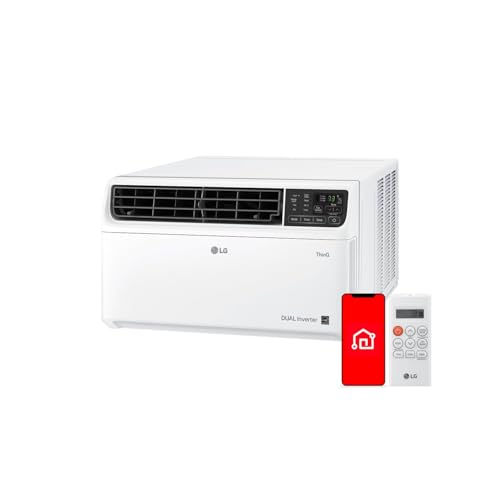
LG 14,000 BTU Dual Inverter Smart Window AC, 800 sq ft
14,000 BTUDual inverter800 sq ft115V
Check price on Amazon
Best for: A very large room or open apartment up to 800 square feet.

LG's dual inverter unit is rated at 14,000 BTU for up to 800 square feet on a 115V circuit, and the listing claims energy savings up to 35 percent beyond the Energy Star requirement. Dual inverter refers to variable-speed control of both the compressor and the fan, which lets the unit modulate more finely than a compressor-only design.

It is a big, heavy unit for a very large room or a whole open apartment, and it needs a sturdy window and a dedicated circuit. It stands alone in the lineup for capacity: the next largest is the 10,000 BTU Midea at 450 square feet. The tradeoff is cost, weight and the loss of the narrow-neck quiet layout.

Ownership includes a heavy lift, a bracket and the usual filter and coil care. LG's service network is broad, which offsets the cost of its electronics. Plan to hire help for the install, because lifting a unit of this size to a second-floor window is the step most likely to cause an injury or a dropped cabinet.

What works

  • Covers up to 800 square feet
  • Dual inverter modulates compressor and fan
  • Runs on 115V
  • Wide LG service network

Watch out for

  • Very heavy for a window install
  • Needs a sturdy window and dedicated circuit
  • Highest price tier here

Spec sheet

Cooling capacity
14,000 BTU
Coverage
Up to 800 sq ft
Compressor
Dual inverter
Supply
115V
Efficiency claim
Up to 35 percent above Energy Star

Spec sheet decoder

What the numbers on the box really mean

The specs manufacturers lead with, translated into what they tell you about real-world performance.

Inverter or DC inverter

A compressor whose speed is controlled electronically, so output follows demand. It avoids hard starts and reduces temperature swing.

Watch forAll six here use one, and the LG calls its design dual inverter.

Energy Star

A certification that the unit meets an efficiency threshold set by an independent program.

Watch forOnly the Midea 7,800 BTU lists it in the data.

Watts

The electrical power drawn while running. Multiply by hours to estimate energy use.

Watch forThe Hisense lists 700 watts, but most others do not state a draw.

ASHRAE BTU

A cooling capacity measured under a standard test method. It is the usual window unit rating.

Watch forThe Hisense labels its 8,000 BTU as ASHRAE, so compare like with like.

Coverage

The room size the maker lists for the unit, assuming an 8 foot ceiling.

Watch forThe range runs from 250 square feet on the Midea 6,000 BTU to 800 on the LG 14,000 BTU.

Methodology

How We Evaluated These Inverter Window Air Conditioners

Verifiable efficiency

We weighed certifications and stated electrical figures above percentage claims. The Midea 7,800 BTU earned credit for Energy Star and the Hisense for its 700 watt figure, while the 37 and 35 percent claims were treated as best cases.

Modulation quality

We looked for inverter designs that vary compressor speed, and credited the LG dual inverter for varying the fan too. A unit that only claims to be quiet without a variable compressor scored lower.

Fit and weight

We compared window requirements, from the U-shaped neck of the Midea 6,000 and 10,000 BTU to the sturdy window the LG 14,000 BTU needs. Easier installs scored higher.

Room match

We matched coverage to realistic rooms, 250 square feet for the smallest Midea and 800 for the LG. Units that suit common bedrooms scored higher than extremes.

Ownership cost

We considered the inverter board replacement risk and brand service networks based on owner feedback patterns. The LG and Midea networks helped, and newer brands lost some points.

Decision guide

How to Choose the Right Inverter Window Air Conditioners

By Room Size

SituationPickWhy
Bedroom up to 250 sq ftMidea 6,000 BTU U-ShapedSmallest inverter, quiet layout
Bedroom up to 340 sq ftMidea 7,800 BTUEnergy Star inverter
Bedroom or living room near 350 sq ftTCL 8,000 BTU Q-SeriesLowest entry cost
Large room up to 450 sq ftMidea 10,000 BTU U-ShapedInverter with outside compressor

By Budget

SituationPickWhy
Lowest cost inverterTCL 8,000 BTU Q-SeriesEntry price tier
Mid-range with a stated drawHisense 8,000 BTU700 watts listed
Mid-range with Energy StarMidea 7,800 BTUVerified efficiency
Highest outlay for capacityLG 14,000 BTU Dual Inverter800 square feet

Standard Chassis vs U-Shaped

Standard chassis

The Midea 7,800 BTU, TCL, Hisense and LG sit in the window with the compressor partly indoors. They fit ordinary windows and cost less, but are louder than the U-shaped units.

U-shaped

The Midea 6,000 and 10,000 BTU straddle the sash so the compressor sits outside. They are quieter, but the window must close on a narrow neck.

Choose U-shaped if your window allows it, standard otherwise.

Efficiency Proof

SituationPickWhy
Want a certificationMidea 7,800 BTUEnergy Star listed
Want a stated wattageHisense 8,000 BTU700 watts
Want the biggest claimed marginLG 14,000 BTUUp to 35 percent above Energy Star
Want the quietest designMidea 6,000 BTU U-ShapedCompressor outside

For Heavy Daily Use Specifically

Look for

An inverter with a verified efficiency mark, a stated power draw and a size that matches the room. Hours of use are what turn an inverter premium into savings.

In this comparison

The Midea 7,800 BTU with Energy Star and the Hisense 8,000 BTU with 700 watts are the best-documented choices for daily use.

When to Spend More

Spend more if

You run the unit for months, sleep in the room or need very large capacity. The Midea 7,800 BTU, the U-shaped Midea units or the LG 14,000 BTU repay the premium.

Save if

Use is occasional. The TCL 8,000 BTU Q-Series gives the inverter experience at the lowest cost.

Ownership

Maintenance schedule

The upkeep that decides whether this machine lasts two seasons or ten.

TaskIntervalWhy it matters
Wash the filterEvery 2 to 4 weeksA clogged filter forces the inverter fan to run faster and louder. Rinse and dry fully.
Clean the coilsEach springDirty coils make the compressor work harder and cut the inverter's efficiency edge.
Inspect side panels and bracketEach installA loose cabinet rattles and leaks air. Tighten the bracket and replace worn foam.
Check the drain tiltEach installA slight outward tilt drains condensate outside. A level unit drips into the room.
Update firmwareEach springSmart inverter units need current firmware to stay connected. Do it before the first heat wave.

FAQ

Frequently Asked Questions

Are inverter window air conditioners worth it?

If you run the unit for months each year, yes, because steady modulation saves power and reduces noise. For occasional use a fixed-speed unit costs less and the savings never repay the premium. A bedroom unit running eight hours a night for four months is the typical case where the premium is justified.

Do inverter units use less electricity?

Usually, because they avoid full-power starts and run at partial load most of the time. The size of the saving depends on use, and claims like 37 percent are best-case manufacturer figures. The cleanest way to compare is the stated wattage at a given capacity, which only some listings provide.

Are inverter units quieter?

Yes, since they do not thump on at full speed. The U-shaped Midea models add an outside compressor for even less indoor noise.

What fails on an inverter unit?

The electronic drive board is the typical failure, and it costs more than a mechanical part. Choose a maker with a wide service network and a long warranty.

Can an inverter window unit run on a normal outlet?

Yes, all six here use a 115V supply. The larger LG 14,000 BTU still needs a dedicated circuit because of its current draw. Avoid sharing the circuit with a microwave or space heater.

What size inverter unit do I need?

About 20 BTU per square foot at an 8 foot ceiling, so 6,000 BTU for 250 square feet and 8,000 BTU for about 350. Inverters tolerate slight oversizing better than fixed-speed units but still waste money.

Bottom line

The short version

Browse more inverter window air conditionerson Amazon →
James Miller, Lead Machine Editor

About the author

James Miller

Lead Machine Editor, MachineFanatic

James Miller leads MachineFanatic's buying guides, turning spec sheets, manuals and owner feedback into clear verdicts on power tools, outdoor power equipment, shop machines and kitchen machines.

More from James →

Keep reading

Related guides