
Amazon affiliate links - we earn a commission.Affiliate disclosure

Buying guide · 12 min read · Updated 2026-11-07

Best KitchenAid Food Processors (2026)

Three KitchenAid food processors compared: the 13-cup with Exact Slice, the 7-cup with in-bowl storage and the 3.5-cup chopper, with fit and care advice.

James MillerBy James MillerLead Machine Editor3 machines comparedSpec-sheet verified
Best KitchenAid Food Processors

At a glance

Our top picks

Side by side

Spec comparison

MachineBowl capacityStorageAssemblySpeeds
KitchenAid 13-Cup Food Processor KFP1318Best OverallKitchenAid 13-Cup Food Processor KFP131813 cupsIn-bowl caddy for blades and discsTwist-free, one-click bowl with latched lidn/a
KitchenAid 7-Cup Food Processor KFP0718Best ValueKitchenAid 7-Cup Food Processor KFP07187 cupsBlades and discs store in the bowlOne-click bowl, latched lidThree plus pulse
KitchenAid 3.5-Cup Food Chopper KFC3516Best ChopperKitchenAid 3.5-Cup Food Chopper KFC35163.5 cupsCord wrapn/aTwo plus pulse

This maker's food processor line is small and sensible: a large machine, a mid-size one and a countertop chopper. All three share a design philosophy built around one-click assembly and storage that keeps every sharp part in one place.

Because the range is short, the question is not which brand to buy but which size fits your kitchen. We compare the three on bowl capacity, slicing control, storage and the kind of cooking each one rewards, and we are candid about where a larger machine is simply more than most households need.

Before you buy

6 Criteria to Look For Before Buying a KitchenAid Food Processor

  1. 01

    Choose size before anything else

    The range has three clear sizes: 3.5 cups, 7 cups and 13 cups. The chopper suits salsa and herbs, the 7-cup suits a household of one to four, and the 13-cup suits big batches and dough. Because the three are priced in steps, buying one size too large costs real money and cabinet space. A good test is to think of the biggest recipe you cook monthly, not the biggest you cook yearly, and pick the size that handles it in one or two batches. People who bake bread every week are the main group who benefit from the 13-cup bowl.

  2. 02

    Adjustable slicing

    The 13-cup KFP1318 has an externally adjustable Exact Slice disc, so thickness changes by lever. The 7-cup uses fixed discs and the chopper has none. If you slice potatoes, cucumbers and apples often, the adjustable disc is the main reason to pay for the larger model. Fixed discs are fine when you always slice at the same thickness, but an adjustable lever shines when one recipe wants paper-thin cucumber and the next wants chunky potato. If you rarely slice, skip the premium and put the money toward a good knife.

  3. 03

    In-bowl storage

    The 13-cup and 7-cup both store all blades and discs inside the bowl. This is a safety and convenience feature, because there is no loose drawer of sharp parts. The chopper has a single blade, so it does not need this. The practical benefit shows up in year three, when a processor with loose discs has usually lost one in a drawer, while a machine that keeps every part in the bowl tends to stay complete and in use.

  4. 04

    Feed tube design

    The KFP0718 has a 2-in-1 feed tube with a wide opening and a narrow inner pusher. That suits both whole tomatoes and thin carrots. A single narrow tube would force pre-cutting. Wide openings also make the machine safer, because you spend less time handling sharp knives and more time letting the disc do the cutting. Use the inner pusher for thin foods and keep fingers clear of the opening.

  5. 05

    Control layout

    The 7-cup has three speeds plus pulse, the chopper has two plus pulse and the 13-cup lists chopping, shredding, kneading and mixing capability. More speeds help with delicate batters. For salsa, pulse alone is enough. Low speed is where the extra setting earns its keep, because a gentler spin keeps cake batters and soft mixes from climbing the walls of the bowl.

  6. 06

    Finish options

    All three come in several finishes, such as Contour Silver, Black Matte, Empire Red and White. The finish does not change the machine, so choose by color and price. Check that the listing is new, because renewed units of the same model are also sold. A renewed unit can be a sensible way to lower the cost, but it comes with a shorter warranty and less certainty about wear, so weigh the savings against the peace of mind.

Detailed reviews

The 3 best kitchenaid food processors, explained

01
KitchenAid 13-Cup Food Processor KFP1318
13-cup bowlExact Slice discIn-bowl storage caddy
Check price on Amazon
Best for: Cooks who slice often, bake and want the largest bowl in the range.

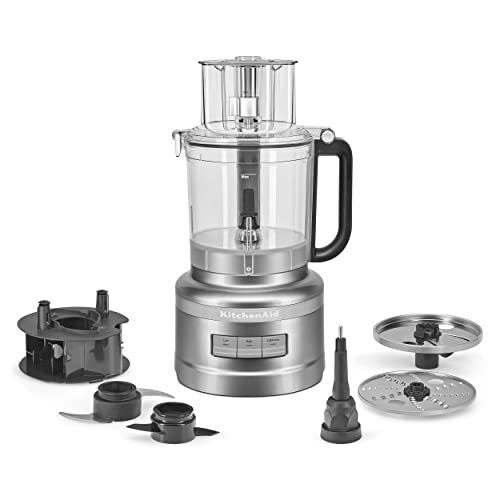
The standout detail of the KFP1318 is the Exact Slice disc, which lets you change slicing thickness with an external control rather than swapping discs. Thick for potato gratin, thin for cucumber salad: you set it and keep working. That level of control is why it sits at the top of this three-machine range.

The 13-cup bowl is large enough for a family-size batch of slaw or a double recipe of dough, and the in-bowl storage caddy holds every blade and disc inside the bowl itself. There is no drawer of loose sharp parts to dig through. Assembly is twist-free: the bowl clicks on and the latched lid locks, which is easier on tired hands than lock-and-twist designs.

Beside the 7-cup KFP0718, you gain six cups of bowl and the adjustable slicer, and you give up some counter and cabinet space. It comes in several finishes, including Contour Silver and Black Matte, which are the same machine. Either hand washing or the top rack works for the bowl and lid, keep the caddy dry and wipe the base with a damp cloth. When you slice, set the lever before you start the motor, and use the pusher with steady pressure so the produce rides the disc instead of being forced into it. Because the bowl is tall and the caddy sits inside it, plan a shelf with room to lift the whole assembly straight up and out.

What works

  • Exact Slice disc adjusts thickness externally
  • 13-cup bowl handles big batches and kneading
  • In-bowl caddy stores every blade and disc
  • One-click bowl and latched lid

Watch out for

  • Large footprint and tall for cabinets
  • Costs more than the 7-cup model

Spec sheet

Bowl capacity
13 cups
Slicing
Externally adjustable Exact Slice disc
Storage
In-bowl caddy for blades and discs
Assembly
Twist-free, one-click bowl with latched lid
Tasks
Chop, shred, slice, knead, mix
02
KitchenAid 7-Cup Food Processor KFP0718
7-cup bowl3 speeds plus pulse2-in-1 feed tube
Check price on Amazon
Best for: Small households that want slicing, shredding and tidy storage in a mid-size bowl.

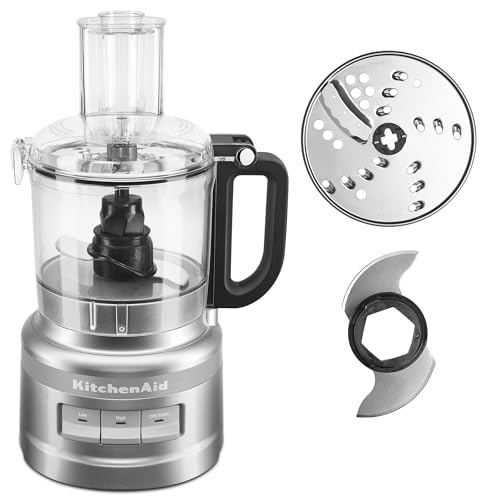
The KFP0718 is the sensible middle of the range. Its seven-cup bowl suits a household of one to four, and it keeps the signature all-in-one storage: every blade and disc lives inside the bowl. A 2-in-1 feed tube gives you a wide opening for bigger pieces and a narrow inner pusher for thin items like carrots.

Three speeds plus a pulse button give more control than a basic on and pulse machine. Use low for soft mixing and high for chopping, and pulse for salsa. It chops, shreds, slices and purees, covering most of what home cooks ask of a processor.

The trade against the 13-cup is bowl size and the lack of an adjustable slicer, since it relies on fixed discs. In return it is lighter, cheaper and easier to store. It is sold in several colors, including Black Matte, Empire Red and White, which are all the same machine. Keep the latch free of crumbs and wash the bowl by hand if you grind nuts. A quick-clean trick the maker describes is adding warm water and a drop of dish soap and pulsing for a few seconds, which loosens residue before the final rinse.

What works

  • Seven cups suits one to four people
  • Three speeds plus pulse for control
  • 2-in-1 feed tube for big and thin foods
  • Everything stores in the bowl

Watch out for

  • Fixed slicing discs, no adjustable lever
  • Seven cups fills quickly on big jobs

Spec sheet

Bowl capacity
7 cups
Speeds
Three plus pulse
Storage
Blades and discs store in the bowl
Feed tube
2-in-1
Assembly
One-click bowl, latched lid
03
KitchenAid 3.5-Cup Food Chopper KFC3516
3.5-cup bowl2 speeds plus pulsePour spout
Check price on Amazon
Best for: Quick daily chopping of onions, herbs, salsa and small hummus batches.

This is the small machine in the range, and it is a chopper rather than a disc processor. A 3.5-cup work bowl has a handle and a pour spout, so it moves from prep to serving. A locking blade keeps the blade in place when you lift the bowl, which is a safety touch that many choppers lack.

Two speeds plus pulse give coarse or fine results, from chunky pico de gallo to a creamy hummus. The listing positions it for salsa, hummus and similar jobs. It cannot slice or shred, so it is not a replacement for the 7-cup or 13-cup models.

Its footprint is small and the cord wraps away, so it tucks into a cabinet. The work bowl is dishwasher safe. Many owners own both a chopper and a larger machine, using the chopper for daily jobs and the big one for weekend cooking. When you make hummus, add the liquid in small amounts through the opening and scrape the bowl once, because a small bowl can pack thick mixtures against the walls. It also comes in Contour Silver and Matte Black, which are the same chopper.

What works

  • Handle and pour spout on the bowl
  • Locking blade is safer to lift
  • Dishwasher-safe work bowl
  • Cord wrap and small footprint

Watch out for

  • Cannot slice or shred
  • 3.5 cups limits batch size

Spec sheet

Bowl capacity
3.5 cups
Speeds
Two plus pulse
Bowl
Dishwasher-safe with pour spout and handle
Blade
Locking stainless steel multi-purpose
Storage
Cord wrap

Spec sheet decoder

What the numbers on the box really mean

The specs manufacturers lead with, translated into what they tell you about real-world performance.

Exact Slice

An external lever that adjusts slice thickness without changing discs. It gives quick control from thick to thin without opening the lid or hunting for a different disc, which keeps the recipe moving.

Watch forOnly the 13-cup KFP1318 has it among the three.

In-bowl storage caddy

A tray or holder inside the bowl that stores blades and discs. It keeps sharp parts in one place and means the machine goes into the cabinet as a single, complete unit.

Watch forThe 13-cup and 7-cup have it.

2-in-1 feed tube

A feed tube with a wide opening and a smaller inner pusher for thin items. It reduces pre-cutting.

Watch forThe 7-cup lists this design.

Locking blade

A blade that stays in the bowl when you lift it out. It prevents it from falling free when you lift or pour, which is the usual moment a loose blade causes a cut.

Watch forThe 3.5-cup chopper uses a locking blade.

Twist-free assembly

A bowl that clicks onto the base without twisting. It is gentler on wrists and quicker to assemble, which matters when you are in the middle of a recipe with wet hands.

Watch forThe 13-cup and 7-cup list it.

Methodology

How We Evaluated These KitchenAid Food Processors

Size fit

We matched bowl size, from 3.5 to 13 cups, to household size and typical jobs. A clear fit for a definite buyer earned credit. We also checked that each size adds something useful, because a range of three only makes sense if no step is redundant, and we noted that the chopper and the 7-cup overlap least while the 7-cup and 13-cup overlap most.

Slicing and discs

We compared the adjustable Exact Slice on the 13-cup against the fixed discs on the 7-cup and the chopper's lack of discs. Adjustable control ranked highest for slicing.

Storage and safety

We looked at the in-bowl caddy, the locking blade and the cord wrap. Designs that keep sharp parts contained ranked higher, and we noted that a locking blade and a closed caddy both reduce the number of times you have to reach near a cutting edge.

Ease of use

We considered one-click assembly, feed tube design and speed control. Simple, twist-free assembly earned credit.

Value across the range

We ordered the three by price tier and asked what each step adds, weighing whether the upgrade from the chopper to the 7-cup, and from the 7-cup to the 13-cup, buys features you would use at least weekly. The chopper is the entry, the 7-cup adds discs and the 13-cup adds capacity and slicing control.

Decision guide

How to Choose the Right KitchenAid Food Processors

By Household and Use

SituationPickWhy
Salsa, herbs and hummus for one or twoKitchenAid 3.5-Cup ChopperSmall, dishwasher-safe bowl
Everyday slicing and shredding for a small familyKitchenAid 7-Cup KFP0718Fixed discs and in-bowl storage
Big batches, dough and varied slicingKitchenAid 13-Cup KFP1318Exact Slice and 13 cups
Cooking for a crowd regularlyKitchenAid 13-Cup KFP1318Largest bowl in the range

By Budget

TierPickWhy
LowestKitchenAid 3.5-Cup ChopperCheapest in the range
MiddleKitchenAid 7-Cup KFP0718Disc processor at a mid tier
TopKitchenAid 13-Cup KFP1318Largest bowl and adjustable slicer

Chopper vs Disc Processor

Chopper

The 3.5-cup chopper minces and purees small batches and is easy to store. It cannot slice or shred, so it suits salsa, herbs and nuts.

Disc processor

The 7-cup and 13-cup models slice, shred, chop and knead. They take more space but replace a lot of knife work.

Choose the chopper for daily small jobs and a disc processor if you slice or shred weekly, because the chopper cannot do either and a disc machine is overkill for a clove of garlic. Many cooks own the chopper and one disc processor, because the chopper is quick to wash and the large machine is for bigger jobs. If you can only buy one, the 7-cup is the safer middle choice unless you bake or slice in volume.

By Slicing Needs

PreferencePickWhy
Adjustable thicknessKitchenAid 13-Cup KFP1318Exact Slice lever
Fixed everyday slicesKitchenAid 7-Cup KFP0718Included discs
No slicing neededKitchenAid 3.5-Cup ChopperChop only

For Small Kitchens Specifically

Look for

A compact footprint, in-bowl storage and a bowl that fits a standard cabinet. Weigh counter space against capacity. A machine that fits under the cabinet can stay on the counter and get used daily, while one that must be lifted from a high shelf tends to come out only for special occasions.

In this comparison

The 7-cup KFP0718 is the best balance because the shorter bowl fits under many standard cabinets, and the 3.5-cup chopper is the smallest option with its cord wrap. If your counter is truly tiny, the chopper is the only one of the three that tucks into a drawer, so be honest about how much you cook before you pick the larger bowl.

When to Spend More

Spend more if

You slice often, bake or cook for four or more. The 13-cup KFP1318 repays the cost with adjustable slicing and bowl size, and it is the one that can stand in for a stand mixer when you only need a quick pie dough or a batch of pizza dough.

Save if

You chop salsa and herbs or live alone. The 3.5-cup chopper or the 7-cup is enough, and the savings are better spent on a good set of knives and a sturdy cutting board, which you will use every day.

Ownership

Maintenance schedule

The upkeep that decides whether this machine lasts two seasons or ten.

TaskIntervalWhy it matters
Wash the bowl and lidAfter each useAdd warm water and a drop of soap and run a short pulse for a quick clean, which loosens residue before you rinse. Then rinse and dry, and always lift the blade out by the hub before you tip the bowl over the sink.
Keep the caddy dryAfter washingA damp caddy can hold water against steel discs and leave spots or a musty smell. Dry the caddy and each disc with a towel before returning the parts, and leave the lid off for an hour so the bowl can air out.
Clean the latchWeeklyCrumbs in the latch stop the bowl clicking in and can make the lid seem faulty when it is only dirty. A small dry brush or an old toothbrush clears the track in seconds.
Wipe the baseWeeklySplashes dry on the control area and in the seam where the bowl meets the base. Use a damp cloth, never run water over the base, and let it air dry before you plug the machine in again.
Check the leverMonthlyDried juice can stiffen the Exact Slice lever, and a lever that sticks is usually dirty rather than broken. Wipe around it with a damp cloth, move it through its full range and dry it before the next use so the thickness marks stay easy to read.

FAQ

Frequently Asked Questions

Which KitchenAid food processor is best?

The 13-cup KFP1318 is best for most cooks who slice and bake, thanks to the Exact Slice disc and large bowl. The 7-cup KFP0718 is best for small households that still want slicing and shredding. The 3.5-cup chopper is best for salsa, herbs and small hummus batches, and it pairs well with either larger machine.

What is the difference between the 7-cup and 13-cup?

The 13-cup has six more cups of bowl and an adjustable Exact Slice disc. The 7-cup uses fixed discs and a 2-in-1 feed tube. Both have in-bowl storage and one-click assembly, so the real choice is capacity and slicing control rather than basic features.

Is the chopper a real food processor?

It is a chopper. It chops and purees small batches but cannot slice or shred. It suits salsa, herbs and hummus, and its dishwasher-safe bowl with a handle and pour spout makes it easy to serve straight from the machine.

Do the colors change the machine?

No. Contour Silver, Black Matte, Empire Red and White are the same machine. Choose by color and price.

Can they knead dough?

The 13-cup lists kneading and mixing, so it is the one for dough. The 7-cup is better for chopping and slicing. Check the manual for limits, knead in short bursts and let the motor rest between batches, since food processor dough is meant to come together in about a minute, not to be worked for long periods.

Are renewed units a good idea?

A renewed listing of the same model can lower the cost, but check the seller and the warranty. A new unit has the full manufacturer warranty, and the all-in-one storage means it arrives with every disc accounted for. Ask the seller what the return window is before you commit.

Bottom line

The short version

Browse more kitchenaid food processorson Amazon →
James Miller, Lead Machine Editor

About the author

James Miller

Lead Machine Editor, MachineFanatic

James Miller leads MachineFanatic's buying guides, turning spec sheets, manuals and owner feedback into clear verdicts on power tools, outdoor power equipment, shop machines and kitchen machines.

More from James →

Keep reading

Related guides