
Amazon affiliate links - we earn a commission.Affiliate disclosure

Buying guide · 12 min read · Updated 2026-11-12

Best Lawn Aerators for Seniors (2026)

Easier lawn aerators for seniors: knee-friendly frames, adjustable handles, self-cleaning tines and low-effort rolling designs that cut bending and strain.

James MillerBy James MillerLead Machine Editor6 machines comparedSpec-sheet verified
Best Lawn Aerators for Seniors

At a glance

Our top picks

Side by side

Spec comparison

Aerating a lawn is physical work, and most tools ask you to stamp a heavy fork into the ground hundreds of times. For older gardeners the question is less about hole count and more about posture, leverage and recovery.

This guide favors designs that let you stay upright, spread your weight across a wide foot platform and avoid scraping mud. It also points out where an easier tool trades away some effectiveness.

Before you buy

6 Criteria to Look For Before Buying a Lawn Aerator for Seniors

  1. 01

    Weight, depth and ballast

    Wheeled and towed units only dig as deep as their weight pushes them, so the weight tray or fillable drum is the depth control. The KD Stonedge core roller is one of these ground-driven designs, which means a tray, drum or roller you must load with sand, bricks or water. Add ballast in small steps, stay within the maker's stated limit and watch the tow vehicle or your own back before adding more. A loaded unit that spins a mower tire or stalls a push is already past the sweet spot.

  2. 02

    Sprinklers and obstacles

    Buried sprinkler heads, shallow irrigation lines and invisible utility runs are the hidden hazard. A tine that meets a plastic head breaks it, and a repair costs more than the aerator. Flag every head with a stake before you start, and with a machine such as the TOPHDY spike stay several inches clear of each one. Mark septic fields and shallow cables too, and stay out of zones you cannot map.

  3. 03

    Soil moisture and timing

    Timing beats equipment. Every pick here, including the Josmimic dual-step silver, works best when the soil is moist but not saturated, usually a day after rain or a deep watering. Cool-season grass is best aerated in fall and warm-season grass in late spring to early summer, when turf recovers quickly. A shovel test helps: if a spade sinks about halfway with modest effort, compaction is mild and spikes may suffice.

  4. 04

    Tine steel and finish

    Tines are the wear item, so material and finish decide how the tool looks in year three. The Josmimic dual-step silver advertises a steel treatment such as galvanizing, stainless or heat treatment, which resists rust and bending better than bare iron. Look for welded or bolted joints at the foot bar and handle, since cheap tools fail there long before the tines. Rinse and dry after every use, whatever the metal.

  5. 05

    Clog and ejection design

    Hollow tines clog with clay plugs, and spike heads pack with soil, so ejection design matters more than it sounds. The Josmimic dual-step silver relies on its tine shape and side discharge to move plugs out, while the Josmimic spring-loaded leans on a spring or open frame to shed soil. Test the idea by asking how many steps you can take before you stop to scrape. Soil moisture is the real fix: wait for the ground to be damp, not wet, and the plugs release cleanly.

  6. 06

    Lawn size and format

    Lawn size should drive the format before anything else. A small lawn rarely justifies storage for a tow unit, while a large one wears out a person with a step tool. The Josmimic dual-step silver and the Josmimic spring-loaded sit at different points on that scale, so decide your area and your tolerance for effort first. As a rule, a few thousand square feet suits hand tools, up to about a quarter acre suits rollers, and anything larger suits a tow-behind frame.

Detailed reviews

The 6 best lawn aerators for seniors, explained

01
Josmimic knee-friendly manual core aerator, silver
4 hollow tinesDual-step bar43 to 48 in
Check price on Amazon
Best for: Same dual-step design in a silver finish.

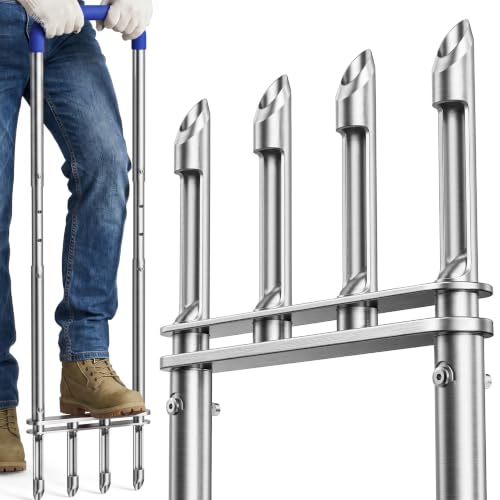
The silver version of the dual-step Josmimic extends from 43.3 to 48 inches, with a two-position foot platform to spread pressure. Four stainless hollow tines pull cores each step. The two-position bar helps people who rock between stance widths. It is still a manual tool, so hardpan clay will slow you. Josmimic knee-friendly manual core gives type manual step core, tines four hollow stainless, height 43.3 to 48 in and step two-position foot bar on its product page.

Adjustable height from 43.3 to 48 inches, wide dual foot platform and four stainless hollow tines are what you pay for here. Same dual-step design in a silver finish is the use it was built around. Manual effort remains and not meant for large lawns are the trade-offs to accept. Its 4 tines makes fewer holes with each step or revolution when set against the GrdnCare 15-spike, which sits at 15 tines.

Given the Josmimic knee-friendly manual core aerator, step this Josmimic about two to four inches apart across the lawn, working in lanes so you do not miss ground or double up. Around the Josmimic knee-friendly manual core aerator, keep the tines of this Josmimic off hard concrete when you set it down, which protects the edges that do the cutting.

What works

  • Adjustable height from 43.3 to 48 inches
  • Wide dual foot platform
  • Four stainless hollow tines
  • Even pressure on both feet

Watch out for

  • Manual effort remains
  • Not meant for large lawns

Spec sheet

Type
Manual step core
Tines
Four hollow stainless
Height
43.3 to 48 in
Step
Two-position foot bar
Finish
Silver
02
Josmimic knee-friendly spring-loaded spike aerator
Spring self-cleanOpen frameManual spike
Check price on Amazon
Best for: People who hate scraping mud off tines.

A spring-loaded spike head returns itself after each push, which shakes soil off the tines. The open center frame gives knee clearance when you step down. The self-clean action reduces stopping, but spikes compress soil more than hollow tines do. Josmimic knee-friendly spring-loaded spike comes to type manual spike, mechanism rebound spring, frame open center, knee clearance and power foot pressure, spec for spec.

People who hate scraping mud off tines is the shopper who gets the most from it. Spikes compress soil and spring fatigue is a long-term question are the main cautions. Rebound spring helps the spike head reset, open center frame clears the knees and self-cleaning reduces scraping are what you pay for here.

With the Josmimic knee-friendly spring-loaded spike aerator, inspect the welds or joints at the head of this Josmimic before each season, since a manual tool takes all of its stress at that one point. On the Josmimic knee-friendly spring-loaded spike aerator, step this Josmimic in a grid pattern about four inches apart, and work after rain softens the top inch rather than on dry hard ground.

What works

  • Rebound spring helps the spike head reset
  • Open center frame clears the knees
  • Self-cleaning reduces scraping
  • Spike design is light

Watch out for

  • Spikes compress soil
  • Spring fatigue is a long-term question

Spec sheet

Type
Manual spike
Mechanism
Rebound spring
Frame
Open center, knee clearance
Power
Foot pressure
Use
Light compaction
03
TOPHDY heavy-duty manual spike aerator, adjustable height
Manual spikeAdjustable heightReinforced joint
Check price on Amazon
Best for: Budget buyers who want a simple height-adjustable spike tool.

The TOPHDY is a plain manual spike aerator with adjustable handle height and a reinforced connection where cheaper tools usually fail. It aims at homeowners who like DIY lawn care. Spikes are easy to push but compress soil. This is a maintenance tool rather than a cure for compaction. TOPHDY heavy-duty manual spike means type manual spike, height adjustable, joint reinforced connection and power foot pressure, by the numbers.

Spikes only, no coring and manual speed is slow are the trade-offs to accept. Budget buyers who want a simple height-adjustable spike tool is the job it is aimed at. Adjustable height fits more users, reinforced connection at the stress point and spike design is easy to push are what you pay for here.

Owning the TOPHDY heavy-duty manual spike aerator means this: pull this TOPHDY straight back out of the ground rather than twisting, which keeps the spikes from bending sideways. Given the TOPHDY heavy-duty manual spike aerator, do a test patch with this TOPHDY first to see how deep the spikes really go in your soil, then adjust how hard you step.

What works

  • Adjustable height fits more users
  • Reinforced connection at the stress point
  • Spike design is easy to push
  • No assembly complexity

Watch out for

  • Spikes only, no coring
  • Manual speed is slow

Spec sheet

Type
Manual spike
Height
Adjustable
Joint
Reinforced connection
Power
Foot pressure
Use
Small to mid lawns
04
GrdnCare manual aerator, 38 in, 6 springs, 15 spikes
15 spikes6 springs38 in handle
Check price on Amazon
Best for: Shorter users who want a spring-cleaning tool.

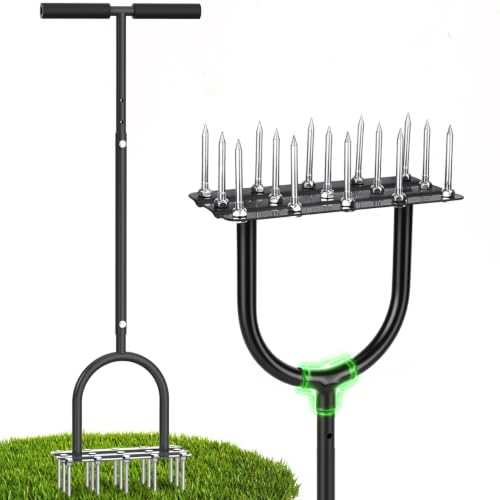
Six springs in a dual-layer auto-eject system distinguish GrdnCare from simpler tools. The 38 inch handle suits average height. GrdnCare manual aerator is listed with type manual spike, spikes 15, springs six, dual-layer and handle 38 in.

Shorter users who want a spring-cleaning tool is the buyer it has in mind. Spikes compress soil and shorter handle for tall users are the trade-offs to accept. Six springs eject soil, heavy-duty steel frame and 38 inch handle make the case for it. Its 15 tines puts more holes in the ground with each step or revolution when set against the Qsxou 11-spike, which sits at 11 tines.

Given the GrdnCare manual aerator, inspect the welds or joints at the head of this GrdnCare before each season, since a manual tool takes all of its stress at that one point. Around the GrdnCare manual aerator, step this GrdnCare in a grid pattern about four inches apart, and work after rain softens the top inch rather than on dry hard ground.

What works

  • Six springs eject soil
  • Heavy-duty steel frame
  • 38 inch handle
  • 15 spikes

Watch out for

  • Spikes compress soil
  • Shorter handle for tall users

Spec sheet

Type
Manual spike
Spikes
15
Springs
Six, dual-layer
Handle
38 in
Use
Small yards
05
K.D Stonedge rolling coring aerator with transport wheels
Coring tinesTransport wheelsRolling
Check price on Amazon
Best for: Push aeration without bending.

A rolling coring aerator that punches holes and extracts plugs, with transport wheels for moving it between jobs. It improves air, water and nutrient flow. Rolling coring needs steady forward effort in firm soil. K.Beyond that, D Stonedge rolling coring comes to type rolling manual core, action extracts soil plugs, wheels transport wheels and power push, spec for spec.

Extracts plugs, transport wheels move it and reinforced build are the reasons to shortlist it. Push aeration without bending is the use it was built around. Pushing in dense clay is hard work and fewer holes per pass than tow units are the price of admission.

Given the K.Overall, D Stonedge rolling coring aerator with transport wheels, step this K.D about two to four inches apart across the lawn, working in lanes so you do not miss ground or double up. Around the K.Put simply, D Stonedge rolling coring aerator with transport wheels, keep the tines of this K.D off hard concrete when you set it down, which protects the edges that do the cutting.

What works

  • Extracts plugs
  • Transport wheels move it
  • Reinforced build
  • Push format saves your back

Watch out for

  • Pushing in dense clay is hard work
  • Fewer holes per pass than tow units

Spec sheet

Type
Rolling manual core
Action
Extracts soil plugs
Wheels
Transport wheels
Power
Push
Use
Compacted soil
06
Qsxou manual aerator, 11 steel spikes, easy step-on
11 steel spikesEasy step-onManual
Check price on Amazon
Best for: Lighter users who want a balanced eleven spike tool.

Eleven steel spikes are the sweet spot between easy push force and useful hole count. Step-on bar placement is designed for easy pull-out. It works on hard or dry soil if watered first. For heavy clay, a hollow-tine tool does more. Qsxou manual aerator gives type manual spike, spikes 11 steel, step easy step-on bar and power foot pressure on its product page.

Balanced 11-spike layout, easier step-in, pull-out and heavy-duty steel spikes make the case for it. Spike design compresses soil and slow for larger yards are what you give up. Lighter users who want a balanced eleven spike tool is where it fits best. At 15 tines, the GrdnCare 15-spike is the yardstick, and its 11 tines makes fewer holes with each step or revolution.

With the Qsxou manual aerator, spikes compress the soil walls rather than removing plugs, so use this Qsxou for light upkeep and not for severe compaction. On the Qsxou manual aerator, hang this Qsxou by the handle in the shed; leaving it flat on its spikes dulls them and risks a stubbed ankle.

What works

  • Balanced 11-spike layout
  • Easier step-in and pull-out
  • Heavy-duty steel spikes
  • Low force per step

Watch out for

  • Spike design compresses soil
  • Slow for larger yards

Spec sheet

Type
Manual spike
Spikes
11 steel
Step
Easy step-on bar
Power
Foot pressure
Use
Yards and gardens

Spec sheet decoder

What the numbers on the box really mean

The specs manufacturers lead with, translated into what they tell you about real-world performance.

Weight capacity

How much ballast the tray or drum accepts. It caps how deep the tines can be forced into hard soil, and it also sets the pull load.

Watch forCheck the stated limit for the KD Stonedge core roller before loading.

Tine or spike count

More tines mean more holes per pass, but each tine also needs force. On a hand tool, more spikes can make the step harder; on a tow unit it raises the pull.

Watch forThe GrdnCare 15-spike lists 15, the Josmimic dual-step silver lists 4.

Operating format

Step-on, push roller, tow-behind, three-point and gas-driven designs all sell as lawn aerators, but they suit different lawn sizes. Format decides effort, speed and storage.

Watch forThis lineup mixes hand core, hand spike and rolling core.

Tine geometry

Hollow or spoon tines remove soil cores, while solid spikes and star wheels only punch holes. Core removal does more for compaction; spikes are quicker to use.

Watch forCompare the Josmimic dual-step silver with the Josmimic spring-loaded before assuming holes are equal.

Penetration depth

Aeration depth is usually listed as a maximum; real depth depends on soil moisture and weight. Two to three inches is the practical target for most lawns.

Watch forTreat listed depth as a ceiling and use a ruler on the Josmimic spring-loaded the first time.

Methodology

How We Evaluated These Lawn Aerators for Seniors

Value for the format

Value was judged within each format rather than across them, since a hand tool and a tractor attachment are different purchases. We used relative price tier among the retrieved listings. Longer service history on established names counted in their favor.

Build and corrosion resistance

Steel type, finish and joints were read from each listing. The Josmimic dual-step silver and the GrdnCare 15-spike were compared on galvanizing, stainless, heat treatment and joint design. Welded or reinforced foot bars scored higher than bolted thin tubes.

Storage and transport

We considered folded height, folding bars and transport wheels. The TOPHDY spike was judged against the rest for how easily it moves and stores. Heavy ground-driven frames lost points for awkward storage.

Clog resistance

Hollow tines clog and spikes pack with soil. We looked for side discharge, spring ejection and open frames on the Josmimic spring-loaded and its rivals. Owner feedback patterns on clogging in wet clay also informed the scores.

Core versus spike action

We evaluated whether each pick removes soil or only punches holes. The Josmimic dual-step silver sits at the coring end of this set, while the Josmimic spring-loaded sits at the spiking end. We weighted coring higher for clay and compaction.

Decision guide

How to Choose the Right Lawn Aerators for Seniors

By Lawn Size and Format

Each row starts from a real situation and ends at a named pick from this guide, so you can find your own lawn in the table and read across to a machine and a reason.

SituationPickWhy
Same dual-step design in a silver finishJosmimic dual-step silverAdjustable height from 43.3 to 48 inches.
People who hate scraping mud off tinesJosmimic spring-loadedRebound spring helps the spike head reset.
Budget buyers who want a simple height-adjustable spike toolTOPHDY spikeAdjustable height fits more users.
Shorter users who want a spring-cleaning toolGrdnCare 15-spikeSix springs eject soil.
Push aeration without bendingKD Stonedge core rollerExtracts plugs.
Lighter users who want a balanced eleven spike toolQsxou 11-spikeBalanced 11-spike layout.

Quick read: the Josmimic dual-step silver is the all-rounder in this set, the Qsxou 11-spike sits at the other end of the ranking, and the rows between them trade rebound spring helps the spike head reset against adjustable height fits more users.

By Budget

Tiers are relative to the other picks in this guide, based on the listing price tier when we checked.

Price positionPickWhat you get
Lowest cost in this groupTOPHDY spikeReinforced connection at the stress point; spikes only, no coring.
Lower middleJosmimic spring-loadedOpen center frame clears the knees; spikes compress soil.
Upper middleQsxou 11-spikeEasier step-in and pull-out; spike design compresses soil.
Higher in this groupJosmimic dual-step silverWide dual foot platform; manual effort remains.
Premium in this groupGrdnCare 15-spikeHeavy-duty steel frame; spikes compress soil.
Highest in this groupKD Stonedge core rollerTransport wheels move it; pushing in dense clay is hard work.

Pricing moves, so treat the order as a snapshot. The cheapest pick here, the TOPHDY spike, and the highest, the KD Stonedge core roller, can swap places after a sale.

Core vs Spike

Core and plug aerators

These remove soil plugs and leave open channels for air, water and roots, which is why they are the answer for compacted clay and heavily used lawns. The cost is more effort and a core mess on the surface that breaks down in a couple of weeks. In this guide: Josmimic dual-step silver and KD Stonedge core roller.

Spike aerators

These punch holes without removing soil, which is faster and tidier but compacts the walls of each hole. They suit light compaction, sandy soil and routine upkeep rather than hardpan. In this guide: Josmimic spring-loaded, TOPHDY spike, GrdnCare 15-spike and Qsxou 11-spike.

Pick cores if water pools or a shovel struggles to sink; pick spikes if the lawn is loose and you want quick seasonal maintenance.

By Soil Type

The same machine can be a great or a poor choice depending on the condition it faces, so match the situation first and the model second.

ConditionPickWhy
Heavy clay, compacted or high-traffic soilJosmimic dual-step silver4 hollow tines, dual-step bar.
Light compaction, loam or sandy soilJosmimic spring-loadedSpring self-clean, open frame.
Light compaction, loam or sandy soilTOPHDY spikeManual spike, adjustable height.
Light compaction, loam or sandy soilGrdnCare 15-spike15 spikes, 6 springs.
Heavy clay, compacted or high-traffic soilKD Stonedge core rollerCoring tines, transport wheels.

For Easier Joints Specifically

Look for

Look for height-adjustable handles, a wide stable foot platform, spring ejection, and an open frame that clears the knee.

In this comparison

The Josmimic dual-step silver fits best on the strength of adjustable height from 43.3 to 48 inches. The TOPHDY spike is the alternative when budget buyers who want a simple height-adjustable spike tool.

When to Spend More

Spend more if

You want what the KD Stonedge core roller offers: extracts plugs and transport wheels move it. That matters when you will use it every season or on a larger area.

Save if

The lawn is modest or the job is occasional. The TOPHDY spike gives you adjustable height fits more users, with the caveat of spikes only, no coring.

Ownership

Maintenance schedule

The upkeep that decides whether this machine lasts two seasons or ten.

TaskIntervalWhy it matters
Check fasteners and jointsEach seasonVibration loosens bolts and thin foot bars bend on rocks. Tighten and look for hairline cracks at the welds.
Inspect tine conditionBefore each useBent or dull tines tear turf and make poor holes. Replace or straighten them as soon as you see damage.
Drain fill weightsBefore winterWater left in a drum or tray can freeze and split the shell. Drain, dry and store with the cap open.
Store dry and uprightOff seasonPark the aerator off the floor with tines clear of the ground. A dry corner prevents rust pitting.
Oil moving partsEach seasonLight oil on springs, pivots and axles keeps them from seizing. Grease tow hitches and wheel hubs the same way.

FAQ

Frequently Asked Questions

When is the best time to aerate?

Aerate when the grass is actively growing and the soil is moist. Cool-season lawns do best in early fall, and warm-season lawns in late spring or early summer. Avoid frozen, saturated or drought-stressed ground, even with a capable machine like the Josmimic dual-step silver.

How much weight should I add to a tow-behind or roller aerator?

Add ballast in steps until the tines reach about two to three inches, and stay within the stated capacity. If the tow vehicle loses traction or the unit stalls, you have gone too far. Hard dry soil needs less weight once it has been watered.

Should I leave the soil plugs on the lawn?

Yes. Cores break down in a couple of weeks and return nutrients to the soil, and raking them up undoes part of the benefit. Only rake away large clumps that smother the grass. This applies to any coring pick here, such as the Josmimic dual-step silver.

Do aerator shoes work?

Aerator shoes push spikes in as you walk, but they are awkward, tend to compact soil, and cover little ground. A step tool or roller such as the Josmimic spring-loaded gives you far better leverage. That is why shoes are not featured here.

Will aeration hurt my sprinkler heads or buried lines?

It can. Tines will damage a head or a shallow line, so mark every head and skip buried irrigation zones if you cannot map them. Hand tools like the Josmimic spring-loaded let you step around obstacles.

How often should I aerate my lawn?

Most lawns benefit from one pass a year, and heavily used or clay lawns may want two. Light, sandy lawns can go every second year. A shovel test helps you decide whether the Josmimic spring-loaded is worth bringing out.

Bottom line

The short version

Browse more lawn aerators for seniorson Amazon →
James Miller, Lead Machine Editor

About the author

James Miller

Lead Machine Editor, MachineFanatic

James Miller leads MachineFanatic's buying guides, turning spec sheets, manuals and owner feedback into clear verdicts on power tools, outdoor power equipment, shop machines and kitchen machines.

More from James →

Keep reading

Related guides