
Amazon affiliate links - we earn a commission.Affiliate disclosure

Buying guide · 12 min read · Updated 2026-11-07

Best Leaf Blowers for Large Yards (2026)

Six backpack and cordless leaf blowers for half-acre to multi-acre lots, compared by engine size, battery runtime, volume and carry comfort.

James MillerBy James MillerLead Machine Editor6 machines comparedSpec-sheet verified
Best Leaf Blowers for Large Yards

At a glance

Our top picks

Side by side

Spec comparison

On a large yard the limiting factor is not peak airflow but how long you can keep working at a steady output. A blower that is fine for twenty minutes can become an hour of recharging, refuelling and sore shoulders across an acre of leaf fall.

That shifts the buying logic toward endurance: engine displacement or battery capacity, a harness that spreads weight, and a throttle that holds a setting. Volume matters more than speed, since the job is moving a lot of leaves a long distance.

Before you buy

6 Criteria to Look For Before Buying a Leaf Blower for Large Yards

  1. 01

    Session length drives the choice

    A large yard means long sessions, and the longest-lasting power is gas. A 65.6cc Husqvarna runs until the tank is empty and refuels in a minute, while an EGO LB8803-2 claims 90 minutes at best and less at mid-dial. If you work more than an hour at a time, gas or a stack of spare batteries is the realistic answer.

  2. 02

    Volume over speed

    On big lots you are moving a lot of leaves a long distance, so volume matters most. The ECHO at 1110 CFM and the Husqvarna at 890 CFM move wide windrows, while speed only helps with stuck debris at the edges. A very fast jet with low volume makes more passes.

  3. 03

    Engine size honesty

    Advertised horsepower on small gas engines is often gross. The 72cc PROYAMA claims 3.7HP and the 65.6cc Husqvarna 3.81HP, which tells you the horsepower numbers are not comparable. Use displacement as the sanity check and check brand support.

  4. 04

    Harness and weight

    A backpack moves the load to your hips and is essential past thirty minutes. Look for padded shoulder straps and a hip belt, and check the machine's dry weight. A handheld blower at the same airflow will tire your wrist and shoulder in half the time.

  5. 05

    Throttle control

    A tube-mounted throttle like the ECHO's lets you adjust output without reaching back to the engine. Cruise lock on cordless tools holds a setting. A tool that forces you to squeeze a trigger for an hour will cramp your hand.

  6. 06

    Fuel and battery logistics

    Gas needs premix, a funnel and a can, while cordless needs packs, a charger and a power outlet near your work area. Think about where you will refuel or recharge and how far it is from the far end of the lot. Spare packs are the biggest quality-of-life upgrade for cordless.

Detailed reviews

The 6 best leaf blowers for large yards, explained

01
Husqvarna 360BT backpack, 65.6cc, 890 CFM, 232 MPH
890 CFM232 MPH65.6cc 2-cycle3.81HP claim
Check price on Amazon
Best for: Half-acre to multi-acre lots where reliability and dealer support matter.

On a big lot the 360BT is the machine that gets the job done without fuss. Its 65.6cc X-Torque engine is a low-emission two-stroke design that keeps output steady, and the 890 CFM volume lets you push a wide windrow of leaves down a lawn in one pass. The backpack harness is not a luxury: carrying a gas blower in your hands for an hour is what ends the session early.

Against the cheaper PROYAMA, which claims 880 CFM from a 72cc engine, the Husqvarna looks similar on paper but wins on the things the spec sheet does not show: dealer service, parts supply and a long record of the engine design. Against the ECHO PB-9010T, it gives up volume, 890 against 1110 CFM, in return for a lighter, more manageable machine.

Plan the ownership honestly. Mix premix at the maker's ratio, clean the air filter every few sessions because leaf dust clogs it, and check the spark plug each season. Before winter drain the tank and run the carburetor dry, and inspect the harness and its stitching because it takes the abuse. Adjust the hip belt so the engine rides on your pelvis, not your shoulders, and take a five minute break each fuel stop so your hands recover from the vibration.

What works

  • 890 CFM and 232 MPH is a strong balance
  • Harness is built for long sessions
  • Established dealer and parts network
  • Engine design aims at steady sustained output

Watch out for

  • Premix fuel and seasonal tune-ups
  • Loud enough to need hearing protection
  • Heavy to load and lift

Spec sheet

Airflow
890 CFM
Air speed
232 MPH
Engine
65.6cc 2-cycle X-Torque
Power claim
3.81HP
Format
Gas backpack
02
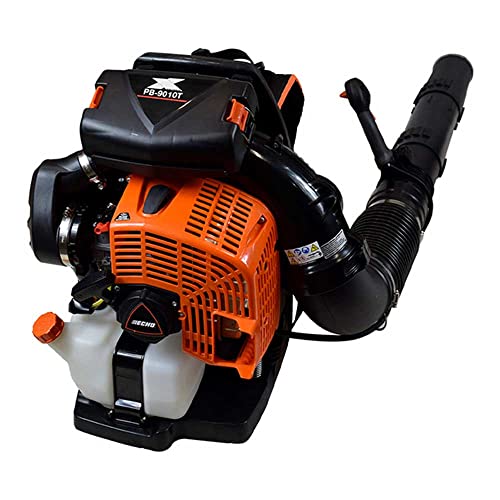
ECHO PB-9010T backpack, 79.9cc, 1110 CFM, 220 MPH
1110 CFM220 MPH79.9cc 2-strokeTube throttle
Check price on Amazon
Best for: Properties of two acres or more with heavy leaf loads.

The PB-9010T is the biggest blower in the guide by engine size and airflow, a 79.9cc two-stroke producing 1110 CFM. That volume is the cheat code for acreage: a wide column of air moves leaves further per pass, which cuts the number of passes across a field. The tube-mounted throttle lets you set a cruising speed with your hand on the nozzle.

It is a heavy, serious tool, and the price is paid in fuel and noise. On a half-acre it is overkill, and the Husqvarna 360BT is more comfortable. On three acres of oak and maple, the extra volume saves real time.

Treat it like a small engine you own. Use fresh premix, keep the air filter clean, torque the exterior fasteners after the first few hours, and check the throttle cable and harness each season. Stabilize or drain fuel before storage so the carburetor stays clean. On a large property a tidy habit is to keep a dedicated fuel can and funnel with the machine, so you are never tempted to top up with stale mix.

What works

  • 1110 CFM is the highest volume here
  • Tube throttle for hand-held control
  • Large engine holds output under load
  • Backpack harness for long sessions

Watch out for

  • Heavy and loud
  • Overkill for a half-acre
  • Needs premix and regular tune-ups

Spec sheet

Airflow
1110 CFM
Air speed
220 MPH
Engine
79.9cc 2-stroke
Throttle
Tube-mounted
Format
Gas backpack
03
PROYAMA 72cc gas backpack, 880 CFM, 275 MPH, dual nozzle
880 CFM275 MPH72cc 2-cycle3.7HP claim
Check price on Amazon
Best for: Large-yard owners who want gas power at a value tier and can do their own upkeep.

PROYAMA gives you a larger engine than the Husqvarna, 72cc against 65.6cc, plus a dual-tube design with flat and round nozzles that adapt the jet to the job. A flat nozzle sweeps lawn in a wide band, while the round one hits stuck debris with a concentrated stream. The listing mentions low vibration and snow clearing as extra uses.

The 3.7 horsepower figure is a claim, not a rated number, and the value tier it sits in tells you where corners are cut: brand support, parts supply and long-term engine history. For a homeowner who clears leaves a few times a year, that is an acceptable trade for a lower entry cost.

Keep a spare spark plug and air filter in the shed, retorque bolts after the first few hours, and run fresh premix. Because dealers are limited, buy a service kit with it, and check the warranty terms on the listing before you commit.

What works

  • 72cc engine with 880 CFM at a value tier
  • Dual nozzles for sweeping and stuck debris
  • 275 MPH jet is the fastest gas option here
  • Low-vibration design claimed

Watch out for

  • Power claim is not an independent rating
  • Thin dealer and parts network
  • Engine track record is shorter

Spec sheet

Airflow
880 CFM
Air speed
275 MPH
Engine
72cc 2-cycle
Power claim
3.7HP
Nozzles
Flat and round dual tube
04
EGO Power+ LB8803-2 cordless blower, 880 CFM, two 4.0Ah
880 CFMTwo 4.0AhTurbo mode56V platform
Check price on Amazon
Best for: Owners already in the EGO ecosystem with a one-acre lot and a spare pack.

On a large lot the EGO is the battery blower worth considering because it is the only cordless model here with a 90 minute claim across two packs and 880 CFM of volume. That is competitive with the 880 CFM claimed by the gas PROYAMA, but without noise, fumes or fuel mixing. The turbo mode clears caked debris, and the platform gives you spare packs shared with the maker's mowers and trimmers.

The weakness is arithmetic. A claimed 90 minutes is at low speed, and on a two-acre lot you will probably burn through both packs, so you will need a third and a rapid charger. In steady use at mid-dial, plan on far less than the headline runtime.

Store the packs indoors at partial charge, rotate them, and keep the intake free of leaf dust. If you already own EGO tools, it is a very good fit; if not, a gas backpack costs less for the same acreage.

What works

  • 880 CFM from a cordless handheld
  • Two batteries included
  • Packs shared across the EGO line
  • Quiet compared with gas

Watch out for

  • Runtime falls short of acreage work without spares
  • Handheld weight tires the arms
  • Turbo drains packs quickly

Spec sheet

Airflow
880 CFM
Batteries
Two 4.0Ah packs
Runtime claim
Up to 90 minutes, two packs
Turbo
Boost for wet, caked debris
Platform
EGO Power+
05
Greenworks 80V brushless blower, 700 CFM, 2.5Ah battery
700 CFM80V2.5AhBrushless
Check price on Amazon
Best for: Half-acre yards where quiet matters and a spare pack is available.

Greenworks uses 80 volts to deliver 700 CFM from a brushless motor, which the maker positions against a 27cc gas blower. That is a fair comparison for the lighter end of gas power but not for the big backpack engines in this guide. It fits a property where you want quiet and no fuel, and a modest lot of about half an acre.

The 2.5Ah pack is small for large-yard work, which is the main limitation. Higher voltage helps the motor but does not change the energy in the pack, so expect shorter running time than the EGO's two 4.0Ah packs. A spare pack and a fast charger are a requirement, not a luxury.

Treat the batteries as the main long-term cost and keep them indoors at partial charge. The 80V platform has a range of other tools, so owners of those get value from the pack. If you do not own other 80V tools, weigh that against a plain gas backpack, which costs less and runs longer on this much ground.

What works

  • 80V brushless motor at 700 CFM
  • No fuel or exhaust
  • Platform works with other Greenworks tools
  • Quiet compared with gas

Watch out for

  • Only a 2.5Ah pack in the kit
  • 700 CFM trails the gas and EGO options
  • Runtime on big lots is short

Spec sheet

Airflow
700 CFM
Voltage
80V platform
Battery
2.5Ah pack and charger
Motor
Brushless
Claim
Compared by the maker with 27cc gas blowers
06
ALSO GO 880 CFM brushless cordless, 280 MPH, 2 x 6.0Ah
880 CFM280 MPH2 x 6.0Ah1500W peak
Check price on Amazon
Best for: Owners who want the biggest cordless pack pair and do not need a platform.

ALSO GO gives you the largest cordless battery pair here, two 6.0Ah packs, plus 880 CFM and a five-step speed dial. On paper it beats the EGO's 4.0Ah pair for runtime, which is the number that matters on a big lot, and the 280 MPH jet tackles damp leaves. The 1500W peak is a turbo figure.

What you do not get is the support behind it. There is no wider tool platform and the long-term parts supply is unproven. If the packs fail after two years, replacements may be hard to find, which turns a good-value tool into a disposable one.

Store the packs at partial charge, avoid hot garages and clear the intake. On a larger property, keep a spare charger at a second location so recharging does not stall the job.

What works

  • Two 6.0Ah packs are the largest here
  • 880 CFM and 280 MPH together
  • Five speed settings
  • Brushless motor

Watch out for

  • No tool platform or proven parts supply
  • 1500W is a turbo peak
  • Heavier with larger packs

Spec sheet

Airflow
880 CFM
Air speed
280 MPH
Batteries
Two 6.0Ah packs
Peak power
1500W
Speed modes
5 settings

Spec sheet decoder

What the numbers on the box really mean

The specs manufacturers lead with, translated into what they tell you about real-world performance.

CFM

Volume of air per minute, the number that decides how much leaf mass you can push in a pass.

Watch forECHO at 1110 CFM versus Greenworks at 700 CFM is a big gap on acreage.

Displacement (cc)

The size of the engine in cubic centimeters. A bigger displacement generally means more airflow and more fuel burned.

Watch forPROYAMA 72cc, Husqvarna 65.6cc and ECHO 79.9cc.

Horsepower claim

A gross engine rating that varies by maker. It is not a measurement of the air power at the nozzle.

Watch forPROYAMA's 3.7HP and Husqvarna's 3.81HP are not directly comparable.

Battery Ah and voltage

Voltage is the platform and Ah is the fuel tank. Together they set energy and runtime.

Watch forALSO GO ships 6.0Ah packs, Greenworks only 2.5Ah.

Runtime claim

How long a battery lasts, usually at the lowest speed. Real use at mid and high speed is much shorter.

Watch forEGO's 90 minute claim across two packs is a low-speed figure.

Methodology

How We Evaluated These Leaf Blowers for Large Yards

Endurance on large lots

We evaluated how long each blower can work, comparing gas tank life with battery pairs from 2.5Ah to 6.0Ah. Claimed runtimes were treated as low-speed best cases. Gas and big battery pairs scored highest.

Volume and coverage

We compared CFM from 700 on the Greenworks to 1110 on the ECHO. On acreage, volume decides how many passes a lawn takes.

Carry comfort

Based on the spec sheet, we weighed backpack harnesses against handheld weight. Long sessions favour a harness. Throttle design also counted.

Ownership burden

We looked at fuel, filters, plugs and battery care. The Husqvarna and ECHO have the strongest dealer networks, while newer brands carry more risk.

Value tier

We compared relative tiers from the value PROYAMA to the premium ECHO, crediting extra cost only where a spec gap justified it.

Decision guide

How to Choose the Right Leaf Blowers for Large Yards

By Lot Size

SituationPickWhy
Half-acre with oaksGreenworks 80V700 CFM and no fuel for a mid-size lot
One acre, mixed treesEGO LB8803-2880 CFM with two packs and a platform
One to two acresHusqvarna 360BT890 CFM harness blower with strong support
Two to five acresECHO PB-9010T1110 CFM volume for long passes
Large lot on a budgetPROYAMA 72ccGas power at a value tier

By Budget

SituationPickWhy
Lowest gas tierPROYAMA 72ccBig engine at a value price
Low to mid cordlessALSO GO 880 CFMTwo 6.0Ah packs included
Mid cordless with platformGreenworks 80VBrushless 80V motor
Higher cordlessEGO LB8803-2Platform and strong airflow
Premium gasHusqvarna 360BTDealer support and balance

Gas vs Battery on Big Lots

Gas

The Husqvarna, ECHO and PROYAMA run until the tank is empty and refuel quickly. They are loud, need premix and demand seasonal care. They are the practical choice for a half-hour-plus session.

Battery

The EGO, Greenworks and ALSO GO are quiet and start instantly. Runtime is limited and turbo is brief. They suit lots up to an acre if you own spare packs.

Choose gas above an acre; choose battery for quieter neighbourhoods and shorter jobs.

Backpack vs Handheld

PreferencePickWhy
Longest comfortable sessionHusqvarna 360BTHarness spreads the load
Maximum volumeECHO PB-9010TBackpack with 1110 CFM
Handheld with a platformEGO LB8803-2Swap packs and share batteries
Handheld with big packsALSO GO 880 CFMTwo 6.0Ah packs

For Heavy Leaf Fall Specifically

Look for

Volume above 800 CFM and a way to sustain it. Heavy leaf fall needs wide passes, so choose a blower with a flat nozzle and a throttle that holds a setting. Plan on a break every hour for fuel or packs.

In this comparison

The ECHO PB-9010T at 1110 CFM and the Husqvarna 360BT at 890 CFM are the best for heavy fall. The EGO LB8803-2 is the best cordless.

When to Spend More

Spend more if

You work more than an hour per session, or want proven dealer support. The Husqvarna 360BT and ECHO PB-9010T pay back in service access.

Save if

You clear leaves a few weekends a year. The PROYAMA 72cc gives strong airflow at a lower tier.

Ownership

Maintenance schedule

The upkeep that decides whether this machine lasts two seasons or ten.

TaskIntervalWhy it matters
Clean the air filterEvery few sessionsLeaf dust clogs the filter and richens the mix. A clean filter keeps gas engines running at full power.
Use fresh premixEvery sessionOld mixed fuel gums the carburetor. Mix only what you will use in a month.
Inspect the harnessSeasonallyStitching and buckles wear under load. A failed strap mid-job is a hazard.
Care for batteriesOngoingStore at partial charge indoors and rotate packs. Heat and deep discharge cut life.
Re-torque boltsFirst few hours then seasonallyTwo-stroke vibration loosens fasteners. A loose tube or handle is a safety issue.

FAQ

Frequently Asked Questions

How much CFM do I need for a large yard?

Above 800 CFM is the target for lots over half an acre, and 1000 plus helps on acreage. Volume moves leaves further per pass. Endurance matters as much as the number.

Is gas or battery better for a large yard?

Gas still wins on endurance, since a tank refuels in a minute. Battery models are quieter and easier to start, but need spare packs. Choose gas above an acre.

How much should I spend?

The PROYAMA is at the value tier for gas, the cordless kits in the middle and the Husqvarna and ECHO at the higher tiers. Spend for dealer support if you rely on the machine.

How long do gas blowers last?

A well-maintained two-stroke can last many seasons. Fresh premix, a clean filter and a drained tank for winter are the key. Poor fuel care is the main killer.

Is a backpack blower worth it?

Yes for sessions over thirty minutes. The harness moves weight off your arms. For short jobs a handheld is easier to store and handle.

Do I need hearing protection?

Yes with gas models, and sensible with cordless on turbo. Long exposure to a blower engine can damage hearing. Wear ear protection and eye protection.

Bottom line

The short version

Browse more leaf blowers for large yardson Amazon →
James Miller, Lead Machine Editor

About the author

James Miller

Lead Machine Editor, MachineFanatic

James Miller leads MachineFanatic's buying guides, turning spec sheets, manuals and owner feedback into clear verdicts on power tools, outdoor power equipment, shop machines and kitchen machines.

More from James →

Keep reading

Related guides