
Amazon affiliate links - we earn a commission.Affiliate disclosure

Buying guide · 13 min read · Updated 2026-11-07

Best Midea Cube Dehumidifiers (2026)

Four Midea Cube dehumidifiers from 20 to 50 pints compared by tank size, pump and coverage, so you can pick the right compact cabinet for a basement.

James MillerBy James MillerLead Machine Editor4 machines comparedSpec-sheet verified
Best Midea Cube Dehumidifiers

At a glance

Our top picks

Side by side

Spec comparison

MachineRated capacityCoverageEfficiencyDrainTank
Midea Cube 50-Pint Smart Dehumidifier with Pump, 4,500 Sq FtBest OverallMidea Cube 50-Pint Smart Dehumidifier with Pump, 4,500 Sq Ft50 pints per dayUp to 4,500 sq ftEnergy Star certifiedn/an/a
Midea Cube 50-Pint Dehumidifier with Drain Hose, 4,500 Sq FtBest 50-Pint ValueMidea Cube 50-Pint Dehumidifier with Drain Hose, 4,500 Sq Ft50 pints per dayUp to 4,500 sq ftEnergy Star certifiedGravity hose includedUp to 3x larger than older design
Midea Cube 35-Pint Dehumidifier for Basement, 3,500 Sq FtBest for Mid-Size BasementsMidea Cube 35-Pint Dehumidifier for Basement, 3,500 Sq Ft35 pints per dayUp to 3,500 sq ftEnergy Star certifiedHose for continuous drainUp to 3x larger than older design
Midea Cube 20-Pint Dehumidifier for Basement, 1,500 Sq FtBest for Small SpacesMidea Cube 20-Pint Dehumidifier for Basement, 1,500 Sq Ft20 pints per dayUp to 1,500 sq ftEnergy Star certifiedHose for continuous drainUp to 3x larger than older design

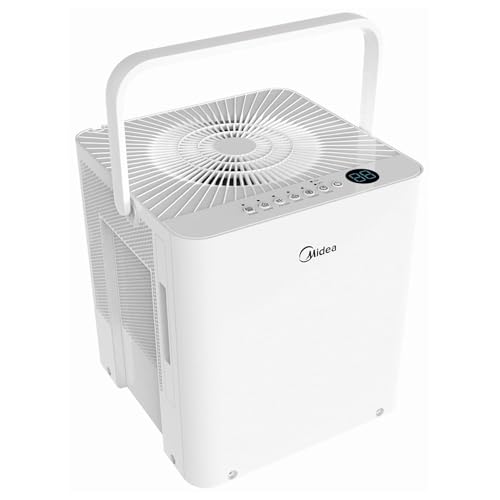
A cube-shaped dehumidifier trades the usual tall box for a squat, stackable cabinet. The idea is simple: keep the footprint small, make the water tank larger and give owners a way to drain without lifting a bucket.

That layout suits basements where floor space is limited and the machine lives in a corner for months. The decision comes down to the capacity step, whether a pump is needed and how much connectivity you want, since the cabinet shape stays the same across the range.

Before you buy

6 Criteria to Look For Before Buying a Midea Cube Dehumidifier

  1. 01

    Pick the capacity step

    The Cube range here comes in 20, 35 and 50 pint steps, rated for roughly 1,500, 3,500 and 4,500 square feet. A bedroom or small room suits the 20-pint, a mid-size basement suits the 35-pint and a large or damp space suits the 50-pint. If the room smells musty or shows condensation, go one step up so the unit cycles off instead of running nonstop. Coverage labels assume open floor and a mild problem, so a basement divided by closed doors behaves like several small spaces, and a single machine placed in one room will leave the others damp.

  2. 02

    Pump or gravity hose

    The smart 50-pint Cube has a built-in pump that drains vertically or across the room. The hose-only 50-pint, the 35-pint and the 20-pint rely on gravity. Measure the height from the machine to the drain first, because a pump costs more but solves an uphill layout that gravity cannot. Also check how long the hose run is, since a long horizontal stretch reduces the effective lift of a small pump, and a sagging loop can trap water and slow the flow.

  3. 03

    What the larger tank buys you

    The cube design advertises a tank up to three times larger than the older design. That means fewer trips if you choose the bucket, but at 50 pints a wet room still fills it fast. Use the hose for continuous running and treat the tank as a backup. A full tank shuts the unit off, so an owner who travels often should plan on a hose or a pump rather than relying on a daily emptying habit that will eventually slip.

  4. 04

    Smart control versus a plain panel

    Only the 50-pint with pump lists smart control among the Cube listings here. It helps in a second home or a basement you rarely visit. Check that the local controls still hold a setpoint if the network drops. A simple test is to switch the router off for a minute and confirm the unit keeps working toward its target, and a separate hygrometer will show whether the app reading matches the room.

  5. 05

    Footprint in a real basement

    The cube shape keeps the footprint small and the height low, which helps in a corner near a furnace or a laundry sink. Measure the spot, leave a few inches of clearance at the intake and avoid stacking boxes against the cabinet. A unit with blocked airflow looks weak when it is really mis-placed. Setting it on a small riser keeps it off damp concrete, and keeping the cabinet level helps the bucket float switch read correctly, which prevents false full-tank shutoffs.

  6. 06

    Energy cost across a season

    Every Cube listed here carries Energy Star certification, which signals lower consumption per pint. Over a humid summer a right-sized machine that cycles off uses less power than one running flat out. Sizing correctly matters more than any badge. Running the machine on a schedule during the humid part of the day and letting the room coast overnight is another way to trim the bill without losing control of the humidity.

Detailed reviews

The 4 best midea cube dehumidifiers, explained

01
Midea Cube 50-Pint Smart Dehumidifier with Pump, 4,500 Sq Ft
50 pints per dayBuilt-in pumpSmart controlEnergy Star
Check price on Amazon
Best for: Large basements with no floor drain nearby.

This is the Cube with the most going for it. A built-in pump moves water through a hose, vertically or across a room, so a basement without a convenient floor drain stops being a problem. The compact cabinet also carries a water tank up to three times larger than the older cube design, which gives you a longer gap between emptyings when you choose the bucket.

Its 50-pint rating and 4,500 square foot coverage sit at the top of the Cube range, fifteen pints above the 35-pint and thirty above the 20-pint. Smart control lets you adjust the target and check status from a phone, and Energy Star certification keeps running cost down. A pump model costs more than the hose-only 50-pint Cube, so you are paying for drain flexibility.

Ownership is mostly about the hose and the filter. Keep the discharge line free of kinks, rinse the filter every few weeks and test the pump when the humid season begins. If you have a floor drain beside the machine, the cheaper hose-only 50-pint does the same drying without a pump to maintain.

What works

  • Built-in pump drains vertically or across the room
  • Tank about three times larger than older cube designs
  • Smart control for remote setpoint changes
  • Energy Star certified with 4,500 square foot coverage

Watch out for

  • Pump is an extra part to test each season
  • Costs more than the hose-only 50-pint Cube

Spec sheet

Rated capacity
50 pints per day
Coverage
Up to 4,500 sq ft
Pump
Built in
Control
Smart app control
Efficiency
Energy Star certified
02
Midea Cube 50-Pint Dehumidifier with Drain Hose, 4,500 Sq Ft
50 pints per dayDrain hose includedUp to 4,500 sq ftEnergy Star
Check price on Amazon
Best for: Basements with a floor drain that need 50-pint capacity.

The hose-only 50-pint Cube is the straightforward version of the top model. It keeps the 50-pint rating and 4,500 square foot coverage but drains by gravity through an included hose rather than a pump. If a floor drain or sump sits at or below the machine, this is the cheaper way into the same drying capacity.

The cabinet stays compact, and the larger tank means you can still run it without a hose for stretches. The listing stresses smaller form with larger capacity, which is the cube idea in a sentence: you get a 50-pint machine that fits where a tall box would not. Against the 35-pint Cube it adds fifteen pints, which decides whether a damp open basement ever reaches its setpoint.

The tradeoff is flexibility. With no pump, the drain must run downhill, so check the layout before ordering. Keep the intake clear of walls, wash the filter regularly and verify the reading with a separate hygrometer.

What works

  • 50-pint rating at a lower cost than the pump model
  • Drain hose included for continuous gravity drain
  • Compact cube cabinet fits tight corners
  • Energy Star certified

Watch out for

  • No pump, so the drain must be downhill
  • Less flexible than the pump model

Spec sheet

Rated capacity
50 pints per day
Coverage
Up to 4,500 sq ft
Drain
Gravity hose included
Tank
Up to 3x larger than older design
Efficiency
Energy Star certified
03
Midea Cube 35-Pint Dehumidifier for Basement, 3,500 Sq Ft
35 pints per dayUp to 3,500 sq ftDrain hoseEnergy Star
Check price on Amazon
Best for: Mid-size basements with a steady humidity problem.

The 35-pint Cube is the middle step and the best match for most mid-size basements. The 3,500 square foot coverage figure matches what some larger-looking units quote, and the cabinet and enlarged tank are the same cube design as the others.

Compared with the 20-pint Cube, it adds fifteen pints, and against the 50-pint it trades capacity for a lower cost and less draw. In a basement with a steady but moderate problem it cycles off between wet spells, which is healthy for the compressor. In a wet unfinished space it would run nonstop and you should step up.

It is easy to live with. The drain hose supports continuous running, the tank gives a fallback and the Energy Star badge keeps the electric bill reasonable. Rinse the filter monthly and keep the room closed to limit the air volume the unit must treat.

What works

  • 35-pint capacity balances size and output
  • Rated for up to 3,500 square feet
  • Hose supports continuous drain
  • Energy Star certified and compact

Watch out for

  • Underpowered for a wet unfinished basement
  • No pump option at this size

Spec sheet

Rated capacity
35 pints per day
Coverage
Up to 3,500 sq ft
Drain
Hose for continuous drain
Tank
Up to 3x larger than older design
Efficiency
Energy Star certified
04
Midea Cube 20-Pint Dehumidifier for Basement, 1,500 Sq Ft
20 pints per dayUp to 1,500 sq ftDrain hoseEnergy Star
Check price on Amazon
Best for: Bedrooms, bathrooms and small basement rooms.

The 20-pint is the smallest Cube and the one for a bedroom, a bathroom or a small basement room. It is rated for up to 1,500 square feet and keeps the enlarged tank and drain hose of the larger models.

The cost of the small size is capacity: fifteen pints less than the 35-pint and thirty less than the 50-pint. Under the current federal test of 65F and 60% RH, a 20-pint rating is respectable, but it will still run constantly in an open basement. Keep it for a closed room.

It is the lightest and easiest to carry. Use the hose if you cannot empty the tank daily, clean the filter monthly and place it with room to breathe. For a second room, the same cube shape makes it simple to stack storage around it.

What works

  • Smallest cube cabinet, easy to place
  • Larger tank than older small units
  • Drain hose supports continuous running
  • Energy Star certified

Watch out for

  • Only 1,500 square feet of listed coverage
  • Runs constantly in an open basement

Spec sheet

Rated capacity
20 pints per day
Coverage
Up to 1,500 sq ft
Drain
Hose for continuous drain
Tank
Up to 3x larger than older design
Efficiency
Energy Star certified

Spec sheet decoder

What the numbers on the box really mean

The specs manufacturers lead with, translated into what they tell you about real-world performance.

Pint rating

Daily moisture removal, measured under a stated test condition. The current US test is at 65F and 60% RH, so figures run lower than older labels.

Watch forThe 20, 35 and 50 pint steps map to the listed 1,500, 3,500 and 4,500 square feet.

Built-in pump

A pump that lifts condensate through a hose, vertically or across a room. It handles drains above or far from the machine.

Watch forOnly the smart 50-pint Cube lists it.

Tank size

The reservoir that fills between emptyings. A larger tank means fewer trips unless a hose is used.

Watch forThe Cube listings advertise up to three times the older design.

Coverage

The area the maker believes the unit can serve with a mild problem. It is a rough guide, not a promise.

Watch forThe 35-pint lists 3,500 square feet, which is generous for its capacity.

Energy Star

A certification for lower energy use per pint removed. It matters on a machine that runs for months.

Watch forAll four Cube listings here carry it.

Methodology

How We Evaluated These Midea Cube Dehumidifiers

Capacity ladder

We compared the 20, 35 and 50 pint steps and how they map to rooms. Seeing the capacities side by side lets a buyer pick the smallest cube that covers the room. We treated ratings as spec sheet figures, not measurements, and we asked whether the fifteen pint gaps between steps are large enough to change how a damp room behaves.

Drain flexibility

We compared the pump on the smart 50-pint with the gravity hose on the others. Because it lifts water to a distant drain, the pump model suits awkward layouts best. A hose in the box scored well for simple installs. We also considered what happens when the hose is blocked, since a unit that fails quietly into a bucket is easier to live with than one that overflows onto a floor.

Cabinet and tank

We looked at the compact cube shape and the advertised larger tank. A smaller footprint helps tight basements. We noted that a bigger tank helps only when you cannot use a hose. We also weighed how the low cube profile affects airflow clearance, since a compact body can be pushed too close to a wall.

Smart features

We assessed smart control on the pump model and the lack of it on the others. App control helps remote spaces. Local control that works without the network is the baseline. Because only one Cube here has the app, we did not treat smart features as a reason to overpay for a small room.

Value across the range

We compared relative price tiers from the 20-pint at the low end to the pump model at the top. All four carry Energy Star. Buying the smallest cube that handles the room gives the best value.

Decision guide

How to Choose the Right Midea Cube Dehumidifiers

By Room Size

SituationPickWhy
Bedroom or small basement roomMidea Cube 20-Pint1,500 square feet in the smallest cabinet
Mid-size basementMidea Cube 35-Pint3,500 square feet with a hose
Large basement with a floor drainMidea Cube 50-Pint with Hose4,500 square feet at a lower cost
Large basement, no floor drainMidea Cube 50-Pint Smart with PumpPump drains vertically or across the room
Remote or rarely visited basementMidea Cube 50-Pint Smart with PumpSmart control

By Budget

TierPickWhy
LowestMidea Cube 20-PintEntry model for small rooms
MiddleMidea Cube 35-PintValue for mid-size basements
UpperMidea Cube 50-Pint with HoseLarge capacity without a pump
HighestMidea Cube 50-Pint Smart with PumpPump and smart control

Pump vs Gravity Hose

Pump (50-Pint Smart)

Moves water vertically or across the room, so it suits basements without a floor drain. It adds a part and a cost. It is the only Cube here with smart control.

Gravity hose (50-Pint, 35-Pint, 20-Pint)

Simpler and cheaper with nothing extra to fail. It needs a downhill path to the drain. It suits basements with a floor drain.

Choose the pump when the drain is uphill or far, and the hose when a floor drain is close.

Tank vs Continuous Drain

PreferencePickWhy
Empty a tank occasionallyMidea Cube 35-PintLarger tank in a compact cabinet
Never touch the tankMidea Cube 50-Pint Smart with PumpContinuous drain by pump
Gravity drain with no tank choresMidea Cube 50-Pint with HoseHose included
Small room, simple useMidea Cube 20-PintLight and easy to carry

For Basements Specifically

Look for

Capacity that matches the dampness, a drain route you can actually use and a cabinet that fits the corner. Keep the intake clear of walls and stored boxes.

In this comparison

The 50-Pint Smart with Pump is the best for awkward drains, the 50-Pint with Hose is the value choice with a floor drain and the 35-Pint suits a moderately damp basement.

When to Spend More

Spend more if

The drain is uphill or far, or you want remote control. The 50-Pint Smart with Pump earns its cost.

Save if

The room is small or has a floor drain. The 20-Pint, 35-Pint or hose-only 50-Pint do the job for less.

Ownership

Maintenance schedule

The upkeep that decides whether this machine lasts two seasons or ten.

TaskIntervalWhy it matters
Wash the filterEvery 2 to 4 weeksWhen the cube's filter fills with dust, air barely reaches the coil and frost becomes more likely. Rinse and dry it fully before reinstalling, and never refit it damp.
Rinse the tankMonthlyStanding water grows slime and odor that ends up in the room air. Mild soap and a rinse prevent it.
Test the pumpStart of each humid seasonA pump that sits idle through a dry winter can stick. Run a cycle and watch the discharge until the flow is steady.
Check the drain hoseEvery 3 monthsKinks and sediment stop flow and cause overflow. Confirm the hose end is secured at the drain.
Vacuum the coilOnce a yearDust cuts heat transfer and efficiency, and a lint-packed coil is the usual reason a unit slows by its third summer. Unplug first.

FAQ

Frequently Asked Questions

Which Midea Cube size do I need?

A bedroom or small room suits the 20-pint, a mid-size basement suits the 35-pint and a large or damp basement suits a 50-pint. If the space smells musty or shows condensation, go one step up so the unit cycles off instead of running constantly.

Is the pump model worth it?

Yes when the drain is above the machine or far from it. With a floor drain nearby, the hose-only 50-pint does the same drying with one fewer part to fail.

What is special about a cube design?

The cabinet is compact and low, and the tank is advertised as up to three times larger than the older design. It is meant to fit tight spots and cut how often you empty the bucket.

Do these work in a cool basement?

Compressor units lose output near 65F as the coil frosts. Size up a step if the space stays cold, and check the manual for the low-temperature behavior of your model. In a basement that sits near 55F for months, a gentle source of heat or a different technology may do better than a larger compressor unit.

How long will one last?

Expect the compressor in a cube to last roughly 5 to 10 years. Cleaning the filter and coil and avoiding an undersized unit are the main levers. A unit that runs flat out in a room it is too small for wears its compressor faster than one that cycles off between wet spells.

What humidity should I target?

Set the Cube for roughly 45 percent. Sustained readings past 60 percent feed mildew and dust mites, and a room pushed below 30 percent turns dry and static-prone. Because the sensor sits right at the unit, a cheap meter in the far corner shows whether the whole room has dried out.

Bottom line

The short version

Browse more midea cube dehumidifierson Amazon →
James Miller, Lead Machine Editor

About the author

James Miller

Lead Machine Editor, MachineFanatic

James Miller leads MachineFanatic's buying guides, turning spec sheets, manuals and owner feedback into clear verdicts on power tools, outdoor power equipment, shop machines and kitchen machines.

More from James →

Keep reading

Related guides